|
|
|
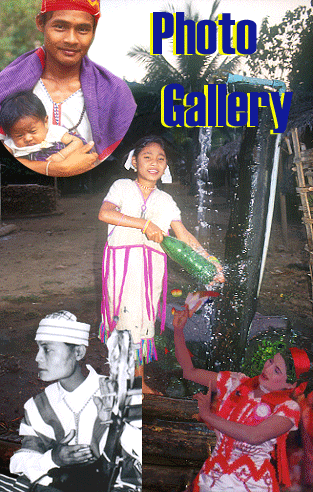
Richard Humpheries (Black and White) Jason Miller Shwe Koako, Karen State Sylvia Murcfeld Photographs Jean de La Tour Richard Humphries _______________ Version Date June 2004 12/01/2005 Website: Designed, Built and written by Paul Keenan |
Karen Voices Karen Celebrations 'When I was a child I saw the Karen National Day many times. People celebrate it every year. If tomorrow was Karen National Day: the night before the young would sing and dance. Some men would prepare the food for the morning. At midnight they would pray to God. But some say the year changes in the morning-rather than the night-at six o'clock, when the sun shines, so that's when they start celebrating. Then they would put the Karen national Flag up. After that you pray to God; they talk about Karen national traditions, history and culture. All the Karen people are said to have preserved their national character. After finishing, they eat the food which the men have prepared. Some people cook curry at their home and bring it to the celebration, so they could eat it together with the people.' Saw Law bath Marriage In my village if a groom lived in another village and the bride also lived in another
village, the groom must come to the bride’s village and invite the people to
drink alcohol, the people would sing animist song, break a tree branch and then
they would count how many people would go with them. Once you reached the house
of the bride they would put alcohol in a jar in front of the house and then
they drank together. They came with an orchestra. If they felt drunk they sang poetry
in front of the bride’s house. In front of the house they put down one log for
the groom. He must cut until the log breaks. They say that if the log breaks the
groom can come into the house, if the log doesn’t break then the groom cannot
come into the house. While he climbs the stair, the bride pours water onto the
groom. Then the bride makes clean water, washes the groom, and asks him to
weave. Saw Lew K'paw
Becoming a soldier 'I was born in the Jungle during, the rainy season. Burmese soldiers came to our place and hurt our people, the Karen people. When I was four years old, Burmese soldiers killed my father. They shot my father. So when I was a child I hated Burmese soldiers very much. And then I came to be a Karen soldier. When I was a child I wanted to be a soldier very much, but the people did not allow me to be. After I became 27 I became a Karen soldier in Brigade One.' Saw Lee Key Education 'Before when I lived at my village, we had reconciliation and then we had some concessions. Now we see things differently and most people are of a different religion. Bur they are facing conflict. Although we now get an opportunity to get an education, so some Karen people are now educated people, because some foreigners give training to the Karen. Today, we see our Karen, people's education is improving.' Saw Kah Le Language All of our students shouldn’t be taught Burmese language; we should teach Karen language. Karen language has been lost a lot. So we have to find and teach children Karen language. If people don’t have a language then they die. If you want to hurt people you must make them lose their language, but language isn’t easy to lose. You must try your best and your nation, culture, and history will continue in the world. Saw Jelrelain Festivals About the feast "Bghai" was eaten twice a year. A pig was used to feast the "Bghai" and they will cut thin green bamboo strips for tying sliced piece of bamboo. They will slice pieces of bamboo outside inside the shell. Their can't only be one slice. And then two slices will be tied on the pig's nose, hand, and foot. Two slices are used to make a little tent of bamboo. The little tent is built on upper sleeping bed up on the house and the pig is left under the little tent and all of the couples children will push the side of the pig's body . They then pray to the spirit. and they said: you asked us to give you the pig and we will give you, come down and live together with us and make us lucky, don't punish us, don't make pain to us, heal us. make us happy and make us lucky as you need I do now. They put water on a big plate and they cover the pig's nose with water and cloth and they push the pig into it's nest till the pig dies; this begins in the morning until evening. Once the pig is dead they take of the pig's intestines, they burn the pig is in the kitchen. they can't burn anywhere else. they burn till the pig skin is yellow.And then they wash the pig and lie a pig on upper sleeping bed. the mean that customs will be dirty on the bed. First they carve the left of shoulder, second time the right thigh, and put them together. Then they carve the right shoulder and left thigh and put them together. then they cut the pig's heart and put it under the little tent as an offering. The little bamboo tent on the upper sleeping bed is called a "poor house" and then they pray to the spirit to come and eat this all together with out spices. All of the intestine is cooked together and then when they are already they take the pig eat meat a little, and intestine a little, it's oil a little and they called the spirit again and say: 'Oh
my god, came down and eat the food first and make us happy and give us good
life. Now we are offering to you.' Then they put the meat and intestine,
oil together and throw to outside
|