(XIV) THE REFUGEE SITUATION AND
FORCED REPATRIATION
14.1. Refugees in the West
Due to the harassment of SLORC army, 40 households from Khone-roa, 60 households from Poonhyongwa, 30 households from Pagawa, 25 households from Loungadv and 20 households from Theimoat-wa, Ngoaylak-wa and Quandaums, numbering a total 225 households with about 1,200 people fled into the Triangle area of Indo-Burmese-Bangladeshi border in southern Mizoram State of India. Over 180 families who fled in different waves into India in 1994 are scattering at the villages of Takpoat-che, Upper Khaki, Lower Khaki, Maungbuwas and at Musa area without having a name in the remote area of Indo-Burmese-Bangladeshi border. [Source: ASC]
14.2. Recent Refugee Influx into India
In January 1995, more than 300 Chin refugees fled into Bangladesh after the village head was executed by SLORC IB 376. They were not recognised as refugees by the Bangladeshi government. As they were taking refuge at CNF headquarters, CNF had to provide them with food and medicine. [Source: Independent Chin Report]
Due to the brutal killings of villagers by SLORC IB 376, more Arakanese people have recently poured into Mizoram State, India, as refugees. From February to May 1995, more than 60 families with 400 population fled from Arakan State to escape the killings of SLORC Army. Most of them are taking shelter in the Parava Camp in the southern-most area of Mizoram State, which is situated in the triangle area of the Indo-Burmese-Bangladeshi border. [Source: ASC]
On 8 February 1995, Burmese military and Indian authorities met at Rih Khuadar village, in Falam Township of Chinland. They issued a statement saying that all Chin refugees (who are all citizens of Burma) who have escaped to India should be forcibly sent back to Burma. [Source: Independent Chin Report]
On 1 June 1995, the only refugee camp in Mizoram, located in Champhai Town, was closed down by the Indian government. And on 15 June 1995, the Mizoram government started forced repatriation of all the Chin people who had taken refuge in Mizoram State. It was the third time the Indian government had deported Chin refugees to Burma. Hundreds of Chin refugees were handed over to the SLORC Army. [Source: Independent Chin Report]
In a statement released on 13 August 1995, Mr Ran Naing, representative of the Arakanese refugees at Parava Camp in India said:
“These refugees have been resettled in Parava Camp by the concerned local authorities. But assistance in the form of food and medicine is not still provided by anybody. When they (the refugees) fled into India, they could not bring anything with them except some essentials. They could not bring even enough pots for cooking. Now many of them have no pots, no plates, no blankets and no mosquito nets. They build their own makeshift bamboo huts for sheltering at their temporary locations. Children are dying of malaria, diarrhoea, dysentery and malnutrition in deteriorating conditions. Epidemics are threatening everybody. To keep them alive, they are in urgent need of emergency aids, medicines, food and clothing.” [Source: ASC]
In recent months, about 1,000 villagers have fled their homes and made their ways through formidable jungles into Mizoram State in India. As Bangladesh is not much willing to accept and provide help to the Buddhist Rakhine refugees, in contrast with the Rohingya Muslim refugees, the escape to Bangladesh is still insignificant. [Source: ABYMU (Arakan)]
[See also under “Eyewitness Accounts”, interview, 19-21, 149-156, 293-294]
14.3. Chief Justice Systematically Executed by Indians
At the invitation of Indian intelligence service, SIB, to a meeting at their outpost in Parva village, which lies at the southern tip of Mizoram State, on 31 March 1995, Salaing Sang Hlun and other two CNF officers — Mr Kung Ling and Mr Thawng Mang — went to SIB office. After a short conversation, the Indian authorities told them to come back the following day. However, the Border Security Forces (BSF) arrested them in that evening. The following day, the BSF handed over them to the Assam Rifles, who picked them up from Parva. The whereabouts of Sang Hlun, Kung Ling, and Thawng Mang was not known by the relatives and friends until 25 April 1995 when a friendly Zo soldier informed their relatives that the Indian Army (Assam Rifles) had a dead body, at the Aizawl hospital morgue. The soldier also informed that the Indian Army was planning to bury the body in secrecy. The Assam Rifles had dug a big hole in their compound and explained that they were going to bury a cow. That was how the friendly soldier found out how the body was to be buried. When the relatives including Sang Hlun’s sister were shown only the lower part of the body at the hospital, with no doubt they could identified the body was Sang Hlun’s. Sang Hlun’s mother had come to Mizoram on hearing that her son had been taken away by the Indian authorities and his whereabouts was not known. What a shock to see her son’s body! She had not seen him since he joined the CNF in 1988.
They learned from the hospital staff that Sang Hlun died on 23 April 1995 and an autopsy was done on his body on 24 April. When the people went back to the hospital the following day, the hospital was guarded by army personnel. At first they were not allowed to see the body but after pleading with the soldiers, the relatives were allowed to see the body. They were instructed to look only from a distance, but they went and looked at the body closely. They were told that Sang Hlun had died of malaria. When the relatives of Sang Hlun insisted on knowing the cause of Sang Hlun’s death, because he was very healthy before he was taken away, some soldiers gave the account of how he died.
Sang Hlun, Kung Ling and Thawng Mang were kept in the army barracks in Aizawl and they were allowed to talk freely with anybody in the barracks. They were questioned often by the authorities. Sang Hlun was very communicable and the soldiers liked talking to him as he knew a lot of things.
On 23 April, a dinner with mutton curry was served at 6:00 p.m. After a few bites Sang Hlun complained of stomach pain. So he asked for salt and said: “ If I swallow salt I’ll throw up all the poison, please give me salt.” The Assam Rifles refused to give him salt, instead they took him to the hospital where he died at 8:30 p.m.
After the relatives pleaded with the Indian authorities, by applying to the Mizoram government, they were allowed to take the body for burial. They could see that there was no evidence of physical harm. The only strange thing they noticed was all the tip of his fingers were darkened. When Sang Hlun’s sister asked for the belongings of her brother, the Assam Rifles returned his bag-pack, however, a note book and diary Sang Hlun kept constantly, were not among the returned belongings.
After the relatives went to court the hospital released the autopsy report, which stated the cause of death as cerebral malaria.
Born in Farrawn, Thlantlang District, Chin State, 38 year old Sang Hlun was a graduate of the University of Rangoon. Sang Hlun fled to India in 1988 from Rangoon to escape the brutal crack down on participants of 1988 pro-democracy movement. He immediately joined the Chin National Front and was elected vice-president of the CNF. He served until 1992 in that function. At the time of his death he was in-charge of the justice department (Chief Justice) of CNF and commander of CNF northern command.
The whereabouts of Thawng Mang and Kung Ling is still a mystery. The relatives of both of them believed, however, that the stench coming from the Assam Rifle’s barracks, where the two persons were kept, to have come from the body of Thawng Mang. They believed that the big hole which was dug at the Assam Rifle’s compound must have been dug for them. Sang Hlun, Thawng Mang, and Kung Ling were having the same dinner on 23 April 1995. [Source: ZO CENTER]
14.4. Rohingya Repatriation
In 1991-92 SLORC mounted a religious campaign against Muslim Rohingyas in Arakan State. It is unknown how many were massacred, but at least 300,000 fled to Bangladesh to become refugees. At least 200,000 of them have now been forced back to Burma by Bangladeshi authorities with the support of the UNHCR. UNHCR made agreements with SLORC and the Bangladeshi government (but not with any representative of the refugees) to support this forced repatriation and tell the world it is “voluntary” as long as they can get a monitoring presence on both sides of the border. They now have that presence. On the Bangladeshi side, UNHCR cancelled the process of interviewing refugees to find out if they want to go back, instead holds mass “information sessions” encouraging refugees to go back. At these sessions they fail to mention forced labour, as they consider it to be an isolated occurrence. In its June 1995 Bulletin, UNHCR stated that SLORC had promised them to use returnees for forced labour only four days per month, and later said that SLORC had promised not to use returnees for forced labour in their first two months back home (i.e. while they still have their returnees allowance money to pay off the troops). However, there are reports that returnees are being used for up to five days per week of forced labour on road construction and other duties in the north of Buthidaung Township. UNHCR still does not mention this in its “information sessions”. The vast majority who express personal fears of persecution upon return are rejected as not having “valid reason” to be afraid. Furthermore, refugees being sent back to Burma are not being told that UNHCR will only stay in Arakan for one year after the repatriation (this is standard UNHCR policy). Many are going back with a misguided belief that UNHCR plans to remain in Arakan until the situation becomes safe and stable.
Now there are still about 50,000 refugees in the camps in Bangladesh. Many are there because SLORC, with or without reason, has refused to take them or one of their family members back. UNHCR now plans to start splitting up these families in order to cut down the number to 20,000, sending back anyone SLORC will accept (with the exception of the spouse or children of those specifically rejected). In Asian society, breaking up the extended family like this is completely unacceptable.
In Bangladesh, UNHCR states that they have injected US$3 million into local communities. However, much or most of this money appears to have been spent donating four-wheel drive Land Cruisers to Bangladeshi officials and building a large and fancy new building in Cox’s Bazaar to house the “Office of the Refugee Relief and Repatriation Commissioner”. This impressive building was completely paid for by UNHCR and inaugurated in December 1995, with most of the refugees already repatriated.
In Burma, UNHCR has 14 expatriate staff, but only four of them are protection officers — the rest are development consultants. They work through SLORC, and people from the area said that most returnees with problems would never dare to be seen entering the UNHCR office in Maungdaw. Land was confiscated at only 10% of its value to build these offices, and villagers nearby have lost their second annual paddy crops because the irrigation water has been diverted to UNHCR. In response, UNHCR reportedly paid only 5,000 Ks one-time compensation for the farmers — only enough to buy the equivalent of one-third of an acre’s crop at current prices. Buddhist Rakhines in the area say that UNHCR is fuelling racial tensions by favouring Muslims for all jobs and contracts. Meanwhile, UNHCR is claiming that the Rohingyas who fled Burma never owned their own land, and therefore should not all expect to have their land returned to them (the return of their land was promised to them before their repatriation). Rohingya sources claim that since September-October 1995, SLORC has been issuing new identity cards in Arakan State: red ones for Burmans and Rakhine Buddhists, which is a full citizenship, and white ones for Muslims, which is a provisional ID card stating that the holder is not the national of any country. They report that some Muslims who received National Registration Cards between 1955 and 1962 have now had these confiscated and replaced with a white card, thus losing their citizenship rights. UNHCR admits that forced relocation of villages for military camps and to avoid Rakhine/Muslim clashes has occurred, but claim that SLORC has promised to stop doing this. Both Rohingyas and Rakhines have reported that SLORC is forcibly relocating Muslims from other townships to Maungdaw and Buthidaung areas, and that Buddhists are also being forced to move to border areas.
Some returnees have subsequently fled again to Bangladesh. Most of them go into hiding and do not bother trying to report to UNHCR, but some have tried. UNHCR refuses to discuss them. Rohingya sources report that there are also new refugees and that they also go into hiding in the towns. UNHCR says that some new arrivals have come to their office with “false claims” of persecution in Burma. [Source: KHRG]
14.5. Karen Refugee Movements
Even before the main Manerplaw offensive began in January 1995, refugees were already fleeing into Thailand. For example, Sho Klo Karen refugee camp (110 km north of Mae Sot, Thailand) reported the arrival of 75 new families in December 1994 and January 1995, primarily from Hlaingbwe area in Pa-an District. The families were a mixture of Buddhists and Christians, and they said that people were fleeing primarily because of SLORC troops’ sweeping villages for porters, though some villagers (Buddhists and Christians) were also fleeing because they were afraid of the growing DKBA-KNU conflict. One woman commented that more families wanted to come but that it was difficult because SLORC was deliberately blocking the way.
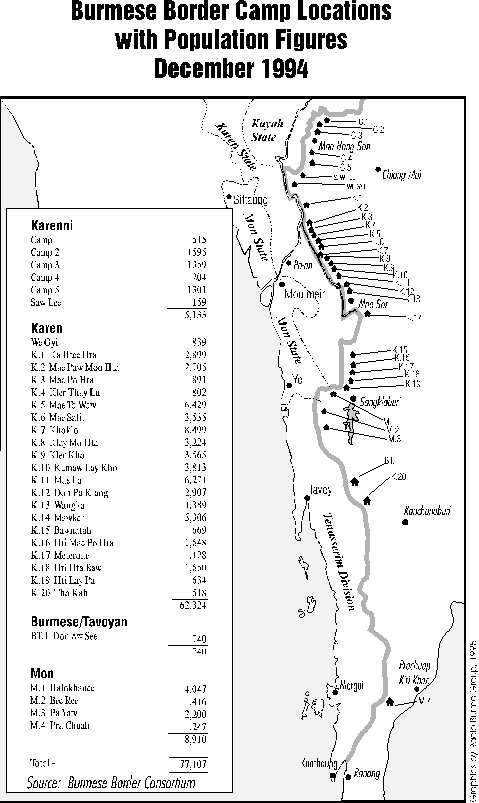
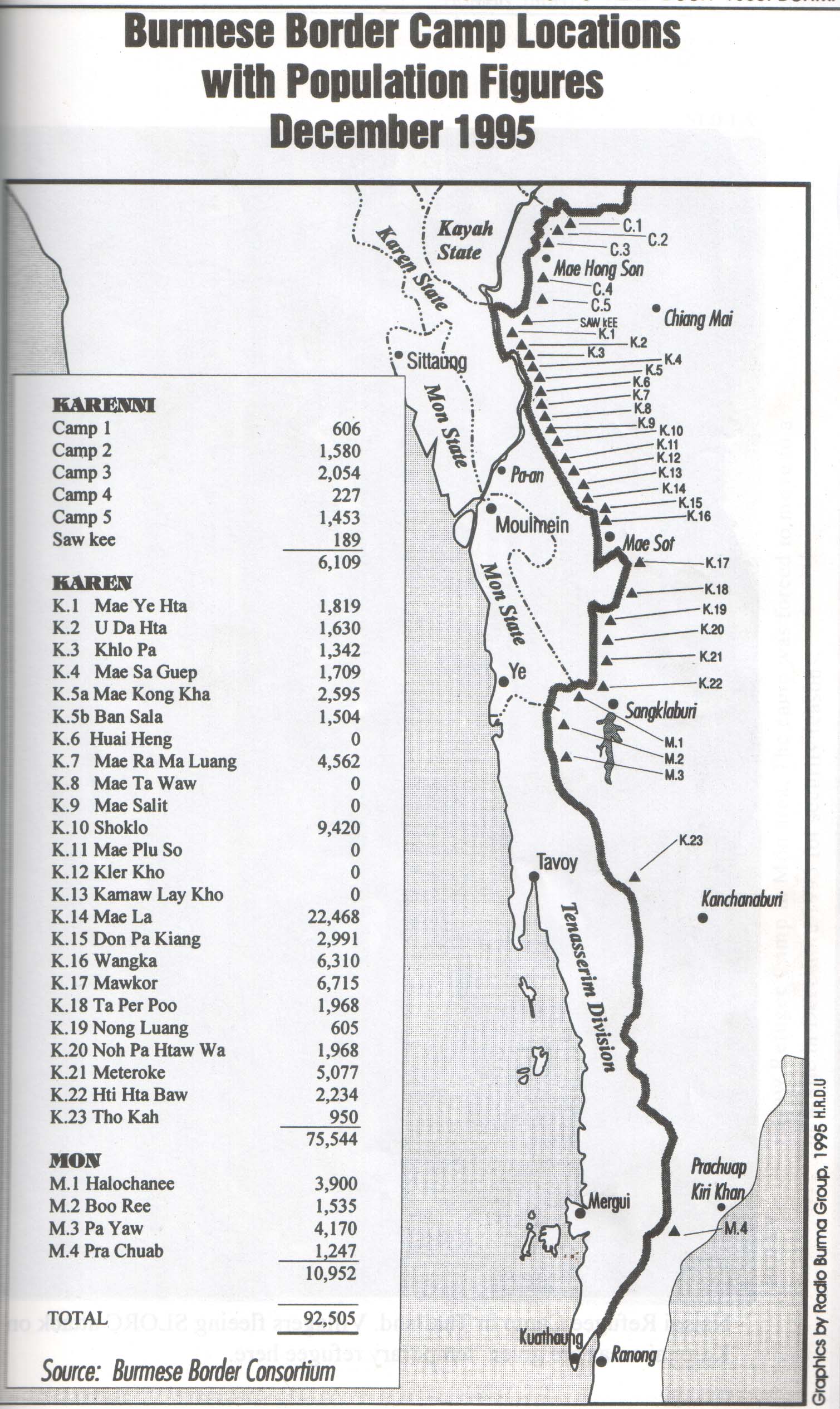
Particularly since the fall of Manerplaw in January 1995, the refugee situation has because increasingly confusing, but it can be divided into three main aspects: new refugees arriving, the movement of existing refugees, and the return of some refugees to Burma. At the beginning of 1995, there were an estimated 10-12,000 new Karen refugees who arrived in Thailand from the area north of Kawmoora. Majority of them were form villages form the Manerplaw area northward all the way to the Karenni border. Many of them fled before SLORC arrived in their villages because they dread of being taken as porters and life in general under SLORC domination; others tried to stay in their village only to witness it terrorised or destroyed when SLORC arrived, so they fled; while others fled because they feared religious persecution or forced relocation by the DKBA. Another small group of the new refugees fled from non-fighting SLORC-controlled areas because SLORC troops swept all such areas for porters. According to official figures, at the end of November 1994 there were 14 Karen refugee camps along that part of Thai-Burmese border with a total registered population of 50,356. By the end of February 1995, refugees from six of these camps fled to new locations further inside Thailand. Eight new camps were formed: some camps were totally filled with newcomers and some camps were occupied with the already-arrived refugees who had moved while others sheltered a combination of these two. A total registered population of those 16 camps was 61,257, an increase of 10,901. That number excluded hundreds of new refugees who did not register, and the numbers have continued to rise since then. This increase in the total has also occurred despite the return to Burma of about 1,500 refugees. The number of those in Thailand were only the tip of the iceberg; many more had fled into the forests or to homes of relatives, while new refugees estimated that at least 700 families were trapped west of the Salween River.
As new refugees keep arriving, existing refugee camps had also been on the move further into Thailand. All Karen refugee camps are unofficial, recognised neither by the Thai Government nor the UNHCR. The existing of those camps subject to understanding between Karen refugee leaders, local Thai villagers and officials, and the Thai Ministry of Interior. As such, they are not “closed camps” and have little or no security. They were all located within a few kilometres of the Burmese border; some of them were located right on the banks of the border rivers, in places where the KNU controlled the opposite bank. When SLORC occupied the Burmese side of the border, the civilians there felt no longer safe. SLORC troops have never shown respect for international borders, and since the end of January 1995 armed and unarmed SLORC/DKBA units have been crossing the border almost every day. Refugees from some camps moved in fear of being attacked while others moved after being shelled or penetrated by SLORC/DKBA troops. The situation has been getting worse than ever before as SLORC sends its troops across the border and then responds to any Thai Government protest by saying it is DKBA, which SLORC claims it does not control in any way. Witnesses have confirmed that SLORC troops have been involved in most of the border incursions. The Thai Army had almost no presence along this section of the border because it was never necessary while KNU controlled the other side. However, SLORC and DKBA have been taking advantage of the absence of Thai forces to cross the border with arms and with impunity, and to carry out their campaign to control the villagers in the refugee camps. Using threats, coercion and violence, SLORC and DKBA have been trying to frighten the refugees into returning to Burma. In some cases it is working as evidenced by the steady trickle of refugees who have fled the camps to return, usually crossing the border at Mae Ta Waw. There they are met by SLORC trucks and taken away either to DKBA areas or villages where SLORC chooses to keep them. SLORC has claimed that over 9,000 refugees have already returned, but the real total is more like 1,500-2,000, primarily from two of the largest camps, Baw Noh and Sho Klo.
Ever since the DKBO was first formed it tried to coerce Buddhist refugees into returning, seeing the refugee camps as a source of support for KNU and wanting the refugees as DKBA recruits. At first, their tactic was gentle suggestion combined with promises of an untroubled life at the Myaing Gyi Ngu “refuge”, as promised to other villagers. Of course, only Buddhist refugees were invited. The refugees already felt insecure because of indications that Thailand and the UNHCR may have been preparing a forced repatriation programme for Karen refugees, so gradually about 350 people from Baw Noh camp made their way across the border. However, after the fall of Manerplaw the DKBA was not satisfied with those numbers, and in unison with SLORC their tactics changed to threats and attacks on the camps in an effort to terrorise the refugees back to Burma. In February 1995 the DKBO widely distributed a letter stating that “In order to dismantle the refugee camps, we have various plans. Therefore all nationalities must leave the refugee camps and return to Myaing Gyi Ngu. If you do not comply with this document, you will be considered as anti-Buddhists and KNU and we are going to uproot you.” While this has worked to a certain extent, driving more people to return even as others were fleeing DKBA and SLORC areas for their lives, it has also backfired. At least some refugees who were planning to return changed their minds after the camps were attacked, while many Buddhists who were adopting a “wait and see” attitude because they are determined to stay in Thailand at all costs. After that Thailand has provided some limited security in the camps, many refugees feel they are safer with the Thais than taking chances with the DKBA. Most Christian refugees in particular feel that to return to Burma now would be suicide.
Table 9. Movements of Karen Refugee Camps
|
Camp abandoned (November 1994) |
Pupulation | Moved to | Remark |
| We Gyi |
1737 |
Mah Ya Hta | Moved to location several kilometres inside Burma |
| Bo Ya Hta | 1152 | Mah Sa Ger | Moved to site of a 15 minute walk inside Thailand |
| Ka Htee Hta | 2,891 | Mae Kong Kha | Moved three times due to attacks; now three hours walk inside Thailand, but was attacked there as well. |
| Mae Paw Mu Hta | 2624 | Huai Heng Mae | Moved three times due to attacks Ra Ma Luang |
| Mae Po Hta 919 | 919 | Baw Noh | Population scattered Ber Lu Ko, Sho Klo |
| Kler Thay Lu | 802 | Baw Noh | Population scattered Ber Lu Ko, Sho Klo |
| Kler Mu Hta | 3224 | new Klay Mu Hta | Camp was on the Burmese (Thai side) of Moei River, has now fled to Thai side. |
| Baw Noh | 9374 | Sho Klo, Other, Thai towns, etc. | (*) |
(*) Figure of Baw Noh camp was as of February 1995. All but about 2,000 of them fled the camp in March 1995 due to escalating armed attacks on the camp by DKBA, but many later returned again.
Of the aforementioned abandoned camps, the first four were along the Salween riverbank. Mae Po Hta was on the Moei riverbank, and Kler Thay Lu was about one kilometre from Moei River inside Thailand. Klay Mu Hta was a refugee camp set up on the Burmese side of the border due to a Thai decree that no more Karen refugees would be allowed. Baw Noh is less one kilometre inside Thailand, but is east of a main Thai road and in an area populated by Thai citizens.
Table 10. New location of Refugee Camps
Name Population Location Remarks (February 1995)
Meh Ya Hta 1,737 East of upper Salween Relocated refugees
U Da Hta 1,137 “ New refugees
Klo pa 505 “ New refugees
Meh Sa Ger 1,313 “ New & relocated refugees
Mae Kong Kha 2,817 3 hrs. east of Mae Sam Lap Relocated refugees
Huai Heng 1,800 2 hrs. east of lower Salween Relocated refugees
Mae Ra Ma Luang 4,900 3 hrs. east of Manerplaw New & relocated refugees
Klay Mu Hta (new) 3,659 Moei river near Mae Salit Relocated refugees
14.6. Attacks on Refugee Camps
Attacks on Karen refugee camps in Thailand by groups of SLORC and DKBA soldiers have grown increasingly common and serious since the fall of Manerplaw in January 1995. Initially many of these groups crossed without arms, but later they were almost always heavily armed — with assault rifles and on many occasions with M79 grenade launchers or even RPG’s (rocket-propelled grenades). The initial incursions were primarily for the purpose of looting by SLORC troops. Then the campaign of terror against the refugees camps began. The SLORC has long wanted to wipe out these camps, which are an international embarrassment to them and which provide civilians with a way to escape from SLORC control, while also providing a mean for information on the reality of political and human rights situation to the outside world. But destroying these camps was impossible until the DKBA came along. Now the SLORC can use the Karen DKBA to infiltrate the camps, and can send its own troops into Thailand under the cover of the DKBA. A major campaign to destroy the camps was introduced, first by gently persuading refugees to return, but since February 1995 by changing tactics of using threats, fear and violence, by SLORC/DKBA troops. The following is translation of a letter in Burmese received in several refugee camps in February 1995:
Stamp: Hlaing Bwe Township, Myaing Gyi Ngu Old Town
To:
—————————— refugee camp
Date:—95
Subject: All Buddhist people from the refugee camps are to leave and go back to Myaing Gyi Ngu
We will take care and responsibility for the family needs of all Buddhists who return from the refugee camps. You will be accepted as the families of Myaing Gyi Ngu. Already many families from the refugee camps are joining us every day. We have learned from people who have returned that the KNU is harassing and frightening the Buddhist community in the refugee camps.
To continue living in the refugee camps means to prolong the existence of the KNU and its harassment of the Buddhist community, and is a hindrance to peaceful resolution. In order to dismantle the refugee camps, we have various plans. Therefore all nationalities must leave the refugee camps and return to Myaing Gyi Ngu. If you do not comply with this document, you will be considered as anti-Buddhists and KNU and we are going to uproot you.
Families who return will be received at Myawaddy and will be sent to Myaing Gyi Ngu free of charge.
Soe Thit Sa Ti (Kyaw Win)
DKBA (Special Forces)
SLORC and DKBA troops have learned that they can move into Thailand at any time without being attacked. At present, the number and intensity of attacks against the camps is increasing, and at the same time cross-border robberies are happening every night all along the Thai border from Mae Sot to Mae Sariang. Rather than limit these robberies to impoverished refugees, the SLORC/DKBA troops are increasingly committed robberies on Thai citizens at gun point in the areas such as Meh Dan and Mae Ta Waw.
Making the situation worse, most of the new refugee camps are in remote areas which is completely cut off from outside access by road or river (now that SLORC controls the rivers) in rainy season from June to October.
The following report details some of the significant border incursions since January 1995, confirmed by KHRG. This is by no means a complete list.
14.6.1. Manerplaw Area
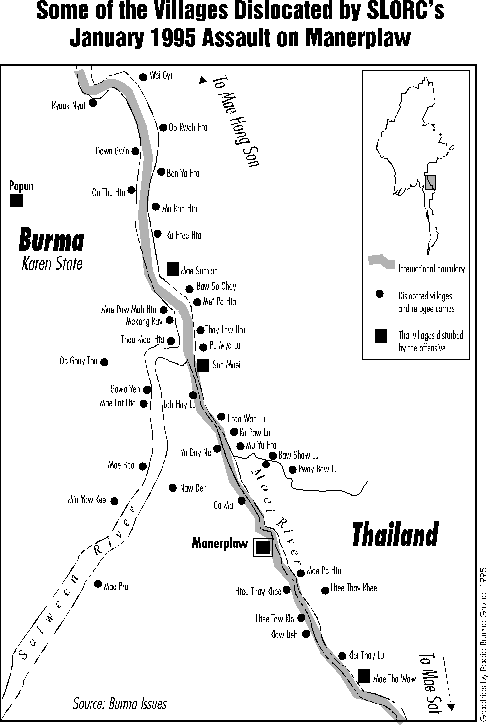
Several days before SLORC overrun Manerplaw itself, much of the civilians in Manerplaw area had already sought refuge in Pway Baw Lu, a village two kilometre. Even so, as soon as SLORC took a hill from which they could see Pway Baw Lu, most families began fleeing further into Thailand, fearing a ground attack or artillery barrage. The day that SLORC troops arrived in Manerplaw, they immediately began a mortar barrage against Thai territory on the other side of the Moei River as a form of pursuit of the Karen soldiers who had withdrawn to Thailand and disarmed themselves. Thai soldiers form Task Force 35 had already been flown in to take up positions to secure their border, but this did not affect the SLORC troops’ actions. As the concentration of Thai troops increased, many of the refugees trickled back into Pway Baw Lu, but the atmosphere was very tense. Most refugees felt that if a massive SLORC forces crossed the river, the Thai troops would simply withdraw to avoid fighting. SLORC/DKBA units began crossing the Moei River to loot abandoned villages on the Thai side such as Htoo Wah Lu, Ka Paw Lu and Mae Po Hta. There were reliable reports that they opened fire on a refugee trying to recover some belongings in Ka Paw Lu, and that they had come across to have lunch with Thai troops in Htoo Wah Lu. Then there was a rumour that the SLORC/DKBA troops were about to launch ground attack on Pway Baw Lu, and the village was completely evacuated further into Thailand. The refugees camped along dusty roads near a Thai Karen village of Meh Taw La and eventually established a camp, about three hours’ walk into Thailand, at Mae Ra Ma Luang (also called Mae Ra Mu Klo). The continued strong presence of Thai military and Border Patrol Police between the camp and Manerplaw has thus far prevented any attacks on the camp.
14.6.2. Mae Paw Mu Hta/Huai Heng Camp
Mae Paw Mu Hta camp, with a population of 2, 624 in November 1994, was on the bank of Salween River less than 10 km. south of Mae Sam Lap. SLORC occupied the opposite bank of the Salween and shelled this refugee camp on 4 February 1995. At least three shells landed in the camp, followed by about 10 minutes of machine gun fire. The refugees fled the camp in a panic together with Thai Border Patrol Police who had been stationed there. On the same day, as SLORC troops crossed the Salween a few kilometres further downriver and looted a shop in a Karen village of Pu Mya Lu (displaced Karen from Burma who farmed on the Burmese side of the river, but not a refugee camp), the villagers there had to evacuate as well.
The Pu Mya Lu villagers fled to Mae Ra Ma Luang camp, while the refugees from Mae Paw Mu Hta fled inland an hour’s walk to Meh Po Kee, which was a temporary shelter. As that place was unsafe, on 22 February, aid organisations sent five small cargo trucks to help move the refugees and their belongings to a 30-minute-drive to southeast permanent site at Huai Heng, further inside Thailand. The move continued throughout 22-23 February. At 5-5:30 p.m. on 23 February, when most people had already been moved, one of the trucks left Meh Po Kee with 4-6 families and some of their belongings. A few minutes along the road, it was forced to stop by a group of uniformed and heavily armed soldiers, who appeared out of the forest and immediately opened fire on the truck with AK47 assault rifles and one M79 grenade launcher. The Thai driver and two women on the truck were killed and 11 others wounded, including a five-year-old boy who had to have surgery in the field before being referred to Mae Sariang hospital, but survived.
Following were casualties of the shooting.
| Name | Sex | Age | Remarks |
| Udorn Khieumool | M | 40 | Killed by multiple bullet wounds |
| Naw Peh | F | 36 | Killed by gunshot in the back, large exit wound in the belly |
| Naw May Paw | F | 36 | Killed by gunshot in the head |
| Saw Ma Lay | M | 5 | Bullet wound in the left chest; bullet punctured the pleura and the spleen, then came to rest in the stomach. Doctors on site had to perform a field transfusion and splenectomy and removed the bullet from the stomach, then referred to Mae Sariang hospital. Saw Ma Lay is Naw May Paw’s son. |
| Naw Mu Heh | F | 25 | Wounded on right shoulder, piece of M79 shrapnel embedded |
| Naw Krit Heh | F | 27 | Wounded behind left ear, three small wounds on the back |
| Pa Nga Bya | M | 35 | Superficial wound on the right cheek |
| Nay Hta Ghay | M | 3 | Wounded superficially by flying glass |
| Pa Naw Mu | M | 7 | Superficial wound on the left cheek |
| Naw Shwe Roh | F | 42 | Wounded on right knee, also hematoma |
| Saw Kwa | M | 49 | Multiple wounds on the back, including one deep wound |
| Naw Meh Ta Ker | F | 17 | Superficial wounds |
| Saw Wih | M | 30 | Superficial wounds |
| Naw Nya Gu | F | 30 | Superficial wounds |
| Saw Ber Cher Ler | M | 47 | Superficial wounds |
All of those who suffered were Karen refugees, except Udorn Khieumool, who was the Thai truck owner/driver, a well-respected resident of Mae Sariang Town in Mae Hong Son Province. The other Thai national on the truck, the conductor, escaped without serious injury. The shooting appears to have been an act of pure terrorism to intimidate the refugees, although there has been speculation that it was also a form of warning to aid organisations to leave the camps, because the trucks had been hired by aid organisations.
The rest of the refugees fled that evening to Huai Heng on foot, where the atmosphere became one of extreme fear. Saw Maw Si, an educated and soft-spoken medic in his mid-forties who served as camp leader, had been targeted for execution by DKBA in December 1994, when he had to live in hiding in the forest for a week. After the attack on Mae Paw Mu Hta and shooting of the truck, he was close to a nervous breakdown and was no longer able to function as a camp leader. Without guidance, many refugees fled to Mae Ra Ma Luang on foot or by small truck.
14.6.3. Ka Htee Hta Camp
Ka Htee Hta refugee camp, with a population of 2,891 in November 1994, was located on the bank of Salween River about one hour’s walk north of Mae Sam Lap. On 7 February 1995, SLORC troops started shelling Oo Thu Hta, on the Burmese side of the river opposite Ka Htee Hta. They entered Oo Thu Hta in the late afternoon on the same day. At that point most of the villagers had already fled Ka Htee Hta to Meh Wih Kloh, five kilometre further inside Thailand. By 10 February, everyone had left main Ka Htee Hta camp and only about 50 families remained in Section 1 (Meh Wih Der). That afternoon, a group of armed soldiers — about 15 SLORC and three DKBA — crossed the river. The DKBA men went up the hill and spoke to the refugees telling them to go to Khaw Taw (Myaing Gyi Ngu) without threat. Fifteen families went with them. From 10 to 12 February, armed SLORC troops then came across the river and looted Ka Htee Hta, taking all the livestock and belongings they could find, 400 fifty-kg. sacks of rice from the storehouse and 100 sacks which had already been distributed to the houses. The refugees had planned to return for these, but became too afraid once SLORC had occupied the other side of the river. Soldiers, porters and conscripted refugees had to carry the rice to three stolen cattle-boat which SLORC used to transport it to Oo Thu Hta. After this period, the remaining families in Section 1 also left the camp for Meh Wih Kloh. On 12 February, three armed DKBA men went to Meh Wih Kloh and forced five more families to go back with them at gun point, threatening to shoot anyone who refused. They told the rest of the refugees they had better return to Burma or the SLORC would shell their camp. The refugees panicked and fled to Meh Paw Kloh, another one hour’s walk into Thailand. They later learned from a monk who was still staying in Ka Htee Hta that SLORC shot dead two men — Win Oo (28) and Than Myint (20) — who returned on 10 February and three more — Meh Ka La (26), Maw Bee (38) and Pa Da Kee (32) — who returned on 12 February. One 18 February, the same monk came and told the refugees that 30 SLORC soldiers were preparing to attack Meh Paw Kloh at night if the refugees didn’t return right away. The refugees fled again, this time to Mae Kong Kha, near a Thai Karen village, three hours’ walk from Salween River. SLORC troops never came to Mae Paw Kloh. On 21 February, it was reported that a young woman, Ma Nyay (18), who had crossed back to Burma on 10 February was sent back across the river at Mae Sam Lap for treatment after being raped by 20 SLORC soldiers.
At 2:00 a.m. on 10 March, armed DKBA soldiers came to Mae Kong Kha and abducted the camp leader, Saw Ghay Ploh (in his late forties, a Christian) and the camp security leader Aung Lay (a Buddhist). In the process, Aung Lay was beaten up and suffered one rib broken as the DKBA men disarmed him. Both victims were taken back to Burma with their families, totalling nine people. They have reportedly been taken to Kyaw Taw and not too badly treated along the way because Ghay Ploh knew the DKBA soldiers involved. Two days later, 54 more families left the camp for Burma, either with the idea of following the camp leaders or in fear of further attacks.
14.6.4. U Da Hta Camp
At U Taw Hta near U Da Hta on 8 February 1995, SLORC and DKBA reportedly crossed the Salween River, looted rice, pigs and buffaloes and burned down five houses.
14.6.5. Ber Lu Ko
Ber Lu Ko is a Thai Karen village just north of Mae Ta Waw, but when several refugee camps had to be evacuated, 27 refugee families from Kler Thay Lu and Mae Po Hta camps came to stay there. At about 9:00 p.m. on 2 March 1995, six armed DKBA men entered the village while an estimated 20-30 DKBA or SLORC troops waited around the village perimeter. DKBA sought out Pu Kyaw Li (or “Jolly”), who had been a former KNU official and camp leader of Kler Thay Lu. He, in his late 60s, is a Christian Seventh Day Adventist, a religion particularly hated by the DKBA because it is Gen Bo Mya’s religion. When they found him, they beat him with a torch-light and kicked him, tied him up and took him away. They also left a letter saying that everyone must leave the camp by 5 March or it would be burned down. They took Pu Kyaw Li across the river to Burma. His daughter and his bodyguard followed him the following day, and when his bodyguard returned he reported that Kyaw Li was held at Meh Baw Plaw and was still alive. The 5 March deadline passed with no action being taken against Ber Lu Ko camp. No further word has been received regarding Kyaw Li, and there is strong fear that he might be executed because of his religion.
14.6.6. Baw Noh (Mae Ta Waw) Camp
Baw Noh camp with a population of 9,374 in February 1995, just south of Mae Ta Waw, had increased in population by about 3,000 because it was a well-established refuge for people fleeing camps such as Kler Thay Lu and Mae Po Hta. However, it was a prime target of the DKBA and SLORC because of its large population, its proximity and accessibility from the SLORC border post of Mae Ta Waw, and its mixed Buddhist/Christian/Muslim population. Even before the fall of Manerplaw and shortly thereafter, a total of about 350 refugees from Baw Noh were persuaded or coerced into returning to Burma by DKBA supporters who infiltrated the camp. DKBO leaflets were distributed encouraging people to go back. However, in February 1995 they introduced a new tactic of armed incursion and fear in Baw Noh as well as elsewhere.
At 1:15 a.m. on 28 February 1995, about 30 armed men from SLORC and DKBA came to the camp. Nine of them entered the front section of the camp while the others stayed in the surrounding small hills. The nine came to the main gate and found people there sleeping. Other witnesses later said four of them were Karen in DKBA uniform and five were Burmese in SLORC uniform. They captured San Htun Kai (age 57-58 years, Buddhist and married with three children) who had formerly been a low-level KNU official in Burma. As they were capturing him, two people walked into the camp from the direction of the main road. They were Thai Karen traders — Thai citizens who sell goods in the camp while their families live in Mae Ta Waw village. When the traders saw a group of people at the gate, they shone a torch-light at them, and two of the soldiers opened fire. Both men were wounded in the legs. Ah La (21, married with no children) was hit by one bullet in the ankle and Pa Dee Thu (35, married with four children) was hit by several bullets: one in the lower leg, one just above the knee and one hit his hip from the rear and exited from the front beside his groin. The armed men then left, abducting San Htun Kai to Burma and leaving the two wounded men laying there on the ground. Ah La was later sent to Meh Dan Hospital, while Pa Dee Thu was referred to Mae Sot Hospital. No news has been heard of San Htun Kai.
According to camp officials, “They left behind a letter that said, ‘Buddhists must all came back between now and 15 March. If you stay you’ll be considered bodyguards of Christians and under their command. On 5 March, we’ll come and burn the whole camp. All the Christians will be buried here.”
On 2 March 1995, an armed group robbed a shop in Klu Me Nee Hta, between Baw Noh and Mae Tha Waw. At about 9:00 p.m. on the same day, three people — two armed and one with a radio — were seen carrying a red sign with black letters was found posted in Baw Noh saying (according to camp officials), “After 6-7:00 p.m. you can’t cross the river. Anyone crosses the river will be killed. If we come to the camp don’t shoot us. If you do, we’ll burn the whole camp. If you shoot, you’ll see what happens.”, signed by “Soe Thein, Soldier of Religion”. Some of the former sawmills across the Moei River from Baw Noh had already been burned after 28 February attack. Less than one kilometre east of the river is the north-south Mae Sariang-Mae Sot highway with a Thai police post, and the camp started on the eastern side of this road, stretching east about one kilometre where the camp ends and open paddy-fields begin. Between 28 February and 5 March, the front part of the camp (nearest to the road) had largely been cleared out. Many people were staying in their houses by day but leaving at sunset to sleep in the bush and the paddy-fields to the east of the camp. Some had sent their families to stay in nearby Thai Karen villages. People in the back end of the camp had many of their belongings packed. Everyone was waiting to see what would happen, afraid but also somewhat defiant. Every day small trucks carried people moving south to Sho Klo camp, as well as those going to Mae Ta Waw to return to Burma. Thai authorities kept promising to send security forces and everyone was hoping for this, but they were slow to arrive. People were doubtful of the DKBA’s threats but unsure what to believe. About noon on 4 March, a large number of SLORC troops appeared on the Burmese bank of the Moei River directly opposite Baw Noh, and the fear increased. Finally, a few Thai soldiers arrived on 5 March, but not nearly enough to defend the camp. However, the threatened attack did not happen. As with most of the DKBA’s threats, its purpose was only to intimidate people into fleeing the camps.
At about 5:30 a.m. on 15 March, a heavily armed group of about 20 Karen and SLORC soldiers entered Section 2 of the camp, coming out of the forested hills and across the paddy-fields. It appeared that they might have already been encamped in Thailand for one or more days, as they had passed through a Thai Karen village and told the villagers not to say anything. The armed men approached the camp leader’s house, which faced onto the paddy-fields. The camp leader and his family were staying in another house, but there were some camp security (refugees on security duty) outside the house. The soldiers shot and killed a camp security man who was sleeping on the ground outside the house, then opened fire on the house. Two other security guards were wounded — one in the back and another in the hand. The soldiers fired an M79 grenade which hit the house to the left of the camp leader’s, totally destroying the front wall. Fortunately the house was empty. Then they entered the camp leader’s house, shot it up, took the Bible and tore it into pieces as they ran away. They ran up a hill behind the house shooting, and hit a woman and child in one of the houses, wounding her in the arm and the hip and the child in the neck. People in the houses on the hill fled their houses and ran away from the armed men and down into the paddy-fields . The soldiers arrived at the pastor’s house and opened fire on it, but the pastor and his family had already run. Then the soldiers ran in the same direction as the refugees, but more camp security and some Thai soldiers arrived and fired on them, killing one DKBA soldier and wounding two or three other Karen and SLORC soldiers. They captured an M1 rifle from the dead man. Camp security witnesses said the armed men were definitely a mixture of DKBA and SLORC, armed with AK47 and M79. Some carried two weapons. The soldiers then fled onto the hills. The armed men made their way 10 km. to the north through the hills and crossed the Moei River into Burma just south of Mae Ta Waw. At 3:00 p.m. on that day there was further panic in the camp because a rumour said that DKBA and SLORC were coming back to retrieve the dead body of their comrade, but this never happened. One of the four wounded refugees died that afternoon.
After this attack, about 2,000 refugees fled Baw Noh, most of them going 20 km. south to Sho Klo camp, scattering to Thai Karen villages or the hills and forests, or camping in the paddy-fields immediately surrounding the nearby Thai Army position. Later on an order was issued asking all Baw Noh refugees at Sho Klo to return to their former camp. Many had already done so, especially among the Muslim community. Some said as they could no longer stand the cramped conditions where they were all kept in two open warehouses in Sho Klo, they returned to stay at Baw Noh whatever was the cost. As the camp leader dared not return, a new camp leader has been appointed in Baw Noh. Another letter was then received at Baw Noh, threatening to burn the entire camp on 27 or 28 March.
At about 7:30 a.m. on 28 April 1995, Baw Noh camp was attacked by a group of about 100 men, most of them DKBA but apparently with a few SLORC soldiers among them. The armed men launched attack from two direction: one came from the south and across the highway while the other came down the highway from the north and brazenly marched right across a large highway bridge just in front of the camp. Without provocation, they then opened fire on the Thai police post along the highway in front of the camp. The post was manned by its usual contingent of five police, plus an additional seven Border Patrol Policemen. They exchanged fire with the attackers for five minutes, wounding two DKBA, but Thai police had to flee because DKBA were outnumbered. Two policemen ended up having to hide under the highway bridge while one Border Patrol Policeman, Sgt Thawatchai Wanond, was captured, tied up and taken to Burma as a prisoner when the attackers withdrew. He was released unharmed the following day. The attackers later burned down the police post, destroying an estimated 200,000 baht (US$ 8,000) worth of equipment and personal belongings.
They then advanced to the front part of the camp, while troops (probably SLORC) on the Burmese side of the Moei River (one kilometre to the west) began shelling the back half of the camp with 81 mm mortar, probably to stop the refugees escaping into the paddy-fields behind the camp and to deter any attempt at defence by the camp security force. Over ten mortar rounds hit the back half of the camp, wounding two people. As the attackers entered the camp, they fired RPGs (Rocket-Propelled Grenades) and small arms. They began looting and then burning houses. They arrested three refugees but released them before leaving. They looked for the camp leader but he was up the road in Mae Ta Waw village, and they looked for Saw Abraham (also known as Ah Kya), the Seventh-Day Adventist pastor. He and his family had to hide in two covered holes under their house, and did not come out in fear of being shot. Their house was then set on fire. As the house began to collapse, the pastor, his wife and their youngest son managed to escape with bad burns, but their 18-year-old daughter Naw Geh Moo Paw, a 10th standard high school student, was alone in a separate hole. The house collapsed on her and she was burned to death. Her screams were heard by people throughout the camp.
The attackers stayed in the camp for about one hour. They set half the camp on fire and then the fire spread to the whole camp. An estimated 700 houses were burned, including the school and the camp hospital. Only the monastery and a few houses were left standing at the front of the camp and on the low hills surrounding. They threatened the refugees that they would come back again in a few days, and next time they would kill everyone who remained.
Five refugees were wounded and one (Naw Geh Moo Paw) was killed. Pastor Abraham (47), his wife (39-40) and their youngest son (12) suffered from burns and were sent to hospital. Two others were wounded by shrapnel from 81 mm mortar shells — one was hit by fragments in both shoulders and the nose, and the other was hit by two or three fragments in the lower leg. They were also sent out to hospital for treatment.
At 8:00 p.m. the night before the attack, Karen camp security already had notification that DKBA troops were in the monastery directly across Moei River and were preparing to attack the camp, and they immediately notified the Thai police at post. Thai police said they had notified their superiors repeatedly and in detail that the camp was about to be attacked, but their superiors had never responded or sent reinforcements. Instead, the policemen were notified to disarm the Karen security at the camp. The evening before the attack, they told the camp security leader that a senior Thai Army officer was coming and that on 28 April all houses would be searched for weapons, so camp security must either hand over or bury their weapons (the then Thai Army Commander-in-Chief Wimol Wongwanich did in fact visit the camp two days after the camp was burned). At 5:00 a.m. on 28 April, the Thai officer in charge again notified camp officials to get rid of any weapons. As soon as the camp security had finished disarming themselves, the attack began.
14.6.7. Mae Salit (Tala Thaw, Gray Hta) Camp
Mae Salit, with a population of 3,573 in February 1995, initially seemed to be quieter and safer than the other camps. The relocation was 119 km. north of Mae Sot, between Sho Klo and Baw Noh, about 30 minutes walk into Thailand from Moei River. However, later on it was the subject of threats and reported infiltration by DKBA posing as refugees. At 1:30 a.m. on 9 March, armed soldiers came to a hut alongside the Moei River near Gray Ht, the home of a refugee family that had farms on the Burmese side of the river but they used to sleep in Thailand for safety. The elderly couple and two of their sons were there. Three men stayed under the hut while three others, armed with an AK47 and two knives, entered. They threw away the family’s Bible and went through the house, stealing jewellery and the family’s entire savings of 10,140 baht. When Saw Htoo Htoo (61) swore to God that this was all they had, the man said, “There is no God any longer” and shot him twice, killing him. The perpetrator then shot his son Tamla Htoo twice and killed him. The younger son had already had already escaped from the back of the house when the men arrived. They then left without harming the boys’ mother.
On 20 March, another house, located at one end of Mae Salit camp, was looted. Two or three men came with guns and a grenade at night but they did not shoot. They robbed 7,000 baht and a radio/cassette recorder.
14.6.8. Sho Klo Camp
Sho Klo camp, with a population of 8,523 in February 1995, is 110 km north of Mae Sot, a short walk from the Moei River. Although DKBA sent a lot of leaflets and propaganda to the camp’s monastery with orders to the monks to distribute it, no serious attacks was reported as of March 1995. Letters threatening to destroy the camp if everyone does not return have also been sent. At night on 2 December 1995, about 60 armed men from DKBA attacked this refugee camp, robbed the people there, taking an estimated 10,000 baht and seized three KNU officials. The raiders also threatened to burn down the camp before they fled. At 1:00 p.m. on 26 December, about 30 armed men from DKBA led by Chit Nu entered Section 7 of Sho Klo refugee camp and committed a robbery. Because of shootings, Saw Aye Tun, in charge of Section 7, and his two- year-old daughter was wounded. Some houses were destroyed and all the valuable belongings which worth more than 510,000 baht were taken away.
14.6.9. Mae La (Beh Klaw) Camp
Mae La camp, with a population of 6,907 in February 1995, is 60 km. north of Mae Sot and the back end of the camp is about one hour’s walk from a major SLORC base at Maw Pa Thu. About 9 p.m. on 9 February, seven armed men entered this back section of the camp and went to the house of Pado Mahn Yin Sein (55), former KNU governor of Pa-an District. Armed men abducted him, his nephew Saw Sim Bo, Sia Jed (a former of KNU judge) and Aung Maung Aye, who is Mahn Yin Sein’s son-in-law and second vice-governor of Pa-an District. The perpetrators tied up them and at gun point they took Mahn Yin Sein’s pickup truck, parked in a shelter near the house, and forced Aung Maung Aye to drive them southward along the main road toward Moei River opposite Maw Pa Thu. They told Aung Maung Aye that if Thai police stopped the car, they would shoot them. Unused AK 47 cartridges were later found in the car shelter, and the soldiers also had an M79 grenade launcher. Aung Maung Aye, a Christian, tried to stop the kidnapping by driving the car off the road into a tree. He then managed to escape with a wounded leg, and was later admitted to hospital. However, the kidnappers escaped with Mahn Yin Sein and the others on foot. There has been no further news of those abducted.
After the kidnapping, families stopped sleeping in the outlying section of the camp near Mahn Yin Sein’s house and the car shelter and moved their belongings to houses in other parts of the camp. At 4:00 a.m. on 28 February, people saw the light of a fire from that part of the camp but dared not go to inquire. At daybreak they found that the house of U Pa Dwa (40, married with four children) was completely razed to the ground. The family had already abandoned the house at that time. But after it was burned, U Pa Dwa was so afraid that he was targeted and he took his family back to Burma.
At night on 2 March, some DKBA members reportedly entered the camp to force some of their relatives to go back to Burma. However, the women refused to set off with the children in the middle of the night, and when other refugees arrived on the scene the men fled. Since then there have been several reported incidents of families being robbed at night in outlying sections of the camp, and automatic rifle fire has been heard throughout the camp on at least two occasions. There is a report that one refugee was injured in one of these incidents; however, camp authorities have been trying to prevent general panic by withholding information on such incidents.
14.6.10. Huay Bone (Don Pa Klang) Camp
Huay Bone camp, with a population of 2,919 in February 1995, is 19 km. north of Mae Sot near Moei River. It has also been the subject of threats, and at some time in March 1995 there are reliable reports that two men were arrested in the camp by security and found to be carrying one or more hand grenades.
14.6.11. Huay Kalok (Wan Kha) Camp
Huay Kalok camp, with a population of 4,448 in February 1995, is only five kilometre north of Mae Sot and is three kilometre. from Moei River and the former KNU stronghold of Kawmoora (Wan Kha). During the final assault on Kawmoora on 20 February, SLORC fired several artillery shells three kilometre into Thailand at a Thai Army artillery position just outside the camp. No one was hurt. The day after SLORC occupied Kawmoora on 21 February, SLORC soldiers in civilian clothes started coming into Huay Kalok camp every day after about 11:00 a.m. At first they only came to the market on the outskirts of the camp, but then they started wandering around the camp, looking around the clinic, the school and other parts of the camp, in some cases even asking people question in Burmese. Refugees recognised them without a doubt as SLORC soldiers, and sometimes they were accompanied by Thai Border Patrol Police. Camp officials and religious leaders began sleeping in different houses every night, general panic began to spread through the camp, some families began fleeing to other refugee camps and talks began with Thai authorities about moving the camp. Then after about ten days, the incursions suddenly stopped. Presumably, Thai authorities had given SLORC a strict warning. However, there is still a lot of fear and uncertainly in the camp. By 27 March, some Thai citizens had erected makeshift drinking stalls on the Thai bank of the river opposite Kawmoora, less than three kilometre from Huay Kalok. SLORC soldiers have been coming across to these stalls every day to get drunk, in uniform but with their epaulets undone and hanging over their shoulder badges. At least some of the soldiers were from LIB 3 of LID 44.
14.6.12. Mae Ra Ma Luang (Mae Ra Mu Klo) Camp
Mae Ra Ma Luang camp was newly formed in 1995 to house refugees from Manerplaw area and the lower Salween who had fled SLORC’s Manerplaw offensive. It is home to about 5,000 refugees and is about 10 km inside Thailand, with hills and Thai forces between it and the Moei River borderline. It was not attacked until 25 April 1995, when 40-60 soldiers entered it from the north along the main stream which passes through the camp. They crossed the Moei just upriver from its mouth at the Salween River and followed a main path for 2-3 hours to the camp, taking a few villagers as captives along the way. Despite the fact that there were heavily armed Thai and Karen security deployed to protect the camp, the force was not attacked and the refugees had no warning of their approach. They arrived at noon or 12:30 p.m., probably having planned to arrive in the heat of the day when houses burn most easily. Most of the attackers were Karen and spoke to their captives in Karen, but there were a few who looked Burmese and never said a word, only pointing and signalling. They entered the Section 1 end of the camp and immediately began looting, taking refugees and shooting. They quickly opened fire on the Thai army station at the other end of Section 1. The Thai forces fled, and later the attackers stole their radio set and took it with them. While refugees fled into the surrounding forested hills or were taken captives, the attackers advanced slowly through Section 1 and into Section 2, telling refugees they were going to burn the camp shortly. After looting half of Section 2, they began an orderly retreat back to Section 1, one group setting the houses afire while another group covered them, shooting all the time and taking the refugees as they went. Houses were set afire by cigarette lighters on the roofing leaves or burning tracer rounds fired from assault rifles.
By the time they got back to the place where they had entered the camp, they had at least 100 refugees, young, elderly, women and men. They told these people they were taking them to DKBA headquarters at Khaw Taw (Myaing Gyi Ngu) and set out back along the path with villagers interspersed with soldiers to act as a human shield. Along the way a few people were released and a few escaped, then when they reached Tee Ler Baw there was a brief burst of fire from camp security forces in the surrounding hills. In the confusion, many villagers escaped. By the time they reached Moei River and crossed back into Burma, the attackers reportedly had only two refugees left: Deh Mu (about 60, a Christian), who used to be a KNU official in Papun District and Johnny (personal details not available). These men were tightly tied with rope, and DKBA specifically wanted to take them back. They had also planned to take back Hla Tin, a former Karen Army training officer, but he managed to escape.
Ten people were wounded during the attack; eight by gunfire & shrapnel and two by burning:
No. Name Sex Age Remarks
1. Aye Day M 42 Hit in the right upper back and the bullet was lodged inside. Referred to Mae Sariang Hospital.
2. Sa Mya M 32-33 Deep flesh wound across the back muscle. Ref- erred to Mae Sariang Hospital.
3. Ma Aye F 21 Shot in the back of her left shoulder while trying to run away with her three-month old infant. The bullet went through her shoulder and exited out the front, leaving a hole the diameter of a finger. Being treated in the camp.
4. Kyaw Myint M 32 Hit in the thigh with M79 grenade shrapnel which became lodged inside. He was having great difficulty in walking but was treated in the camp.
5. Hla Aye F 30 Small wound in her left heel from M79 shrapnel, Kyaw Myint’s wife was treated in the camp.
6. Name not M about Hit by an exploding M79 shell while running available 22 away, many wounds on his right up per body and head. Referred to Mae Sariang Hospital.
7. Hsa Po Htoo M 24 Hit by the same shell as No. 6 and suffered one bone broken in his right forearm. Referred to Mae Sariang Hospital.
8. Name not M about grazed on one toe, was treated in the camp.
available 15
9. Mya Maung M 84 Badly burned across his forehead, elbow, but tocks and heel. Mya Maung is deaf, cannot see well and cannot walk on his own. He did not know what was happening and was caught in his house when they set it on fire. He was treated in the camp.
10. Pu Pu M 82 Badly burned on his face, back, arms and all over his body. Pu Pu is blind. He was under his house when they set it on fire. He report edly died of his wounds on 27 April.
In the attack, 170 houses were completely destroyed — all of Section 1 and half of Section 2 (the camp has seven sections). Storehouse of Section 1 was burned, completely destroying 905 sacks (90,500 kg.) or rice, 1,500 kg of salt, 2,640 blankets, 1,760 mosquito nets, fish paste and other miscellaneous items. The food supply had just been stockpiled for rainy season (until November 1995), because the monsoon rains were about to wash out the road to the camp and it would be inaccessible. Since the attack, Thai security forces have been slightly increased to a total of 10 or 20 in the camp, but there is no evidence that any further security measures are being taken. The camp could easily be attacked again.
14.6.13. Kamaw Lay Ko Camp
Kamaw Lay Ko camp was a long-established camp on the west side of the main north-south highway 76 km north of Mae Sot. As of February 1995, its official population was a relatively stable 3,961.
At 5:00 p.m. on 25 April 1995, four Thai Border Patrol Policemen assigned to guard the camp received information from a KNLA officer operating on the Burmese side of the border that DKBA would attack the camp at 11:00 p.m. that night. The police immediately reported this to the Thai Army base near Mae Dan, only ten minutes by car, but there was no response and no reinforcements were sent. At 11:00 p.m. approximately 100 soldiers attacked the camp from at least two directions: the southwest end, entering near the school, and the northeast end, entering from the highway past the Thai post. Refugees claimed up to half of them were uniformed SLORC soldiers. All the soldiers, SLORC and DKBA, were wearing SLORC Army hats, boots, and SLORC-cut uniforms. Four Thai guards, grossly outnumbered, hid inside their post. The group from the northeast went into a shop beside the Thai post owned by a Thai Karen and looted it. Among other things, they stole some beer and paused to drink it while they argued over whether or not to burn the camp. According to the shop owner, Karens with local accents argued against burning it while some with Irrawaddy Delta accents wanted to burn it. They then went into the camp, and later came back to burn the Thai Karen’s house and shop. Meanwhile, the other group stopped by the school (which is on a hillside) and began firing small arms, RPGs, , M79 grenades and 60 mm mortars down the camp. They then went into the camp and began setting houses ablaze with tracer bullets and lighters to the roofing leaves. The fire spread among houses. One refugee reported that the DKBA soldiers let people try to stop their houses burning, but the SLORC soldiers did not let them. Only one man, Eh Pree Pa, age about 32, was slightly wounded in the leg by RPG shrapnel. All other refugees managed to escape to the surrounding hills, while some took refuge in the camp monastery. About 300 houses were completely destroyed. The soldiers arrested three teenage boys, took them to the camp cemetery and then released them after giving them the message that all the refugees must return to Burma within three days or they would come back and kill all those remaining. They then left at about 12:30 a.m. with no refugees, carrying the items they had looted by themselves.
14.7. In Search of a Heaven
There have been reports of attacks of various kinds at every Karen refugee camp north of Mae Sot. In summary, every camp north of Mae Sot has been received written and verbal threats by DKBA coercing them to return to Burma or their camps will be destroyed. The refugees whose homes have been destroyed or who felt insecure in their former places have scattered into the hills surrounding their camps, where they always face great difficulties. Many of them joined their fellow refugees in other camps at which once again they seem safer enough for them. As of December 1995, six Karen refugee camps — Huai Heng, Baw Noh (Mae Tha Waw), Mae Salit, Mae Plu So, Klor Kho and Kamaw Lay Kho camps — once each of which housed thousands of refugees has already turned into place with no inhabitant. Most camps still do not have enough and effective security provided by the Thai authority, instead the Thai forces there are even under orders to evacuate if the camp is attacked as the Thai military wants all the Karen refugees be forcibly repatriated as soon as possible.
[See also under “Eyewitness Accounts”, interview 22-36, 47-58, 72-82, 89-100, 256-260]
14.8. New Influx of Karenni Refugee
Despite the cease-fire agreement reached between KNPP and SLORC— less than three months later on 15 June 1995 — Rangoon’s troops started collecting porter fees in SLORC-designated areas of Karenni State. The Tatmadaw also started rounding up porters, horses and tractors for corvee service. The first round of fighting between KNPP and SLORC which started in the last week of June 1995 prompted a fresh exodus of some 1,500 Karenni refugees — adding to the toll of the displaced Karenni by more than 6,000 at refugee camps on the Thai side of the border. [Source: ABSDF]
[See also under “Eyewitness Accounts”, interview 276-283]
14.9. BPP Orders for Repatriation of New Arrivals
On 25 April 1995 the officials from Thai Border Patrol Police ordered leaders of Halockhani Mon refugee camp to quickly repatriate the refugee families of new arrivals who built their houses along the edge of the camp in Thai territory of the border.
Because of the consistent human rights abuses in Mon areas by SLORC troops and hardships for survival, hundreds of local inhabitants had to flee to the refugee camps on the Thai-Burmese border during February and March 1995. But since the location of the refugee camps along the Thai-Burmese border is very far from their native villages, only a few of them arrived at the camps. Nearly 200 new comers arrived during the second week of April and May. As the location of Halockhani is at the edge of Mon and Karen states, many new arrivals were from Kyaikmaraw and Kyar Inn Seik Kyi townships.
The Halockhani camp has not had enough space for new arrivals to build their huts as the camp is situated in the mountainous area which has already been occupied with the houses of the refugees. During the first week of May, some BPP officials said the new arrivals could build their temporary shelters in the site, which is at the edge of camp, in Thai territory, without fencing them. They were also barred from the right to cultivate on the land temporarily provided to them. During the second week of May, after the houses were built and the families settled, a different order saying to move from Thai territory to Burmese soil as soon as possible was issued. After they issued the order, the camp leaders and MNRC had appealed them not to move those refugees until the next dry season. But their suggestion was refused. Although the refugees did not have any desire to move, being afraid of measures taken by Thai authorities, they had no alternative. During the second week of May, about 40 families moved from Thai territory to unsafe Burmese territory, causing the refugees facing with hardships to build new shelters again.
Most of them moved to Halockhani main camp. Though the site is inconvenient to build many shelters there, the camp leaders have arranged possible settlement for those new arrivals. Then they cleared and dug hillside areas in the main camp. Because of the narrow space in Halockhani main camp, very few families of refugees who have no choice for making shelters went to Baleh Dunphai section where they would have enough space for buildings but less safety, as the site is very close to the route which connects Three Pagoda Pass and SLORC military headquarters in Mon State or Tenasserim Division. As that route has been used by SLORC for military purpose, they are living in Baleh Dunphai in fear of another attack by SLORC troops.
Baleh Dunphai is one section of Halockhani camp and about four kilometres from the main camp. In July 1994, Baleh Dunphai section was attacked by IB 62 of SLORC troops and the whole Halockhani refugees fled and attempted to seek refuge in Thai territory.
On 5 April 1995, when 200 SLORC troops from LIB 403 retreated to their headquarters in Tavoy, there was a small fighting between Mon troops and Burmese army. The fighting broke out near Baleh Dunphai and many refugees had fled to the main camp because they were afraid of another attack and arrest by the SLORC troops as in July 1994. After the Burmese troops moved down to their headquarters and the situation came to stable, the refugees returned to their former site again. [Source: MNRC April/May 1995 Report/ HURFOM]
More than 1,000 local people from Tavoy District escaped to Payaw where they thought it was safer than that of Halockhani refugee camp. Local people in Tavoy District were also subjected to atrocious human rights violations committed by SLORC troops. Payaw Camp is situated more than 50 km from Sangkhlaburi, while Bee Ree camp is far about 80 km. [Source: MNRC April/May 1995 Report/ HURFOM]
[See also under “Eye-witness Accounts”, interview 106-108, 110-114, 117-120, 123, 125-128, 133, 136-142, 144-148, 206, 221, 238, 255, 208, 261-263, 267-275]
14.10. Enforcing Immigration Act: Crackdown on Refugees and Illegal Immigrants
At 3:00 p.m. on 19 April 1995, Thai police came in a very violent way and captured “illegal emigrants” in Wat Prok, the Mon monastery in Yannawa District, Bangkok. Two victims’ heads and another person’s leg was broken as a result of violence practised by the Thai Police. Altogether 13 people, including the wounded persons, were arrested and brought to the police station. After that they were subsequently sent to the Immigration Detention Centre (IDC) on Suanplu Road. Brother John Beeching, a Canadian Maryknoll father, went to the police station and asked for allowing at least some assistance to the wounded but he was not taken in account. Among those who were subjected to arrest were Naing Bai and her eight-month-old baby girl, We Lai. Naing Bai was separated from her desperately ill baby who was listed in serious condition at Lertsin Hospital. She had symptoms of illness at time of raid. She was diagnosed as suffering from pneumonia, malnutrition and other complications after spending several days at IDC where the temperature soaring to 43(C during the day. She was noted to have a high fever and was breathing in great difficulty. The baby was rushed to hospital after immigration authorities thoroughly checked her documents. She was then placed in an oxygen room with a nurse to assist her breathing.
Although Naing Bai’s husband is a Thai national, he was said to suffer from mental illness and was unable to support the family. We Lai and her five-year-old brother are Thai citizens. But Naing Bai did not have a resident permit nor was being recognised by UNHCR as a person of concern. On 25 April, Naing Bai was transferred to the detention centre in Kanchanaburi as a the first step of her deportation.
Also arrested was Maung Kyan — a Mon national who lost both arms and both eyes in a land mine explosion ten years ago — along with his wife and two children. Before arrest, Maung Kyan underwent a cornea transplant operation to regain some of his vision. Since Maung Kyan had been officially listed as a “person of concern” by UNHCR, he and his family were the Safe Area for Burmese refugees in Ratchaburi Province, Thailand. [Source: MIS]
14.11. More Arrests on Burmese Asylum-seekers
At night on 1 May 1995, there were raids on the residences of the Burmese refugees in Bangkok and 29 were arrested by Thai Special Police Force 191. Most of them were recognised by UNHCR Bangkok office as person of concern, bearing their papers for refugee status in Thailand, while others applied at the UNHCR for recognition as refugees. Their papers were refused and most of them, who were former members of NLD and ABSDF, were handcuffed and sent to a police cell of 191 in Bangkok.
Name Age Organisation Sex
1. Tun Tun Oo 25 NLD-LA M
2. Tin Saw 27 “ “
3. Thaung Tan Cho 24 “ “
4. Ko Ko Nai 28 “ “
5. Kyaw Nyunt 25 “ “
6. Myint Htay 28 “ “
7. Banyar Aung 25 “ “
8. Kyaw Soe Moe 25 “ “
9. Ma Myain 32 ABSDF F
10. Zar Ni 23 “ M
11. Maung Win 31 “ “
12. Ma Than 19 “ F
13. (Their one-year-old son)
14. Soe Nai 28 “ M
15. Mar Mar Aye 18 “ F
16. (Their eight-month-old son)
17. Nai Nai 23 “ M
18. Kyu Kyu Win 20 “ F
19. (Their nine-month-old daughter)
20. Chit Ko 27 “ M
21. Mya In (Pregnant) 21 “ F
22. Soe Chit 25 “ M
23. Ma Thaung Yin 19 “ F (Pregnant)
24. Hla Win 38 “ M
25. Aung Nai Soe 27 “ “
26. Aung Nai 29 “ “
27. Soe Myint 31 “ “
28. Soe Lwin 29 “ “
29. Ngwe Htun 33 “ “
14.12. Life in IDC of Thailand
Following story was told by one of the detainees who was arrested during the raid.
“The cell was only 15 x 40 ft wide and at that time, there were nearly 240 detainees including 40 women. The smell from three toilets in the cell made us very impatient and we were not able to take a bath. Later we were detained in an outside room with 40 Khamer women. In the evening, as the room was full, we had to stay with other illegal immigrants who were arrested on that day. Unfortunately, there was no toilet in this room and when we asked for using toilets in the next room, we were scolded by the policemen. We slept there at that night.
The following day, 2 May 1995, approximately 300 detainees, including us, were lined up according to the areas where we were arrested and feed on the floor. Then, all of us were ordered to get on to three air-conditioned buses which headed to 191 police headquarters. When we arrived at their headquarters, we were lined up in the scorching sun for an hour while police chief and officers were checking us and a video crew was making records. When they reached in front of our line, we talked to them that we are Burmese students and we have got the refugee status from UNHCR. After showing our papers, we were sent to IDC in Bangkok.
At about 2:30 p.m., we arrived at the floor of IDC in Bangkok and had to wait for something that we did not know. As it was in the afternoon, we felt thirsty and we asked the policemen for water. The police responded that if they could survive without drinking water in the afternoon, why not us. Then, one policeman, carrying some plastic water bottles, asked who felt thirsty. As soon as we replied, we were beaten by another policeman. And then, all of us were lined up according to our numbers. Some refugees who did not understand what the police were talking about or calling their names in Thai were repeatedly beaten. Then, we were put in a cell under the main IDC. They took our shirts off and made our finger-prints in the record book. That room was too crowded for those 300 people, no fresh air nor enough space to sit down or squat. Fifteen minutes later, some people fell down after being suffocated. Until 6:00 p.m., we were not given any food. At that time, a policeman came to us and asked us to sit down. As there was not enough space for everybody to sit down, some of us were subjected to beatings.
Late in the evening, all the detainees were put in different cells depending on the areas where they were arrested. My friends and I myself were detained in Cell No. 6. Our cell was only 20 x 80 ft wide and normally it was suitable only for 100 people. But, at that time, exactly 318 people were there.
Two toilets in this cell was only for urinating because all were broken. When we arrived, we found that there was no drinking water in the room. Every detainee was getting bad smell from the toilets and suffocating. Dinner was not provided until 10:00 p.m. A refugee who fell down on sight because of lack of fresh air was moved to down stair and was never seen again.
At about 6:30 a.m. on the following day (3 May), police gave us some pea-milk for breakfast. But, most of the people in the room have suffered from sore throat because of no water and bad smell from the toilets. At about 10:30 a.m., we were given some prison-typed sticky rice for breakfast. But no drinking was given. Neither was water in the toilets, we were not able to use them in that morning.
Finally, we hit the floor with tin plates and some policemen came up and asked us why we did like that. We answered them that there was no water to drink or to use in the toilets. They gave us a response of broken pump and beatings. After that, they sent eight gallons of water for 318 detainees in our cell. No water was left for the rest after nearly 60 people drank it. At about 5:00 p.m., we had have a meal for lunch, but no water again. When we were curious about water from senior refugees, they said,” If we want water, we have to pay them (policemen) some money.”
After breakfast in the next morning, water was scarce as before. There were eight sick detainees in that morning in our cell. Finally, we collected money amongst us, totally 500 baht, then we dealt with a policeman for water with that money. During our dinner, water coming up to our room for a while, then it was stopped. On the next day, as there was no water as usual, we hit the floor with tin plates again and some policemen came up and ordered us to line up and then some 20 detainees were beaten. But, we requested water from the police, and in that evening there was some drops of water and run out of again. If new detainees were about to be put into our cell, we were ordered to get up and line up at least 2-3 times even night.
The next morning, a female representative from UNHCR named Ms. Khun Wadani came and asked us whether there were Burmese students or not. When we heard that we were really happy. She asked our names and our NI numbers given by UNHCR when we applied for the refugee status at the UNHCR office in Bangkok. We told her about some students who want to have interviews with UNHCR in the IDC, if possible. She said she couldn’t. She told us one thing that those students who passed the UNHCR interviews should enter Safe Area in Ratchaburi. She used to come to IDC for some time, but she did not help us anything. As more and more people got sick in the cells day by day, a doctor named Dr Khaziya came to IDC. But she emphasised only those who were severe enough or who were dying.
When there is time for the detainees to be sent back to the IDCs in border towns like Mae Sot and Sangkhalaburi, every refugee need to pay the police for his/her transportation charge. For example, it costs 500 bahts per person if transported to Mae Sot. Those who cannot afford have to spend more time in Bangkok IDC. When 100 detainees were sent to Mae Sot or Sangkhlaburi, their former room was filled with more than 100 new arrivals again.
During my ten days in the cell in IDC, I suffered from sore throat as I was not given any pill. During these days, I got a chance to take a bath for three times. But drinking water for me only comes from the tap.
Although the time for transfer to IDC in Kanchanaburi was drawing near, I myself could not afford to pay money to the police. Before we were sent there, some detainees wanted to go to Mae Sot. But they could not afford the transportation charges. At that time, police reduced the amount to 300 baht per person. But later on they were denied to be sent to Mae Sot. Some detainees were beaten until bloodshed on their backs for changing their prison cards with others. As a result, three refugees were moved to Cell No. 10 (A) where criminals were detained.
At noon on 12 May 1995, when approximately 100 detainees were about to get on the bus, the police asked us whether we wanted to have lunch. When we said, “Yes”, they laughed at us and said, “Just joking, no food for you today”. When we arrived at Kanchanaburi IDC, those detainees who changed their prison cards in Bangkok were beaten again.
Later, they delivered rice packages, but they said we were not allowed to eat until each of us had paid 100 baht for bus fare to Halockhani Deportation Point. Finally, each of us paid them 100 baht. After lunch, the police said that if we wanted to stay upstairs, we would have to pay 100 baht each. The police said that we were not allowed to stay in the room downstairs and then they switched off all the ceiling fans and running water. A few people who could afford were moved to upstairs, but most of us remained downstairs.
At 5:00 p.m., two female detainees were searched by the police for money. First, they thrust their hands into the women’s chest and breast. These two women explained them again and again in tears that they had no money. Impatience rose from our hearts and we shouted at them (the police) not to do like this. They replied that if we did not want to see, we must pay for those two women. Then, the policemen came into our room and beat us again.
After that, they started searching the women again. The police thrust theirs hands into the women’s pants and moving here and there. Sometimes they prodded their batons into the women’s groins. Finally, all of us in the room collected money amongst ourselves and paid the police. After that, 20 women were moved upstairs.
But some detainees and I myself were ordered to line up, and then the police hit and kicked us one after another. We did not defend them because our situation would be getting worse if we did so. Blood oozed from the mouths of some detainees because of violent beatings by the police. At 6:00 p.m., each of us got one plate of rice. Then, the police asked whether it was enough or not. When one detainee answered it was not enough, he was taken out of the room. He came back with his face swollen and was not able to speak a word. When I arrived, there were more than 200 detainees in a room of 60 ft x 30 ft. One plate of rice there was 5-10 baht. The prison workers took some cooked rice from quota of the detainees and made money by selling it again at the price of 5-10 baht per plate.
Men and women detainees were separated into two cells. If someone wanted to move to the women’s cell, he needed to pay 100 baht. Some men moved to their wife’s place after paying 100 baht. Those who wanted to stay freely and comfortably paid 100 baht to the police and moved to the women’s cell.
The prison authorities persuaded the girls whom they liked to sleep with by offering more food and threat. They always persuaded the girls they desired by saying, “If you sleep with us, you will be released in Kanchanaburi and sent back to Bangkok”. If the girls scolded at them, they always hit and kicked those girls with intimidation, “You will be killed; what do you think of me”.
Some women who were very afraid of them and who tried to accommodate with prevailing condition were finally raped by the prison authorities. Some girls were even re-arrested at the bus terminal while they were trying to sneak back to Bangkok.
The Burmese who left Bangkok for Kanchanaburi were also arrested at the Kanchanaburi bus terminal or nearby places. They were then kept in the detention centre in Kanchanaburi. All possession of the detainees were always seized by the police as soon as they were in Kanchanaburi IDC. Whenever high-ranking officers visited the prisons, these unlisted detainees were forcibly moved to a hiding place as ordered by the police.
Any detainee who can afford to pay 8,000 baht is released in Kanchanaburi. Some employers used to come to Kanchanaburi and take their labourers out by giving a bribe to the police. Some Thai employers also came and bought the detainees for working on their vessels at sea or at their workshops. The employers buy the Burmese detainees at the price of 8,000 baht per person and cut all their salaries in the beginning months, and after the repayment period, they are promised to receive the monthly salary again. So some agreed to follow the employers for working instead of staying under uncertain future in prisons and detention cells. The number of detainees released were filled in with the new detainees arrested in Kanchanaburi on the same day by listing the same names of those released.
One day before release, we were moved into the women cell with others who had paid for transportation charges. All women detainees who cannot afford to pay were moved into the men cell. All detainees who cannot afford to pay the transportation charges were not released even if their terms are expired in accordance with the Illegal Immigrant Act of Thailand, instead their terms are extended at least two-three weeks or so.
As a girl whom the police desired was in our group to be repatriated at Halockhani Point in the following morning, she was referred to the new cell. At midnight, she was replaced by a new girl and taken out by the police. On the wall of the cell, there was a notice in Burmese, suggesting all Burmese girls and women to pretend as those who got married in order to escape from the rapes by Thai police. At that time 220 released persons had to sleep for one night in that cell. She was not seen among those released detainees when we arrived at Halockhani on 29 May 1995.
At 6:00 a.m. more than 200 people were put into two prison lorry trucks which were roofed and surrounded with no waterproof, except prison-styled iron bars, and all of us were sent back to Halockhani. We got a package of rice per person before leaving. Because of heavy rains on the way, all the people got wet and cold. All cars could not reach Halockhani and we had to stop at a point one and half hour walk from Halockhani as the road was damaged by the rains. We were ordered to get down from the trucks and walk to Halockhani after being divided into four groups of 50 detainees. After half-an-hour walk, we were ordered to sit down on the ground in front of a Thai border check point to listen their words of not try to enter Thailand again as they had planted land mines along the border and to go back inside Burma.
Thai Border Patrol Police (BPP) singled out five girls from our group to help them cook in this afternoon while they were pressing the released detainees ahead to the border point with a promise that they would be sent back after cooking. The girls refused to cook and explained BPP that they just wanted to go back to Halockhani. The other prisoners also helped these girls in explaining the BPP. Therefore, BPP allowed them to go back to Halockhani along with other released detainees. It was 3:00 p.m. when we arrived at Halockhani and the rains came to cease. We had to sit again in front of the Refugee Camp Committee in row and in groups to be recounted the numbers. Village headmen asked whether any of the released detainees was left behind by Thai police. Then the Refugee Committee in the village arranged accommodation for all of us at different homes there.
Meanwhile, Thai police arrived at this village and asked for 600 baht per person to bring the refugees back inside Thailand in a safe manner. Some persons who were able to pay the money managed to get back to Sangkhalaburi of Thailand in a police car. There are four main Thai check points on the way from Halockhani to Sangkhalaburi. If anyone who does not have a Thai identity card or travelling document want to pass these check points, he/she need to pay 600 baht to Thai police and travelled in a police car and back within one day. Normal bus fare from Halockhani to Sangkhalaburi is 150 baht.
A friend of mine and I had an opportunity to stay at the hut of one of village leaders. After dinner, I did have a talk with him and he requested me to explain a little bit about my experiences regarding the situation in IDC and on the way back there. I explained details to him, including how Thai police targeted five girls at the check point before arriving this camp. When I asked him about the experiences of others which he had ever heard, he said they were the same, but sometimes the girls who were of good looking and whom the Thai police desired were forcibly left on Thai soil. Then all the girls remained at the Thai check point were raped by Thai police and then sent to Sangkhalaburi instead of a refugee camp in order to black out what happened to the victims.”
14.13. Monks Disrobed
On 26 May 1995, about ten Thai police raided Wat Jei Dee Hoi, a Thai-Mon temple at Pathum Thani, Thailand. Three monks and four novices (all are Mon national) who were ordained in Burma, but did not possess identity cards as Thai monks were forcibly disrobed by the Thai police and made to put on lay clothing. [Source: MIS]
14.14. No Longer Assistance for Burmese
On 1 June 1995, UNHCR Bangkok branch office issued two announcements for 52 persons of concern from Burma regarding their new policy to cut off assistance in Bangkok.
“UNHCR has determined that the Safe Area meets accepted international standards for the protection and welfare of refugees. It is a semi-open camp administered by the Ministry of Interior where the residents are provided food, accommodation, comprehensive medical care, educational/vocational training opportunities and a monthly allowance. The residents of the camp can request the camp commander to leave the camp for one week every month for any destination in Thailand and are granted opportunities to study in Bangkok on UNHCR-sponsored scholarships. The residents also have permanent and unhindered access to the UNHCR staff member who is based there.”
The UNHCR have provided financial assistance for food and accommodation and also medical care and educational/vocational training through Foundation in Support of Refugees Assistance in Thailand (FISRAPT) to the refugees who have been recognised as persons of concern since late 1988. UNHCR provided special social assistance to each applicant for refugee status until late 1990 and has granted 3,000 baht (US$120) per person per month. In August 1991, by echoing the policy of Thai Government, UNHCR reduced the allowance to 2,500 baht per month. Although Burmese refugees staged sitting demonstration in front of ESCAP building in Bangkok, it did not effect to change the policy to grant 3,000 baht per month.
Later, UNHCR introduced a new policy to the refugees of ethnic nationalities from Burma that there would be no mean of assistance for them in Bangkok and they should go back to the border and receive assistance over there. Although UNHCR suggested them to go back to the border, it had not issued any recommendation letter for travelling to the border. Moreover, UNHCR fails to provide any assistance to them once they are at the border. The survival of these refugees much depends on Bangkok-based relief organisations — Burma Border Consortium and COEER — which contribute some rice, salt and fish paste. Chilli is available some time..
Thai government have been putting so many kind of pressure upon the refugees living in Bangkok and along the Thai-Burmese border to achieve good relation with the military junta in Burma, SLORC. In the late 1995, all persons of concern from Burma were asked to enter the Safe Area in Ratchaburi.
14.15. The Plight of Burmese Students in SDC
As of 21 December 1995, a total of 20 Burmese students are still behind the bars at Thai Special Detention Centre (SDC), Bangkok. Among them are Toe Kyi and Tin Maung Htoo, both of them are leaders of All Burma Basic Education Students Union (Thailand ), who were arrested in Bangkok along with other eleven students by the Thai police on 3 December 1993 while they were attending a “Conference on Human Rights in Burma” organised by the Students Federation of Thailand (SFT), Action Committee for Democracy in Burma (ACDB) and Students Committee for Human Rights in Burma (SCHRB).
All of them were sent IDC in Bangkok and were held for two months. They were informed that they were charged with illegal entry to Thailand under the Thai Immigration Act. On 4 February 1994, all of them were transferred to SDC. They were joined by the Burmese students arrested in front of the SLORC embassy in 1994 and those from the safe area arrested after the march-out from the camp on 17 January 1995.
Life in the SDC is terrible. No one was allowed to see visitors except a medical doctor from FISRAPT, an organisation affiliated with United Nations in Bangkok, who appeared once a week.
The detainees were separated into small groups and kept in tiny cells. Some of them were not allowed to physical exercise. Zaw Moe, one of the Burmese students in SDC, died in a police hospital on 13 June 1995. He suffered from brain neurasthenia which caused him half-body-paralysed two weeks before he passed away. Medical doctor from FISRAPT came and visited him on 8 June 1995 and recommended the police to send the victim to a hospital. But he was hospitalised just one day before his death when his condition was fatal.
Some students left for the third countries under the refugee resettlement programme and a number of students were transferred to Safe Area in 1995. All of them revealed their terrible stories during their time in SDC. Among them, Maung Maung Oo is now suffering from some mental problems in Safe Area. The fate of the remaining students remains unknown.
List of the first group released from SDC on 29 June 1995 is as follow.
No. Name NI No. Entry to SDC ALLEGED OFFENCE
1 Tun Tun Oo
2 Saw Myint Aye
3 Ba Hein Kyaw
4 Aung Naing Tun
5 Hla Soe
6 Aung Myint Than
List of the second group released from SDC on 21 July 1995 is as follow.
No. Name NI No Entry to SDC ALLEGED OFFENCE
1 Latt Ko Ko 1236 19.01.1995 staged protest in SA
2 Hein Htat 3377 19.01.1995 staged protest in SA
3 Maung Maung Pyone 3520 19.01.1995 staged protest in SA
4 Yaung Ni Oo 3781 19.01.1995 staged protest in SA
5 Han Zaw 19.01.1995 staged protest in SA
6 Myint Wai 5853 19.01.1995 staged protest in SA
7 Maung Maung Tun 6081 19.02.1995 staged protest in SA
List of the third group transferred from SDC to Safe Area on 18 October 1995 is as follow.
No. Name NI No. Entry to SDC ALLEGED OFFENCE
1 Zaw Lat 1370 19.01.1995 staged protest in SA
2 Zaw Wanna 1372 19.01.1995 staged protest in SA
3 Zaw Min 1608 19.01.1995 staged protest in SA
4 Hla Kyi 2614 19.01.1995 staged protest in SA
5 Zaw Lay 2966 19.02.1995 staged protest in SA
6 Kon Balai #
7 Charly #
8 Maung Maung Oo #
9 San Lwin 3903 19.01.1995 staged protest in SA
10 Win Tun Lin 5340 19.01.1995 staged protest in SA
List of the fourth or group transferred from SDC to Safe Area on 24 November 1995 is as follow.
No Name NI No. Entry to SDC ALLEGED OFFENCE
1 Tun Lin 1181 19.02.1995 staged protest in SA
2 Yan Naing 1574 19.01.1995 staged protest in SA
3 Kyaw Thu 1593 19.01.1995 staged protest in SA
4 Paing Htoo 1828 19.01.1995 staged protest in SA
5 Kyaw Zay Ya 1873 19.02.1995 staged protest in SA
6 Toe Toe 1883 19.01.1995 staged protest in SA
7 Soe Oo 3309 19.01.1995 staged protest in SA
8 Tin Htut 3799 19.01.1995 staged protest in SA
9 San Tun Aung 5070 19.02.1995 staged protest in SA
10 Htun Htun Oo 5689 19.01.1995 staged protest in SA
Following persons left for Australia directly form SDC for the resettlement.
1. Khin Maung Aye
2. Phone Myint
3. Aung Kyaw Moe
4. Soe Soe Oo
5. Tin Htay
6. Ms. Mi Mi
7 Par Pa (a) Nyi Nyi Soe
8. Maung Maung Than
List of the detainees remained in SDC before a 21 December 1995 release of ten students.
No. NAME NI No. Entry to SDC ALLEGED OFFENCE
1 Han Thein 1149 19.01.1995 staged protest in SA
2 Myint Lwin Oo 1185 19.01.1995 staged protest in SA
3 Win Naing Tun 1187 19.01.1995 staged protest in SA
4 Nanda Kyaw 1319 19.01.1995 staged protest in SA
5 Ye Hein 1340 19.01.1995 staged protest in SA
6 Pho Shwe Hla 1359 19.01.1995 staged protest in SA
7 Thet Oo Naing 1360 19.01.1995 staged protest in SA
8 Aung Tun 1397 19.01.1995 staged protest in SA
9 Naing Tun 1587 19.01.1995 staged protest in SA
10 Win Htut 1852 19.01.1995 staged protest in SA
11 Aung Myint Kyi 1864 19.01.1995 staged protest in SA
12 Win Myint 2093 27.01.1994 violation of SA rules
13 Tin Kyaing 2000 19.02.1995 staged protest in SA
14 Tint Zaw Oo (a )
Toe Kyi 2500 03.12.1993 staged protest in BE
15 Ye Moe 2702 17.12.1993 violation of SA rules
16 Nyi Nyi Lwin 3218 19.01.1995 staged protest in SA
17 Kyaw Soe 3276 19.01.1995 staged protest in SA
18 Min Khin Kyaw 3360 19.01.1995 staged protest in SA
19 Myo Aung 3659 19.01.1995 staged protest in SA
20 Min Naing Aung 4103 19.01.1995 staged protest in SA
21 San Oo 4274 09.02.1995 violation of SA rules
22 Tin Maung Htoo 4311 03.12.1993 staged protest in SA
23 Kyi Win 5209 19.01.1995 staged protest in SA
24 Than Naing 5725 19.01.1995 staged protest in SA
25 Aung Zaw 5850 19.01.1995 staged protest in SA
26 Tint Lwin Oo 6204 19.01.1995 staged protest in SA
27 Thant Zin Htun 6929 19.01.1995 staged protest in SA
28 Myint Soe 7295 03.12.1993 staged protest in SA
29 Aung Kyaw Moe 7296 03.12.1993 staged protest in SA
Myint Ko Ko (5688) has been hospitalised in emergency from SDC for full-blown AIDS on 22 November 1995.
They all seem to be faint and particularly they have been suffering from scabies, eye & ear problems and mental illness. Possibility of HIV infection is also a serious problem.
* BE = Burmese Embassy
* SA = Safe Area
NOTES: Tint Zaw Oo (2500), Tin Maung Htoo (4311), Myint Soe (7295) and Aung Kyaw Moe (7296, who have been detained there since December 1993), have been charged with illegal entry and for staging protest in front of the SLORC Embassy in Bangkok and got sentenced only 40 days imprisonment or 2,600 baht fine since 12 January 1994. But their release has not yet come out up to now. Among them, Myint Soe and Aung Kyaw Moe haven’t recognised status of person of concern by UNHCR but they appealed to UNHCR for recognition.
Ye Moe (2702) has been put in SDC, without having any court processing for violation of Safe Area’s rules since 17 December 1993 and Win Myint (2093) has been in SDC for the same case since 27 June 1994. All students staged protest in Safe Area were detained in SDC such a long time without having any court processing. How long they need to serve there for such violation of Safe Area’s rules and what are the sentences in terms of implementing those rules?
A group of ten were released from the SDC on 21 December 1995, but the release orders for Tint Zaw Oo (Toe Kyi), Tin Maung Htoo, Myint Soe and Aung Kyaw Moe did not come out yet. A total of 20 Burmese students, including Myint Ko Ko, are still remained in SDC.
14.16. Chronological Report of Safe Area
Empowered by section 17 of the Ministry of Interior 1979 Immigration Act, the then Annand Panyanachun Administration made a Cabinet decision on 24 September 1991 to establish “a Burmese Students Centre”.
The Burmese students initially refused to enter the Area in fear of forced repatriation to Burma as the Tak Repatriation Centre, which opened on 19 December 1988 and deported over three hundred Burmese dissidents to Rangoon, some of them against their will. Many subsequently disappeared and were reportedly tortured to death following arrests by SLORC authorities after being deported. But the Burmese students were forced to enter the Safe Area against their will based on the following facts:
1. The monthly allowance of 2,500 baht to the Burmese students were cut off by UNHCR.
2. Thai Interior Ministry announced through the media, stating that any Thai citizen who shelter the Burmese students would be fined 50,000 baht and six months imprisonment.
3. The students would be detained at SDC and IDC without time limit if they were not willing to enter the Safe Area.
4. The authorities of IDC psychologically and physically harassed the stu dents to enter Safe Area.
5. Regarding resettlement or scholarship programmes, it is compulsory for Burmese students to enter the Safe Area to get exit permit.
14.16.1. Incidents Taken Place
In late June 1993, while Ko Peter Win Pe and some friends were sitting at shop in front of camp gate, Ko Peter Win Pe was beaten by a villager with an iron bar, losing consciousness and was hospitalised with eight stitches. In September 1993, window mirror of UNHCR office’s in Safe Area was broken. On 16 September 1993, some papers from UNHCR office there were set on fire and someone wrote a death threat to Khun Villaiwan, UNHCR’s representative for Safe Area, on the office notice board.
As a result, UNHCR office there was closed and its allowance for the Burmese students in Safe Area were cut off for two months. A suspect student Bo Tar was not only arrested and detained three months in jail without any charge or trial but also he was revoked from Safe Area. He was later released, the official finding was that the fire had probably been started from an electric shock. Meanwhile, the Thai authorities imposed a curfew and deployed security forces around Safe Area.
On 6 October 1993, while a Burmese student, Maung Toe Toe, was watching TV at recreation centre, he was beaten by a drunk security man with butt of his assault rifle. When the victim reported to the commander the offending security man was not prosecuted, instead the curfew order was extended up to 2:00 a.m. on Fridays and Saturdays. On 12 October 1993, Thai registration officer (Pi Mu) and some security men lunged the barrel of their guns into stomach of Min Khin Kyaw who was watching TV at the recreation centre and Myint Aung was beaten twice — on the thigh and on the shoulders by Thai security guards with the butt of their guns. Meanwhile, Maung Oo who came out to see what was happening because of the noise was also beaten without questioning by the security guards. Not only the registration officer (Pi Mu) did not compromise but shouted “Ying Ying”(Shoot Shoot!!!) at the security guards as he wanted the students back to their beds.
On 15 October 1993, while Soe Min and Bader were walking on the main road of the village, they were beaten by two villagers with bottles. Soe Min was hospitalised with seven stitches. Bader was forcibly pressured to return to Burma. Now he is in a SLORC’s prison. In late October 1993, while Ye Moe was attending an invited wedding ceremony held in front of the camp, he got an injury of four stitches on the head after beaten by some villagers. On 24 January 1994, Kyi Win was called over in a friendly manner and was slapped across his face without any apparent reason by one of the Thai security men by the order of the camp’s officer (Pi Mu) Therefore, all Burmese students in Safe Area staged a protest by not participating in the inauguration ceremony of COERR school and demanded the transfer of registration officer (Pi Mu ). On 13 April 1994, the Burmese students, who were celebrating the traditional water festival, were disturbed by some intoxicated youths from the village with a threat, “You just stop your water festival, if you don’t stop, we will come and make you stop.” So the Burmese students had to stop it.
On 16 April 1994, while Zaw Latt and Tun Tun Kyaw were returning to the camp after releasing fish at a monastery, two villagers on a motorbike approached and beat them. Then the two students complained to the camp’s official and Pak Thor police station . The police officer told them that fine for this offence is only 200 bath and when the two accused were released, the victims would be in danger.
On 2 June 1994, a Burmese female student, Lay Lay Nwe received a sexual assault by a security man (whose nick name is Udom) who asked, “Can we sleep together ?” (Non deuakan dai mai ?). Aung Kyaw complained to the camp’s officer about that case. They replied that was only a joke without any action by a security man. Moreover, the camp’s officer said, “You just complain for joking case. So you have no chance to go outside for shopping and religious ceremonies at church by car driven by a security man.” There is only one driver for the Burmese students’ ferry to go outside. So it was stopped.
At night on that day, around 8:00 p.m., while Pai Htoo was going for shopping outside the camp, he was beaten by a villager with a broken bottle. He was wounded and taken to a hospital to be treated with two stitches on forehead, four stitches on eyebrows and another twelve stitches on nose.
On 3 June 1994, Tun Lwin, who was a volunteer English teacher at Maneeloi village school, was accused on charges of molestation. Then, some Burmese student leaders met with the deputy governor of Ratchaburi Province, educational authorities and immigration officers who agreed to discuss about the case. Tun Lwin was not found guilty. The Burmese student leaders requested the Thai authorities to explain about misunderstandings among the villagers.
But at that night, while Win Naing Bo and Nyi Nyi Lwin were returning to the camp after shopping, they were hacked with small axe by the two villagers. Win Naing Bo got seriously injuries on the left hand that required 16 stitches, but luckily escaped from being murdered. No sooner then, Aung Kyw was hit on the protuberance of the occiput with a large farming knife. He required four stitches. Luckily, as he was wearing a hat, it helped him to get only a soften blow. On account of brutal torture, their friend, Nyi Nyi Lwin drank some petrol in an alleged attempt to commit suicide and had to be hospitalised. Later Tun Lwin was sentenced for two years in jail without any appeal.
On 16 January 1995, around 11:00 p.m., while five Burmese students — Phone Myint, Win Htut, Min Khin Kyaw, Thet Oo Naing and Myo Aye — were watching TV at the recreation centre and while the latter two were warming up, five over-drunk Thai security guards came and kicked the fire as well as Myo Aye’s body with jungle boots. While Min Khin Kyaw was compromising, he was punched by a security guard. Then, the camp’s driver, Phi Sant caught Min Khin Kyaw’s body from behind and four other guards beat him with belt buckles. As Min Khin Kyaw was brutally tortured, Phone Myint and Min Khin Kyaw repeated to the camp’s acting commander (Pi Mu) to solve the problems. Min Khin Kyaw was beaten by fifteen security guards with torches and batons, but the acting commander did not try to stop brutal torture in front of MOI office. In the meantime, The already drunk acting commander and a female staff had left the camp by car without solving the problem in Safe Area.
Then some police from Pak Thor police station arrived at Safe Area. After that, the injured student, Min Khin Kyaw was sent to Pak Thor hospital by a Thai police accompanied by two Burmese students — Mi Mi (female) and Phone Myint. The Burmese students requested the police officer to solve the problem of brutal torture, but they received no response from the police. Then, some security guards catapulted the roof of dormitory 1A, 1B , 1C and 1D, where a number of Burmese students were gathering. When the injured student and his companions returned to the safe camp, the police left the camp compound and took position on the main road in front of the camp. Since the threat to their security had intensified, Burmese students in the Safe Area held a meeting and decided to leave for UNHCR office in Bangkok as the incident proved that Safe Area was no longer safe as guaranteed by the Thai government.
At 11:00 a.m. on 17 January 1995, all the Burmese students including children, women and those in pregnancy, left the Safe Area peacefully. They were holding posters that read, “We should not disturb any other people, we are peacefully going no our way”. The Burmese students leaving the camp on foot were blocked by 150 police forces, soldiers and firemen who were armed with batons and firearms. The students were blocked three times. The final block was when the Burmese students arrived in front of the Wat Sa Wang monastery where they were surrounded by the Thai security forces.
Then, the Burmese students discussed the problem with the responsible persons of Ratchaburi Province and asked the deputy governor to allow them meeting with the officials from Ministry of Interior, who can solve the problem and can decide. Also, the students explained to the deputy governor that it was impossible for them to return to the Safe Area since it was not safe for the Burmese students as the last incident proved that it was not secure there. When one of the police officers said that the MOI officers should arrive within one hour, the Burmese students were waiting quietly there. Then, in a few minutes, the UNHCR officer, Mr. Sonsit arrived, but he could not solve and decide the problem. At that time, some Thai villagers brought some food for Burmese students. But Thai police did not allow those food to reach to the Burmese students. Burmese students were threatened by Thai police who said that Thai villagers did not agree with the Burmese students.
Finally, about 20 women and children were forcibly sent back to the Safe Area while others were detained at Pak Thor police station and town hall. On 18 January 1995, some of Burmese students were forcibly loaded on a pick-up by the Thai police and brought back to the Safe Area. Once in the Safe Area, the Burmese students were kept under house-arrest-like situation and they were not allowed to make any telephone call or to go outside. Moreover, they were surrounded by the Thai police. At noon on 19 January 1995, 55 Burmese students from the Safe Area were transferred to SDC while 13 others were charged with illegal entry into Thailand and detained at Ratchaburi Police Station.
14.17. Cheap Labourer or Illegal Workers
There are thousands and thousands of illegal Burmese working in Thailand, Malaysia and Singapore because of deterioring economy inside Burma. Some of them using Thailand as a stepping stone and try to go and work in Malaysia and Singapore while a number of Burmese have been sneaking into the latter two countries by sea directly from southern Burma. Among them, Thailand has housed majority of these refugees-turn-workers who unwillingly have to be in Thailand without any paper or document. The number of illegal Burmese working in Thailand dramatically increased after 1990 as a result of gross human rights violations and economic hardships in Burma which forced many Burmese to leave the country. Political turmoil and grave human rights violations against the rural inhabitants led the massive influx of refugees and migrant workers into Thailand. The root cause of unmerciful poverty in Burma is corvee labour, forced portering, forced taxation and forced relocation which uproot most of, if not all, their home community. The only way to escape from such brute burdens for them, especially able-bodied young men and women, is to leave for Thailand where they think that they can survive from the circle of oppression one way or the other round.
At this point, a serious shortage of unskilled labour in Thailand has paved the way for the refugees (according to the international standards) or illegal immigrants (as defined by the Thai government) to seek job opportunity rather than to remain in the refugee camps where they have little or no guarantee for their survival. Although they are aware of how risky for them to be working illegally in the cities without any paper or document, they have no alternatives because their consideration is that whether in the refugee camps or in the cities, recognition to them as persons of concern from UNHCR office in Bangkok still remains out of question.
Approximately 300,000 Burmese nationals from all ethnic backgrounds have been working in Thailand. Those who want to work are usually trafficked into Thailand’s cities or work site as promised via a safe passage arranged by the traffickers who deal with some Thai police at every check-point before hand. They are usually trafficked by vans or tracks which are fully covered with tarpaulin sheets, tightly tie with ropes. In one case, about seventy Burmese men, women and children trafficked in one ten-wheeled truck were caught in a fire on the truck and more than fifty were injured.
Once they are in Thailand, they have no say regarding the work or pay or working condition because the bottom line for them is to get a job, whatever it is. As a consequence, many are working for much lower than the minimum wage and in deplorable working condition. Illegal workers are most common in ten border provinces — Chiang Rai, Chiang Mai, Mae Hong Son, Tak, Kanchanaburi, Ratchaburi, Chumphon, Petchaburi, Prachuap Khiri Khan and Ranong — where they work mostly as unskilled labourers at construction site, fishery, rubber plantation and farming. Other workplaces for the Burmese girls range from restaurants, construction sites, factories, sweatshop, and brothels.
Most Burmese illegal immigrants, who are sold at the work-site for approximately 8,000-10,000 baht per person, after being trafficked into Thailand, have to work without any pay for three or four months in the work-site like debt-bondage. Repercussion of their vulnerability and willingness to work for whatever they can get is “cheap pay”. Their employers are known to pay 50-60 baht a day to each Burmese workers, compared with an official minimum wage for Thais of 145 baht. Illegal workers from Burma share apartments, living together ten or twenty people in one apartment to cover the expenses — rental charges, electricity and water.
Moreover, in Thailand, their status itself is vulnerable to the abuses and exploitation by the police and their employers. From their lower pay is deducted a sum of money for an extra protection fee in order to bribe the local police. The Thai employers pay the bribe which is collected from the Burmese illegal workers to some police to make sure they turn a blind eye. Once the police are aware that they are illegal, they are always hounded or their places raided by the police. They can be released if they can bribe as demand by the police before reaching the station.
To avoid from paying wages, even though which is less than half of the minimum, sometimes the employers deliberately inform the police to arrest his workers on pay day. In case of special operations launched by the police, victimised workers are directly sent to IDC soon after being arrested. Normally they are sent to the police station where they have to wait for trail at a court where the victims were charged with illegal entry to Thailand and received a regular sentence of two months or equivalent fines. Those who can afford to pay are sent to IDC in Bangkok and detained for two weeks in minimum. Once at the entrance of their cells, all their possessions are normally seized by the Thai police. The expired date of their sentence, if not being renewed, and expectations for being released can come true one day, but the return of their possessions is beyond their hope.
Prostitutes from Burma also suffered the same condition because illegal workers are penalised while their employers and the pimps go free. While detained, they faced appalling overcrowding, sexual harassment and inadequate food rations.
Their release and chances to work depends on the willingness and demands of their employers or saviours who wished to buy them at the bottom price as well as depends on how cheap the victims themselves are able to offer.
As in Thailand, illegal Burmese workers in Malaysia are hunted by the police. In Malaysia, the police deported these illegal workers directly to Burma via the airport. Some escaped deportation by bribing but many Malay police did not accept bribe.
Circle of working and subject to arrest forms their way of life. Even though their life in Thailand or Malaysia or Singapore is getting worse, they dare not return to Burma where the question of survival and right to live is unequal. Where there is no right to life, there is no way to survive and, victims are forced to leave in such a situation. Only very few per cent of Burmese are coming to those countries merely for better job opportunity and money.
14.18. List of Incidents
14.18.1. On 19 April 1995, approximately 200 troops of SLORC and DKBA from Mae Ta Waw garrison troops crossed into the village of Meh Wah Kwee in Thailand, burned down 30 houses where Karen refugees were staying and abducted about 10 families to Burma. [Source: KHRG]
14.18.2. On 23 April 1995, approximately 300 SLORC and DKBA troops, largely SLORC, crossed Moei River at Kler Thay Lu (20 km south of Manerplaw) and attacked Mae Law village and burned down refugee homes there. On the same day, another large SLORC/DKBA forces crossed Moei River and attacked Karen refugees in Mae Wih Kee, 10 km south of Manerplaw, set up roadblocks along a dirt road and threatened Thai security forces in the area. [Source: KHRG]
14.18.3. On 24 April, these forces (approximately 300 SLORC and DKBA troops) again attacked Mae Wih Kee and took a large number of refugees back to Burma across the border at gun point. [Source: KHRG]
14.18.4. On 25 April 1995, 40-60 SLORC/DKBA troops hit Mae Ra Ma Luang, which had not been attacked before, and Kamaw Lay Ko camps. On 28 April, SLORC/DKBA troops attacked and burned Baw Noh camp. These attacks were completely different from those preceding them: they attacked brazenly with 50 to 100 heavily armed troops, in broad daylight in all, except Kamaw Lay Ko, and they showed no hesitation to attack Thai forces even without being provoked. At Baw Noh, they even had supporting fire from SLORC’s 81 mm mortar from the Burmese side of the border. Furthermore, the attacks aimed to destroy the camps as a whole by burning them down. One hundred and seventy houses were burned in Mae Ra Ma Luang, 300 in Kamaw Lay Ko and over 700 in Baw Noh. Over 6,000 refugees were left homeless and destitute as the monsoon season was about to begin. [Source: KHRG]
14.18.5. In August 1995, a SLORC-appointed chairman of village LORC from Yin Gyi village in Longlon Township, Tenasserim Division, fled to the Thai-Burmese border area with the reason that he could not continue to collect money from the villagers monthly to present the Township LORC chairman and IB 104. [Source: KNU]
14.18.6. On 26 November 1995, the driver of a tour van was killed instantly and 10 tourists injured when the DKBA fired with small arms and grenades. The party was ambushed at Tha Song Yang District along the 150 km scenic road paralleled the Moei River in Tak province, Thailand. [Source: ABSDF]
14.18.7. At night on 2 December 1995, about 60 armed men from DKBA attacked Sho Klo refugee camp where approximately 10,000 people were sheltering. The perpetrators robbed the refugees, taking an estimated 10,000 baht and seized three KNU officials. The raiders also threatened to burn down the camp before they fled. The camp has been in existence for 10 years. [Source: ABSDF]
14.18.8. At 1:00 p.m. on 26 December 1995, about 30 armed men from DKBA led by Chit Nu crossed into Thailand and committed a robbery at Section 7 of Sho Klo refugee camp. Because of shootings, Saw Aye Tun, in charge of Section 7, and his two- year-old daughter was wounded. Some houses were destroyed and all the valuable belongings which worth more than 510,000 baht were taken away. Other perpetrators were Hla Win, Kyi Win, Maung Win, Pattamya, Soe Oo, Shwe Kyaw Myaing, Pha Naw Pa Leh, La Kaba, Paw Lo and Maung Aye Myint. [Source: KNU]
14.18.9. At night on 27 December 1995, a group of armed men from DKBA attacked U Thu Kloh, killing an eight-year-old girl and wounded an elderly woman. Both victims were Thai Karens. The armed men not only committed a robbery but also destroyed the properties of the villagers. At 10:30 p.m. of the same night, that armed group reached at old Ka Ye Htar village and opened fire on the villagers, causing three Thai Karens wounded. [Source: KNU]
o0o
I. Extra-judicial, Summary or Arbitrary Executions
II. Arbitrary Detention and Enforced or Involuntary Disappearances III. Rights of Child
IV. Forced Labour and Slavery V. Forced Relocation and Internally Displaced Persons
VI. Deprivation of Livelihood VII. Minority Protection
VIII. Torture and Other Cruel, Inhuman, Degrading Treatment or Punishment
IX. Freedom of Belief: Discrimination Against the Right to Practice Religion and Intolerance
X.
Freedom of Opinion and Expression XI.
Freedom of Assembly and Association XII.
Freedom of Movement
XIII.
Abuse of Women XIV.
The Refugees Situation and Forced Repatriation