7. Rights of Women
7.1 Background
“[There are] continuing violations of the human rights of women, in particular forced labor, trafficking, sexual violence and exploitation, often committed by military personnel, and especially directed towards women who are returning refugees, internally displaced or belong to ethnic minorities or the political opposition.”
UNHCR Resolution on Burma
Since the military regime took power in 1962, it has had to put disproportionate resources into maintaining its power and strengthening the military. The result of this and the ongoing civil war is poor infrastructure, inadequate health care and education systems, widespread poverty and a militarized society that puts the needs of the civilian population, particularly women, second to military concerns. The elevation of the military in society has enforced stereotypes about the subordinate status of women while at the same time blocked access to the tools, such as education and health care, that women need to attain genuine equality. Although the military regime became a party to the Convention on the Elimination of Discrimination of Women (CEDAW) in 1997 it has done little more than make token changes, such as the formation of some women’s organizations, to implement the tenets of the convention.
Ethnic women living in conflict areas are particularly vulnerable to human rights abuses. Health care and education is severely underdeveloped in these areas, including access to family planning methods. Women in these areas are also subject to forced relocations, forced labor, forced portering in war zones, physical abuse and sexual violations. These are directed, primarily, at ethnic minorities seeking autonomy. Women in conflict areas find themselves vulnerable to abuse and lacking in their basic needs, which may force them into becoming refugees or migrants.
Women in Politics
Although Burma signed the U.N Convention on Political Rights in 1954, male dominance is also seen in the Burmese political arena. Women and girls are educated less frequently than males and are often relegated to low-paying, unskilled jobs in the economy. As a result of this and other factors women have less access to positions of power, and excluded from decision and policy-making processes. Since 1962 the number of women reaching high-level positions in their careers has declined, and, because women are barred from serving in the military, they are effectively blocked from all positions of leadership in the country. The few women who are in senior positions, such as Dr. Khin Win Shwe, leader of the MMCWA, are often the wives and relatives of SPDC officials. In 1996, following the Beijing conference on women, a Myanmar National Women’s Affairs Committee was established, which was followed by the establishment of Women’s Affairs Committees at the state/division and township levels. However, on the national level both the chair and vice-chair are men, and of the remaining 32 members, only half are women. On the state/division, district and township levels, the wives of SPDC administrators hold the second positions. There are no women in the SPDC cabinet. And at the district and township levels administrators are male military appointees. In addition, in villages and remote areas that have little contact with the central government, most local authority figures, such as village heads and village council members are men.
During the 1988 pro-democracy uprising many women took to the streets to protest against the military dictatorship and during the violent suppression of the movement hundreds were shot and killed while demonstrating in Rangoon and other towns. After the formation of independent political parties in 1988 several women, including Daw Aung San Suu Kyi he NLD, rose to prominent political leadership roles. In the election of 1990, the results of which have never been honored, 14 women, out of 485 members, were elected to parliament. Since that time hundreds of women have been imprisoned, systematically harassed, interrogated or detained for being politically active, aligning themselves with a political party, or speaking out for human rights. Wives and mothers of male political prisoners have been harassed by MI and are left with the financial responsibility of the family in the absence of their husbands and sons. The number of politically active women on the whole has been smaller than that of men, in part because of a fear that they are vulnerable to sexual abuse if taken in to custody. Young women who are part of banned student unions are also routinely arrested and deprived of their liberty, often in the context of peaceful protest demonstrations. Moe Kalayar Oo, a university science student in her early 30s, was arrested in 1995 for participating in a funeral eulogy of former Prime Minister U Nu and sentenced to seven years imprisonment. She currently remains in Tharawaddy Prison, central Burma, where she is in poor health. (Amnesty International, Unsung Heroines: the Women of Myanmar)
7.2 Health of Women from Burma
As a result of the SPDC prioritizing military expenditures over spending for social services, such as health care, women’s health has suffered. Not only has the prolonged military conflict in Burma created new health care concerns for women- such as landmines- access to basic health cares services, including family planning and prenatal care, is extremely limited, particularly in rural and conflict areas. Women are denied access to adequate health care for many reasons, including violence or threats of violence (such as actual warfare or fear of encounters with SPDC troops), inadequate infrastructure and transportation, and the high cost of medicine. In addition, Burma is seriously lacking in facilities with sufficiently trained health care workers. Women who are on the run or in relocation sites, suffer from exposure to the elements, lack of clean water and sanitation, not enough food and no medicine, and are thus more likely to contract diseases such as malaria, anemia, hepatitis and dysentery. Family planning education is extremely limited, and for those who have the necessary information, access to family planning methods is scarce. In 1994, the World Health Organization helped the National AIDS Program measure HIV infection among addicts. The results showed that HIV infection rates among Burma’s addicts are the highest among drug addicts worldwide. The lethal drugs-AIDS combination is found particularly in ethnic minority areas that are the source of the drugs. Because most addicts are men, this facilitates the fast spread of the infection to women. According to figures from the National AIDS Program, of all the HIV infections estimated to have occurred by 1995, 50 percent were among pregnant women attending antenatal clinics.
The maternal mortality rate for women in Burma is approximately 517 per 100,000 live births. Infant mortality is 105 per 1,000 live births and both figures are presumed higher in conflict areas. Births are more dangerous as a result of complications from repeated pregnancy. Access to family planning education and methods is extremely limited and contraceptives were only legally introduced in 1991 and condoms in 1993. Sterilization for women is cost prohibitive, difficult to get and permission must be given from the husband. Vasectomies for men are illegal. For ethnic women, particularly IDPs, even when there are health care facilities available, information is often not printed in their native language and they are either not aware of contraceptives, contraceptives are unavailable, or they cannot afford them. Women who do attempt to use modern contraceptives often do not have information on how to use them correctly, which leads to misuse and negative experiences. Women who have bad experiences with contraceptives are deterred from using them again in the future, as are others who hear negative things about them. Women under 20 years old account for approximately 8 percent of maternal deaths. Unmarried adolescents are especially vulnerable to unwanted pregnancies and sexually transmitted infections (STIs), including HIV, since what limited reproductive health education and services are available have traditionally targeted only married women of reproductive age. (Source: WLB)
Lack of access to contraceptives and lack of education about reproductive health, have made illegal abortions a common form of birth control in Burma. A recent UNFPA paper on Burma estimates that one in three pregnancies ends in abortion, which indicates that approximately 750,000 abortions are carried out each year, or about 2,000 abortions per day. The UNFPA estimates that illegal abortions are responsible for around 50 percent of all maternal deaths. The following is a typical case of botched abortion that was seen in a clinic on the Thai border.
“Two young women came to the clinic…one was bleeding from an abortion she had with the help of a woman who claimed to be a traditional medical practitioner. The practitioner put a stick in the woman’s cervix, then the ovary to abort the pregnancy. An hour later, the young woman started bleeding heavily. She was still bleeding when she arrived to our clinic. It cost 500 baht. She was married. Both her husband and she decided to have an abortion because they could not afford to raise a child with earnings from daily-wage jobs.” (WLB Report)
In March 2000 it was reported that over the previous six months more than 300 women from Burma had been hospitalized in Mae Sot, Thailand for botched abortions. In addition, the Globe and Mail reported that doctors in a Mae Sot hospital have been sterilizing Karen women without their knowledge after they have given birth. The women were forced to thumbprint authorization forms for sterilization, which they could not read. This covert family planning policy was in practice throughout most of the 1990’s.
7.3 Women and Forced Labor
Burma ratified Article 11 of ILO convention No. 29 in 1955; the article states that the use of compulsory labor must be confined to males between the ages of 18 and 45 and only used under very limited circumstances. Despite this, the SPDC does not hesitate to use women in all kinds of forced labor, such as building railways, hydro-electric dams, building and maintaining military supply roads, digging ditches, breaking stones and portering in war zones. Ethnic women, who largely live in rural areas, are routinely taken for forced labor duties, including teenage girls if both their parents are busy working and they must fill a household forced labor quota.
Forced labor, and in particular forced portering, puts women at greater risk for sexual violence. In addition to being vulnerable to sexual harassment and abuse during forced labor, women most often do not receive adequate food or medical treatment which combined with the physical strain of forced labor puts their health at risk. Women who are pregnant are not exempt from forced labor assignments. Generally it is possible for people to pay another person to go in their place, but women who cannot afford to do this must risk their own health and that of their unborn child to carry out what are often arduous tasks. The following incident recorded in a recent WLB report illustrates how pregnant women are sometimes forced to make agonizing choices for what is in the best interests of their babies.
“There is a young woman who lives 3 houses away from me. She was 5-months pregnant and went to carry logs for the army from the top of the hill to the downhill to the road. I don’t know where her husband was on that day. She went to do this by herself, as hiring another person to do the job would cost 1,500 Kyat, which she could save for her future baby. The task for the army was that everyone was given a pile of wood, and had to finish taking it down to the road as soon as possible. So she carried the wood down the hill, and walked up the hill to carry the wood down all day long. At one point, she had a miscarriage. It was a baby boy. She got unconscious and other men brought her back to the village. The medic was not at the nearest clinic, so I told people to send her to the hospital. So people carried her and walked to the main road where we could hitchhike a car and sent her to the hospital in China. She was saved.” (Source: WLB)
Even when women are not directly engaged in forced labor, the absence of men, either because they have been taken for forced labor or because they have fled their homes to avoid capture for forced labor, puts greater financial burden and responsibility on the female members of a family.
Example incidents of Women and forced labor
12 February 2001, Troops from SPDC LIB 370, based at
Mae-waing demanded 30 women from Mae-waing village, Pa-pun Township to winnow
and clean rice.
(Source: KIC)
From the beginning of May to until now (May 18th 2001), a column from SPDC IB 75 under LID 66, based in Glaw-mee-doe village, Tantabin Township regularly forced 12 people, including men, women and children from the villages to go for portering. Any villager who failed to go when it was their turn had to pay a 700 Kyat fine. The villages in the Glaw-mee-doe area had to pay 252,000 Kyat porter fees each month if the month had 30 days, but if the month had 31 days, the villagers had to pay 336,000 Kyat. At present, SPDC troops from battalions, columns and guerrilla units of Operation Command No. 3, under Southern Command, have been operating in Glaw-mee-doe area, planting landmines, demanding porters, runners and food from the villages. The SPDC troops from battalions, columns and guerrilla units of Western Command in Than-daung Township, demanded cash from the villages in their operational area. In addition, the troops place all kinds of restrictions on the villagers in Ba-yin-naung-tat-myo and demand food and various kinds of items from the villagers in that area. (Source: KIC)
In mid-June 2001, SPDC troops from LIB514, led by Capt. Thein Maung, forcibly conscripted 250 civilian porters, including 108 women and children, with some as young as 8, from a relocation site in the outskirts of Murng-Kerng town, Shan State. The villagers were conscripted on the orders of battalion commander, Lt. Col. Hla Myint, on June 13, after an armed clash between SPDC troops and Shan resistance soldiers in Murng-Kerng township. The SPDC troops took all the adult men, and they took women and children from houses where men were not available. Many were between the ages of 8 to 16, and were forced to carry ammunition, rice and other foodstuffs as well as military equipment. Some children were forced to carry 6 cans of condensed milk each, some carried rice and others carried 10 rounds of m79 mortar shells each, and were kicked and beaten when they could not go fast enough. The porters were forced to serve the military without pay for 16 days, during which all the women porters above 15 years of age were said to have been raped by the SPDC soldiers. They were released on June 28 but, 5 days later, the same SPDC troops ordered the village headmen in the area to provide 10-15 civilian porters from each village, either men or women. The 150 porters were displaced persons who had been forcibly relocated to the outskirts of Murng-Kerng town 4-5 years ago by the SLORC troops. (Source: SHRF)
7.4 Violence against Women
According to a shadow report prepared by the Women’s Affairs Department of the NCGUB and various women’s groups from Burma for the 22nd session of CEDAW, violence against women is present in 3 realms of society; the family, the community and the state. Domestic violence is a worldwide problem, however it has been found that incidents of domestic violence increase in situations where there is fear, anxiety, desperation and anger that can turn to violence, such as in areas where there is ongoing civil war. One symptom of post-traumatic stress disorder (PTSD), which has been found present in up to 15% of some adult refugee populations, is irritability and anger than can lead to aggressive and violent behaviour. All types of violence are aggravated by the militarised nature of Burmese society and the ongoing civil unrest.
Women, particularly ethnic women, are the targets of state violence in Burma. Rape is a common form of violence carried out against women and troops often rape ethnic women in conflict zones knowing that they will not be punished. Because women are often raped during everyday activities they cannot avoid situations where they might be at risk of rape and are in constant fear of sexual violence. Gang rapes are common, suggesting that rape is not a random act of violence but is systematically carried out by the military, and women are not infrequently killed afterwards to prevent them from reporting the incident. In addition, women and in particular young girls often die of injuries sustained during rape. There are also known cases of soldiers raping women in order to force marriages. The SPDC has shown itself at worst to be encouraging the practice of rape of ethnic women and at best to be indifferent to it. Villagers that complain about rape can either be met with apathy or threats of retaliation if they continue to complain about it.
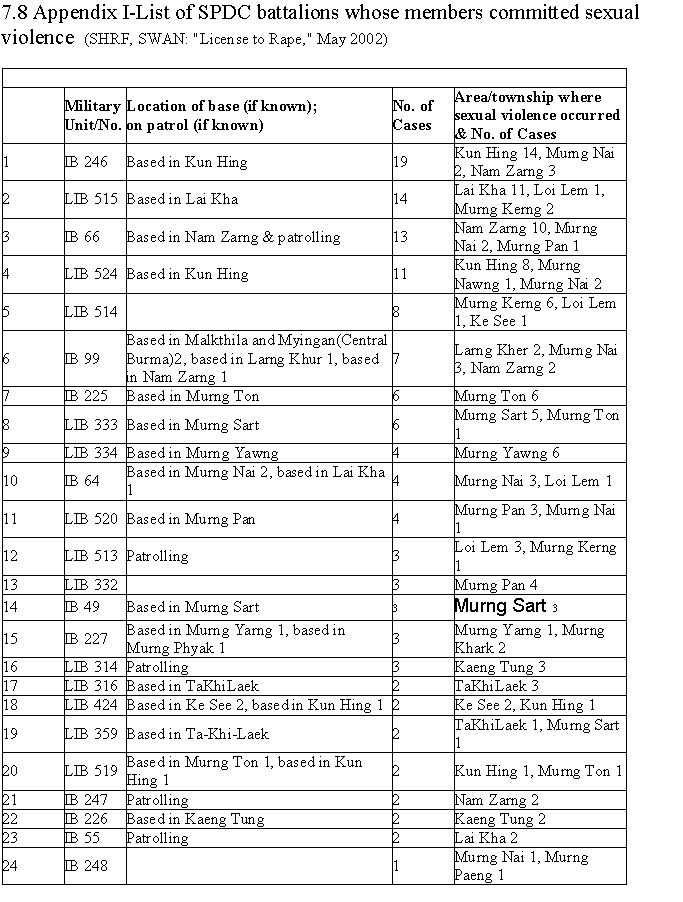
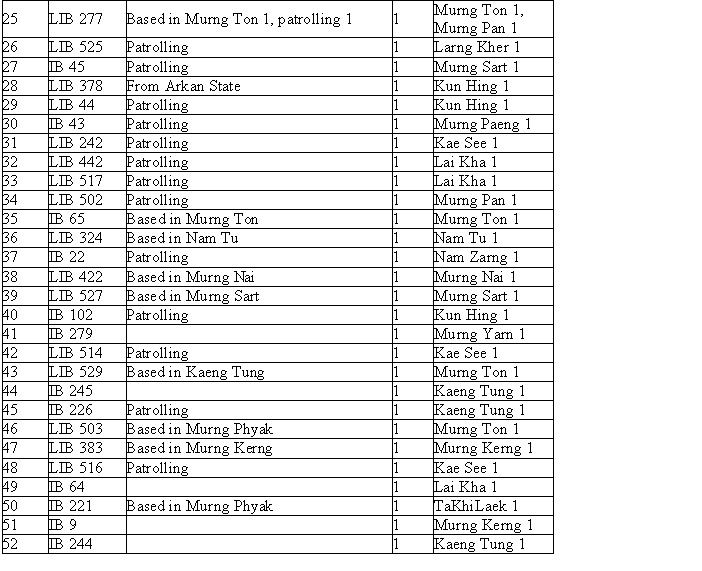
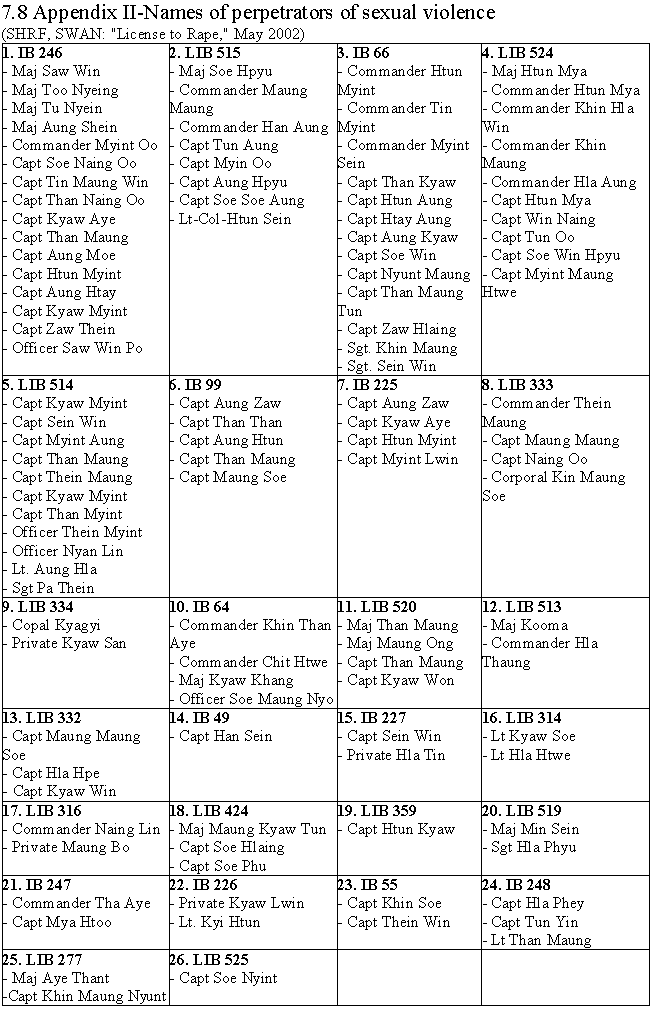
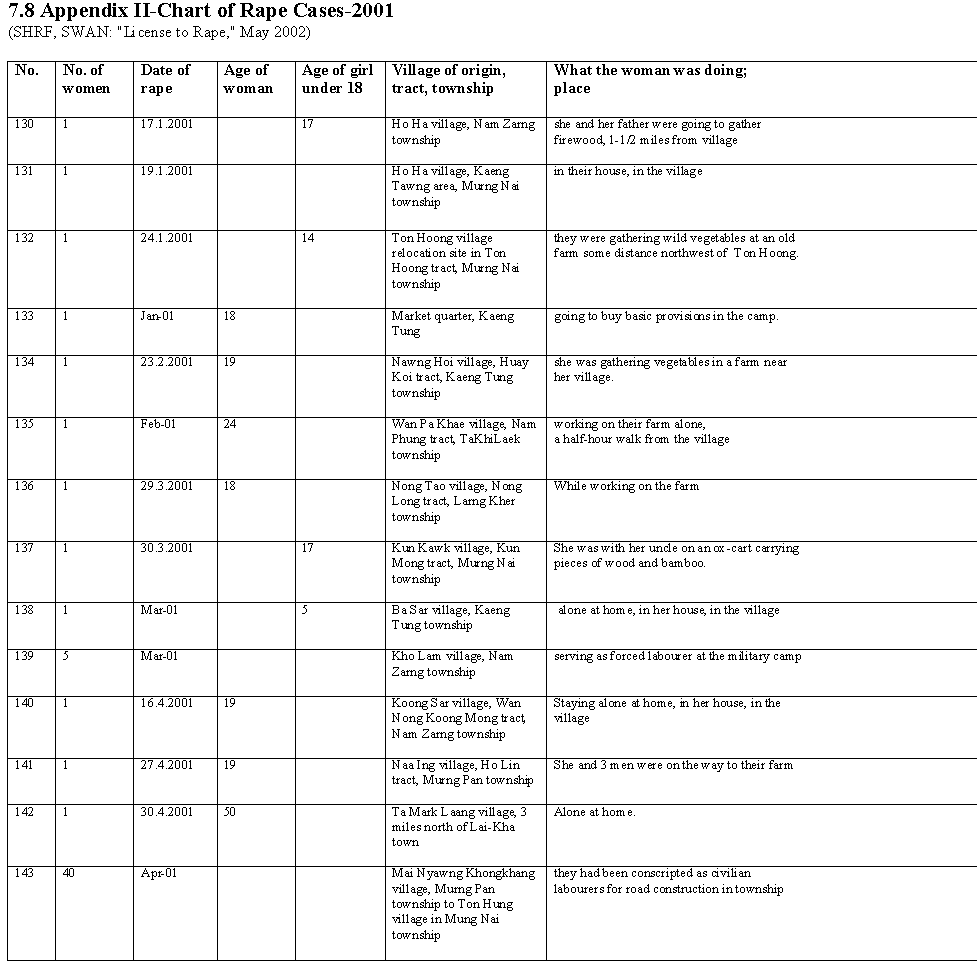
In May 2002 the Shan Human Rights Foundation (SHRF) and Shan Women’s Action Network (SWAN) released a report, “ License to Rape: The Burmese military regime’s use of sexual violence in the ongoing war in Shan State,” which documented 625 cases of Shan girls and women raped by SPDC soldiers between 1996 and 2001. The following excerpt from the report provides information about the victimization of Shan women. Thousands of other ethnic women suffer from a similar situation to that described below:
“In accordance with their subordinate status, women are expected to be demure in public, and, unlike men, chaste until marriage. Women who lose their virginity before marriage are described as “soom to” or “spoiled”, and any women engaging in sex outside marriage are liable to censure, even if the sexual encounter was forced upon them. Fear of censure within their own communities thus inhibits women from reporting incidents of rape.... Nevertheless, in the past, rural Shan women had recourse to customary legal processes to punish rapists. Cases would be brought before village elders, and if found guilty, men would be punished by a fine payable to the women, her parents and the village elders. Women also had the option of taking the cases to the township courts to be tried under the Burmese penal code (according to which the maximum penalty for rape is 10 years in prison.)... Therefore there was some measure of legal protection available to women in the case of sexual violence. However, this has now been eroded by the Burmese military’s contempt for the law. In numerous instances of rape in this report the Shan women survivors attempted to seek justice within their community, turning to their parents and the village headmen according to their custom, but were inevitably thwarted by the absolute power exercised by the Burmese military in their areas.
The context of the civil war has given Burmese troops licence to practice sexual violence against local ethnic women with impunity. As potential supporters of the resistance, women are perceived as legitimate targets for violence. Sexual violence serves the multiple purpose of not only terrorizing local communities into submission, but also flaunting the power of the dominant troops over the enemy’s women, and thereby humiliating and demoralizing resistance forces. Furthermore, it serves as a “reward” to troops for fighting in the war.....Ethnic factors have exacerbated the tendency to violence, as the military regime has deliberately deployed troops of other ethnicities in the various ethnic states. Alienation of the troops from the local communities, and Burmese nationalist sentiment fuelled by propaganda, facilitates violence, including sexual violence, against the local ethnic civilians.... The regime has continued to build up its army over the past decade, and has increased the number of troops deployed in the ethnic states, which has inevitably led to an increase in sexual violence....
In the vast majority of these cases (85%) the officer was on duty with other troops, and made no attempt to hide his crime. In fact, in 10 of the cases, the officer actually passed on the victim(s) to his troops either to let them gang-rape her, or to let them kill her....The extreme and unrestrained brutality displayed by the troops committing the sexual abuses reveal clearly that the rapes are being used together with other acts of violence, such as torture, as part of a campaign to terrorize and subjugate the local civilian populations. In 25% of the incidents documented, the girls or women were killed following the rape, by being shot, suffocated, beaten, stabbed or burned to death.... In many of the incidents documented, the women were not only raped, but were also physically tortured in other ways, including being beaten, suffocated by having plastic put over their head, and having their breasts cut off... In most of the incidents, there were no efforts made to conceal the bodies of the dead rape victims.... 61% of the rape incidents documented involved gang-rape. These incidents were thus committed collectively, with no fear of being witnessed. In many of the gang-rape cases, the victims were also killed by the troops. However, in a number of the cases, the women were released, showing that the perpetrators clearly had no fear of repercussions arising from the incident... In twenty-four of the cases, women were kept by the regime’s troops for periods of up to four months for the purposes of rape. Again this open use of “comfort women” without fear of reprisal indicates the climate of impunity regarding rape amongst the armed forces...
Evidence in this report shows clearly that not only are there no serious efforts on the part of the military authorities to bring perpetrators of rape among their ranks to justice, but they are actively discouraging the reporting of such incidents by inflicting physical abuse, imprisonment and fines on any complainants... In most of the rape incidents documented in this report, the victims reported the abuse first to a family member and then to a village headman or other community leader. Together they would then advise the girl or woman of the best action to take. Often (in 22 cases, 13%), the headman advised the family not to take the case any further as it would not only fail to bring justice, but might also be dangerous for the complainants. The fact that in one case a headman was himself beaten and tortured to death by SPDC troops for having reported a rape shows the disincentive for community leaders to get involved in such matters... Other factors discouraging girls and women from reporting rape incidents to the SPDC authorities were: they could not speak Burmese, which would clearly disadvantage them during any subsequent judicial proceedings; and they often did not know the name and the military unit of the rapist, and thus realised that they had almost no chance of proving the case. However, in as many as 37 (21%) of the rape incidents documented, the victims, their relatives or community leaders actually dared to report the crime to the SPDC authorities. In only one of these cases (in April 1997) was the perpetrator, from the SPDC mortar battalion in Murng Hsat, punished by his commander... However, even in this case, it does not appear that the matter went through the process of law, and it is thus unlikely that the perpetrator would have been given the maximum 10-year jail sentence for the rape. In eleven cases, the SPDC officers registered the complaint, but did nothing further. In nine cases, the SPDC officers arranged for a “line-up” of as many as 80 soldiers in order for the victim to identify the rapist, but deliberately left the rapist out of the line. Following the lack of positive identification, in one case the headman who had made the complaint was beaten unconscious and detained until the family of the rape victim paid 2,000 kyat for his release. In two other cases, the victim herself was imprisoned and up to 20,000 kyat had to be paid for her release. In another case the headman and his deputy were imprisoned until 5,500 kyat could be paid for their release. In three other cases, the complainants were not imprisoned but had to pay fines of up to 30,000 kyat for defaming the military. Only in one case was there a positive identification from a line-up, which appears to have been the result of an intervention from an officer from one of the Shan cease-fire organisations. However, following the identification no further action was taken.
More commonly, the SPDC officers rejected the accusation outright. In three of these cases, the SPDC officers claimed that the perpetrator had not been in the area when the crime was committed, in one case stating that he had long been transferred. Significantly, in two of the cases, the officer accused was indeed immediately transferred to another unit... Out of the eleven cases when the SPDC officers rejected the accusation outright, in seven cases the complainants were punished for making the complaint. In three cases, the complainants were physically abused: the rape victim was beaten unconscious, the father of one victim was beaten, and a headman was slapped. In six cases, the complainants were actually fined, as much as 60,000 kyat, for making the complaint. In one case, the father of the victim was arrested and detained until village leaders paid a cow for his release.
In none of the cases documented for this report was there any mention of the SPDC authorities asking that the raped women be given proper medical examinations, which could be used as a basis for rape prosecution. This again indicates that they had no serious intention of bringing the perpetrators to justice.
There is information that in eleven of the cases, women themselves or their families arranged for medical treatment, either for injuries or illnesses arising from the rape, or to test blood for possible infection. In two of the cases, the hospital workers documented evidence of the sexual abuse, and in one case (of a 5-year-old girl who was raped in her home by an SPDC soldier), even took photographs and said they would try and report the incident. However, no further action was taken, and in one case, hospital workers who had treated a woman who had been beaten and raped, advised the woman to lie about the cause of her injury. In other words, the medical personnel themselves were too afraid of the military authorities to dare to push for justice in the case...
Although specific physical details are not available in most of the incidents in this report, in several of the cases it was clear that the survivor was severely injured during the assault. In several cases, survivors were unconscious when found after the incident, and in at least two cases, the survivor was unable to walk. One of the cases was a woman who was gang-raped when she was 7-months pregnant, and who then gave birth prematurely to her child...
There is a lack of detailed information concerning the mental state of the survivors, mostly because interviews conducted for this report were too brief to explore fully the depth of emotions experienced by the women involved... It is apparent that some of the physical symptoms suffered by survivors following the incidents, were closely linked to their mental state. For example, several women spoke of insomnia, loss of appetite, loss of weight, and lack of energy. Some women mentioned feeling “depressed,” “sad” and “afraid.” One woman stated: “When my mind wandered to what had happened, my heart would beat so hard. I was afraid of all men.” (case 1). Another woman “kept to herself after the incident. She didn’t want to see or communicate with anyone.” (case 119) Several of the survivors stated a strong desire to bring their rapists to justice. One mentioned feeling “angry” when justice was not done. At the same time, several of the survivors mentioned feeling “shame” at what had happened, undoubtedly a result of prevailing gender attitudes and censure within the community... In none of the incidents mentioned were any counselling services available for the survivors. From the little evidence available, it is clear that the survivors were in urgent need of such services, particularly those facing censure from their communities... The fact that one of the women repeatedly raped during a period of almost two months (case 51) became insane is an indication of the level of trauma experienced by women subjected to rape. Another woman became an opium addict following the rape (case 76), and abandoned her young child as a result.
In three of the incidents, the women suffered blame by their boyfriends or husbands following the rape. One of these women had her engagement broken off by her boyfriend, who refused to come and see her after the rape. Another woman was taunted by her husband, who called her “Burmese leftovers.” In a particularly disturbing case, a woman was beaten by her husband following the rape..In three of the incidents, the women suffered blame by their boyfriends or husbands following the rape. One of these women had her engagement broken off by her boyfriend, who refused to come and see her after the rape. Another woman was taunted by her husband, who called her “Burmese leftovers.” In a particularly disturbing case, a woman was beaten by her husband following the rape.” (SHRF, SWAN: “License to Rape,” May 2002)
In addition to the abuse they suffer from SPDC soldiers, women from Burma are also often victims of sexual violence while staying in Thailand where such incidents often tolerated. This is both because of negative attitudes and stereotypes about Burmese and because rapists feel certain of their impunity if they attack an undocumented migrant worker. See the partial list of incidents at the end of the chapter for more information on rape.
7.5 Trafficking of Women
“Trafficking in persons - the illegal and highly profitable recruitment, transport or sale of human beings for the purpose of exploiting their labor - is a slavery-like practice that must be eliminated.” Human Rights Watch
Many refugees, particularly from Shan State, Chin State and Sagaing Division are unable to enter refugee camps and therefore are restricted in their options for leaving the country. Seeking the help of agents and being trafficked, whether for sex work or other types of employment, such as factory work or domestic service is one option open to them. The greatest number of women are trafficked to Pakistan via Bangladesh and Thailand. In a best case scenario trafficked women are able to escape exploitative labor situations and enjoy greater self-determination than they would have by staying in Burma. In worst case scenarios they are sold into bonded labor situations where they are kept incommunicado in slavery like conditions. Age is an important factor in determining what kind of situation a trafficked person will face, with younger women and girls being more easily exploited. The continuing economic crisis in Burma combined with the lack of social welfare services and the strong sex industry in Thailand, as well as inside Burma, has left sex work as one of the only viable employment opportunities for women. It is estimated that there are more than 40,000 Burmese sex workers in Thailand alone. Sometimes women willingly go into this kind of work, but often don’t realize the conditions they will be working under or the risks to their health, while in other cases women and girls are sold by their families, or others, into prostitution. Once inside brothels, their bonded labor situation continues, with the women being forced to pay for mandatory HIV tests and abortions, and exorbitant living costs, thus ensuring that they remain in debt to the brothel owners. Brothels in Thailand are frequently raided, with some of these raids carried out with owner’s cooperation in order to further raise the women’s debts. In February 2001, 33 teenage girls were arrested in Thailand on charges of prostitution, with four of them admitting that they were from Burma. During these raids police frequently find women and girls tied up or chained to prevent them from trying to escape. (Source: Burmanet)
Individuals who traffic women and girls are often powerful and easily escape prosecution as a result of maintaining close ties with border police and other officials who profit from the trafficking. The complicity of officials allows the trade to continue and thrive and limits women’s access to other types of work as they are often passed from the trafficker directly into the hands of the brothel owner. Women who return home after working in the sex industry often face discrimination and can be prosecuted for illegal departure and prostitution with sentences of up to three years. To combat the migration of women for sex work the SPDC enacted laws to restrict the movement of women who want to travel both domestically and internationally. A law initiated in 1995-6 prohibits women from obtaining a passport that allows them to work abroad and for travel within the country, women between 16 and 25 must be accompanied by a legal guardian. However, rather than curtailing trafficking, this has just put women in a more vulnerable position where they are more dependent on traffickers for their movement.
Sex workers in Burma
In August 2001 the WHO produced a report including Burma in the list of Asian countries where a growing sex industry severely inhibits the work of HIV/AIDS prevention programs. According to UNAIDS statistics, up to 95% of people in developing countries with HIV/AIDS are unaware that they are infected. In Burma most women involved in sex work do so on a part-time basis to supplement their primary work as traders, laborers, and transport service workers in roadside teashops. Due to the fact that many of these women do not identify themselves as sex-workers, and because of their high mobility, establishing HIV/AIDS support and awareness programs for sex workers in Burma has been difficult. Female sex workers in Burma are concentrated in cities such as Rangoon, Pegu, Prome, Magway, Mandalay, Monywa, Lashio, Pa-an, Tavoy, and Mergui; or else along trade routes or international border towns such as Tachilek, Muse, Mong La, Keng Tung, Myawaddy, Kawthaung, or Tamu.
In many cases women are forced into the sex industry, and significant physical and sexual abuse is used in order to ‘break them in.’ Such violent sexual acts can result in abrasions increasing a women’s susceptibility to contracting HIV. A practice gaining in popularity is the selling of young girls as ‘virgins.’ These girls face increased risk for infection due to the immaturity of their cervix. Most girls and women engaged as sex workers feel that they are unable to insist that customers use a condom, and thus it believed that most commercial sex in Burma, and the rest of Asia, occurs without a condom.
There are many obstacles to empowering and educating all women in Burma about sex-issues. Cultural taboos limit open discussion about any kind of sexual activity, and there is a tendency for many people to view sex in general as immoral. There is also a huge stigma against people with HIV, and many women who are infected feel that they cannot return to their communities. (Source: ALTSEAN)
Trafficking of Rohingya women to Pakistan
A report by Images Asia states that large scale trafficking of Rohingya refugees from Bangladesh via India to Pakistan has been going on for about a decade and the number of Rohingyas in Karachi is estimated to be over 300,000. Exoduses of Rohingya refugees from Burma in 1978 and 1991/2 have coincided with influxes of immigrants into Pakistan. The refugee camps in Bangladesh have become recruiting areas for traffickers and a Bangladeshi NGO found that there have also been various cases of disappearances, abductions, rape and sexual assault of women living outside the camps. Many women are trafficked into brothels in the southern province of Sindh and some have been sold to feudal landlords as concubines. Rohingya prostitutes are extremely likely to contract sexually transmitted diseases because they have little knowledge of contraception and are afraid to visit health authorities for fear of being caught by the police. The Rohingya in Bangladesh are unwanted refugees and face the threat of repatriation and deportation to Burma where they are deprived of citizenship and face atrocities committed by the military junta. This and the conditions of the refugee camps where they are unable to meet their most basic needs means that being trafficked is often the only option for survival. During the journey to Pakistan the women are vulnerable to sexual and physical abuse whether it be from traffickers, police, border guards or while in detention. The Dhaka Ahsania Mission, a Bangladeshi NGO, reported one case to Images Asia in 1998 in which a bus carrying 71 passengers, mostly women and children, was intercepted on its way from Cox’s Bazaar to Benpole on the Indian border, after the bus driver got suspicious. It was found that all the passengers were going to be trafficked illegally to India, and after the passengers gave fake addresses in Cox’s Bazaar to the police, it was assumed that they were all Rohingya.
Not only Rohingya women are trafficked into Pakistan. There is large scale trafficking of women of other ethnic groups from Burma into Pakistan on the pretense of finding them legitimate work. However, they are then sold to third parties, mostly for prostitution, but also as domestic servants. In some cases they are sold like slaves in an open market, such as the one in Thar district of Bangladesh, in which buyers are able to examine them, molest them and harass them before buying them. At least one former minister and two members of the disbanded parliament maintain huge stakes in the business of selling women in Thar. They are often sold and resold after their utility has been used up by one buyer. Human rights lawyer Zia Awan, says women can be bought in any Burmese slum in Karachi where 2.5 million of the residents are illegal.
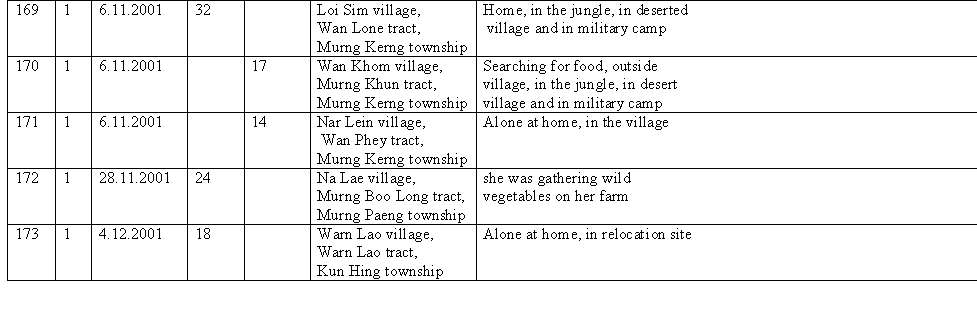
7.6 Rape and sexual violence - Partial list of incidents
Incidences of Rape and Killing
Rape and Killing in Mergui
On 11 January 2001 a column from LIB 101, led by Major Aung Myint Oo arrived to Taket Lor village in Tenasserim township, Mergui District, Tenasserim Division, Southern Burma, and opened fire on village residents. Four villagers: Saw Ta Pu (male 45 yr.), Naw Nyunt Lay (Female 28 yr.) Naw De Hse (F 22 yr.) and Naw Lay Myit (F 25 yr.) were wounded. After shooting at the villagers the troop captured a villager Naw They Satin, age 20 yr. daughter of Saw Pe Lo and Naw Pi. The soldiers took her to a house, raped her, and then stabbed her to death. The next day, that troops cleared the area and took all everything that the villagers left behind them when they fled. (Source: Unity)
Rape and Murder in Laikha Township
On 14 February 2001 Captain Kyaw Myint, Company 4, LIB 515 (Laikha) raped and murdered Nang Liengsa, 18, from Wan-khai village, Panghsang Tract, Laikha Township, Shan State, in the woods outside the town. Her body was found two days later after a soldier from the unit tipped off her relatives. ”The captain, during his patrol on that day, came across her picking vegetables in the woods, forced her and beat her to death because of her resistance,” one villager quoted the soldier as saying. A few days after the incident, Captain Kyaw Myint and his men passed through the village and he was pointed out to her brother, Sai Mon, and sister-in-law, Nang Lu. One of the members of the patrol then overheard them talking about Liengsa’s death in connection with Capt Kyaw Myint and he took them to him. Captain Kyaw Myint then beat them and sentenced them to a 3-month imprisonment. Liengsa was one of those thousands of people who were forcibly moved to Laikha from her home village in 1997, when the massive 4 cuts campaign was launched by Rangoon against the Shan State Army of Yawdserk. (Source: SHRF)
Farmers Beaten to Death, Women Raped and Killed
On 11 July 2001, 5 rice farmers, 3 men and 2 women, were beaten to death by a patrol of SPDC troops from IB 247, led by Capt. Mya Htoo, on a rice farm about 3 miles southwest of Wan Phui village in Kho Lam tract, Nam-Zarng township. The women were raped before they were killed. On July 7, troops from IB247 had found several fresh footprints close by the rice farm and they suspected that the farmers were providing rice for the Shan soldiers. Upon finding out that the farmers lived in Wan Phui village, the commander of IB247 sent an order to the village headman of Wan Phui to bring the 5 farmers to the military camp at Kho Lam where they were interrogated and later released. However, when they returned to the farm on July 11, they were arrested by SPDC troops from IB247. The 3 men were tied up and interrogated, tortured and beaten to death. The 2 women were taken into the farm hut and gang-raped by the SPDC soldiers, and finally beaten to death in the hut. (Source: SHRF)
The five victims were:
1. Lung Kan Na (m) Age 51
2. Zaai Wi-La-Sa (m) Age 43
3. Naang Seng (f) Age 30
4. Naang Maai (f) Age 24
5. Zaai Kaw (m) Age 21
Woman Raped and Killed while Traveling
On 3 August 2001 at 3:00 pm, a young woman, Naw Moo Kler, age 20, was raped and killed by a group of soldiers from SPDC troop IB-124, based in Ba Yint Naung Ta Myo (Ba Yint Noung Military town), led by the battalion commander Thu Ra Saw Mya Thoung. The soldiers attacked Naw Moo Kler while she was traveling between Than Doung Gyi and Kyauk Kone, section (5), Than Daung Township. Naw Moo Kler was a teacher who lived in Than Doung town, section (2). Her father’s name is Saw Khin Maung. The soldiers also took from the victim 1 gold necklace, 1 gold ring and 1 watch valued at 100,000 kyats. (Source: KORD, KIC)
Incidences of Rape
Woman Gang Raped for Four Days
Name: Naang Yin (not her real name)
Age: 18
Status: Single
Ethnicity: Shan
Religion: Buddhist
Occupation: Shopkeeper, High School Student
Location: Market quarter, Kaeng Tawng town, Murng Nai township S IB 246,
PDC Troops: Kun-Hing-based, Commander Myint Oo, Officer San Win Po
Date of Incident: January, 2001
Naang Yin was the 18-year-old daughter of two shopkeepers, Lung Tha and Pa Khong. Lung Tha and Pa Khong sold dry foods in their shop, such as oil, beans, seeds, and rice. Naang Yin studied at the high school in Kaeng Tawng town, and so she spoke Burmese in addition to Shan. SPDC troops from the local military camp regularly came to the shop to sell staples they got from the military camp, and to supplement their basic provisions. The troops from IB 246, including officer San Win Po, invited Naang Yin to come to the camp to buy some basic provisions at cheaper prices.
Naang Yin went to the camp for the first time alone in January, 2001. She arrived to find that many of the commanders, captains and soldiers were away from the camp, patrolling the surrounding area. But there were still a few soldiers at the camp, including officer San Win Po. Coming into the camp alone, she was taken by officer San Win Po and ten other soldiers. They held her prisoner and gang raped her for four days. Her parents searched everywhere for her, until, finally she was released on the fourth day. She reported the incident to the village headman, and received a medical check-up from a relative who was a nurse.
The village headman, worried for her safety, told her, ‘If you have a place to go, you should go. If you have a place to move, you should move. You shouldn’t face those soldiers again.” And so Naang Yin stayed on the move, spending each night at a different relative’s house. Her parents were anxious about her security, but they didn’t dare complain to the military for fear of repercussions. Ten days after her release, Naang Yin’s mother took her to Thailand. The people in village were angry and blamed the soldiers for what had happened. When the village headman counseled the young girls in the village, many of them would talk about what happened to Naang Yin. (SHRF, SWAN: “License to Rape,” May 2002)
Woman Raped While Traveling
On 28 January 2001, Lieutenant Thein Myint Zaw from IB 104 raped a traveling villager and took away all her money . According to villagers from Tavoy Township who arrived to the border, Ma Aye Aye Khaing (daughter of U Chit Tin) who worked in a Thai border town Htong Hpa Hpon was traveling back to her home village in Kyet San Pyin, in Tavoy Township, when on the evening of January 28 she arrived at a Burmese Army camp at the Thuka border check point, opposite Thailand’s Kanchanaburi province. Lt. Thein Mhint Zaw a company commander in that camp summoned her to his hut and said that he needed to search her. Afterward Lt. Thein Myint Zaw raped her in his hut. After raping her, Lt. Thein Myint Zaw stole 10,000 Baht from her. The next morning Thein Myint Zaw gave her back 1,000 Baht for her traveling expenses and then released her. (Source: Unity)
Gang Rape in Wan Pa Khae Village
Name: Ar Phue (not her real name)
Age: 24
Status: Widowed 2 years ago, married at 14, mother of 3- year-old son
Ethnicity: Akha
Religion: Christian
Occupation: Farmer
Location: Wan Pa Khae village, Nam Phung tract, Ta-Khi-Laek township
Date of Incident: February, 2001
SPDC Troops: LIB 359, Ta Khi Laek township
Note: When Me Lue was 10 years old, she had lost partial use of her leg due to an illness. As a result, she cannot walk very well.
Two years prior to being raped, Ar Phue’s husband, 30-year-old Ah Kho, had been beaten to death by SPDC soldiers. He had been taken to be a porter for their troops, and Ar Phue did not know exactly where her husband had died, nor the identification number of the battalion that had killed him. Nevertheless, she was left to work on their farm alone, a half-hour walk from the village. In February, 2001, seven soldiers from LIB 359 base in Ta-Khi-Laek approached her and threatened to shoot her with their guns. Not able to speak Burmese, she couldn’t understand what the soldiers were saying, and could not run away on her bad leg. The soldiers proceeded to gang rape her for an hour. A villager, hearing her screams, ran over to help. Upon seeing the villager, the soldiers stopped their attack, and left the scene.
Ar Phue reported the incident to the village headman. Luckily, she did not get ill, but at the time of the interview, she was three months pregnant. Fighting between the Shan army and the Burmese army broke out two days after the rape, preventing Ar Phue from seeking medical attention. Her village is close to the Burmese camp, and she could hear bombs and shelling near by. She was forced to relocate, with her child and relatives, to further inside Shan State away from the border with Thailand. She stayed there for 4-5 days before moving to an IDP settlement on the border. She traveled to the camp with her neighbor’s family, as her parents did not live in the same village.
On days it did not rain, Ar Phue left the camp to work on a tea plantation. She left earlier than the others, because her bad leg forced her to walk slowly and she wanted to get there early enough to get work. She received 3 baht for every kilogram of tea leaves she picked, and one day she earned as much as 30-40 baht for her work. At the time of the interview, there were so many people looking for jobs, that there were days when there was no work for Ar Phue to do.
Knowing she was pregnant, her neighbor’s family urged her to find a husband. “If other people knew that I was pregnant with a Burmese baby,” Ar Phue said, “who will like that?” She didn’t want to marry a soldier, for fear of having to either worry about his safety, or endangering herself or her child by accompanying him on his forays into the jungle. “I know that we’ll have a difficult time, but I don’t want my child to have a step-father,” she said. “Some men love only women, but not their children. If I get married it will be difficult to get a divorce.” Added to her difficulties, Ar Phue was not educated and spoke limited Shan. “I don’t know how to deal with the incident,” she said. After her husband died, Ar Phue had decided not to go to live with her parents. Her father had died due to illness around the same time as the attack. Her mother visited her at the camp and stayed to marry a Shan villager there. The village she had left, which was so close to the Burmese army camp, often fell prey to the Burmese soldiers when fighting broke out. The troops regularly forced villagers to be porters for the army, and looted village houses for livestock, food and household items. Although she didn’t know exact details, Ar Phue believed that other women in her village had also been raped by Burmese soldiers. (SHRF, SWAN: “License to Rape,” May 2002)
Lahu Woman Raped in Kaeng-Tung
On 23 February 2001, a 19-year-old Lahu woman, A-juay (not her real name) was raped by an SPDC soldier, Lt. Kyi Htun, from IB226 at a farm in Nawng Hoi village, Huay Koi tract, Kaeng-Tung township, Shan State. He arrived at her farm with 20 soldiers, but after discovering her alone, he ordered them to go ahead of him to Maak Khaam Bawm, the next village. He then ordered her into her hut at gunpoint and raped her before leaving for Maak Khaam Bawm. A-juay and her father, A Nu, reported the incident to the village headman and the next day they lodged a complaint at the SPDC township office in Kaeng-Tung. However, no action was taken against Lt. Kyi Htun. (Source: SHRF)
5-year old Girl Raped
Name: Naang Mie (not her real name)
Age: 5
Status: single
Ethnicity: Shan
Religion: Buddhist
Occupation: N/A
Location: Ba Sar village, Kaeng Tawng, Murng Nai township
Date: March, 2001
SPDC Troops: IB 99, Mitthela and Myinchan-based from Central Burma, new camp in Ba Sar Village.
Naang Mie lived with her parents, Lung Lao and Pa Kham Sar in Ba Sar village. In March 2001, when Naang Mie was five years old, her parents went to work on their farm, leaving Naang Mie with her twelve-year-old sister. That night, her elder sister went out to a movie. The movie finished at 9 p.m., and their house was far away from the other houses in the village. So Naang Mie was left alone.
At 7 o’clock, an SPDC soldier from IB 99 came into the house. He tied up Naang Mie’s hands and legs with rope, and raped her. When her sister came home from the movies, she found Naang Mie there, tied up and crying, with her sexual organs bloody. There was no one else around. Naang Mie was too afraid to tell her sister what had happened, because the soldier had threatened to kill her if she complained to anybody. A neighbor came and took Naang Mie to the hospital that night. She summoned the courage to tell a doctor what had happened, and a nurse stitched up her ripped vagina. They gave her medicine and took photographs for their records. The doctor and nurses told the girls that they would try to report the incident. Naang Mie’s parents complained to the village headman, but they were too afraid to go to the military with their grievance. They were afraid for their children’s safety, and because they were often away from their house all day, they worried that the military might loot and destroy their home. Many of the villagers blamed the parents for the incident, believing that if the parents had not been away, Naang Mie would not have been raped. (SHRF, SWAN: “License to Rape,” May 2002)
Woman raped in Mergui-Tavoy District
On 4 March 2001, troops led by Major Htein Win, under SPDC Local Tactical Command 19, came to Wan-chaung village from Pa-law Township of Tavoy District, Tenasserim Divison, to arrest U Maung Ni. U Maung Ni was not at his home, so they took his wife and raped her. (Source: KIC)
Robbery and Rape of Travelers by the SPDC
On 20 March 2001 at about 8:00 am, approximately 20 ethnic Burmese travelers coming from Pin-si village, Taung-pa-pu township, Kanchanaburi district in Thailand, arrived at Thu-kha border camp. The travelers were originally from Aok-tu village, Ka-sit village, and Chaung-wa-pyi village, Tha-yet-chaung township in Tavoy district. When they arrived at Thu-kha camp, IB 104 column (2) commander Khin Maung Htway, collected 200 baht from each of these travelers for crossing the border and sent seven soldiers from their group to accompany the travelers, stating that this was necessary for security reasons. These seven soldiers from IB 104, left Thu-kha border camp with the 20 travelers and when they had traveled 3 miles to the base of Thu-kha mountain, they lied to the travelers saying it was not safe to travel further because the security situation was bad, and made them stop. Then the soldiers started searching the bodies of the travelers and taking all of their valuables, including gold jewelry, money, radios, cassettes, clothes and Thai and Burmese currency. Then they took one of the travelers, an 18 year old woman from Aok-tu village, to the forest for about 30 minutes where she was raped by the 7 security force members, one by one, and then released. In a few short hours the travelers had lost all the money and household goods that they had earned during the two years they worked in Thailand. Continuing on their way, they encountered the SPDC IB 25 column and again were inspected and questioned. The travelers were afraid to tell the truth about what had happened to them. (Source: ABSDF)
Woman Raped in Nong Tao Village
Name: Naang Shwe (not her real name)
Age: 18, youngest daughter
Status: Single
Ethnicity: Shan
Religion: Buddhist
Occupation: 4th Standard Student in primary school, Farmer
Location: Nong Tao village, Nong Long tract, Larng Kher township
Date of Incident: 29-3-2001
SPDC Troops: Co. 4, LIB 525, Captain Soe Nyint
Eighteen-year-old Naang Shwe went out to her family farm to look after their cows. At that time, SPDC troops from Co. 4 of LIB 525 led by Capt. Soe Nyint were patrolling the area and noticed Naang Shwe staying at the farm. The Captain called her to him, and when she approached he grabbed her and raped her. She cried and shouted, but he didn’t release her until he had finished. She told her relatives what had happened, and her uncle, Lung Aue Zay Ya, went to complain to the village headman and village elder. A Shan police captain told Lung Aue Zay Ya not to bother reporting the incident because he expected that the villagers would lose the case, and that there would be no consequences for Capt. Soe Nyint. After the rape, Naang Shwe felt ashamed, angry and sad. Eventually, she traveled across the border to Thailand. (SHRF, SWAN: “License to Rape,” May 2002)
Rape in Tenasserim Division
On 30 March 2001, Sergant Ba Sein and one of his soldiers repeatedly raped Ma Khin San Ye, age 21 and Ma Nway Nway, age 16 from Ta Byay Chaung village, Tenasserim Division. The soldier were from LIB 401 led by Cap Thurein Thant Zin. (Source: THRF)
Attempted Rape of 12-year old Girl
Name: Naang Tong (not her real name)
Age: 12
Status: Single
Ethnicity: Shan
Religion: Buddhist
Occupation: Farmer
Location: en route to Ton Hoong village from temple in Ba Sar village, Kaeng Tawng, Murng Nai township
Date of Incident: April, 2001
SPDC Troops: IB 99, Mitthela and Myinchan-based from central Burma, new branch in Kaeng Tawng, Murng Nai township.
Twelve-year-old Naang Tong lived with her parents, Lung Malar and Pa Ong, in Ton Hoong village. She had had trouble with her eyes since she was a baby, and could not see very well. In April, 2001, the villagers from Ton Hoong went to worship at the temple in Ba Sar village, Kaeng Tawng, Murng Nai township. On her way to the temple, she walked with the elders of her village. On the way back, however, Naang Tong walked alone with a friend. An SPDC soldier, from IB 99, saw the two girls, grabbed Naang Tong and tried to rape her. Her friend was afraid and ran away, but Naang Tong could not run far because of her poor eyesight. She struggled away from the soldier, but tripped and fell on the ground in the dirt road. The soldier grabbed her and tried again to rape her. At that moment, a woman riding a bicycle from Ton Hoong to Ba Sar village passed by and saw what was happening. When the soldier saw the woman watching him, he released Naang Tong.
Though the soldier didn’t have a chance to rape Naang Tong, her face was bruised and scarred from the blows he had inflicted, and her body was sore. She reported the incident to the village headman, and a villager took her to Kaeng Tawng hospital for medical treatment. A doctor and several nurses took photographs of her injuries to keep on record.
The family and village headman did not complain to the military, for fear of repercussions. Others had been raped in the past, and when they went to complain they were forced to pay a fine of ten chickens and one bucket of oil to the military. Many of the villagers blamed Naang Tong for the incident, claiming that she had been foolish to return to Ton Hoong without the elders. (SHRF, SWAN: “License to Rape,” May 2002)
Rape in Koong Sar Village
Name: Naang Mya (not her real name)
Age: 19
Status: Single
Ethnicity: Shan
Religion: Buddhist
Occupation: Farmer
Location: Koong Sar village, Nar Kharn tract, Murng Nai township
Date of Incident: 16-4-2001
SPDC Troops: Co. 3, LIB 248, Captain Hla Phey
On April 16, 2001, 19 year old Naang Mya was alone at home, in an area regularly patrolled by SPDC troops from Co. 3, LIB 248. When Captain Hla Phey, the commander of the patrol unit saw that Naang Mya was alone, he approached her and said, “ One of the soldiers from my battalion is lost. He might be hiding in your house.” Claiming that he needed to search the house, he entered and ordered Naang Mya to come with him. He directed her into the bedroom, where he raped her. After the rape, he ripped Naang Mya’s gold necklace off her neck and took it with him. Her gold necklace weighed 1 baht and was worth 5000 Thai Baht. Ashamed, and fearful of retaliation by the Burmese soldiers, Naang Mya did not complain to the authorities. She kept to herself, lost weight and eventually fell ill, becoming severely jaundiced. Though her relatives supported and took care of her, her fiance, 21 year old Zaai Moon, would not come to see her. As a result of the rape, they broke off their engagement. (SHRF, SWAN: “License to Rape,” May 2002)
Mother and Daughter Raped
On 19 April 2001, two soldiers (one nicknamed ‘Ka Lar’) repeatedly raped Ma Than Hla, age 36 and her daughter Myint Myint Htway, age 13. The victims complained to the military officials but no action was taken against these two soldiers. (Source: THRF)
Rape in Nong Kor Village
Name: Naang Nyunt (not her real name)
Age: 18
Status: Single
Ethnicity: Shan
Religion: Buddhist
Occupation: Farmer
Location: Nong Kor village, Wan Zad tract, Ke See township
Date of Incident: 1-5-2001
SPDC Troops: Co.5 of LIB 424, Captain Soe Phu
Naang Nyunt, an 18-year-old woman from Nong Kor village, Wan
Zad tract, Ke See township, Shan State was attacked and raped in her house by
Captain Soe Phue on 1.5.2001. After the incident, Naang Nyunt’s father
complained to the village headman, Lung Tun Hla. Together they reported the rape
to Captain Thung Zaw, commander of LIB 424 based in Ke See township. As there
were no eyewitnesses, other than Naang Nyunt herself, the commander said he
could do nothing.
(SHRF, SWAN: “License to Rape,” May 2002)
Lahu Woman Raped in Murng-Ton
On 4 May 2001, a villager from Naa Kawng Mu village in Murng-Ton township, Shan State, was raped in her home by SPDC Capt. Thaung Sein, Commander of No.4 Company from Murng-Phyak-based LIB503. The troops were returning from an attempt to recapture Pa Khee camp, which had been seized by Shan resistance, when Capt. Thaung Sein entered a house where a young Lahu woman was staying alone. Nakhaa (not her real name), age 18, is the wife of Zaai Kaw (not his real name), aged 24, a Shan man who was out on security duty at the time. When he arrived at her house, Thaung Sein ordered Nakhaa to go into the bedroom. When she shouted in protest, he slapped her, dragged her into the bedroom and raped her, threatening to shoot her with his pistol if she did not comply. Villagers heard the shouting but no one dared come near the house. Soon after the incident, the SPDC troops left Naa Kawng Mu village. (Source: SHRF)
Woman Fined After Being Raped
Name: Naang Phong (not her real name)
Age: 21
Status: Married
Ethnicity: Shan
Religion: Buddhist
Occupation: Farmer
Location: Nam Kat village, Nar Boi tract, Nam Zarng township. Nam Kat was relocated to Nam Zarng town on 11-3-1997.
Date of Incident: 18-5-2001
SPDC Troops: IB 66, Captain Than Maung Tun
On May 18th, 2001, local camp commander, Captain Than Maung Tun, ordered fifteen women from Nam Kat village, Shan State to come to the military camp to clean the camp’s guardhouse. The fifteen women entered the camp, and Captain Than Maung assigned fourteen women to clean the bedrooms of the other captains, while ordering Naang Phong to clean his room. As Naang Phong entered the room to begin cleaning, Captain Than Maung followed her, closing the door behind him. He grabbed at her, and she screamed “The Captain is raping me!” He slapped her mouth with his hand, and raped her. When she got home, she told her husband, Zaai Pan Ti, what had happened. He reported the incident to the village headman, Lung Au Li Ya, who in turn took Naang Phong and her husband to see the Captain. Naang Phong accused the Captain saying, “Yesterday, you raped me in your room.” In response, Captain Than Maung replied, “If I raped you, why didn’t you tell anyone, or call for help? If I raped you, why didn’t the other fourteen women who came with you see or hear any noise or sign of a struggle?” Turning to the other fourteen women, the Captain asked, “Did anybody here see me rape this woman? If so, raise your hand.” No one raised her hand, because no one had seen the rape with her own eyes. They had only seen the Captain take Naang Phong into his room. Upon that, the Captain fined Naang Phong 15,000 Kyat for causing him to “lose face.”
After the incident, Naang Phong felt sad, ashamed and afraid. She was lethargic and had no appetite. Her husband and relatives understood and supported her, and she and her husband continue to live together. Two to three months after the incident, Naang Phong and her husband came to live in Thailand. (SHRF, SWAN: “License to Rape,” May 2002)
Gang Rape in Murng-Ton
On 8 June 2001, a resident of Naa Kawng Mu village in Murng-Ton township, Shan State, was gang-raped at her house by SPDC troops from Co. No.4 of LIB333, led by Capt. Win Zaw. At about 10 pm, Capt. Win Zaw and 5 of his soldiers went to inspect all of the houses in the village for unreported guests. When they came to the house of Naang Seng Num (not her real name), whose husband had been conscripted to provide forced labour at the local military camp, the troops saw her alone and Capt. Win Zaw raped her, threatening her with his pistol, while the other soldiers stood guard around the house. When he had finished raping her, Capt. Win Zaw let the 5 other soldiers into the house and they gang-raped her. When her husband returned from his forced labour duty, he and Naang Seng Num both went to report the rape to the village elders and community leaders, and they all went to lodge a complaint with the SPDC local military camp commander, Captain Myint Lwin, Commander of Co. No.4 of IB65. Captain Myint Lwin listened to the case and said that he would report it to the superiors of the soldiers responsible. But so far no action has been taken. (Source: SHRF)
62 Year Old Woman Raped in Murng-Ton
On 7 June 2001, a 62-year-old woman from Paang Ken village in Pha Khe village tract, Murng-Ton township, Shan State, was raped at her house by Capt. Htun Myint, commander of Co. No.4 of IB225. The SPDC troops were on their way to relieve the troops from IB65 stationed in Loi Laang and Murng Yawn areas, when they stopped at the village for a rest. Capt. Htun Myint chose a house to spend the night in, and told his troops to find some food for dinner and stay where they liked. The house he entered belonged to Zaai Pan-Ta (not his real name), aged 36, and his family, but they had all gone to work overnight at their rice farm, leaving only their 62-year-old widowed mother, Me Thao Mung (not her real name), to look after the house. Once in the house, Captain Htun Myint raped Me Thao Mung and when she tried to shout he closed her mouth firmly with one of his hands until he finished raping her. Me Thao Mung did not dare to tell anyone until the troops left the village. (Source: SHRF)
Women Raped in Po Kheh Hta Village
On 14 June 2001, Than Win a soldier from SPDC division 33, tactical strategy command No. (332), LIB-111, entered the house of Naw Thain Mya, in Po Kheh Hta village, Karen State, and raped her. Naw Thain Mya is 51 years old and married, her husband’s name is Saw Kyaw Tint. Naw Thain Mya reported the rape to the village headman, and the headman reported it to the battalion commander Aung Min Lwin. Then Aung Min Lwin forced Naw Thain Mya to accept 50000 kyat to drop her case and to keep quiet about what had been done to her. Aung Min Lwin threatened Naw Thain Mya, saying that if she continued pressing her case, she would be in trouble. (Source: KORD)
Mass Forced Portering and Rape in Murng-Kerng
In mid-June 2001, SPDC troops from LIB514, led by Capt. Thein
Maung, forcibly conscripted 250 civilian porters, including 108 women and
children, some as young as 8, from a relocation site in the outskirts of
Murng-Kerng town. They were conscripted on the orders of battalion commander,
Lt. Col. Hla Myint, on June 13, after an armed clash between SPDC troops and
Shan resistance soldiers in Murng-Kerng township. The SPDC troops took all the
adult men, and took women and children from houses where men were not available.
Many of those taken were aged between 8 to 16, and were forced to carry
ammunition, rice and other foodstuffs, and military supplies. Some children were
forced to carry 6 cans of condensed milk each, some carried rice and others
carried 10 rounds of m79 mortar shells each, and were kicked and beaten when
they could not go fast enough. The porters were forced to serve the military
without pay for 16 days, during which all the women porters above 15 years of
age were said to have been raped by the SPDC soldiers. They were released on
June 28 but, 5 days later, the same SPDC troops ordered the village headmen in
the area to provide 10-15 civilian porters from each village, either men or
women. The 150 porters were displaced persons who had been forcibly relocated to
the outskirts of Murng-Kerng town 4-5 years ago by the SLORC troops.
(Source: SHRF)
Woman Raped for Five Hours
Name: Naang Ang (not her real name)
Age: 27
Status: Married, no children
Ethnicity: Shan
Religion: Buddhist
Occupation: Farmer
Location: Ter Hong village, Nong Hee tract, Murng Nai township. Ter Hong was relocated to Ton Hoong on 11-4-1996.
Date of Incident: 4-7-2001
SPDC Troops: Co. 3, LIB 524, Capt. Tun Oo, Kun Hing town-based
On June 29, 2001, as SPDC troops were patrolling the area around the Ton Hoong relocation site, Shan State, Captain Tun Oo noticed Naang Ang in the village. The Captain then ordered 30 troops, led by Captain Tan Aung, to patrol the area. A few days later, the captain ordered Lung Min, the village headman, to bring Naang Ang’s husband, Zaai Maung Hla, to him. When Zaai Maung Hla arrived, the Captain said, “Today, I want you to serve as a guide for my troops for two days. Go pack your things and come back and wait here.” Zaai Maung Hla could not protest, and had to do as he was ordered.
On July 4th, Zaai Maung Hla was still away from home. Knowing her husband was away, Captain Tun Oo went to see Naang Ang, and without any questions, walked right into the house. “What do you have in your bedroom? Let’s go and see.” “Captain,” Naang Ang said, “go and see by yourself.” At that, the Captain said, “You will go inside with me.” He pulled out his pistol, aimed it at her forehead, and threatening her, he dragged her into the bedroom and raped her. He raped her for five hours, from 10 in the morning until 3 in the afternoon.
When Zaai Maung Hla came home, Naang Ang told him all that had happened. Her husband reported the incident to the village headman and a village elder. Upon hearing what happened, they said. ‘The only eyewitness is Naang Ang. Though we want to report the incident, it is your word against his. We will not be able to win.” They decided not to complain to the military.
At times, her husband called Naang Ang “Burmese leftovers.” But family members from both sides intervened and talked through what had happened, making it clear that Naang Ang had not chosen to have sex with the Captain, but rather had been raped at gun point. In August 2001, she and her husband came to Thailand. (SHRF, SWAN: “License to Rape,” May 2002)
16-Year old Girl Raped
Name: Naang Aye (not her real name)
Age: 16
Status: Single
Ethnicity: Shan
Religion: Buddhist
Occupation: Farmer
Location: Koong Sar village, Wan Nong-Koong Mong tract, Nam Zarng township
Date of Incident: 16-7-2001
SPDC Troops: Co. 2, IB 66 Nam Zarng-based, Captain Zaw Hlaing
On July 16, 2001, Naang Aye, a 16-year-old girl from Koong Sar village, Wan Nong-Koong Mong tract in Nam Zarng township, was raped by Captain Zaw Hlaing one and a half miles east of her village. She did not report the incident to authorities. 9-10 days after the rape, however, Naang Aye fell ill. She was depressed, lethargic, and had no appetite. Her relatives brought her to Nam Zarng Hospital, where she stayed for 5 days. As she still had not recovered after 5 days in the hospital, her family moved her to Loi Lem Hospital. After 10 more days of treatment and 17,000 Kyat in medical bills, Naang Aye felt well enough to return home. (SHRF, SWAN: “License to Rape,” May 2002)
Gang Rape in Murng-Kerng
In the early morning of July 23, 2001, 3 Shan women were raped by 7-8 SPDC soldiers in a guardhouse at the base of LIB383 in Murng-Kerng township, Shan State. The three women were from Pang Kae Tu village in Pang Kae Tu tract, Murng-Kerng township, and on the day of the incident were going to their rice field to plant rice when they passed by the LIB 383 base. When the 3 women got near the base, they were stopped by the soldiers and forced into the nearby guardhouse. The 3 women were gang-raped by all the soldiers in the guardhouse for some time and then released. As they let the women go, the soldiers said, “We don’t have any friends here and we are not afraid of anyone. Having to stay at a remote place like this, we will do as we like.” (Source: SHRF)
Rape of Mon Women in Yebyu Township
On 28 July two members of the Yapu village militia forcibly raped two women and attempted to rape a third in Aleksan village, Yebyu township, Tenasserim Division. Deputy Commander U Aung Win and one of his subordinates had spent the evening drinking with friends in Aleksan village, approximately 10 miles from their base in Yapu village. When they became drunk they left their friends and began looking into villagers’ houses for women who were alone. At midnight U Win Aung’s subordinate entered the house of a 50 year old women, Ma Mi, and threatened her with a knife. When she attempted to defend herself he cut her hands with the knife, pointed the knife at her throat and other body parts, and then raped her. She was too afraid of being killed to cry for help. While this was occurring U Win Aung entered the house of another woman, Mi Pae, age 40. When she tried to defend herself he cut her hands with a knife, beat her and threatened her with a knife. Then he raped her. After being raped Mi Pae lost consciousness because of loss of blood. After raping Mi Pae, U Win Aung climbed into the house of another woman, Mi Kayae Lun, age 20, and attempted to rape her as well. Mi Kyae Lun cried for help, and when U Win Aung attempted to cut her with his knife she was able to run out of her house and escape. Mi Kayae Lun’s cries summoned the other villagers who came to her assistance, and the two rapists were arrested. By that time Mi Pae had lost a lot of blood and was in critical condition. The villagers sent her by truck to Yapu village to be treated by a medic there. The villagers sent the two soldiers to Yapu village and reported the rape and physical assaults on the three women to the military commander. The two rapists received no serious punishment, but were only dismissed from their command and given permission for retirement. (Source: HURFOM)
Rape of Pregnant Woman in Keng Lom Village
Name: Naang Hla (not her real name)
Age: 16
Status: Married, with 2-month-old child
Ethnicity: Shan
Religion: Buddhist
Occupation: Farmer
Location: Keng Lom village, Keng Lom tract, Kun Hing township, Shan State. Keng Lom was relocated to Kun Hing in 1996.Lived in Kun Hing for 2 years due to difficulty in securing money and food. In 1998 she went into hiding in the jungle near Keng Lom, and had been there until the incident. After the attack, she crossed the border into Thailand.
Date of Incident: August, 2001
SPDC Troops: LIB 246
Naang Hla was sixteen years old, had been married three years, and was seven months pregnant when she and her husband were attacked by SPDC troops patrolling the area. Naang Hla lived with her twenty-six-year-old husband, Zaai Kue Na, in a small hut on their farm. In August, 2001 SPDC troops entered their farm and beat, tortured and interrogated Zaai Kue Na. They blindfolded him with a towel and tied him to a tree. After beating Zai Kue Na, the soldiers took Naang Hla into the hut and beat her with a stick, threatening her with their guns. They pushed at her body and face with their guns until her nose bled. Then, although she was seven months pregnant, they raped her, one after the other. In all, ten soldiers raped her while others stood outside the hut, laughing when she cried and shouted. They had tied her husband near enough to the hut to hear everything happening to his wife and to hear her cry out loudly in pain. They treated her as though she were not a human being, and raped her from 8am until 4pm. As the nightmare continued, Naang Hla lost consciousness several times. When they had finished raping Naang Hla, the soldiers took her husband with them to be a porter for the SPDC troops. He never came back. Naang Hla knew that he must have died.
Naang Hla was left alone, sick and numb, in the small hut in the jungle. She was too dizzy to stand or walk. She had a constant headache, violent dysentery, and bled so profusely she thought she had lost the baby. Still alone four days later, Naang Hla gave birth to her child, after only seven months of pregnancy. The next day, her husband’s relatives arrived from Kun Hing to take her to Thailand. They were worried about the troops patrolling the area, and by the time they arrived, they had heard about the rape and Zaai Kue Na’s death. She wanted to complain about her husband’s death, and to punish the soldiers who raped her, but she couldn’t. She spoke no Burmese, and did not know how to approach the authorities. Not being sure of the troop number of the soldiers, she was hesitant to report the rape or her husband’s murder. At the time of the interview, her baby was two months old and very ill. Drinking her milk gave the child violent dysentery, but Naang Hla had no money to buy milk. Too weak to work, she had no money to travel to a clinic or pay for medical attention. (SHRF, SWAN: “License to Rape,” May 2002)
Rape of 13-year old Girl
Name: Naang Mo (not her real name)
Age: 13
Status: Single
Ethnicity: Shan
Religion: Buddhist
Occupation: Farmer
Location: Nam Kham village, Kun Hing township, Shan State
Date of Incident: August, 2001
SPDC Troops: LIB 246, Kun Hing-based
SPDC troops were patrolling the area near Kun Hing base, when they saw thirteen-year- old Naang Mo with her fourteen-year-old friend, Naang Jung collecting vegetables in the forest, two hours outside Nam Kham village. They approached the girls, and Naang Jung managed to escape and run to safety. But a captain caught and raped Naang Mo and then released her near Nar Khue village early the next morning. Just outside Nar Khue village, Naang Mo put her face in her sarong and cried. Eventually, she made it back to her village and told her relatives what had happened. They wanted to complain to the local base commander, but they were afraid that, if they were to report the incident, they would be punished with fines or imprisonment. Although they wanted justice, there was nothing they could do. Naang Mo felt depressed, ashamed, and lethargic. (SHRF, SWAN: “License to Rape,” May 2002)
Four Women gang raped at Thukha Camp
On 1 August 2001, four women were stopped in Thukha Camp, Tenasserim Divison, and gang raped by soldiers from LIB 104 led by Lt Col San Tee. They were released the next day.
The victims were:
1) Ma Nu, age 21, from Ya Wel village, Thayetchaung tsp
2) Ma Than Sein, age 18, from Min Yep village, Launglon tsp
3) Ma Pu Lay, age 17, from Min Yep village, Launglon tsp
4) Ma Khin Aye, age 17 from Min Yep village, Launglon tsp. (Source: THRF)
Gang Rape at ‘Ta Saang’ Bridge in Murngton
From 11-18 August 2001, 3 Shan women were detained and raped by SPDC troops from IB225 led by Capt. Myint Lwin, stationed at Ta Saang bridge on the Salween river, at Ta Saang bridge camp in Murng-Ton Township, Shan State. On August 11, 2 truckloads of Shan villagers, mostly from central Shan State, heading for Murng-Ton were stopped at Ta Saang bridge checkpoint by the said SPDC troops. While the troops searched the villagers’ belongings and questioned them, Capt. Myint Lwin picked out 3 women from among the villagers, took them to a separate place and interrogated them. After searching and questioning them for a while, one of the troops said to the truck drivers, “We received an order from our superior to keep the 3 women here until we learn more about them, and they may be released later”, then he ordered them and the other villagers to go on their way. While detaining the 3 women at the Ta Saang bridge camp, Capt. Myint Lwin brought them into his bed room one at a time and raped them, starting with the youngest.
After he had raped all 3 women Myint Lwin let his close subordinates also rape the women. Later, all the 21 soldiers manning the Ta Saang bridge checkpoint raped the women. The three women were released them on August 18, 2001.
The three women were:
1. Naang Naw (not her real name), aged 28, a teacher, from Wan Long village, Ham Ngaai tract, Murng-Kerng township
2. Naang Khur Zed (not her real name), aged 20, from Wan Long, Ham Ngaai tract, Murng-Kerng township
3. Naang Thuay Zaam (not her real name), aged 18, from Wan Long, Ham Ngaai tract, Murng-Kerng township (Source: SHRF)
Rape and Extortion in Kae-See
On 17 August 2001, a patrol of about 37 SPDC troops from LIB516, led by deputy battalion commander, Maj. Tin Maung Htoo, came to Wan Zing village in Kae-See township and issued an order requiring the villagers to provide them with 3 tons of teakwood. When the villagers explained that there was no teakwood in the area, the SPDC troops ordered them to give 210,000 kyat instead. Although the villagers tried to protest several times the troops kept demanding the money, and eventually the villagers had to comply with the order for fear of further abuses. While stationed at the village monastery in the evening of that day, the troops were said to have forcibly taken the following things from nearby villages: (a) 20 viss (1 viss = 1.6 kg) of chickens, 5 pairs of canvas boots and 13 bags of peanuts from Loi Long village; (b) 30 viss of chickens from Wan Kung village. A young housewife at Wan Kung village, Naang La (not her real name), was also reported to have been raped by some of the SPDC soldiers. (Source:SHRF)
A Women Raped, Beaten, and Robbed in Murng-Khark
On 30 August 2001, Naang Kham (not her real name), aged 21, from Nam Kaa Long village in Nam Saw tract, Murng-Khark township, Shan State, was raped and beaten unconscious by SPDC soldiers from IB 227. The rape and beating occurred on the banks of Nam Luay river near Paang Mu village in Murng-Khark township. After visiting the town market with some other people from her village, Naang Kham returned before the others in order to stop on the way back and visit relatives in Paang Mu village. After her visit she was waiting for the other villagers near Nam Luay river when 3 SPDC soldiers suddenly appeared and dragged her into the nearby bush. Although she shouted for help a few times before one of the soldiers covered her mouth, no one came to her aid. The soldiers took turns raping her one after another, while the other 2 held her down and covered her mouth. After all 3 soldiers had raped her, they beat her until she lost consciousness. When she regained consciousness, the soldiers were gone and had taken 600 kyat from her. Although her relatives later lodged a complaint with the SPDC township authorities, no action had been taken as of November 2001. (Source: SHRF)
Widow Raped in Htee Baw Lo Village
On 31 August 2001, DKBA commander Kyaw Shwe, called Po Kha Hu, entered Htee Baw Lo village, Papun District, Karen State, and raped a widow in village. The victim was Naw Aye, age 51, also called Paw Say Moe, and she is the daughter of Saw Pah Kaw. After raping her, Po Kha Hu threatened Naw Aye that if she told anyone about the incident she would have problems, and he put 4500 kyats on her mouth. (Source: KORD)
Girl Raped in Loi Noi Village
Name: Naang Kham (not her real name)
Age: 16
Status: Single
Ethnicity: Shan
Religion: Buddhist
Occupation: Farmer, Finished 4 Standard in primary school in Murng Pan town
Location: Loi Noi village, Nong Long tract, Murng Pan township, Shan State. Loi Noi was relocated to Murng Pan town in 1998.
Date of Incident: 11-9-2001
SPDC Troops: Co. 4, LIB 520, Captain Kyaw Won
Sixteen-year-old Naang Kham was alone at home when Capt. Kyaw Won came into the village, saying that he wanted to buy some chickens. Finding Naang Kham alone, he entered her house and raped her. She cried out loudly, and he slapped her face, leaving it badly bruised. After the incident, she did not complain to authorities, but confided in her family. She later went across the border to Thailand with her relatives. (SHRF, SWAN: “License to Rape,” May 2002)
Woman Washing Clothes Gang-Raped in Kaeng-Tung
On 16 September 2001, a woman from Wan Lawn village in Murng
Khawn tract, Kaeng-Tung township, Shan State, was gang-raped by 3 SPDC troops
from IB244. On the day of the incident, Naang Long (not her real name), aged 19,
was washing clothes alone in a stream some distance west of her village. As she
was standing knee-deep in the water washing clothes, 3 SPDC soldiers from Loi
Muay-based IB244 approached her and, when they saw she was alone, dragged her
out of the water, letting all her clothes be swept away in the stream. The 3
soldiers raped her and then left the scene, leaving Naang Long alone. She
returned to her village told her parents what had happened to her, but they had
no one to complain to. There was no one who would dare file a complaint with the
military authorities.
(Source: SHRF)
Two Bamboo Shoot Gatherers Raped in Murng-Yawng
On 22 September 2001, 2 Akha women from Pa Pek village in Pa Hok village tract, Murng-Yawng township, Shan State, who were collecting bamboo shoots were raped by SPDC troops from LIB334 in the forest near their village. The 2 women, Aa Pyae and Aa Nu (not their real names), aged about 24-25, were collecting bamboo shoots in the forest near their village when a patrol of 7 SPDC soldiers forced them into a bush and raped them. The troops brutally pulled and tore off their clothes while raping them. When all the 7 soldiers had raped the 2 women, they went away leaving the women lying with their torn clothes. Although the women and their village leader reported the rape to the head of the people’s militia of their village tract, no one dared take the case to the SPDC soldiers. (Source: SHRF)
Woman Gathering Vegetables Raped in Kun-Hing
On October 1 2001, a displaced villager from Ka Li village
relocation site who was gathering wild vegetables was raped by an SPDC military
officer from LIB524 at the edge of a rice field about 1 mile from Ka Li village
in Kun-Hing township, Shan State. The victim, Naang Man (not her real name),
aged 20, was originally from Kung Lom village in Kung Lom tract, Kun-Hing
township, and had been forcibly relocated to Ka Li village relocation site in
1997 by the Burmese troops. Naang Man was gathering wild vegetables along the
edge of a rice field about 1 mile from the relocation site when an SPDC soldier
called out to her asking her if she had seen Shan soldiers passing through. When
she said she had not seen any Shan soldiers, the SPDC soldier ordered her to
come near him, aiming his pistol at her. Fearing the gun, she went to him as
ordered and recognised him as Capt. Soe Win Hpyu from LIB524. He ordered her to
sit down and, when she sat down, he raped her. Before releasing her, Soe Win
Hpyu warned Naang Man not to tell anyone about the incident, or he would come
and kill not only her but also her parents.
(Source: SHRF)
Wife Raped, Her Husband Beaten, in Murng-Yawng
On October 9, 2001 a woman from Wan Thaang village in Wan Dap tract, Murng-Yawng township, who was returning home from the town market with her husband, was raped and her husband was beaten by SPDC troops from LIB334, at a remote point on the way between the town and their village. On that day, Naang Seng Non (not her real name), aged 23 and her husband, Zaai Long Seng (not his real name), aged 29, went to the town market with some other villagers, but the couple returned home alone, because the others had left before them thinking that they had already returned. At a remote place on the way back to the village, the couple ran into a group of 3 SPDC soldiers from LIB334, who stopped them and searched their things and their bodies. While searching, the soldiers deliberately and repeatedly touched Naang Seng Non’s private parts in front of her husband, prompting him to intervene. One of the soldiers then punched the husband in the temple with his fist, pushing him to the ground, and pointing his gun at him warned the man not to move or he would kill him.
Meanwhile, the soldier who seemed to be the commander of the SPDC troops dragged Naang Seng Non into a nearby bush and raped her. When the soldier released her after raping her, she ran crying to her husband and he held her in his arms, and begged and pleaded with the troops to stop molesting them. The troops then laughed at them loudly and went away. When they got back home, the couple reported the rape to the village headman and the head of people’s militia of their village. The head of the people’s militia reportedly filed a complaint with the Murng-Yawng township SPDC authorities the next day, but so far there has not been any action taken in relation to this case. (Source: SHRF)
Two Women Gang-Raped While Fishing In Ta-Khi-Laek
On 19 October, 2 women from Mae Hai village in Murng Hai tract in Ta-Khi-Laek township were raped until they lost consciousness by a patrol of SPDC troops from IB221. The rape occured near Nam Hai stream some distance from their village. Naang Seng Kham (not her real name), aged 18 and Naang Suk (not her real name), aged 19, were catching fish in the Nam Hai stream that evening when a patrol of 25 SPDC soldiers from Murng-Phyak-based IB221 came and ordered them to come to the bank of the stream. When the women got to the bank, the soldiers gang-raped them without speaking to them. After being raped repeatedly for some time, both of them lost consciousness. When they regained consciousness, it was almost dark, and they managed to get back to their village that night where they related what had happened to their parents. Although their parents reported the incident to the village elders and village leaders, no one dared to take the case any further. (Source: SHRF)
Woman Punished for Reporting Rape
Name: Naang Tun (not her real name)
Age: 19
Status: Married
Ethnicity: Shan
Religion: Buddhist
Occupation: Farmer
Location: Kang Oon village, Nong Kaw tract, Lai Kha township, Shan State. Kang Oon was relocated to Wan Long Bue Hui, Lai Kha township on 4-4-1997.
Date of Incident: 24-10-2001
SPDC Troops: Co. 3, LIB 515, Captain Soe Soe Aung
On October 24, 2001, 4 SPDC soldiers, led by Captain Soe Soe Aung, left the local military camp to buy chickens in the relocated village of Kang Oon. Arriving in the village, Captain Soe Soe Aung noticed Naang Tun alone, and asked her, “Where is your husband?” “He is away, doing forced labor,” she answered. “I need to search your house,’ he said. “You must come with me to protect against the loss of any personal property.” At the house, the captain grabbed Naang Tun’s hand and forced her to lie down, pointing his pistol at her head. “Don’t get up,” he ordered. “If you do, I’ll shoot you.” As he was raping her, she cried out loudly two or three times, screaming “Don’t do this to me, Captain!” He slapped her face and threatened her again with his pistol, saying, “Do you want to die?” Afraid, she grew silent and said nothing more until he had finished raping her and left with his troops to go back to the camp.
Naang Tun reported the incident to headman Lung Kan Na and 7 or 8 elders in the village. They asked her to wait until her husband came home. He arrived home 2-3 days after the rape, and Naang Tun, crying, told him what had happened. They went with the headman and village elders to the camp. In all, 13 villagers approached to local LIB 515 military camp to talk to the camp commander, Captain Than Tun. The Captain said, “Captain Soe Soe Aung has been patrolling the area for the last 19-20 days. He’s not back yet.” Naang Tun insisted that she would easily recognize him, so the camp commander ordered a line-up of all his troops. 146 soldiers stood in line, but Captain Soe Soe Aung was not among them. When Naang Tun could not identify the rapist, Captain Than Tun said, “These are all the soldiers in my camp right now. I don’t know who raped you, but you can’t blame my soldiers and my military camp like that.” Upon saying that, he sent Naang Tun to a military jail. She stayed there for one day and one night, until a village elder went to see Capt. Than Tun again. The villager apologized to the Captain, and asked that Naang Tun be released. The Captain said, “You have to pay for Naang Tun’s release. You have made me feel shame, and have caused me to lose face. You must pay 20,000 Kyat.” The villagers paid the money, and Naang Tun was released. After her release, Naang Tun did not feel well. She had a headache and was dizzy and had to go to the hospital in Lai Kha town five times. Eventually, she recovered. Her family is supportive and understanding, but Naang Tun wants to see her rapist punished. (SHRF, SWAN: “License to Rape,” May 2002)
Woman Raped for 6 Days
Name: Naang Lawnt ( not her real name)
Age: 32
Status: Married, with 3 children (Zaai Won, 9, Naang Moon, 7, and Zaai Lin, 5)
Ethnicity: Shan
Religion: Buddhist
Occupation: Farmer
Location: Loi Sim village, Wan Lone tract, Murng Kerng, Shan State. Loi Sim was relocated to Murng Kerng town on 27-4-1997.
Date of Incident: 6-11-2001
SPDC Troops: LIB 514, Officers Thein Myint & Nyan Lin
60-70 SPDC troops were patrolling the area around Naang Lawnt's village. When her husband, Zaai Tun, saw the troops approaching, he ran away, but the soldiers saw him leaving. They surrounded Naang Lawnt's house, and searched it thoroughly, inside and out without finding anything illegal. When they were finished searching the house, they ordered Naang Lawnt to come with them, but she didn't want to go. Officer Thein Myint slapped her face three or four times, saying, "Are you coming with us, or not?" She had no choice, and was forced to leave with the troops. They took her first to the jungle for two nights, where both officers Thein Myint and Nyan Lin raped her. They then took her to the deserted village of Koong Ben, Hui Hey tract in Murng Kerng township. They kept her there for three nights, and then took her to the local LIB 514 camp for one last night. She was raped throughout this time, for a total of six days and nights. Finally she was released at 7 am. Before she left, officer Thein Myint warned "If you tell anybody about this, I will come and kill you and your husband." When Naang Lawnt got home, she told her husband everything, but they were too afraid to complain to anyone.
Naang Lawnt and her husband still live together. He is understanding, and only blames the Burmese soldiers for what happened. Naang Lawnt is depressed, and frustrated that there was no way to punish to soldiers for what they did to her. She fell ill after the incident, and spent seven days in the hospital in Murng Kerng town. (SHRF, SWAN: "License to Rape," May 2002)
Gang-Rape in Murng Kerng Township
Name: Naang Ying (not her real name)
Age: 17
Status: Single
Ethnicity: Shan
Religion: Buddhist
Occupation: Farmer
Location: Wan Khom village, Murng Khun tract, Murng Kerng township, Shan State. Wan Khom was relocated to Murng Kerng on 11-6-1997.
Date of Incident: 6-11-2001
SPDC Troops: Co. 5, LIB 514, Captain Kyaw Myint and 4 of his officers
Naang Ying was outside the village, searching for food, when 60-70 SPDC troops passed by. They saw her working, and took her with them. They took her to the jungle for two nights and the deserted village of Koon Ban, Hui Hey tract in Murng Kerng township for three nights, and then, finally, the local camp for one night. Captain Kyaw Myint, along with 4 of his officers, gang raped her every night for those six nights. They released her at 6am on the seventh day. When she got home, she told her parents and relatives what had happened. Her family took her to the hospital in Murng Kerng for a blood test, and her uncle, the village headman Lung Nan Ti, went to report the incident to Murng Kerng town's headman, Lung Hla Shwe. Upon hearing what had happened, Lung Hla Shwe went to discuss the incident with a Shan Captain, Shwe Hla of Company 3, LIB 515. The Captain said, "Burmese soldiers have a habit of lying. Since we didn't witness the incident ourselves, they will ask who can verify that it happened. Although Naang Ying knows which soldiers raped her, they can still claim that she is lying. I'm not saying this because I want the soldiers to go unpunished. Even though I'm an SPDC soldier, all my relatives are Shan, and I'm very sorry about what happened. I just know that it will be impossible to win this case." Her family was understanding and supported Naang Ying. She was frustrated, because she wanted to punish the rapists, but she could do nothing. (SHRF, SWAN: "License to Rape," May 2002)
14-year old Girl Raped
Name: Naang Seng (not her real name)
Age: 14
Status: Single
Ethnicity: Shan
Religion: Buddhist
Occupation: Farmer
Location: Nar Lein village, Wan Phey tract, Murng Kerng township, Shan State. Nar Lein was reclocated to Murng Kerng township on 13-9-1997.
Date of Incident: 6-11-2001
SPDC Troops: Co. 5, LIB 514, Captain Kyaw Myint
When 60-70 SPDC troops entered Nar Lein village, the men of the village ran away in fear of being forced to be porters for the SPDC, leaving only women in the village. Captain Kyaw Myint approached Naang Seng's house and saw that the fourteen-year-old girl was alone at home. Ordering his troops to stand guard outside the house, Captain Kyaw Myint dragged Naang Seng into the bedroom and raped her. She cried loudly, and he slapped her. After the troops left the village, her family came back. Naang Seng told them what had happened, but they were too afraid to complain to authorities. Two days after the incident, Naang Shwe, Naang Seng's older sister, took her to the hospital in Murng Kerng for a medical exam. Afraid and depressed, Naang Seng couldn't sleep for five or six nights. She wanted to punish the captain, but could do nothing. (SHRF, SWAN: "License to Rape," May 2002)
Gang-Rape in Murng-Yawng
On 11 November 2001, 2 women were gang-raped by 7 SPDC soldiers from LIB331 on the bank of Nam Ngaw stream near Nam Ngaw village in Hawng Zaang tract, Murng-Yawng township. During the rape the soldiers squeezed and roughly grabbed their necks, severely bruising them. Naang Seng Kham (not her real name), aged 19 and Naang Bo La (not her real name), aged 19, of Nam Ngaw village were catching fish in Nam Ngaw stream some distance from the village when 7 SPDC troops from LIB331 approached them. The SPDC soldiers seized the 2 women in the stream, dragged them up on to the bank and gang-raped them. Because the women were struggling and kicking fiercely all the time, the soldiers held them down on the ground by pressing and squeezing their necks, making it difficult for them to breathe and causing them severe pain. After all the soldiers had raped the women, they left, leaving their victims with severely bruised and painful necks. Although the women and their parents complained about their plight to the village residents and village tract leaders, except for saying some words of consolation to the victims, the village leaders did not dare to take the case any further. (Source: SHRF)
Woman Raped While Gathering Vegetables
Name: Naang Khei (not her real name)
Age: 24
Status: Married (8 years ago, has 6-year-old daughter and 3-year-old son)
Ethnicity: Shan
Religion: Buddhist
Occupation: Farmer
Location: Na Lae village, Murng Boo Long tract, Murng Paeng, Shan State
Date of Incident: 28.11.2001
SPDC Troops: Co.3, IB 248, Captain Tun Yin and Lt. Than Maung
On 28.11.2001 Naang Khei was gathering wild vegetables on her farm one mile from her village. Capt. Tun Yin and Lt. Than Maung saw that Naang Khei was alone there. They aimed a gun at her and walked toward her. She thought that the 2 officers might want to steal the villagers' vegetables from the farm. But after they reached her, they ordered her to put both her hands up and searched her whole body. When they didn't find anything, they ordered her to go to a pile of straw on the farm. Naang Khei didn't go at first, but they pointed their gun at her back and forced her forward. When they arrived at the straw pile one pointed his gun at her while the other raped her. Then they switched. In all, it took 2-1/2 hours before they let her go back home. When she arrived home, she told her husband and parents about the incident. Together with her parents and her 33-year-old husband, Sai Kaw, Naang Khei went to report the incident to the village headman Loong Saw. The village headman then accompanied the four of them to complain to Co.3, Commander Capt. Kyaw Kaeing in Murng Boo Long tract base. Naang Khei told him all the things that happened to her. The Commander said that it was good for him to know. He told the five of them to come again tomorrow at 8:30 am. On 29.11.2001 at 8:30 am, the five of them arrived at the military camp. The Commander asked Naang Khei to identify the rapist. "Look carefully at their faces, and point out the ones who raped you," he instructed. She was shown a line-up of soldiers, but she couldn't find Captain Tun Yin and Lt. Than Maung among them. Naang Khei told the Commander that Capt. Tun Yin and Lt. Than Maung were not among the 48 soldiers. "I would recognize them," she said. The Commander said, "These are all the soldiers in Co.3. We are all here together 49 soldiers including myself. This means you wanted my military branch to be blacklisted." He started to send all five of them to prison. But the village headman intervened and asked for forgiveness. Instead of prison, the Commander imposed a fine on each of the five villagers. Within five days, Naang Khei and the village headman each had to pay 10,000 Kyat, her husband had to pay 5,000 Kyat and her parents were required to pay 7,000 Kyat each. This came to a total of 39,000 Kyat. (SHRF, SWAN: "License to Rape," May 2002)
Rape in Warn Lao Village
Name: Naang Ku (not her real name)
Age: 18
Status: Single
Ethnicity: Shan
Religion: Buddhist
Occupation: Farmer
Location: Warn Lao village, Warn Lao tract, Kun Hing township, Shan State
Date of Incident: 4.12.01
SPDC Troops: Co.4, LIB 524, Captain Myint Maung Htwe
On 4.12.01, Capt. Myint Maung Htwe from Co. 4, LIB 524, was on a regular patrol of a relocation area to which villagers were relocated in early 2001. When the captain saw Naang Ku alone at home in the relocation site, the captain went up to her house and asked, "I see you're alone at home. Where are your parents?" "My father is away doing forced labour and my mother and my elder sister went to work on the farm," Naang Ku answered "Last night, who came to your house? Did you have a guest?" "Nobody came," she said. The captain, saying he would find out whether or not a guest had stayed there, asked Naang Ku to let him see the house and bedrooms. He ordered her inside with him, drew and aimed his gun at her and ordered her to lie down. When she refused, he grabbed her hand and forced her to lie down. Twice Naang Ku shouted, "The captain is raping me!" The captain slapped her face and her mouth and continued to rape her. "If you scream or tell your parents or relatives what happened, I will come and shoot all of you dead," he threatened as he was leaving her house. In the evening time, when her parents and her relatives came back home from work, she told them about the incident. They didn't report the incident to anyone. The next morning her mother brought her to Kun Hing hospital for a medical check up. After the incident, her parents didn't want to stay in the relocation site any longer. They moved to Murng Ton and later to Thailand. They arrived in Thailand on 26.12.01. (SHRF, SWAN: "License to Rape," May 2002)
7.7 Personal Accounts
Name: Naw Mu Pe
Age: 19
Family: 4 Sisters, Father's name Saw Maung Thet, Mother's name Naw Yor Koot,
Husband's name, Saw Hsar Kwa, age 29
Previous village: Kyaut Pyu kee, Pa Law area, Ler Mu Lah Township, Mergui-Tavoy District, Karen State
Present Village: Tee Poe Lay Tae (IDP hiding site), Ler Muh Lah, Mergui-Tavoy district
When I was a child my parents lived in Kyaut Pyu Kee, a small village in the area. Our village was far from the main village. When I was old enough, my parents sent me to school and I studied up till third grade. My parents earned their living by hillside rice cultivation using the slash and burn method. They went and lived in the rice fields and returned to the village to live with us when they finished their work. In our village we also had a betel plant garden where we lived. When I was thirteen my farther died of disease. As we only had women in our family, my elder sister and I left school and worked with my mother in rice cultivation. Every year we cultivated enough rice for our family. In 1996, at the time we were clearing a site for rice cultivation, the Burmese Army ordered everyone to move out from our village. They did not say where the villagers had to move to or live. They only ordered us to move out from the village and live elsewhere. Some villagers moved to other villages and others fled into the jungle or up the river near to our village. Some people, they did not know where to move to and continued to stay in our village. For our family, we did not know where to move to. If we went to the main village we would not have any food and if we fled into the jungle we also would not have any food. So, as with some other villagers we remained in our village. After one month the Burmese soldiers arrived at our village and burned down thirty houses including ours. After that we fled to the tip of a stream in our area with other villagers and lived there. In that hiding site we earned our living with rice cultivation by slash and burn method. As there were only women in our family, we did not have any man to take care of our security. Whenever we had to go and find fish paste and salt in the village my elder sister and I fearfully went with other people. Sometimes only three of us, my mother, sister and I went to get food.
In 1999,when I was seventeen I married a villager, who was also an internally displaced person. After a year we had a daughter. We lived with my mother and we moved from place to place and lived in the jungle in constant fear. It was more difficult to get food from the village because of the Burmese troops' frequent patrols. For four years we moved and lived with many difficulties. One day, in November 2000, my husband went hunting at 4 p.m., while our families were preparing dinner. During this time we heard gunfire near our house. Many bullets hit our house and landed close to us. We realized that the Burmese troops were firing at us and we ran out from our house. Just after leaving the house I remembered that my daughter was sleeping in the hammock inside and I rushed back to the house and took my daughter. When I came down from the house I saw my younger sister lying dead under the ladder, she had been shot in the head. The Burmese troops were continuing to fire their guns and some bullets landed close to me so I had to keep running and could not care for my sister. After running for a while I heard my daughter moaning and when I looked at her I saw that her leg was bleeding. I realized that my daughter's leg was hit but as the bullets were still coming very close to me, I had to keep on running. When I had been running for a while, I was shot in my shoulder. After some distance I could still hear the gunshots but as none of the bullets were landing close to me, I stopped to rest. After a while my mother arrived and when she saw my daughter was shot, she took off her sarong and tied it round my daughter's wound. After this, as we feared that the Burmese troops would capture us, I took out my sarong and used it to carry my child. My mother and I continued running without any clothes on the lower part of our body. We were running for the whole night in the jungle. Near dawn, we reached a group of our villagers' hiding place and they shared with us some clothes and food. But I could not take any food because I had seen my sister dying from gunshot wound to her head, my daughter was shot and bleeding and I myself was also shot and bleeding. My whole body was covered in blood and I could not eat. I was worried that the Burmese troops would find us and I was very sad about the death of my younger sister, sorry for my daughter and also worried for my husband. All of our family were crying the whole night. I did not see my husband that night. I did not know when he would arrive. The next day he was looking for us and we met him. When we fled from the Burmese troops gunfire, we could not carry anything. Our entire household's property, paddies and rice were taken by Burmese soldiers who burned our house to the ground. Nothing left with us, except the clothes on our body. Other displaced people shared with us and fed us with what they had left. Later we move to another place and we met with Karen resistance fighters who looked after us and treated our gunshot wound. One month later my wound was healed. My daughter's wound did not heal well and she could not walk. When my daughter was shot she was only ten months old.
I remember clearly in my mind what happened to me that time and the fear and sadness are always in my heart. At present we have to live in hiding at the tip of a stream, deep in the jungle, in fear and with many difficulties. We are trying hard to get enough food for our families but we never have enough. We do not know what will happen to us and what we have to face in the future. In my life I never made anybody hurt or sad, so I do not understand why I have to face this kind of trouble. Sometimes these problems cause me to ask God, "Why Lord? Why do you allow this to happen to us? Why Lord?" (Source: CIDKP)