15. The Situation of Migrant Workers
There are an estimated 1 million illegal immigrants from Burma and other neighboring countries working in Thailand. Migrant workers from Burma come from a variety of geographical locations and ethnic groups and work in several different industries and service sectors in Thailand. There are both push and pull factors at work when people make the decision to migrate to Thailand. The pull factors include the close geographical location of Thailand to Burma as well as the demand in Thailand for cheap labor. The push factors include the poor state of the Burmese economy and massive human rights violations that occur all over the country. Many workers have come to Thailand to escape the demands for forced labor and in their home states and divisions. In the case of the more than 300,000 Shans working in Thailand, the majority of them have fled from human rights abuses that include forced labor, forced relocations, arbitrary arrest and rape, but are denied refugee status by Thailand and therefore are considered illegal migrants.
All migrant workers face a common fear of arrest and deportation. This fear keeps many migrants from moving freely and impedes their access to health care and other social services that may be available. For this reason migrants suffer in silence from easily treatable diseases, and the spread of communicable diseases is facilitated by lack of access to health care facilities and medicine, cramped living conditions and poor sanitation. Lack of knowledge of the local language also prevents migrants from seeking help when they face unhealthy or dangerous situations. This combination of fear of arrest and lack of knowledge about the laws, customs and language of their host country means that migrants are easily exploited and abused by their employers, the Thai authorities and each other. However, the conditions inside Burma make migration to other countries preferable for a large number of people despite the risks and dangers involved in such a move.
“Migrant workers generally do work shunned by Thais, that pays little and is dangerous. For example, approximately 95% of fishing crews working on the almost 2,000 boats in Samut Sankorn are illegal migrant workers. Many have families, women and children, depending on such work for daily subsistence. Others have family members who are also migrant workers, working in factories and markets. A recent media report shows that while many Burmese flee Burma in search of a better life and money to send their families, life is Thailand is often a struggle. Although some come to Thailand thinking they will return to Burma upon saving some money, this quickly becomes a dream as wages are so low, brokerage fees so high and illegal migrants vulnerable to all sorts of abuse and exploitation, including in one incident, murder for demanding wages. Furthermore, many are prevented from working due to ill health for which they can seek no remedy in a second country that treats them as criminals.” (Source: ALTSEAN)
In 2001 the biggest change for the situation of migrant workers was the mass registration of migrant workers in September. Migrant workers were given the option of registering with the Thai government for an initial fee of 3,250 bhat with an additional 1,200 to be paid after 6 months. This has made the situation for workers who were able to register more secure in relation to deportations. However, the situation has become increasingly difficult for those workers who were unable to register. Workers that are registered did so for a number of reasons, from lack of financial resources to arrival in Thailand after the registration period. For many workers who are registered, the continue to be dependent on the goodwill of their employers. Factory owners who initially paid the registration fees often deduct money each month from the salaries of their workers. Their registration cards are normally held by the employer, and sometimes the worker is given a photocopy. This means that workers cannot quit their jobs easily as they do not hold the original card. Although the registration fee included a fee for use of health care services in Thailand, the original registration card has to be shown at the time of treatment. Therefore, although registered workers have paid for the right to be treated by the Thai health care system, they often do not have access to this service. Workers who are stopped by the police carrying only a photocopy of their registration card are subject to extortion by the police who do not accept it as a legitimate form of I.D. For unregistered workers, as immigration clamp-downs became increasingly severe, life became much more difficult.
According to Altsean, in order to prevent a “flood” of new arrivals from Burma, security at border checkpoints was heightened with 300 soldiers posted in Tak. It is estimated that 200 crossed into Thailand daily (without returning) in the lead up to the August 31st registration deadline, and numbers increased as the deadline was extended to October 13th. Burmese authorities also attempted to stem the flow of migration to Thailand by imposing fines and prison sentences, enacted October 5th as follows:
1. Persons under 35 years, resident in Kawthuang: 18 month sentence/ 15,000 kyat fine.
2. Persons over 35 years, resident in Kawthaung: 2 year sentence /20,000 kyat fine.
3. All Burmese nationals living outside Kawthaung: 3 year sentence/30,000 kyat fine.
4. Residents of Kawthaung housing individuals planning to illegally enter Thailand: same as above.
5. Subsequently, movement will be restricted.
Benefits of registration to the Royal Thai Government (RTG):
1. They can have a ‘legally’ determined number of workers
2. Registered workers can better access healthcare, making diseases easier to monitor
3. RTG will use it as an impetus to repatriate ‘illegals’; raids began immediately after the deadline with penalties for illegal work increasing (17,592 migrant workers (from all neighboring countries) were arrested in August 2001.
4. RTG earned in excess of 1.7 billion bhat.
5. The business community is appeased-the workers they needed could register.
Workers were slow to register and the 555,541 workers who registered (19,600 of whom were without work at the time, ‘Labour without Employer’) fell well below the government expected figure of 700,000.
Reasons for non-registration include:
1. High cost (3,250 bhat for the first 6 months)
2. There is uncertainty as to what will happen to migrant workers once Thailand decides it has no further use for them. Registration is only effectively a safegaurd for 6 months at a time.
3. All Thai laws and labour regulations are written Thai language only. It was up to NGOs to provide translation and explanations.
4. Concerned NGOs unable to gain adequate access to workers.
Emerging problems regarding registration:
1. Many employers pay 50% of the registration fees and hold registration cards. Workers are therefore still open to abuse by officials and often forced to pay ‘fines’ to the police. Body searches are often imposed upon women.
2. Long working hours are still demanded, often 7:00-24:00.
3. Children of registered workers cannot attend school or receive health care.
4. Protection is extremely limited and in most cases working conditions have not improved. Many workers are sacked or salaries withheld according to employers’ whim.
5. Many workers are now indebted to employers for the cost of registration.
6. Workers must work for their registered employer for 12 months.
7. Movement of workers has been restricted . Employees are
often forbidden to leave factory compounds. This severely limits contacts with
families.
(Source: Altsean)
Situation in Samut Sakhon
The Thai Action Committee for a Democratic Burma (TACDB) released its survey on conditions for 60,000 Burmese workers in Samut Sakhon, documenting their widespread mistreatment. Violence, physical punishment and fines are a common mechanism of workplace control. Workers are beaten for not following directions or when the pace of production is considered not fast enough. Health and safety conditions are non-existent, contributing to the spread of disease, and workplace death and injury are common. Even if workers are sick or injured, fines are commonplace if workers fail to appear. Appalling conditions are coupled with the extreme reluctance of illegal workers to seek medical treatment for fear of repatriation. Women workers face additional problems with sexual assault by employers, senior workers and police. There were reports of women disappearing after being arrested by the police. Complaints and redress are virtually unknown for fear of job loss and repatriation. The survey even found that some employers had their employees arrested on the day before pay day. The report also noted that corruption within the Thai authorities was a serious problem for illegal workers. Arrests often involved beatings and demands for money. The amounts varied but were often substantially more than one month salary. Employers were also somewhat vulnerable with police demanding bribes for the release of workers. (Source: Altsean)
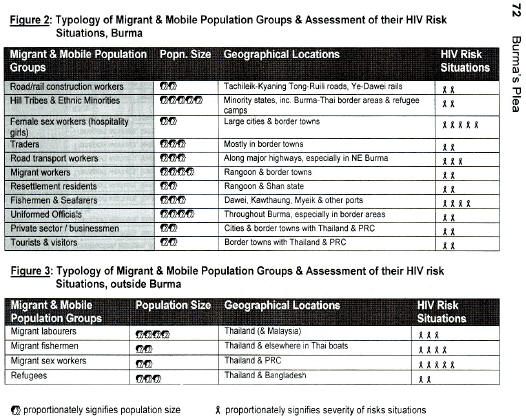
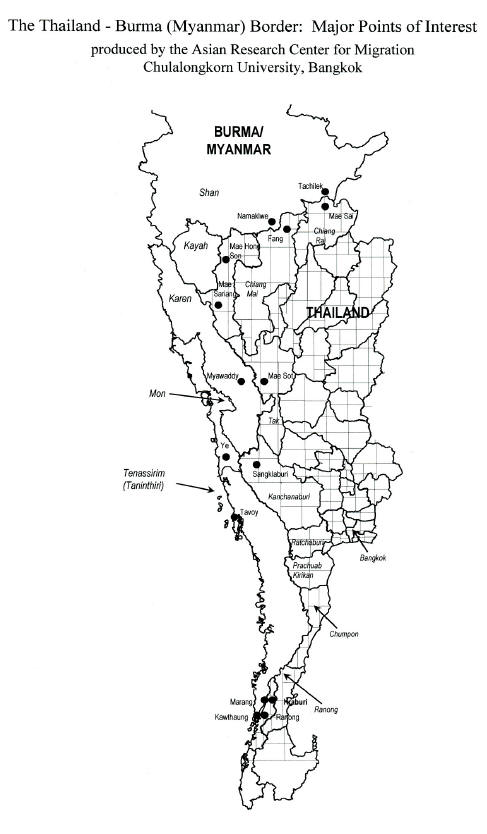
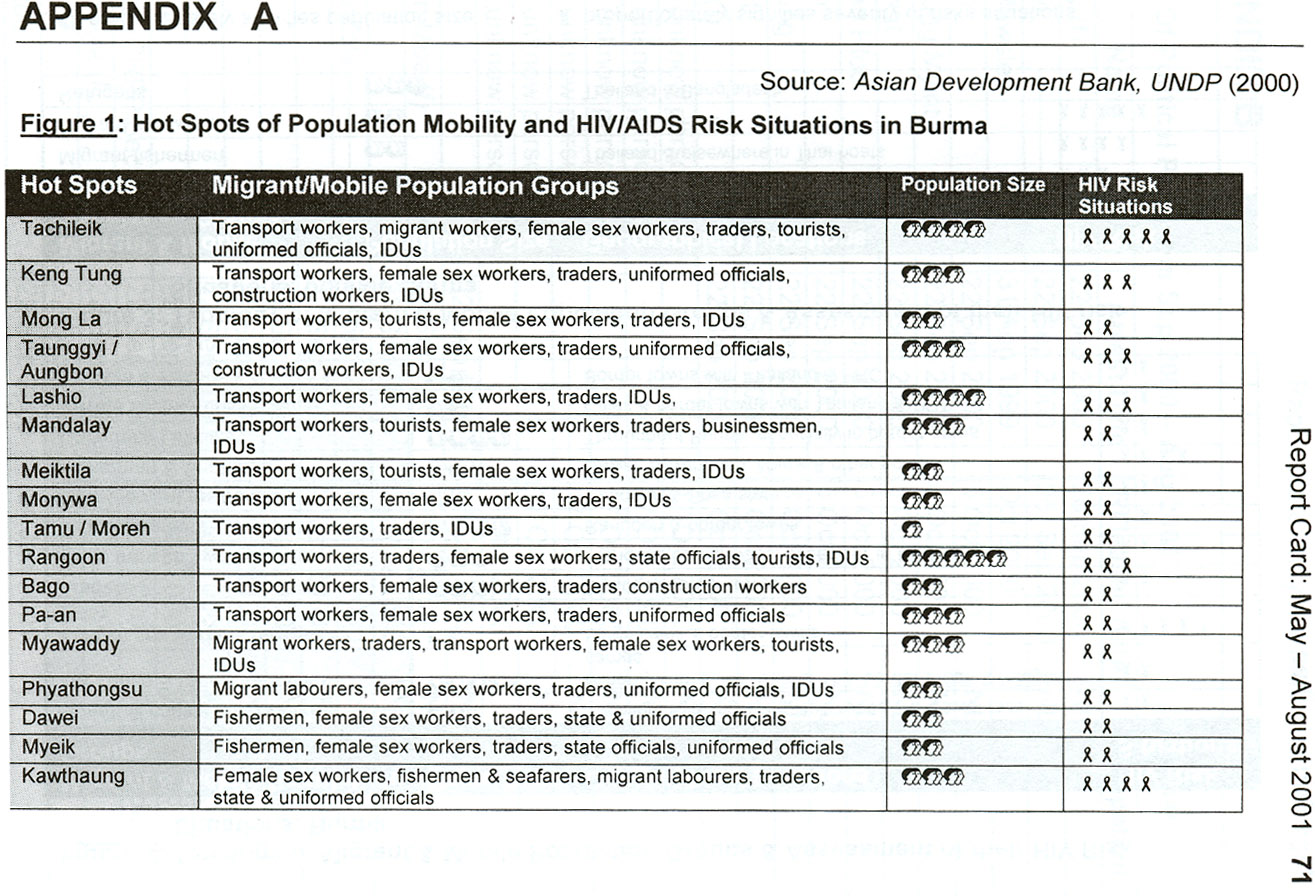
# See to Appendix A Figure 1,2 & Map