13. Internally Displaced People and Forced Relocation
13.1 Background
The situation of Internally Displaced People (IDP’s), in Burma remained critical throughout 2001. The US State Department estimates that there could be up to1 million members of ethnic minority groups who the SPDC has forcibly relocated from their villages and districts, and who are currently living along the Thai border. Reports from NGOs also estimate that an additional 1 million IDP’s are living a precarious existance in other locations throughout the country. (U.S. State Dept, 2001)
In 2001, Human Rights Watch reported that tens of thousands of villagers in the ethnic insurgent areas remained in forced relocation sites or were internally displaced. Total estimates of the number of IDPs throughout all of Burma range between one and two million, with around 300,000 in north-eastern Shan State, 100,000-200,000 in Karen State, 70,000-80,000 in Karenni State, 60-70,000 in Mon State and about 100,000 in Arakan State. (UN 22 August 2000 para.52; USCR annual reports; U.S DOS February 2001, section 2.d). As is apparent from these figures, the most significant displacement has occurred in the border ethnic areas where the military regime has been at war with ethnic armed opposition groups for over 50 years. Ethnic minorities such as the Muslim Rohingyas of Arakan State, the Shan, Karen, Kachin and the Karenni, as well other smaller ethnic groups that live in the same areas have suffered disproportionately. Whatever their background, internally displaced persons in Burma live under conditions of severe deprivation and hardship. Almost all are without adequate access to food or basic health and education services. A large number of IDPs are women and children. In January 2001 BBC released a report stating: “Currently, little can be done to resolve the IDP problem. The SPDC denies that it exists and there is virtually no access to the affected areas from inside the country. The only assistance that can be provided is whatever the ethnic groups themselves are able to deliver. This amounts to very little compared with overall needs.”
Compilation of figures on internal displacement by the Burma Ethnic Research Group (BERG) – (2000)
State and Divisions No. of people Affected Date of Data and Number of Sources
Karen State 108,280 (Dec 1997) ( 1 )
Shan State >300,000 ( April 1998) ( 3 )
Mon State >20,000 (Sept 1998) ( 4 )
Karenni State 31,620 (Dec 1998) ( 5 )
Chin State 40-50,000 ( -) ( 6 )
Kachin State 67,000 (Jan 1994) ( 7 )
Arakan State >250,000 (Aug 1997) ( 12 )
Yangon 504,000 (Oct 1994) ( 20 )
Mandalay 150,000 (May 1990) ( 21 )
Bago 36,000 (May 1990) ( 21 )
Sagaing 1,260 (Dec 1999) ( 24 )
Ayeyarwaddy 18,000 (May 1990) ( 21 )
Tanintharyi 37,000 (May 1990) ( 21 )
Source: BERG September 2000
People in Burma become displaced as a result of SPDC policies that either directly or indirectly compel them to leave their homes. Villagers are subject to forced relocation by the SPDC as part of the military’s four-cuts program; for urban resettlement or “beautification” projects, which are often linked to the SPDC’s campaigns to promote tourism; and for rural resettlement programs. People are also frequently left with no choice but to flee their home villages when faced with resource scarcity, and the loss of their security and livelihoods that result from oppressive SPDC policies. Economic reasons for fleeing include: numerous demands for forced labor and portering; government crop quotas; ceaseless taxes and fees to support the army; army looting or destruction of property; and uncompensated loss of land or property due to SPDC development projects. Even more pressing are people’s fears of the torture, rape, arbitrary arrest and arbitrary killings perpetuated in border areas by the military. Finally, villagers also often flee in anticipation of forced relocation.
The majority of crossborder refugees report that before arriving in refugee camps they had spent some time living as IDPs. Currently however, those IDPs that would seek asylum in neughboring countries are finding it much more difficult to flee Burma, due to increasing SPDC control of the border, increased use of landmines in border areas, and the increasingly restrictive policies on refugees adopted by neighboring governments.
As mentioned above, the military regime has subjected people to displacement for both economic and security reasons. Government displacement programs have been in place since the late 1960s, and possibly before. Since that time, under the guise of regional or area development, private land and plantations from civilians have been confiscated by the military - without any compensation - for military plantations, farms or animal breeding ranches, or for the construction of roads, railways, hydroelectric power plants, large dams and small scale infrastructure projects. In addition, the regime has forced numerous urban populations to move into areas away from city centres. In the 1990s the trend has been for the military to displace civilians from cultivable land which is then used for the construction of military bases or for income-generating projects.
In the volatile border regions, displacement campaigns have been aimed at securing combat zones, cutting off civilians support for insurgents, and curtailing the activities of ethnic armed groups. These activities fall under what the SPDC refers to as the ‘four-cuts’ policy. This program was introduced in 1974 with the aim of cutting the supplies of 1), food, 2) funds, 3) recruits, and 4) information to the resistance groups. In some border areas which the regime had labeled brown areas, forced relocation programs were carried out systematically. In other areas, which were classified as black areas, all villages were destroyed, fields and paddy barns were burnt, and anyone found in the area was shot. These campaigns against civilians were intensified after the 1988 pro-democracy uprising. Currently under the four-cuts campaign, villagers and village elders suspected of having contact with the resistance are detained, tortured, and executed; regime troops systematically extort and pillage villagers’ crops, food supplies, livestock, cash and valuables; and villagers are forced to labor for army projects. Any village that is suspected to be supporting the opposition is forced to relocate. In 1996-1997, the military regime launched programs to forcibly move or wipe out all rural villages in areas not directly under the their control. As a result of these intensified programs to destroy the populations in the ethnic areas, the number of people displaced has continued to increase dramatically.
When a village is forced to relocate, the villagers are usually told that they will not be permitted to go home until the opposition groups have capitulated. The SPDC issues written orders addressed to village headmen, which specifies the date by which the entire village must be relocated to a designated site. Relocated persons are not compensated for their homes nor are they given enough time to collect all of their belonging. Villagers must leave behind the majority of their belongings, including their livestock. Often people must also leave behind elderly and sick relatives. The areas cleared of villagers are then designated as “free-fire” or black areas. Houses, villages, and crops left behind are often pillaged and then dismantled and/or scorched to prevent the return of villages. Villagers seen in the areas of their former homes are considered to be rebel soldiers and shot on site. In some cases landmines are laid on the roads leading into villages, or in abandoned fields and homes.
13.2 IDPs in Burma
There are four types of displacement in Burma:
1) Displacement into state-controlled relocation sites and satellite towns
Villagers forcibly relocated generally are required to move to one of the areas designated as “relocation sites” by the SPDC. These sites are most often located in other villages or towns near army bases, car-road sites where there are no villages, and barren areas where there are no resources or transportation. In the cases of urban resettlement or “beautification” projects, the townspeople are moved to outlying areas of the city called “satellite towns.”
Satellite Towns
These new towns are made of populations forced to relocate by the military government, and are located in the outskirts of cities, usually a few miles out where there are very few facilities. In the last five years, the junta has forcibly resettled tens of thousands of potentially restive poor people from city centers into these distant slums. Clean water is scarce and sanitation is poor in these slum areas. In addition, the people who are relocated face great difficulty as public transportation into the cities is either nonexistant, or else extremely poor and unreliable. Employment in the new satellite towns is scarce. There are inadequately equipped schools in these towns, but health care is a problem as the few clinics that exist are understaffed and under supplied and the city hospitals (also understaffed and under supplied) are difficult to get to.
The Relocation Sites
In most of the places that have been chosen as “relocation sites” by the SPDC, little preparation or organization is done in order to receive the displaced people. The SPDC is unconcerned whether or not water, food, cultivatable land, employment and services are available in the new areas. The burden for sheltering and caring for the displaced at relocation sites generally falls on the local community. If the relocation site is part of, or near another village or town, this extra burden results in increased depletion of the resources of the original population. No humanitarian assistance comes from the government, although at some sites there is very limited assistance from church organizations. In some cases, rice has been distributed to the IDPs during the initial relocation period, yet these rations are insufficient and the distribution period is short. One refugee who came from the relocation site at Mawchi in Karenni State stated that rice intended for the relocated people was diverted and sold by local township authorities.
The SPDC troops force the villagers in the relocation sites to work on a daily or weekly basis; generally one person from each family must go. This forced labor includes clearing bushes and trees from the roadsides both inside and outside the relocation sites, cleaning military buildings, cultivating land for the military bases, hauling water for the troops, building fences around the military camps, digging bunkers, road construction, portering for the military and other general servant work. The villagers are also forced to work in the infrastructure projects in the area. Moreover, they are made to pay various fees for development projects, military funds, food for visiting troops, and so on.
Services at the relocation villages vary from site to site, as each site is under the responsibility of relevant state or township committees. However, in general there are no arrangements made to provide services for the relocated people.
Access to water varies – in some sites wells have been dug in addition to streams and lakes. Yet in some sites, such as the Shadaw relocation site in Karenni State, the lack of drinkable water has resulted in several problems, including sickness and deaths caused by chemicals that were added to the water in an attempt to clean it.
Sanitary facilities are usually nonexistent for the IDPs and they either are required to build their own, or use outer areas of the sites for latrine purposes.
The poor water and sanitation at the sites, among other things, has resulted in higher levels of sickness and mortality, yet health care facilities are either missing altogether, or else seriously under-equipped and under-supplied.
There is no access to electricity in most sites, and in some sites, such as Shadaw relocation site in Karenni State, torches (flashlights) are banned and dry cell batteries are not permitted to be sold in the site. This lack of provisions for night lighting increases the vulnerability of women, among other things.
Education facilities are also insufficient or nonexistent. In most cases, the relocated people establish makeshift schools themselves. If there are pre-existing schools, school buildings, teaching materials and teachers are never sufficient, and families often do not send their children to school as they cannot afford the school costs, or they require their children to help in the family’s attempts for survival. (See chapter on health and education for more information)
At all relocation sites in Burma, access to farmland and employment is a serious problem for the relocated villagers. In some sites, IDPs are able to access farmland around the relocation site, yet this allocated land is usually insufficient for basic survival or unsuitable for farming. In other sites, access to surrounding land is denied, especially when villagers are relocated to sites where local residents are already farming the land, either for themselves or for the military. New refugee arrivals at the Thai border in 1999 reported that they had been able to find daily labor at local farms near the relocation sites, earning between 40 and 120 kyats per day. In some cases, villagers are permitted to return to their former farms and plantations, yet due to the restrictions imposed on their trips out of the sites and the dangers these villagers face outside of the sites, most are unable to make a living in this way.
Villagers in relocation sites live in constant fear of the violence and demands of the state forces, both inside and outside the relocation sites. Villagers are not permitted to leave the sites without passes, which they must purchase from either SPDC soldiers or local authorities. The passes are usually only valid for 1 day, from dawn to dusk, although in rare cases week passes have been granted. (see chapter on the freedom of movement) This leaves the villagers little time to travel to their places of work, complete their work, and then return. In addition, security for the villagers outside of the relocation sites is notoriously bad. Villagers seen outside the camps are vulnerable to capture, arrest, torture, and killing, even if they hold valid passes, as they are accused by SPDC troops of leaving the camps to support rebel forces. Women are especially vulnerable, and many cases of rape have been reported by women who have gone outside the camp to forage for vegetables or get water. (see chapter on women) The local authorities do nothing when cases of abuse are reported to them by the villagers.
2) Displacement into areas under full SPDC control;
Many villagers suffering from abuse under the SPDC four-cuts program, or who have been told to relocate without a specified site have chosen to resettle in areas under full SPDC control, which they feel are safer and more stable than the conflcit areas, or where they have friends or relatives. Yet as most of the displaced villagers are farmers, they face many difficulties when they are forced to move into new villages or towns. Available land in these areas is often scarce and the search for other employment in new areas is difficult. In larger towns or cities farmers are often forced to seek work as day laborers in low paying jobs. The families who have been forcibly relocated also usually move without being able to bring all their belongings, adding to their problems of resettlement. Villagers sometimes move to villages and towns where they have relatives, but their relatives are often not able to provide the extra support needed, as they themselves are suffering. In addition, these IDPs living in areas under SPDC control are subject to the same abuses as the other villagers around them. These include the demands for forced labor, fees, and restrictions that are commonplace across Burma. Yet because the abuses committed are sometimes less then in areas under the four-cuts program, many villagers choose to face the risk of moving to areas under full SPDC control.
3) Displacement into areas and camps controlled by armed opposition groups
Villagers who have been forced to flee their homes and villages for any of the above mentioned reasons, are sometimes able to seek shelter in areas controlled by armed opposition groups, where they feel they have some protection from SPDC abuses. Several of the armed opposition groups operate camps and resettlement sites in their areas of activity. However, in these camps and sites, supplies and services are very limited, and often the shelter and supplies offered are only temporary. Access to food, education and health varies from site to site, as does the level of security. In some camps and sites schools, health care and other services are provided for a limited number of IDPs, and the area is safe from SPDC attack, yet in almost all such places, there are no employment opportunities. Therefore, the IDPs have to live off of whatever the opposition groups can provide for them.
4) Displacement into jungles, fields, and other remote, usually “free fire” or black areas of Burma
There are nearly 1 million people estimated to be hiding in the border conflict areas of Burma, and this is the IDP group with the least access to basic survival needs. These villagers have fled into hiding, despite the risks, because of various factors. These IDPs include:
- Those who flee SPDC troops in advance of their arrival;
- Those who can no longer stand the abuses they suffer in their villages;
- Those who were ordered to move from their village to a relocation site or other place, and who chose not to do so; and
- Those who have fled from relocation sites due to unlivable conditions.
These IDPs are regarded as enemies by the SPDC troops, as the areas where most villagers hide are located in black or “free-fire” zones. They are shot on sight, or else captured, tortured and then sometimes killed whenever they are found. Their shelters, rice plantations and belongings are looted or destroyed when discovered. Under the guise of ridding areas of opposition forces, the SPDC has launched several “search and destroy” operations, in which soldiers root out and destroy everything they see in the area including people. The troops often plant landmines on paths that they suspect the IDP villagers use, and they practice a “scorched earth” policy of looting, destroying and burning any signs of habitation or food supply. Troops have even been known to cut down fruit trees growing naturally in the forest in these operations in an attempt to make it impossible for anyone to survive in the forests or jungles.
Villagers often hide in areas near their old villages and risk attempting to work and harvest their crops in secret. This work is extremely dangerous, and if crops are discovered by soldiers, they are burned or destroyed. If the villagers are unsuccessful in harvesting rice, they forage for other sources of food in the forests. Villagers in hiding, for the most part, are unable to travel outside of their area of hiding to purchase other necessities, and must make do with what they can find around them.
Health is a major concern for people in hiding. Life in the tropics without shelter or adequate food leads to high sickness and mortality rates from malnutrition, diarrhea, malaria, minor injuries and other easily preventable illnesses. With a complete absence of health care facilities, people mainly rely on herbs and traditional medicine. Although there are some healthcare teams which seek to reach IDPs, the medicine and care they are able to provide is insufficient for the numbers of IDPs in hiding across many border areas.
IDPs hiding in the jungle are sometimes able to operate temporary makeshift schools with volunteer teachers. These schools lack any supplies, and are forced to shift from place to place depending on SPDC activity. With the increase in SPDC activity, in recent years, and the common occurrence of “search and destroy” operations, the number of these schools has been greatly reduced.
13.3 Situation in Arakan State
There has been a considerable amount of internal displacement within Arakan State over the last decade. Forced relocation has not been uncommon. Most relocation is connected to military efforts to install military camps, to build administrative or religious infrastructure, to move the Muslim Rohingya population to the north of the state and to settle Buddhist people throughout the state in “model villages.” Small minorities of Arakan (notably the Mro) have also been relocated from their mountainous and remote homelands to the plains. The recent development of tourism in Arakan State has also caused the displacement of people living close to historical sites that the government wishes to promote.
Within Arakan State there is significant displacement due to the government’s continuing discrimination and repression of the Rohingya Muslim minority. The SPDC’s abuses against Rohingya Muslims, including denial of citizenship, forced labor, and arbitrary confiscation of property continue to prompt new refugee flows and limit the reintegration of those who have returned from refugee camps in Bangladesh.
Muslim villages outside the far north are becoming rare. Most of the Rohingyas who lived in the Kyauktaw, Mrauk-U or Minbya districts have been forcibly displaced to the north over the past few years. These forced relocations, which go hand in hand with serious human rights violations, have been denounced by the UN Special Rapporteur on Burma, notably in February 1993 and January 1995. According to villagers still living in Rathidaung, out of the 53 Muslim villages existing in the district before 1995, only two remained in 1999. The construction of model villages for Buddhist settlers in the north of the state also entails the forced relocations of Muslims who are moved to less fertile lands, usually without adequate time to prepare or any compensation.
SPDC plans to establish more Settlers’ Villages in North Arakan
On 16 November 2001 it was reported that the SPDC is preparing to establish more settlers’ villages in the Muslim majority border areas of north Arakan during the 2001 dry season. Instructions have already been sent to local authorities to make the necessary arrangements for this. So far, 33 settlers’ colonies, dubbed ‘model villages,’ have been established in Maungdaw and Buthidaung townships on lands confiscated from Muslims. The new settlers are ethnic Burmans, Rakhines and some members of hill tribes from Arakan Hill Tracts in eastern Burma. They have all been provided with readymade houses, farmlands, bullocks and carts, free rations for more than one year and free labour from Muslim forced labourers.
Although the above settlements are established in the border areas they are not under the control of the Na Sa Ka (border security force) like Muslim villages. Instead they are controlled by the Headquarters of Military Intelligence under the Western military command and Township Peace and Development Council in Buthidaung. These new settlers have been responsible for various crimes against Muslim villagers including picking fights and stealing livestock. (Source: Arakan News Agency)
13.4 Situation in Karen State
“In early 1997 the SPDC began a campaign to wipe out all Karen civilian villages in the hills. Where villagers could be found they were ordered to relocate westward into the plains; where they could not be caught, their villages were shelled without warning, looted and then burned to the ground, while villagers found afterwards were shot on sight. Most villagers fled into the hills to live in hiding in small groups of families while trying to grow small patches of rice, and many others moved westward as ordered into the plains, either to stay with relatives or to garrison villages along the main roads as the SPDC troops had demanded. Many of the people who moved into the plains have now fled back into the hills, They say that they returned to the hills because they could not survive in the plains; they had no land to plant, there was no paid labor to survive on, and they could not face all the demands for forced labor and money from the SPDC troops. Some had died because they were not used to the water and the illnesses in the plains. In the end they fled back into the hills. Now they join the thousands of Karen villagers who have lived as internally displaced in these hills since 1997.
In the hills, the villagers are hiding in small groups of a few families in high valleys and other remote places. They try to grow small patches of rice but have little or nothing to eat....SPDC patrols come through the hills as often as two or three times per month, burn any rice storage barns they find, shoot at villagers they see in the fields or the forests, and burn any shelters they find. The displaced villagers are always fleeing from one place to another to avoid the patrols. They have no change of clothing and few or no blankets, and have to sleep around fires in temperatures which can drop to 10 degrees Celsius or lower.... They have no medicines and speak of treating gunshot wounds by applying sesame oil after saying incantations. These villagers don’t dare go down to the plains for fear of arrest as ‘insurgents’, and it is difficult or impossible for most of them to get to Thailand because they would have to pass through all of northern Papun district, where SPDC troops have destroyed even more villages and are patrolling to shoot villagers on sight. “ (NCGUB 2000, pp. 136-137)
Situation in Pa-an District
“Escalating abuses by the State Peace and Development Council (SPDC) in northeastern Pa’an district, Karen State have forced a stream of families over the border into Thailand. In mid-January of this year, at least 13 families from Hlaing Bwe township fled their village and walked a day and a half across the mountains to cross into Thailand. Currently over 70 Karen villagers are gathered near a Thai Karen village and they have told KHRG that many more may soon arrive.
The new refugees come from the village of Meh Kreh located among the Dawna Mountains in eastern Hlaing Bwe township of central Karen State, about 120 kilometers (75 miles) north of the town of Myawaddy and the Thai town of Mae Sot. Those interviewed by KHRG say they fled their village on January 15th and arrived in Thailand on the 16th. The villagers cited many motives for fleeing villages in the area, the most salient being the increasing use of forced labour by the SPDC. All villages in the area are compelled to send people for forced labour, the only variation being the degrees of severity and frequency... Many villages also face forced recruitment of porters by the SPDC-allied DKBA (Democratic Karen Buddhist Army) operating in their region. DKBA brigades #555 and 999 recently demanded 70 porters from villages in the Kwih Law Ploh area.
The painful burden of carrying immense loads is exacerbated by the villagers’ fears of landmines. Some porters are forced to walk in front of the military columns in order to clear mines, which are laid heavily in the area by all sides in the conflict: the SPDC, DKBA, and KNLA (Karen National Liberation Army)... Consequently, at the beginning of January 2001, Major Win Naing, Column 2 commander of SPDC Light Infantry Battalion 201, summoned the village heads from Kwih Law Ploh, Dta Kreh Kee, Deik Kya, Meh Tha Po Kee, Kha Leh Dee, Day Law Ploh, Tha Wih Hta, Kleh Ka, Haw Tee Po, Tee Ler Doh, Meh Pu Hta, and Meh Kreh villages and ordered them to clear parts of the mountain of landmines. The village heads were threatened with forced relocation to Ywa Po Hta, about 30 kilometers (20 miles) to their southwest, if they failed to carry out these orders. Villagers were understandably distressed over the ultimatum and many decided to flee to Thailand. Back in Hlaing Bwe township, the village heads have been attempting to exempt their villages from the order by offering large sums of money to LIB 201.
Unable to bear the danger and hardship of working as porters, some villagers have fled into the jungle. If caught, the porter can face harsh punishment or even death. A villager from the neighbouring township of T’Nay Hsah told KHRG that an older porter who tried to flee from the SPDC was recaptured and tortured. SPDC soldiers bound his hands behind his back, force-fed him massive amounts of salt and rice and forced water down his throat. Then they beat him with a gun, released him and fined him chicken and rice. The fact that people risk recapture, retribution and a flight through a jungle rife with land mines attests to the desperation of the situation for porters.
In addition to their conscription as porters, villagers in Hlaing Bwe township are enduring an increasing burden of additional forced labour duties including constructing army camps, building and maintaining roads, cutting and transporting wood and bamboo, farming for the Army, making and delivering thatch roofing shingles, and acting as unarmed sentries along the roads.
Since December 2000, LIB 201 has forced villagers to work around their army camp at Kha Leh Dee. Another notable forced labour project in the township is bridge construction at Meh Kheh Kloh and Tee Hsaw Meh. For the villagers, forced labour bears the risks of being beaten or killed by soldiers as well as enduring severe health problems from overexertion and exposure to disease. But on an even greater scale, it takes them away from their farm work. Overtaxed villagers face severe difficulties feeding themselves due the increasing demands placed on them by the military. This problem is compounded by the actions of SPDC and DKBA troops when they arrive in villages. Soldiers relentlessly loot food and belongings from villagers who can no longer afford to resupply themselves. They have taxed, fined and robbed the villagers into severe poverty. Making things worse, the villagers from Meh Kreh say they had heard that a well-known DKBA commander named Moe Kyo (meaning ‘Lightning’ in Burmese) is to come to their area. Moe Kyo is infamous for ordering the burning of houses and the execution of villagers in other areas on the slightest suspicion of any contact between any village and the KNLA.
The SPDC have made it very clear that they will stop at nothing short of complete control of the villages. Their continued attempts to strengthen their hold on the area means an increase in the use of forced labour, looting, extortion, landmines and brutality. As the situation in the Dawna mountains of eastern Hlaing Bwe township stands, villagers face a choice between starvation, violence and utter desperation or an unpredictable and dangerous flight to the Thai border. And at present, it still remains unclear whether Thai authorities will grant asylum to these refugees or not.” (Source: KHRG, “Northeastern Pa’an District: Villagers Fleeing Forced Labour Establishing SPDC Army Camps, Building Access Roads and Clearing Landmines” February 20, 2001)
Villagers Forced to Relocate or Flee
On 16 May 2001, the combined troop of SPDC and DKBA, LIB-341 led bed officer Myint Tin and DKBA, officer Chit Maung entered the villages of Doo K’meh Khee, Pway Lu and Kyaw Nyo Hta, May Tay Hta, Kay Hta and Kler Lu. They stayed 3 days in the villages and conducted activities around the area during planting time. When the troop entered, the villagers had to flee, leaving their belongings, while the troops took what they wanted and could carry. The troops ate up rice and other food that they found in the farm huts and destroyed all the rest that they could not carry. People in these villages now have to stay temporarily in the jungle, some in the farm huts and some by the streams as the above mentioned troops of SPDC and DKBA continue their activities in the area. As a result, now the villagers are facing several shortages of food, medicine, clothing and security. (Source: KORD)
On 25 May 2001, 170 SPDC and DKBA soldiers entered the 2 villages of Kler Ka Pa Doh (Kler Ka Gyi) and Kler Ka Poe (Kler Ka Galay) in Kwee Lor Ple village tract, Hlaing Bweh township Pa-an district, Karen State, where they threatened the villagers and accussed them of supporting the KNU. The soldiers then ordered the villagers to relocate to “ Kler Day “ village, which is near their camp. The troops ordered the villagers to move within 3 days, and warned that if any one failed to move, he or she would be punished. In addition, these troops looted paddy, rice and domestic animal from the villagers. The soldiers involved in this incident were from the following units: SPDC division No 66 under the control of LIB 6, battalion commander lieutenant colonel Aung Soe Win with 80 soldiers; LIB 10, under column commander, Maj Htun Aung Lwin with 60 soldiers; and DKBA troop, brigade No-(555) led by battalion commander Pah Galay alias Pah Day Poe and his troop of 30 soldiers.
The villagers did not move to the place they had been ordered to go to by the SPDC, but instead took temporary shelter in the jungle living in small groups of 4-6 families. To move to the jungle, the villagers had to leave secretly at night so that the soldiers would not see them fleeing. To escape detection they had to hurry, and were not able to take all of their paddy, rice, domestic animals and other belongings. The distance between their village and the village, “Kler Day” which they had been ordered to relocate to is about 4 miles, and takes one and half hours to walk to. The distance from their old villages to their temporary settlement in the jungle is about 5 miles, and it took up to three hours for all of the villagers to walk there at night, including children, and the ill and elderly. When the soldiers found out that the villagers had not moved to the place they had been ordered, they went to the village and ate or destroyed the remaining food, and also destroyed some houses and huts which they used as firewood for cooking their meal. At the time of this report, 3 July 2001, the villagers remained afraid to return to their villages, and were living in the jungle, unable to decide whether they should return to their homes or cross the border and enter the refugee camp. (Source: KORD)
On 8 August 2001, the residents of 6 villages in Kwee Lor Plo village tract, in Lu Pleh township of Pa-an district were driven out of their villages by SPDC and DKBA troops and forced to relocate in Klaw Ka Ti and Myaing Gyi Ngu. The reason given for this forced relocation was that the villagers had been in contact with the KNU. The soldiers responsible for driving them out were from SPDC division No (66) LIB (201) and LIB(6) and DKBA Brigade (555) led by the column commander Win Naing, Captain Than Myint Zaw and Capt: Maung Zaw and the DKBA - Pah Leh and MaeTet Let. (Source: KORD)
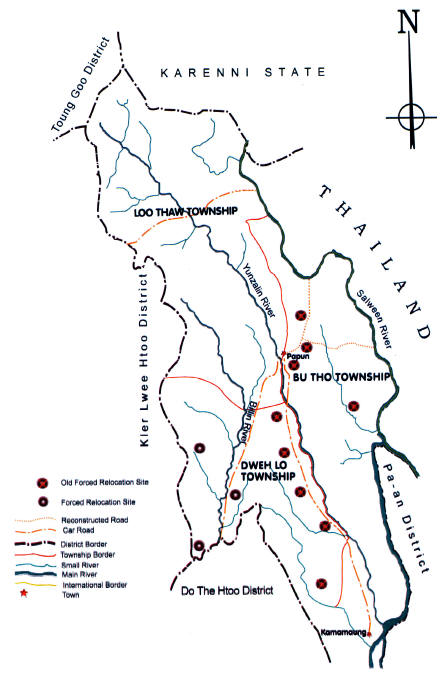
Forced Relocation Sites in Papun (Mu Traw) District, Karen State
Map by CIDKP Dec. 2000
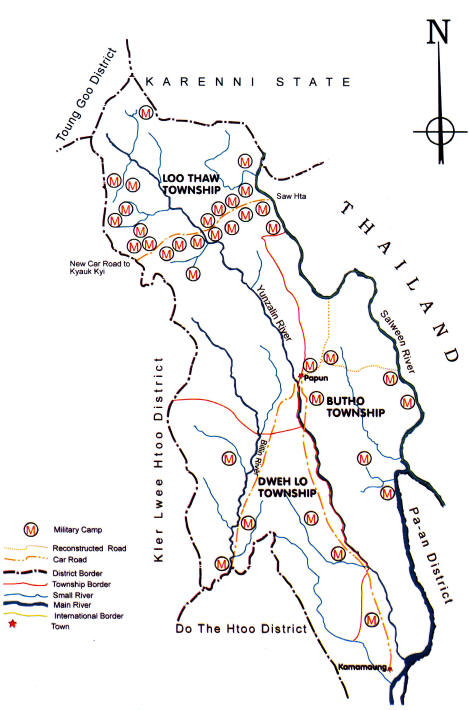
Location of SPDC Military Camps in Papun (Mu Traw) District
Map by CIDKP. Dec. 2000
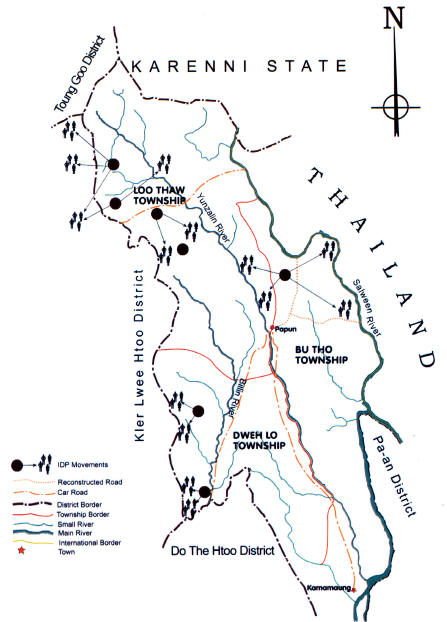
IDP clusters in Mu Traw (Papun) District.
Map by CIDKP, Dec 2000
Brief Background of Mae La Po Hta IDP site
In September 1998 SPDC troops stormed an area in the eastern Dawna Mountains, near the Thai border in Pa’an District, and shelled and burned 5 villages without warning. The villagers fled across the border but soon returned and camped just on the Burma side of the Moei River, hoping to return to their crops and villages if the SPDC troops withdrew. The troops did not withdraw; instead, many more internally displaced people came to join those camped beside the Moei River at Meh La Po Hta. By late 1999 the population had swelled to 5,000 and it had begun to look a bit like a refugee camp, with food and other supplies sent in from Thailand. The site was heavily encircled by KNLA landmines, but it was never safe from attack by the nearby SPDC Army units. Similar camps slightly further south at Tee Ner Hta and Law Thay Hta were attacked by SPDC units in late 1999, and the villagers there fled into Thailand. (Source: KHRG 2000)
Situation in Papun (Mu Traw) District
96% of the people in Papun (Mu Traw) District are Sgaw Karen, and most are farmers. In the past, they farmed peacefully, but this changed in 1979 when the BSPP introduced their ‘four cuts’ operation to Mu Traw District. When this occured, villagers were forced to flee from the numerous abuses committed by the army. Beginning in 1997, SPDC forces mounted a concerted campaign to gain control over the rugged territories of Papun and Nyaunglebin Districts in northern Karen State and eastern Pegu Division. This effort targeted civilians, rather than insurgent armies, and included the destruction of over 200 villages and the forced relocation of thousands of villagers to garrison villages. The campaign also included the establishment of military camps throughout most of the Karen areas, and the forcible relocation of any villages considered too remote to be controlled by an army camp. Typically, after residents are relocated to an army-controlled area, soldiers enter and destroy their former home. This has happened in the plains along the Sittaung River, in parts of Papun District along the lower Bilin and Yunzalin rivers, and near Papun town. As the majority of people living in the rugged Papun hills had never been under SPDC control and for the most part would flee before soldiers could get to them, in 1997 the SPDC began to systematically destroy hundreds of these villages without formally ordering them to relocate.
Today the SPDC continues to search out and kill villagers who have fled into the hills to escape forced relocation. As part of this campaign over 40 Battalions have been sent to the region. New roads have been built, and all villagers relocated into areas under SPDC control are ordered to do forced labour to support these battalions. Since 1999 increasing numbers of soldiers have been sent to the hills in order to hunt down villagers trying to hide near their villages. Since 2000 the soldiers have focused on destroying the crops and food supplies of the villagers in hiding. Internally displaced people in these areas are shot in the fields at harvest time, have their crops burned, and their fields and abandoned villages landmined. SPDC troops leave ‘Peace Passes’ in the destroyed villages to encourage IDPs to come to a relocation center. The passes say “Do not think, take this pass and come to the nearest Army camp”. In the SPDC-controlled villages people face constant demands for forced labour, money, food and materials and the arbitrary torture of village elders and others. Villagers in the region are facing an increasingly desperate situatation, with little hope for releif anytime soon. (Source: KHRG: “Flight, Hunger and Survival Repression and Displacement in the Villages of Papun and Nyaunglebin Districts,” October 2001)
In November 2001 CIDKP issued a report stating that 37,007 Karen remained displaced in Papun district where over 50 villages had been forcibly relocated. People from neighboring Nyaunglebin, Taungoo and Thaton districts have also resettled in Papun district since fleeing army attacks last year. Over 1,000 IDPs from Nyaunglebin (of the 2,000+) who fled between November 2000 and February 2001, remain in Papun district, while an additional 1,000 IDPs who had hoped to remain in this area had to go to refugee camps in Thailand due to the shortage of food. These new arrivals have put a strain on the meagre food supplies of Papun villagers.
In April 2001 it was reported that displaced people from Nyaunglebin District have continued to flee east into northern Papun District, while the situation in Papun District also deteriorated. Along the Bilin River west of Papun, some villagers have been able to return and stay in and around their original villages, but they live in constant fear of SPDC soldiers and flee into the hills whenever they hear news of troops approaching. Further down the Bilin River, the SPDC Light Infantry Division #66 has been active since 1999 causing most people in the area, from Meh Gha Law to Ker Kaw Law to flee their homes. To date these people have been afraid to return, and instead traveled further up the Bilin River out of the reach of Division 66 instead.” (Source: KHRG: “Papun and Nyaunglebin Districts, Karen State: Internally displaced villagers cornered by 40 SPDC Battalions; Food shortages, disease, killings and life on the run,” April 9, 2001)
Situation in Lu Thaw Township
There are 22 army camps in Lu Thaw Township, which makes life
for villagers as well as for the estimated 7,000 IDPs in hiding very difficult.
There are also frequent “search and destroy” operations. There are no relocation
sites in the township, but most of the people in hill villages in the township
are living in hiding. There has been little opportunity for outside groups to
provide assistance for the IDPs in Lu Thaw Township. The health and education
situation for IDPs hiding in the township is very dire. There are no hospitals
and the backpack medical teams cannot always reach these areas. Almost all
people in Lu Thaw have fled from the SPDC troops, but there are a few families
in Klaw Hta and Baw Thay Hta village tracts living under SPDC control. They are
determined not to leave their land if they can possibly stay, but present
conditions are forcing many of them to consider fleeing to Thailand. This,
however has become difficult, because of the landmines and the proliferation of
SPDC Army camps and patrols. Even if IDPs can make it to Thailand, if they
encounter Thai Army troops or Border Patrol Police units before making it to a
refugee camp, they are routinely forced back across the border at gunpoint.
(Source: CIDKP)
“In northern Lu Thaw township, northwest of Papun, the SPDC has fortified its new road from Kyauk Kyi (at the Sittaung River in Pegu Division) to Saw Hta (on the Salween River at the Thai border) with at least 7 army camps, fences protecting the road, and landmines laid along the roadsides. The road itself is impassable to vehicles for much of the year, so the SPDC columns still use large numbers of forced labour porters to carry supplies to the camps along the route. The SPDC uses camps along the new road to launch military operations to secure the Salween River and the entire region. Along the 100-150 kilometre stretch of the Salween River which acts as the border with Thailand there are now over 10 SPDC Army camps dotted at regular intervals, including Saw Hta, Thee Mu Hta, Kyauk Nyat, Oo Da Hta, Meh Ka Hta, Oo Thu Hta, Thaw Leh Hta, Meh Paw Mu Hta, and Thu Mweh Hta. The troops at these camps attempt to shut down Karen ational Liberation Army (KNLA) supply lines, block he escape of refugees, and hunt down people in hding.
One internally displaced person reported seeing hundreds of porters carrying supplies for the army down the Kyauk Kyi - Saw Hta road on January 31st 2001. All of the villages along the road route were destroyed 3 to 4 years ago and no one dares live there anymore. Meanwhile, the military activity along the road and the mines around it have essentially cut off escape routes and supply lines for the people living to the north, in northern Lu Thaw township and in Toungoo District. It is now extremely difficult to send supplies to the thousands of displaced people in these areas, and it is equally difficult for them to flee to the Thai border. Some have managed to reach Thailand by making an extremely difficult and dangerous trip eastward into Karenni (Kayah) State and then southward to the Thai border. Some have managed to break across the road and join the internally displaced in the Yeh Mu Plaw area of central Lu Thaw Township, though conditions there are also extremely difficult. But for most, they are now not only displaced and hunted, but more isolated from the outside than ever before. They are presently suffering from food shortages, mortality from diseases ranging from diarrhoea to malaria with no access to medicines, and the need to regularly flee SPDC columns. (Source: KHRG: “Papun and Nyaunglebin Districts, Karen State: Internally displaced villagers cornered by 40 SPDC Battalions; Food shortages, disease, killings and life on the run,” April 9, 2001)
Situation in Dweh Loh Township
Villagers from Dweh Loh township, just southwest of the town of Papun, began fleeing the area in large numbers after SPDC troops burned and then landmined at least 9 of their villages in March 2000, at the same time that villagers throughout the region were fleeing in increasing numbers from increased SPDC militarisation and forced labor. In November 1999 SPDC troops had entered the township, causing the villagers to flee into the jungles. The villagers had remained in hiding, hoping the troops would leave, but they didn’t and instead the SPDC began landmining pathways around their home villages. Then in March 2000 they began burning one village after another, including the villages of Meh Gha Law, T’Kaw Hta, Baw Wah Der, Lay Hta, Maw Bpu, Tee Th’Reh Kee, Dta Baw Kee, K’Pu Soh, and Maw Thay Hta. The troops also burned all the rice storage barns they could find in order to eliminate the IDPs’ food supply, and burned the villagers’ hill fields which were being prepared for the June/July 2000 planting. The scrub in these fields had been cut and was being dried for the usual burnoff before the rains; however, by torching them early, only part of the scrub was burned and the villagers say it will now be impossible to do a proper burnoff or to plant a crop. They no longer dare go back to their villages for food either, because the troops mined the villages after burning them and are still encamped near the villages. Faced with starvation, many of the villagers have now fled the area.
The Burma army has established itself in six main locations in Dweh Lo township, Mae Wai, Khu Thu Hta, Waw Mu, Ka Ter Ti, Blow Lu and Taung Thone Lone. DKBA troops are located at Ma Taw. There has been a buildup of SPDC troops in Dweh Lo township since the beginning of 2000. In 2000 there were 4 relocation sites in the township. (Sources: KHRG, CIDKP)
“In Dweh Loh township south and southwest of Papun, the SPDC is gaining increasing control. Most of the villagers there have little choice but to stay in their villages, particularly if they are strongly attached to their land and livestock. Those who stay, however, face constant and heavy demands for forced labour, money, food, and materials from the SPDC Army units and authorities in the area. A KHRG researcher from southwestern Dweh Loh township reports that villagers there are constantly forced to cut bamboo for the Army camps, go with the Columns as porters, provide thatch roofing for barracks, and pay extortion money. The people of one village in the area were all forced to go to the forest to cut giant bamboo, then take it and sell it in Bilin and hand all of the money over to Light Infantry Battalion #366. The SPDC officers have stated to the village elders, “If you cannot pay the money, you cannot stay in the village”, so many villagers have sold off their livestock to pay the extortion. Some have fled into the hills, but the Army has sent patrols out to hunt them down and shoots at people on sight in the hills. Villages such as Kwih Dta Ma have to send anywhere from 50 to 80 people at a time, men and women, for forced portering of supplies to outlying Army camps, and smaller villages have to send 25 to 30 people at a time. Children as young as 12 and 13 have to go for the labour so that their parents can try to make a living for the family. Beginning in November 2000, everyone from the villages of Wah Mu, Po Kheh Hta, Nya Cha Gaw Hta, Kwih Dta Ma, Ma Lay Ler and Gkay Gkaw was forced to work building fences around their entire villages, leaving only one to three gates into their village which could be guarded, and the villagers’ movements to and from their fields are now strictly controlled. They were then forced to cut and clear the roadsides, build road bridges, and build 3 rings of fencing around Wah Mu Army camp of Light Infantry Battalion #366. Anyone who failed to go for this labour had to pay 500 Kyat per day, and they must also pay up to 100 Kyat per piece of bamboo which they fail to send. The KHRG researcher in this area estimates that the villagers are only left an average of 10 days in each month to work for their own livelihood, and must work the other 20 days without pay for the SPDC.
Villagers from Dweh Loh township report that SPDC Battalions have issued orders to 25-30 villages that prohibit residents from leaving their villages for the three months from September to November 2001, not even to go to their fields. At the time of this report, the rice harvest was about to arrive, but due to the order none of the thousands of people in these SPDC-controlled villages are able to harvest. People who have recently fled these villages report that the people there are preparing for starvation.” (Source: KHRG: “Papun and Nyaunglebin Districts, Karen State: Internally displaced villagers cornered by 40 SPDC Battalions; Food shortages, disease, killings and life on the run,” April 9, 2001)
Situation in Bilin River area
“While displaced people from Nyaunglebin District flee eastward into northern Papun District, the situation in Papun District also continues to worsen. In areas along the Bilin River west of Papun, some villagers have managed to return and stay in and around their villages, but they must live in constant fear of the approach of SPDC columns and flee into the hills whenever they hear of troops coming near. In late 2000 many of them managed to secure a small rice harvest, but they are having to share some of this with several thousand people who have fled into the area from Nyaunglebin District to the west... The new arrivals from Nyaunglebin District are still living on the ground in small lean-to’s, and many of them have nothing so the local villagers are giving them what food they can.
Slightly further down the Bilin River, SPDC Light Infantry Division #66 has been active since 1999 so most people in the area from Meh Gha Law to Ker Kaw Law have fled their villages and have not been able to return, heading further up the Bilin River out of the reach of Division 66 instead. Over the past 3 years many villages have been forced to move to the SPDC garrison village of Meh Way, where the population is heavily used for forced labour at the Army camp and as porters for the columns heading out into the hills to destroy villages.” (KHRG: “Papun and Nyaunglebin Districts, Karen State: Internally displaced villagers cornered by 40 SPDC Battalions; Food shortages, disease, killings and life on the run,” April 9, 2001)
Villagers forced to flee
On 12 March 2001, SPDC LIB-38 led by the commander Ba Lin, combined with the DKBA, brigade No. 777 led by Pah Kay Kay and Pah Hsi entered the areas of Mae Khu Hta, Htee Doh Hta, Maw Ler Khee, Mae Khu Khee, Toe Mu, Thwa Hta, Kler Hsi Kho, Ta Per Pah, Doo Ta Ba, U Thaw Hta, Mae Nyu Hta, Bgo Ler, U Thaw Khee villages. The troops stayed for 3 days conducting military activities. They arrived while the villagers were clearing the land, cutting down the trees and drying the trees that were cut down, in order to burn them up for the paddy plantation. When the SPDC troops entered tha areas, villagers ran into the jungle, afraid the Burmese soldiers and DKBA soldiers might shoot them or torture them if they were captured. When fleeing, villagers could not take enough food and other belongings along with them, and had toleave behind most of their belongings such as clothing, utensils, domestic animals, rice and paddy. When the troops entered the villages, they ate the rice, domestic animals and other food and took as many of the villagers’ belongings as could as they could carry and burnt down and destroyed all the rest.
Again on 21 April 2001, LIB-341 led by battalion commander Myint Tin left from their base camp at Pa Pun and entered Kyaw Nyo Hta village and stayed there 3 days, after the villagers had already fled. They had to abandon their belongings and all the rice and paddy that they could not take with them while fleeing. The troops took all the rice, pigs, chickens, goats, ducks and properties of the villagers that remained in villages and destroyed all the rest.
Again on 16 May 2001, combined troops of SPDC and DKBA, LIB-341 led by officer Myint Tin and DKBA, officer Chit Maung entered the villages of Doo K’meh Khee, Pway Lu and Kyaw Nyo Hta, May Tay Hta, Kay Hta and Kler Lu. They stayed 3 days in the villages and conducted activities around the area. Again when the troops entered, the villagers, in great fear had to flee, leaving their belonging, rice, and paddy while the troops took what they wanted. The troops ate up all the rice and other food that they found in the villages and the farm huts and destroyed all the rest.
Villagers in these aforementioned villages are now forced to
stay temporarily in the jungle, some in the farm huts and some by streams, as
the SPDC and DKBA troops continue to conduct activities in the area. As a result
the villagers are now facing severe shortages of food, medicine, and clothing
and a lack of security.
(Source: KORD)
On 8 August 2001, the 6 villages in Kwee Lor Plo village tract, in Lu Pleh township of Pa-an district were driven out from their villages and forced to relocate to Klaw Ka Ti and Myaing Gyi Ngu. They were forced out by SPDC and DKBA troop. Those were the SPDC division No (66) LIB(201) and LIB(6) and the DKBA Brigade (555)led by the column commander Win Naing, Captain Than Myint Zaw and Capt: Maung Zaw and the DKBA - Pah Leh and MaeTet Let, who accused the villagers of being in contact with KNU troops. (Source: KORD)
On 11 November 2001, nine Burmese army battalions launched attacks in three areas of Papun district in Karen State. The attacks began shortly after midnight and have driven at least 800 people north and east out of their homes. Most fled with only the clothes on their backs. Those on the run include over 70 children from a primary and middle school that was located on the Bilin River. (Source: CIDKP)
Situation in Thaton District
“In an effort to drive a wedge between the villagers in northeastern Thaton district and the resistance forces of the KNU/KNLA (Karen National Union / Karen National Liberation Army), the SPDC continues to intimidate villagers with violence, threats and military retaliation. Information sent by KHRG field researchers indicates that in Bilin township, east of the Bilin River spanning the border of Mon and Karen States, soldiers are using innocent villagers in a campaign to gain complete control over the villages and defeat KNLA opposition forces. They are capturing and torturing civilians, forcing them to work for the army and committing many kinds of abuses. Interviews by KHRG have documented stories of exploitation and violence in Bilin township, fuelled by ongoing SPDC attempts to gain both military and financial advantage...The SPDC use the Karen villagers in the region as tactical pawns in their war against the KNLA. With every SPDC casualty or setback, a price is exacted on the civilians. If a soldier steps on a landmine, the villagers pay. If there is fighting with the KNU, homes may be ransacked and burned. If any of the troops are wounded in battle, the village might be fined, threatened or even destroyed. One less violent example occurred recently in Htoh Kloh Hta village. After a DKBA soldier was wounded in the area, SPDC and DKBA troops visited the village and demanded 200,000 Kyat, a very large sum by villagers’ standards. Although the villagers have scarcely the resources to feed their own families, they paid out of fear of the consequences if they refused.
Villagers in Bilin township face great difficulties providing their families with enough food because of the actions of the SPDC army. They continue to grow their hillside rice crops, but whenever SPDC patrols come close, they flee into the jungle. The combination of working under this cloud of fear and being kept away from their work by forced labour projects allows them little time to properly maintain their crops. The amount and severity of forced labour tends to depend on each village’s distance from an SPDC army camp. But all villages have to send people on a regular basis to be unpaid army porters, workers or messengers and are forced to work making thatch roofing shingles, constructing camps or maintaining roads. This leaves them little time to work on their crops. Consequently the villagers, particularly the men, have to flee when troops visit the area. They live in fear of being captured and forced to work for the army. Many families have fled their villages entirely, seeking refuge in the surrounding jungle. Around 15 to 20 households have already done so from each of the villages of Baw Naw Po Kee, Ther Khaw Doh Kee, Ther Gkee Pu and Pleh Po Hta. Many villagers prefer this unpredictable life away from their villages and food sources to the constant threat posed by visits by the SPDC and DKBA troops.
In order to minimise the use of villages as KNLA resources, the SPDC have sporadically used forced village relocation to consolidate the Karen in selected SPDC strongholds. This also provides the army with a large, easily accessible pool of forced labourers. This can be accomplished first by oral or written demands, and later by burning and destroying the villages, driving some villagers to relocation sites and others to escape into the jungle. In recent years, they have destroyed the villages of Htee Mu Kee, Nya Po Kee, Kwih Lay Pu, Wah Tho Klah, Ther Rer Kee and many others.” (Source: KHRG: “Thaton District: SPDC using violence against villagers to consolidate control,” March 20, 2001)
On 10 October 2001, Pah Ni Tho from DKBA came to Kweeh-lay village and started to make block and cut-off operation in Pauk-kee, Ta-u-kee, Nya-po-kee, Noh-po-kee and Yo-kla area, Thaton District, Karen State. The villagers in that area escaped from their villages and hid in the jungle. It was learned that the order for the block and cut-off operation programme came from the army general head quarters of SPDC, and was carried out in order to make it impossible for the ILO to investigate forced labour issues in the area. (Source: KIC)
Situation in Dooplaya District
There have been several forced relocation campaigns in Dooplaya District over the last 3 years. In 1999, around 100 villages were forcefully relocated to sites across the district, including Ye Tagun, Anan Gwin, Taungzun, Phar Pyat, Kyi Soe, and Kyar Ein Seik Kyi relocation sites. However, many villagers, out of mistrust for the SPDC refused to move into the relocation sites, and fled into the jungle. Many others who moved into the relocation sites ended up moving out due to the conditions. Due to these forced relocations, as well as the numerous abuses committed by the SPDC troops, there were mass displacements of people throughout 2000, as people attempted to flee. Those interviewed by KHRG reported widespread hunger and starvation in central Dooplaya, and of IDPs subsisting off of taro roots and jungle vegetables. Entire villages were reported to have been fleeing, and many of these who attempted to seek refuge in refugee camps across the border in Thailand were denied access. (See chapter on refugees)
Forced relocation of Taung Galay and Kwee Pa Doh Villages
Due to the fighting with KNLA troop near the Taung Galay village, SPDC battalion IB - 62 column, No (2), column commander Nay Myo Win and his troop with the strength about 60 soldiers forced the village head, Naw Ka Neh to provide 2 guns to them as a fine. They threatened that they would kill her if she could not provide the guns as demanded. The troop then instructed Naw Ka Neh that her village had to relocate to a fixed place. The relocation had to be completed by 13 February 2001. At that time, no houses, including the monastery, should remain in the village. A total of 2 villages were forced to relocate, Taung Galay village and Kwee Pa Doh village. The army fixed 4 relocation sites for the 2 villages, and these were (1) ( Pah Pya) Pah Pra village (2) (Hleh Lan Gu) Mu village (3) (Maung U) Maw Oo village and (4) T ‘reh Kyaw village. The distance between the two villages and the relocation sites are as follow:
ท Taung Galay village to Pah Pra, about 5 hours walk.
ท Taung Galay village to Mu village, about 2 hours walk.
ท Taung Galay village to Maw Oo village, about 2 hours walk.
ท Toung Galay village to T ‘reh Kyaw village, about 3 hours walk.
(The distances from Kwee Pa Doh village to the 4 relocation villages are similar to those above)
The commanders threatened the villagers, that anyone, including children and elderly people, would be shot and killed if still found in villages after the fixed date.
On 13 February 2001, the combined troops of SPDC, IB - 62 column 1 and 2 led by the commanders Col: Than Win, registration No. Ka (A - 15533) column No. 1 and column No. 2, commander Nay Myo Win entered the two villages of Taung Galay and Kwee Pa Doh in order to drive the villagers to the relocation sites. Column No. 1, led by commander Than Win had about 80 soldiers and column No. 2, led by commander Nay Myo Win had about 60. When they arrived, the troops could find no one in the villages, as the villagers had run away at their approach. When fleeing the villagers could only carry a few days worth of food. After finding the villages deserted, the troop destroyed and burnt down houses, looted things and ate the villagers’domestic animals.
Currently the villagers are temporarily sheltering in different places, some in the paddy huts, some with friends and relatives that live far enough away from their villages, some in betel nut fields and some in the jungle. These villagers in hiding are now facing starvation. (Source: KORD)
Villagers killed while in hiding
In April 2001, a group of soldiers from Light Infantry Battalion 548 and 549 led by Company Commander Aung KHain Soe arrived at the hiding area of a group of IDPS, between Wah Blaw Lu and Ta Kaw Htee, in Kya Aye Township, Doo Pla Ya District and opened fire on the people hiding there. Two villagers were killed and another two escaped after being wounded. (Source: CIDKP)
Situtation in Nyaunglebin District
“The people of Nyaunglebin were some of the hardest hit by the Burma Army’s 2000-2001 offensive. Over 2,000 IDPs fled into Papun district between November 2000 and February 2001. 13,000 IDPs remain in central and eastern Nyaunglebin district and 370,000 are displaced in relocation sites in the western lowlands of the district. Of the 13,000 IDPs in the central and eastern areas, 5,450 are from Mone, 3550 from Ler Doh and 4,000 from Hsaw Hti townships. They fled because of the forced labor and “special” taxation as well as direct attacks of the Burma Army. Since November 2000, 83 villages were forced to move to 12 relocation sites. Forced labor is practiced by the Burma Army on the road project between Shwygin in the southwest and Bye Gyi Ma They in central Nyaunglebin district. The road is not yet complete. Around the larger towns and villages of the district, the SSS or “short pants”, (terror squads that work to intimidate villagers and execute suspected KNU supporters), continue to operate, terrorizing the populace. These units are controlled directly from Rangoon and operate independently from the local commands. 15 Battalions of the Burma Army conduct operations in the district with orders to “destroy all rice supplies and disrupt the population in the mountains”. They were also ordered to attack villages and IDP hide sites, but were given the order, “ do not burn down the houses because human rights organizations will take photographs and accuse us”. While a relief team was in the area in October 2001, Burma Army units attacked a village, and close by, shot a 16 year old villager who was gathering firewood. This same relief team also came across the skeletons of two porters (one of whom was beaten to death), who were used by the LIB 367 and LIB 368 commanded by Ltc. Ko Ko Aung, and then left to die, during their November 2000 offensive in this area. In this district, since November 2000, 50 villagers have been killed by the Burma Army, over 100 injured during attacks and 20 women raped. In spite of this, the people of Nyaunglebin district have not given up and continue to rebuild their lives and farms. Where this is not possible they have moved deeper into the mountains to start new villages. Here they have also re-opened their schools and as of November, 2001, there are 27 primary schools and 3 middle schools in operation. There are also mobile clinics and a public health program in place. The churches too continue to function as places of worship and hope as well as providing social organizations that provide assistance to the people.” (Source: Burmanet)
Situation in Loh Kee/Thay Ko Hser Der area
“Since the beginning of January 2001, over 2,000 villagers have fled eastern Shwegyin township in Nyaunglebin Distict and crossed into Papun District near the Bilin River, where they now live in the hill fields in hiding...One large group consists of most of the villagers in the Loh Kee/Thay Ko Hser Der area, who fled in early January when a large column of SPDC troops from Light Infantry Battalion #369 came and stayed in their villages for a week, looting and destroying food supplies. According to a KHRG researcher and villagers in the area, the SPDC Battalions have been ordered to clear out all hill villages west of the Bilin River by any means necessary. Where possible, the villagers are to be forced to move to Army-controlled sites further west for use as forced labour building and maintaining more Army posts, but in most cases the villagers flee before the troops arrive and go into hiding in the hills, so the Army columns shoot them on sight instead. The Army appears to believe that if all villagers can be driven out of the hills, it will no longer be possible for any resistance to operate there. To this end, their military attacks are all aimed at villagers and the internally displaced rather than the Karen forces, and their landmines are planted around ricefields and the ruins of villages where they believe the villagers will return.
One villager from a village in Loh Kee village tract told a KHRG researcher a typical story of SPDC abuses leading to the flight of villagers. West of his village, SPDC activity has been increasing as troops step up their use of forced labour and violent harassment of the villagers. Then an army unit from Shwegyin came to the village during the harvest season at the end of 2000. All of the villagers fled before their arrival out of fear that the soldiers would arrest and torture them, force them to work or just kill them on sight. After staying in the villagers’ homes for a week, the soldiers walked off with whatever rice they could carry and destroyed the rest by dumping it on the ground, devastating the village’s already dwindling food supply. The villagers eventually fled into Papun District, to join 60 or more families who had fled the other villages in their area.” (Source: KHRG: “Papun and Nyaunglebin Districts, Karen State: Internally displaced villagers cornered by 40 SPDC Battalions; Food shortages, disease, killings and life on the run,”April 9, 2001)
Situation in Kyauk Kyi Township
“...In Kyauk Kyi township of Nyaunglebin District many villagers are always on the move. Villagers leave their homes for periods of time ranging from hours to months, waiting for troops to leave the area. One villager from eastern Kyauk Kyi township described to a KHRG researcher the cat and mouse game they must play whenever SPDC columns come into the region, fleeing from one hiding place to the next in the forested hills carrying whatever they can and living off of hidden food caches. Flight is not without risk, however. On December 1st 2000, Column #1 of SPDC Light Infantry Battalion #362 entered L— village in Kyauk Kyi township and sprayed the village with gunfire. People were caught off guard and fled in various directions. Amid the confusion, the SPDC gunfire wounded a pair of fleeing villagers, a six year old girl and a 20 year old man. Three months after that incident, the 10 families from the village had yet to return and were living in the jungle at the foot of a nearby mountain. One family left to try to get to a refugee camp in Thailand. After their attack, the SPDC soldiers looted and destroyed the homes and belongings. Some of the villagers’ rice was stored in paddy storage barns which escaped the attack, and they have occasionally been able to sneak back into the village to get some rice; however, those interviewed by KHRG say that when this supply runs out, they may try to make it to the border with Thailand to stay in one of the refugee camps. Their story is typical of people hiding throughout the region. The villagers are aware of, and have even received messages about, the SPDC’s plans to clear out all the villages west of the Bilin River. Such a plan makes it unlikely that villagers like them will be able to return to their homes anytime soon.” (Source: KHRG: “Papun and Nyaunglebin Districts, Karen State: Internally displaced villagers cornered by 40 SPDC Battalions; Food shortages, disease, killings and life on the run,”April 9, 2001)
Villagers forced to flee or relocate
“Since the beginning of January 2001, over 2,000 villagers have fled eastern Shwegyin township in Nyaunglebin Distict and crossed into Papun District near the Bilin River, where they now live in the hill fields in hiding. Slightly further north in Kyauk Kyi township of Nyaunglebin District, many villagers are always on the move. Villagers leave their homes for periods of time ranging from hours to months, waiting for troops to leave the area. One villager from eastern Kyauk Kyi township described to a KHRG researcher the cat and mouse game they must play whenever SPDC columns come into the region, fleeing from one hiding place to the next in the forested hills carrying whatever they can and living off of hidden food caches ...Once the villages are emptied, the areas become shoot-to-kill zones and landmines are often laid on village land or in rice fields. Villagers then must choose whether to hide in the jungle, flee to another area or adhere to SPDC orders. For those who risk moving to relocation areas, they live under tight Army control and are forced to provide free labour for the army carrying supplies, acting as Army servants, and building security fences and traps at Army camps and around their own relocation sites. The new areas are often without access to rice fields, making the acquisition of food supplies very difficult, and the Army provides nothing. From north to south in Nyaunglebin District, KHRG has already documented the existence of forced relocation sites at Mone, Weh Gyi, Thit Cha Seik and Yan Myo Aung in Mone township; and Yan Gyi Aung and Kaw Tha Say in Kyauk Kyi township.... KHRG researchers recently reconfirmed the continued existence of these sites, and added that in Kyauk Kyi township the 40 households of Dtone Dta Dta village have been forced to move to Shwe Dan on the Kyauk Kyi-Shwegyin motor road (where there is a camp of the Democratic Karen Buddhist Army, DKBA), and Leh Gkaw Wah village has been forced to move to Lay Bin Weh on the bank of the Sittaung River. In addition, independent sources report that there are also relocation sites in western Nyaunglebin District right now at Kyaut Na Ga with five villages and 1,000 people; Kwin Seit with eight villages and 1,500 people; May Po Hta with five villages and 500 people; and Win Maung with 10 villages and 2,000 people.” (Source: KHRG: “Papun and Nyaunglebin Districts, Karen State: Internally displaced villagers cornered by 40 SPDC Battalions; Food shortages, disease, killings and life on the run,”April 9, 2001)
On 24 March 2001, 47 villagers from 7 families from Mae Yan
Khi, Kaw Mu Der, Mae Yen Khi village tract in Hsaw Hti (Shwe Kyin) township,
Kler Lwe Htoo District, Karen State, fled Burmese army persecution and arrived
in eastern Mutraw District, on the Thai-Burma border, opposite Thailand’s Mai
Hong Song Province on 31 March. According to a villager, they travelled for
seven days on foot through an area with much Burmese military activity and where
many landmines had been planted by Burmese troops. Of those traveling, two were
men who had been wounded by landmines and lost their legs in October of last
year. According to the villagers they could not tolerate the activities of the
Burmese soldiers any longer, and believing that their lives were in great danger
and that the situation was getting worse, they decided to find a way to escape.
These are villagers who did not go to the Burmese military’s designated forced
relocation sites and instead hid near their villages in the jungle. While in
hiding they were constantly being hunted by the Burmese troops who wanted to
kill them and destroy their food supplies and belongings. There are eight
battalions which have been active in their hiding area from 2000 until now.
These villagers report that because of the military presence they could not
properly tend their rice fields, and their rice was ruined. The eight battalions
have been specially assigned by the Burmese army to “search and destroy” or to
conduct “Scorched-Earth” military operations to eliminate villagers who are
hiding in the jungle and valley around Hsaw Hti Township, Kler Lwe Htoo
District.
(Source: CIDKP)
In September 2001, as 10 IDP families were attempting to flee the Mae Yae area, Burma Army troops captured them and sent them to the relocation site at Win Maung on the Bilin river. Win Maung is a major main forced relocation site along the southern border area of Nyaunglebin and Papun districts. The following villages were forced to move to another relocation site at Ma Way (north of Win Maung, also on the Bilin river); Wah Tho Ko,Ler Wah Ko,Klo Kee, Pwa Ya Kee, To Ko Kaw Kee, Day Law Po,Mae Tha Ko Hta and Wah Tho Lo. (Source: Burmanet)
Situation in Western Plains Area
“On the western plains of Nyaunglebin District the official SPDC relocation sites are expanding and multiplying, and many villages have been forced to move to these places, particularly villages on the eastern edge of the plains or those which are any great distance from the nearest SPDC Army camp. In these areas, the Army orders people to move to a relocation area within a specified timeframe. Villagers face severe consequences if they do not comply.
In western Nyaunglebin District near the Sittaung River, KHRG has previously documented the activities of the Sa Thon Lon “Guerrilla Retaliation” SPDC execution squads, a specially trained unit which has been roaming villages since 1998 and executing anyone suspected of present or past ties to the Karen resistance. KHRG researchers report that this unit continues to exist and to execute villagers on a regular basis using brutal methods, but that they are not executing as many people as when they first began operations and they are not doing it quite as openly; they now reportedly take people off into the forest never to be seen again, whereas before they sometimes went so far as to impale villagers’ heads on stakes as a warning to others. The decrease in the number of people they are killing may not be due to any change in their mission, it may simply result from the fact that they have already killed most of the people they could identify, while many others have already fled in fear even if they never had any real ties to the Karen resistance. Villagers now avoid the Sa Thon Lon members at all cost, so it may also be getting more difficult for the unit to get good intelligence from those who are left.” (Source: KHRG: “Papun and Nyaunglebin Districts, Karen State: Internally displaced villagers cornered by 40 SPDC Battalions; Food shortages, disease, killings and life on the run,”April 9, 2001)
Situation of IDPs in 5th and 3rd Brigade Areas (Muthraw and Kler Lwee Htoo districts)
As of December 2000 over 2,000 new IDPs had fled from Kleer Lwee Htoo (3rd Brigade) into Western Muthraw due to attacks, or the forced labor and relocation operations of the SPDC. The Burma Army is now stockpiling rice, oil, salt, and other foodstuffs along the Salween for transport to their forward units. Supplies are also being sent down the road from Kyauk Kyi to Saw Hta. Hundreds of sacks of rice line the Salween River in front of major SPDC strong points. During the last weeks of January 2001, every SPDC commander in Muthraw was recalled to higher headquarters at Naunglybin, Toungoo and Rangoon. It is not clear what this means, but the local population is preparing for another dry season offensive by the SPDC. The villagers and IDPs in Loo Thaw township north of the new road continue to face extreme hardship and CIDKP reports that it has not been possible to provide regular assistance to that population. This is a black area where the SPDC troops shoot to kill. The new road is patrolled aggressively by 10 SPDC Battalions, who have also erected a bamboo fence with land mines all along the road, thus making it difficult for relief teams to cross or for IDPs to escape through to the south. Some however have managed to break through and have resettled in Yae Mu Plaw village tract, putting great pressure on the land and natural resources that are already at their limit in providing sustenance for the villagers and IDPs of Yae Mu Plaw. One IDP in Yae Mu Plaw said that, “We don’t want to run any further, we want to stay in our land, we are not brave, we can do no other, we leave all in the hands of God. We believe God will protect us.”
Since November 2000, over 2,000 IDPs have crossed the Bilin River from Kler Lwee Htoo district. On 30 January 2001, 200 more IDPs from Htee Bla and Saw Tha Kee came into Muthraw district. IDPs from Htee Maw Kway Hta, Law Moo Der, Htee Ler Pah Hta, They Ko Ser Der, Htee Bla, Mee Tha Nang Der, Saw Tha Kee, Saw Roko, Lo Khee, and Kyaw Pla Kee villages have all fled because of attacks on their villages by the SPDC as well as demands for forced labor. In this area 124 people have been killed, women raped and many tortured. Most recently, on Nov. 4, 3 villagers at Saw Roko village were beaten to death by troops of LIB 360 while they were gathering rice. On Nov. 10, a father and his two children were wounded by an SPDC mortar attack and on Nov. 16, one was killed by an SPDC land mine. Paddy is routinely destroyed resulting in over 5,000 people being deprived of rice in January 2001 alone. (Source: CIDKP)
Situation in Mon Township
On 20 Februrary 2001, it was reported that SPDC troop, LIB-349 had entered the Mon township area, set their base camp at Kaw La Wah Lu and had been conducting activities in that area since the end of 2000. There are also troops of IB-35/59/60 currently conducting activities in the Mon township area, as well as a guerilla force led by officer Tin Hla, which is responsible for the security of the car road that is being constructed.
On 4 February 2001, 200 combined troops from SPDC IB 26,39 & 35 arrived at Kyouk Kyi Pok with 2 D-7 bulldozers for road construction and one truck for transporting fuel for the 2 bulldozers during the construction work. Again, on February 7, 2001 the troops arrived at Ter Kwe Lay Kho and gave instructions to the Ma La Daw villagers to clear the car road. One person from each family had to go and work every day starting on February 9. Construction on this road has been going on since 1998. The road is supposed to go to Bu Has Khee in Toungoo District. The starting point of this car road is in Mon township, Nyaunglebin district. Throughout the construction period the SPDC has patrolled the area constantly and villagers in the neighboring areas have had to abandon their villages, homes, food and property and hide in the jungle as they believe it is not safe to stay in their villages. Villagers forced to flee were from (11) villages; Saw Tay Der, Kyouk Pya, Kheh Po Der, Yaw Khee, Ka Waw Kho, Thet Baw Der, K’pa Hta, Saw Kher Khee, Nya Mu Khee, They Khay Lu and Nwah Hta. The construction up to Kheh-Po-Der has been finished. (Source: KORD)
On 20 September 2001, troops from SPDC LIB 120 came to Mae-yai-khee and Paw-kyaw villages Shwe-gyin township, Nyaung-lay-bin District and seized 48 villagers from 7 families who were hiding in the jungle. Those troops camped at Thay-kyo and Doh-kho-wah to seize villagers hiding in the jungle. (Source: KIC)
Relocation sites
Relocation operations in Kler Lwee Htoo continue. The following are forced relocation sites:
Kyawt Naga 5 villages = (more than) 1,000 people
Kwin Seit 8 villages = 1,500 people
May Po Hta 5 villages = 500 people
Win Maung 10 villages = 2,000 people.
Each site is fenced, patrolled and the inhabitants must provide labor free of charge to the SPDC. Labor includes road improvements, bridge building, gathering bamboo (often in mined areas), and portering. Quote from an IDP family, “We can’t work our own land, we can’t feed our families so we ran away.” IDPs from Kler Lwee Htoo continue to flee into Muthraw district but due to new SPDC outposts on the west side of the Bilin River, this is dangerous. (Source: CIDKP)
Situation in Toungoo District
“As of November 2001 the IDP population of Taungoo district was over 9,600 and with an increase of Burma Army activity in the district (mainly related to forced labor for road construction), this number will probably increase. There are three major road projects ongoing in the eastern part of Toungoo district. Each of these road projects entails the use of forced labor. The SPDC is building a road from the city of Taungoo (site of a Divisional HQ), to the city of Mawchi in Karenni State. The road is not yet complete but when it is it will connect the two areas with a year around road. There are still 27 miles of un-navigable tract. (Near Mawchi in the Karenni State, the SPDC force villagers to do road work, however they do pay each village headman 8,000 kyat and 2 sacks of rice for each mile of road cleared-70 feet wide by 1 mile long. This amount must be divided among the entire village and the entire village must work. No villager willingly works as this amounts to almost nothing per person. The work is not only difficult it also takes the villagers away from their fields and farms, jeopardizing their harvest). The second road is from Toungoo to Siday in the south central part of Toungoo district. This road also serves Bu Sa Kee where a Strategic Command HQ is located. The third road is a branch road off the Taungoo-Mawchi road, that when complete will link Taungoo with Thandaung in the northeast. Thandaung is important as it quarters a Training HQ for officer, NCO, Land mine operations, guerrilla and SSS training programs. These roads in the north and central areas combined with the highway system to the west and the Kauk Kyi- Saw Hta road to the south, will when complete, enable the Burma army to exert greater pressure on the resistance forces as well IDPs hiding in the mountains.
There are now 15 battalions operating in this district. They conduct road building security missions, patrols and sweeps to find IDPs. The smallest force they usually travel with is 30 men and most often they operate with no less than a column of 100 men. Each column has at least 1 60mm mortor, 2-5 RPG-7s, M91 rifle grenadiers, 1-3 crew served light 7.62 machine guns and 5.56 automatic rifles of Burma manufacture (copies of G-3s and AK 47s). NCOs often carry M1 carbines. They also carry locally produced MM1 and MM2 anti-personnel mines (copies of Chinese mines) as well as mines supplied by China. There is a contingent of SSS (“short pants”-terror units). The SSS operate in mobile teams of 10 men (each of these 10 man units belong to a larger mobile force of 65-85 men), terrorizing villagers with summary executions, brutal interrogations, and the planting of land mines on village paths suspected to be used by the resistant forces. Each team is equipped with automatic weapons as well as 2 land mines each to place as needed. “They have a list of suspects and enter the village at midnight, tie up the victim, torture and interrogate him, then take to the riverside and kill him, throwing his body in the river....this is very terrifying for the people...they also lay in wait and capture people on the way to the market and kill them if they have a flashlight or plastic sheet as these items are thought to be headed to Karen resistance soldier.....on July 24 near Yee Thu Gyi village they killed two men on the trail, Mr. Apollo age 30 and another man I did not know, they were only farmers not Karen soldiers.”, statement by a Karen man , Mae Ii, age 60, from Taungoo district. Each battalion of infantry must supply 10-20 men for the SSS program which is under the direct control of General Maung Ne who is in turn under the command of General Khin Nyunt in Rangoon.” (Source: Burmanet)
Situation of villagers hiding in the forests
The villages in large areas of Toungoo District have been abandoned and their inhabitants have become internally displaced. In Than Daung township, the villagers north of the Kler Lah-Mawchi car road in the area east of the Day Loh River are all living in the forest; the villages north of Kler Lah as far as the Day Loh River were all originally relocated to Kler Lah, but many of them have fled back to their villages and are now living in the forest; and the villagers in northern Than Daung township who were relocated to Leit Tho have also fled back to their villages to live in the forest. Together, these areas comprise over half of Than Daung township. In Tantabin township, all of the villagers between the Kler Lah-Mawchi and Kler Lah-Bu Sah Kee car roads and many of the villages on both sides of the Yaw Loh River are displaced and living in the forest. The villages along the route of the new road construction project from Bu Sah Kee to Ma La Daw appear to still be staying in their villages and facing the soldiers, but increased portering, forced labour, and extortion payments will probably result in these villagers also fleeing into the forest. There is also an area of displaced villagers near Swa Loh village and the Day Loh River, however the SPDC battalions in the area are actively cleaning them out.
The villages in the triangle between the Kler Lah-Mawchi and Kler Lah-Bu Sah Kee car roads are in an especially difficult situation. Most of the villages near the Kler Lah-Bu Sah Kee car road have been displaced since the project began in 1995. Now with the ongoing rebuilding of the Kler Lah-Mawchi car road, these villagers are sandwiched between the camps along the two roads. The villagers in Hsaw Wah Der, Ha Toh Per, Kho Kee, Hee Daw Khaw, Thay Ghee Lah, Sho Ser and Wah Soe were not able to plant crops in the year 2000 because of the close proximity of the new Army camps. Hsaw Wah Der and Ha Toh Per are only 30 minutes’ walk from the nearest Army camp. This has caused a food shortage among these villagers.
The villagers in the forest live in small groups of one to seven families. Smaller numbers of people in one place means it is easier for them to hide when SPDC troops come near. Villagers are shot on sight if they are seen by the soldiers, so the villagers run whenever Burmese patrols come near. The SPDC’s campaign against the villagers in the area began in earnest in the dry season of 1997 when the SPDC units were ordered to burn the villages east of the Day Loh River and north of the Kler Lah-Bu Sah Kee car road. Having done that, the battalions were ordered in 1998 to destroy the fields. This was to deny the villagers still hiding near their villages any means of growing food. The soldiers continued to destroy the fields in 1999, and they were assisted by early rains in April (before the fields have been properly prepared for planting) which did not stop until November, and strong winds which then blew down and destroyed much of the paddy when it grew tall. The result has been a desperate shortage of rice over the past year. In 2000 the SPDC troops used a new tactic, burning off the fields early before all the cut brush and trees have properly dried. In the Karen system of rotating hill fields, the scrub and trees which have grown since the field was last used are cut in January/February and are then left for 2 or 3 months to dry before burning; this ensures that the fields burn off evenly and the whole field can be used, and the new ash also provides protection for the seeds which are planted with the first rains. By searching out fields which the villagers have cut and burning them early, the soldiers have prevented the villagers from being able to properly burn off their whole fields, and have thereby ensured that there will be a bad harvest in 2000 and continued hunger in 2001. According to the KNU, orders have been given to the SPDC units in Tantabin township to find the hill fields and huts and burn them all as well as to plant landmines in the hill fields and shoot dead any villagers they see. The military wants to force the villagers to come down out of the mountains to the relocation sites in order to deny the KNU a support base, while also bringing the civilians under direct control and making them available for forced labor. However, most of the villagers have already lived in the relocation sites or have heard about conditions there, so they are determined to hold out in the hills.
Aid is occasionally brought in from Thailand to the internally displaced villagers, but as the area is so remote and there are so many people, the aid is never enough and the problems are only getting worse. Each aid trip from Thailand requires a month or more of difficult and extremely dangerous hiking through landmine-infested areas avoiding SPDC patrols, and can only bring in enough supplies for 2 months for a small number of people. Only the villagers to the east of the Day Loh and Klay Loh Rivers can be reached with such aid.
There is no other place for the villagers to run to. In the other districts to the south there is the possibility of fleeing to Thailand, but the distance is just too far from Toungoo District and there are too many soldiers along the way. If the villagers flee westward to bigger villages or the plains they are at high risk of being caught along the way, and even if they make it they face arrest if the authorities find out they are from the hills. Some villagers who have fled to Toungoo town found that their relatives could not feed or protect them there, so they eventually fled back up into the mountains. As of July 2000 the number of internally displaced people (IDPs) in the district was estimated by a KHRG researcher at over 10,000. The researcher reported that in Than Daung township, from the Day Loh River to the Klay Loh River, there were more than 30 villages now abandoned with 4-5,000 villagers becoming IDPs, and in Tantabin township, there were nearly 30 such villages with another 4-5,000 villagers displaced. These are only the villagers that could be reached and counted. The villagers in the Leit Tho and Swa Loh areas, as well as those from relocation sites west of the Day Loh River and along the Toungoo-Kler Lah car road who have fled back to the area around their villages, were not counted and would add substantially to these figures.
Education for most of the hiding villagers is non-existent. In the villages closer to the Army camps, the villagers must be constantly ready to run and it isn’t possible to set up a permanent school. At best, when there is some free time and the situation is relatively calm, some of the better educated parents gather the children in one of the houses or a forest clearing and teach them there. (Source: KHRG 2000)
In the second week of January 2001, a group of SPDC’s (State Peace and Development Council) soldiers led by Lt.Col. San Myint from Infantry Battalion 73 shot and killed a 40-year-old woman in Hsaw Wah Der village. Naw Boe was collecting vegetables in the forest when a group of SPDC soldiers appeared and immediately opened fire on her. She was hit by the bullets and died on the spot. The SPDC troops had previously classified that area as a free fire zone after forcibly relocating the villagers. Now the soldiers shoot anyone on sight who is found in this area and conduct regular patrols to search for villagers who remain in hiding near their villages. Villagers who do not go to the SPDC’s designated relocation sites are considered resistance supporters. There are 25 SPDC battalions active in the area around Hsaw Wah Der village, Kaw Thay Der area, in Taungoo District. Most of the local villagers are farmers. (Source: CIDKP)
Relocation Sites in Toungoo District
There are 9 relocation sites around Taungoo and 6 new
relocation sites. In one of the newest ones (Yee-Tha-Gong/ Klaw Mee Dur), the
IDPs were forced to fence in the site, live under a curfew and are forced to
provide labor for local road projects. This site is under the direct control of
LIB 73. LIB 73 was also the battalion that on August 27th 2001 looted Yee Da
Gong village and stole all the money from the church. The 6 new sites are; Aung
Myin Ywa, Tha Bya Nyu, Ye Tha Go, Daw Ga Li Gyi, Na Ka Mau, and Ya Za Ka. In the
Thandaung area only one original village remains, the rest have been abandoned
or their inhabitants forced to enter relocation sites. In the Tantabin area
there are only 2 original villages remaining.
(Source: Burmanet)
The villages of Kler Lah and Kaw Thay Der, which have reached agreements with the SPDC, and are supposedly “peace” villages, include large numbers of forcibly relocated villagers.
Kler Lah Relocation Site
In 1998 the villages of Maw Ko Der, Peh Kaw Der, Der Doh, Naw Thay Der, Klay Soe Kee, Thay Kaw Der and Ku Pler Der were forcibly relocated to Kler Lah and not allowed to return home. These villages each now occupy their own ground around the perimeter of Kler Lah village and keep their own headmen, but are often referred to by the SPDC simply as sections of Kler Lah village, and both the original inhabitants and the relocated villagers are now considered as “Nyein Chan Yay” (peace) villagers.
Forced Labor, travel restriction, and looting at Kler Lah
Relocated villagers are looked on by the military as a convenient pool of forced labor, and these relocations have turned Kler Lah and Kaw Thay Der into large forced labor camps. Villagers there are taken daily to carry supplies to the Army camps along the Kler Lah-Bu Sah Kee and Kler Lah-Mawchi car roads, and to work on these car roads in the dry season. A new dam project, which has begun on the Day Loh River near Pa Leh Wah, will probably result in the forcible relocation of more villages in the area. As of October 2000, there were already reports that forced labour is being used on the project.
Many of the villagers relocated to Kler Lah in recent years have already fled back to their villages due to the heavy demands for forced labor and extortion money imposed on them in Kler Lah. They must work at daily labor to get enough money to pay the fees, while still trying to find time to work a field so they will have enough rice to eat after harvest time. Travel outside the village is heavily restricted, villagers need passes to go anywhere and these often force them to be back by sunset, or at best within a few days. The villagers growing cash crops have seen their plantations looted and their produce sold for the soldiers’ profit. This is compounded by the rising prices of rice and commodities. Inflation has caused the prices of goods throughout Burma to rise, but in Toungoo District it is particularly bad because of the extortion ‘fees’ which traders must pay to every one of the many Army checkpoints on the road up from Toungoo to Kler Lah and beyond. Facing all of these problems, many of the relocated villagers felt that they could plant bigger plots if they stayed in hiding in the forest, and that they would be able to spend more time working in their fields without all the forced labor and movement restrictions they face in a Nyein Chan Yay village. Fear of forced labour on the roads to Mawchi and Bu Sah Kee is also a major factor in the decision to flee for many villagers.
Education at Kler Lah
The high school in Kler Lah has only three teachers. Often the teachers’ salaries, while officially paid by the SPDC, really come from money demanded by the authorities. Because the schools are understaffed, the villagers often hire better-educated people from within the village to teach in the schools alongside the SPDC teachers. All of the students’ school supplies and textbooks have to be bought and school fees have to be paid by the parents. Faced with forced labor, extortion and all the other problems in the region, most families don’t have enough money left to pay the costs of sending their children to school. The unstable situation also forces many parents to keep their children at home or to send them to work in the fields. Enrollment at Kler Lah school has dropped because many of the students have fled into the forest with their parents.
Health at Kler Lah
The hospital in Kler Lah is called the “Tine Ni Say Yone” (Township Hospital) and has been actively promoted by the authorities. It has one doctor, a head nurse, and some other nurses, but no medicine. The villagers who go to the hospital are asked to give a ‘donation’ and then allowed to buy medicine. What little medicine the hospital has is sold at the market price, but most medicines have to be bought outside and then brought back in to be administered. Most of the villagers are not able to buy medicines due to their lack of income. Seriously ill villagers, if they can afford it, are taken by their family or friends to Toungoo to the Pyithu Sit (Militia) Hospital. This hospital doesn’t have much medicine either, and the villagers have to pay for service or they will not even be admitted. It is common in Burma for patients to have to pay to be seen by the doctors as well as for the medicine, and to be ejected from hospitals when they run out of funds even if they have not fully recovered.
Villagers who were relocated to Kler Lah in 1998 have reported that many of the old people have died since being relocated and many of the other villagers are sick. There is an increased health risk in Kler Lah and the other relocation sites due to the relocation of so many people to one place. There is also a higher chance of contracting malaria or diseases and infections related to poor sanitation and a general lack of basic health education. Older people who have lived their whole lives higher in the cold of the hills cannot adapt to the different climate and diseases of lower areas, and once displaced in a relocation site people no longer know which sources of water are good and which are contaminated. Many of the villagers don’t have enough rice or other foods to eat, so there are high rates of malnutrition and vitamin deficiency. The heavy labor demands levied by the military do not give the villagers much of a chance to rest. (Source: KHRG 2000)
Situation in Mergui-Tavoy District
On 16 April 16 2001, a troop from Burma army’s Infantry Battalion 280 led by Khin Maung Aye arrived to a villagers’ hiding site, Ka Hkee, east of Palaw township, Mergui district, and shot to death a villager name Saw Paw Bwe, 40 years old and then burnt him down in his house. (Source: CIDKP)
13.5 Situation in Karenni State
Brief summery of the situation of Internally Displaced Persons in Karenni
Currently in Karenni State there are three types of displacement: conflict-induced; development-induced; and displacement arising as a result of resource scarcity. Conflict exists in these areas as a result of the Karenni National Progressive Party’s (KNPP) efforts to cecede from the central government. These efforts have been strongly resisted by the military government, with displacement used as a tool since the 1960s to secure areas from rebel forces. This displacement has included the confiscation of land and natural resources by the military, greatly impoverishing local communities.
The successive military regimes of Burma have three times carried out forced relocation programs in Karenni State. First under the BSPP, particularly in No. (2) District of Karenni State, when an estimated 50 villages were destroyed and burnt down and tens of thousands of villagers in the area became homeless. Second, under the SLORC, who forcibly relocated many villages in No. (3) District of Karenni State, and about 500 of the villagers in the area died from diseases such as malaria and diarrhea. Then in 1996, the military government again carried out its forced relocation program across the Karenni area. A forced relocation order with the deadline of July 7, was first given to villagers living between the Salween and Pon rivers, the two major rivers in Karenni State. According to the order, the villagers had to leave their villages in seven days and go to forced relocation sites designated by SPDC. The villagers were warned that seven days after the order, the area would be declared a free-fire zone, and anyone found in the villages or in the free-fire zone would be considered a rebel and shot dead on sight. In the year 2000, the SPDC allowed many Karenni people who had been living in forced relocation sites since 1996 to go back to their own villages. The villagers however, were ordered to report to the nearest SPDC outposts at least once a week. Currently, they are not allowed to stay over night at their farms, and are required to possess passes, which cost 20 kyat in order to travel to their farms during the day. Villagers are prohibited from carrying military uniforms or traditional guns used for hunting, and from trading in medicine or batteries, and the purchasing and selling of rice is restricted. Villagers are allowed to travel from village to village only twice a week- on Tuesday and Thursday. When they travel they are checked for their National ID cards, and are required to pay 20 kyat at every checkpoint.
According to a representative of the Karenni people who spoke with Christian Solidarity Worldwide in late 2000: “It was noted that the situation in the Karenni State is worsening. No NGOs are working there although the ICRC is trying to. The SPDC has closed many of the Relocation Camps. Starvation is a problem with hundreds dying. Villages and harvests have been destroyed, and livelihoods lost to the extent that some people were reduced to begging. Large numbers of land mines have been laid by the SPDC, killing and maiming people and animals. However, cross-border attacks on Karenni camps had not taken place since 1998, possibly due to SPDC awareness of world (and Thai) opinion. Fear was expressed concerning the repatriation of the Karenni within 3 years mooted by some Thai politicians. The SPDC continues to view the Karenni refugees as rebels rather than refugees, hindering negotiations to return.” (CSW November 2000)
Villagers displaced by government infrastructure projects
“Recent data indicate that while villagers have been displaced by fighting, it is also government-initiated development schemes, aimed at separating people from non-state groups by forcing them into relocation sites, that has resulted in most displacements since 1960s. These schemes were responsible for the wide-scale displacement of about 25,206 people in 1996 alone. Of these, 11,669 are known to have moved to relocation sites, 4,400 were registered in refugee camps and a further 9,137 unaccounted for. Since 1998, many IDPs have moved out of relocation sites back to their villages (some voluntarily, while others have been ordered back) or to refugee camps in Thailand. (BERG September 2000)
“Another project that caused an unknown number of displacements was the rail link between Loikaw and Aung Ban on the border with Shan state. Work on the railway, which is 40 kilometres long, started in 1991 and was completed in 1994. During this time, 31 acres of farmland plus 9 acres of land in Loikaw city were requisitioned to make way for the line [...] A further 24 households were displaced in Loikaw to make way for additional but unspecified transport infrastructure projects. In each case no compensation was made. In addition to the displacements which came about directly as a result of the railway, the building of the embankments disrupted (in some cases blocked) irrigation systems and supplies of water to local farms. This then resulted in a further voluntary displacement, the extent of which is not known.” (BERG May 2000)
“Land ownership is extremely fragmented and a significant proportion of the population is landless in Karenni State. There are large numbers of displaced connected to economic interests in the area. With an economy based on access to teak resources - and of equal importance, hydro-electric power and mining concessions - the government has in some cases taken steps to pacify areas, quelling so-called ‘insurgency’ problems before undertaking investment in the areas. Much of this displacement is carried out in military style outside any civil or legal framework. Moreover, the deterioration of the formal economy has fostered the growth of an extra-legal state economy, focused on the extraction of natural resources that all groups, including the state, rely on. In the absence of lasting and substantive peace, the displacement of civilians is likely to continue. The current cease-fire agreements in the state appear to be ad hoc economic deals rather than a process aimed at political resolution and peaceful reintegration. The cease-fires in fact have allowed armed groups to legitimise their the extra-legal state economy and added to further factionalism in the competition for increasingly scarce resources.” (BERG September 2000)
Situation in Relocation Sites
Relocation sites have been scattered throughout the state at Shadaw, Ywathit, Mawchi, Pah Saung, Baw La Keh, Kay Lia, Mar Kraw She, Tee Po Kloh and Nwa La Bo. As more villages were relocated, more sites such as Daw Dta Hay were created. All were under complete control of the Army, usually located adjacent to new or existing Army bases. Although living in the jungle was fraught with problems associated with the danger of the patrols and finding food to eat, some people still tried to remain there, but many gave in to the order and moved to the relocation sites. Conditions at the relocation sites were extremely basic, with the lack of proper shelters, pure drinking water, and little food or medicine contributing to many deaths from starvation and illness. At each of the large sites, there is evidence of an intention to provide health care to IDPs, either at a health facility inside the site or at a nearby health centre. In practice, however, given the general constraints to the public health system, services were not utilised well. With facilities both under-equipped and under-supplied, health care providers were often left to do the best they could. In some of the other sites, such as Htee Poh Kloh and Mar Kraw Shay, refugees said there were no health facilities at all.
Approximately, 1000 villagers in No. (1) District alone died in both forced relocation sites and hideouts. International relief organizations have no access to the sites. Leaders from a couple of local churches tried to provide food and other needed materials for the villagers in the hideouts but they were not allowed to do so. The villagers were not allowed to go out of the sites to farm. Recently, villagers from some sites have been allowed to farm outside the sites, but they must return at the end of the day. The villagers also face forced labor and portering. A certain number of villagers have to go to the nearest strongholds of the SPDC everyday where they are forced to offer free labor such as digging trenches, making fences, fetching water and collecting firewood. Women and children are also made to do forced labor.
Perimeters of the relocation sites are reportedly largely left unguarded and the fences that the villagers are often forced to build are primarily around the army camps and not the actual relocation sites. Troops are lax in securing the camp perimeters realizing that villagers have no choice but to forage for food outside the camps. This is often used by the villagers as a chance to flee the relocation site and go into hiding in the jungle, usually near their old villages. The continual flight of residents has been ongoing since the relocation sites were first established, and many villagers report that a large number of people have already left the relocation sites in search of food and that the current populations of the relocation sites are much less than what they were initially. (NCGUB, KNAHR)
By November 2000 CSW was reporting that most of the relocation camps in Karenni State, apart from the two largest at Shadow and Mawchi, had been closed down, because the SPDC could no longer supply them with food. The majority of IDPs who had been forced to live in these Relocation Camps were forbidden to return to their villages, which for the most part had been destroyed. They therefore joined the large population of nomadic IDPs trying to survive while hiding in the rain forests near the Thai border.
A leader of a team who had returned from taking aid to IDPs inside Karenni State says the following about the situation:
“…the conditions of the IDPs were most severe. Many have little food, no access to medical care, and malnutrition is widespread amongst the children. The people driven from the Relocation Camps are allowed neither torches nor any hunting weapons. A few have returned to their villages in an attempt to rebuild their homes and dislocated lives. Some have been injured by land mines placed around the village. Some have rebuilt their homes, only to have them wrecked again by SPDC units as soon as they have been rebuilt. In the south part of Karenni state, bordering with Karen territory, some areas are under KNU control, and IDPs have been able to buy a little food and some have found work with Burmese traders, herding buffalo or cattle into Thailand (these mostly originate in India and are herded for weeks across Burma into Thailand where they are sold). (CSW November 2000)
Situation of IDPs in Hiding
A large number of villagers who were ordered to leave their villages in 1996 remain displaced outside relocation sites. In the first few months following the order to relocate, there were at least 13,537 IDPs living in hiding. These villagers find their lives are in great danger as they are constantly being hunted by SPDC troops. While on the run and in hiding the villagers suffer from many kinds of diseases such as malaria, diarrhea and skin infections. Many villagers have died from treatable diseases. Villagers fall ill frequently due to lack of proper shelter. They are all the time on the move, especially when SPDC troops approach their hideouts. While on the move, villagers have to travel in all kinds of weather, sleep on the ground, eat what they find in the jungle and drink impure water. Many IDPs in hiding have also died from starvation, as most are not able to farm. These IDPs also have no access to education. Some communities in may be able to set up a kind of makeshift way for the children to study, but they cannot keep up this way of studying when attacks and hunting from the SPDC come. Killing of innocent people, destruction of villages, looting of property and making the people’s lives miserable are signs of genocide by the SPDC against the Karenni people. Shortly after the relocation orders in 1996, the military launched a campaign to find IDPs in hiding and force them into relocation sites. As part of this effort, soldiers destroyed rice supplies, domestic animals and fruit trees in the deserted villages. Two years later, in May and June of 1998, there was a further attempt at forcing IDPs into relocations sites, which caused some 87 IDPs to flee to refugee camps on the Thai border.
Villagers ordered to relocate
The Pakyeh village chief received a verbal order from the Burmese commander of LIB No. 250 on July 7, 2001 and saying that all families in the village must move at the latest by July 30 without fail. If they failed to move by the given date, they would face direct action. The Burmese commander gave no reason for moving the village. (Source: KNAHR)
13.6 Situation in Mon State
“In Mon State, the ethnic Mon have suffered serious displacement after nationalists under the New Mon State Party (NMSP), took up arms against the military government after the 1962 military coup. Reported to be more urbanised than either Karen or Karenni State to the north, where inhabitants are mainly rural dwellers, forcible or compulsory displacement has occurred largely in urban areas, such as Moulemein city. While displacement in rural areas has taken place, its incidence has decreased since the cease-fire between the government and NMSP in 1995 - which has held generally with the exception of areas overlapping with Karen-insurgent-held areas.”(BERG September 2000)
“The Mon, numbering about two million, are descended from the ancient Mon-Khmer civilization. They first took up arms in 1948 and have been represented by the New Mon State Party (NMSP) and its armed wing, the Mon National Liberation Army, since 1958. When Mon refugees first arrived in Thailand, the NMSP followed the KNU [Karen] example and formed their own Mon National Relief Committee to organize the refugees and coordinate assistance. In June 1995 the NMSP signed a cease-fire agreement with the SLORC, which allowed them to retain their arms in small pockets of territory in Mon state. The agreement also included the repatriation of Mon refugees in Thailand which was completed a year later, though since the refugees did not feel safe to return to their homes and instead established camps in NMSP-controlled areas, as of July 1998 they remained internally displaced in Burma....
While military offensives were the major cause of Mon refugee outflows in the 1980s, by 1992 - when the NMSP had already lost much of its former territory - forced labor, forced relocations, arbitrary taxation, and the extrajudicial execution of villagers suspected of assisting Mon soldiers were the main causes of flight. The SLORC set about developing the Mon state and Tenasserim division peninsular, embarking on a massive program of road and railroad construction and clearing economically important areas of people who might support the Mon and Karen ethnic armies. The single most common reason for flight over the next five years was the construction of the railroad between Ye and Tavoy (a distance of 160 kilometers). In late 1993 the SLORC started rounding up villagers in Mon state to provide labor to build the railroad, and as of May 1998 the use of forced labor on this project was continuing. Over this period of time, thousands of Mon, Karen, and Tavoyan villagers were forced to work at the site for up to two weeks per month, sometimes more. As in other forced labor projects, the villagers were forced to find their own transportation to the site, take with them their own tools and food for the duration of their stay, and work without pay until their allotted section of work was complete. Villages nearest the site were targeted first, but as the project continued, people from further afield were used. The work was overseen by Tatmadaw soldiers, who often beat people considered not to be working hard enough, and there were few safety precautions, so that laborers sometimes died in accidents and landslides. After months of such work, during which time they were no longer able to tend their fields, villagers lost the ability to sustain themselves and had no option but to flee to Thailand....
The other major development project that affected the Mon was the gas pipeline that was to be built to carry natural gas from the Gulf of Martaban across Burma and into Thailand. The original route was to have taken the pipeline to Three Pagodas Pass, though a shorter land route coming out further south at Nat Ei Daung was finally agreed upon. Nevertheless, in preparation for the pipeline, which would be vulnerable to attack by ethnic minority forces, Mon and Karen villages were forced to relocate, and in 1995, the SLORC created a new army command position, the Tenasserim Coastal Military Command, whose headquarters were in Tavoy. The increase in Tatmadaw soldiers in the area led to an immediate increase in the forced recruitment of civilians as porters and as laborers to build new army barracks in the region, and this contributed to refugee outflows from 1994 onwards.” (Source: HRW: “The Ethnic Minorities” & “The Mon,”September 1998 )
In most cases, whenever forced relocation happens in rural area in Mon State, the commanders who order the villagers to leave their homes do not give the villagers a place they need to move to. Instead they tell the villagers that they can resettle anywhere, as long as it is not in the area of their former village. Some villages are accused of being rebel bases and villagers are suspected of being rebel-supporters. These villagers suffer more than other villagers from torture and killing by the SPDC, and those villagers who are afraid of being killed and tortured try to leave the village. For example in 2001 HURFOM reported that “Ah-mae village in Yebyu Township has been accused as a rebel base for a Mon splinter group and the villagers and village headmen were always beaten by soldiers from IB No. 104. Some villagers were killed by soldiers. Because of systematic persecution against this village community, the villagers from that village have gradually fled to another area, especially, to NMSP control area.”
Sometimes after villagers have been displaced they try to return to their original villages despite the dangers, to harvest cash crops such as betel-nut, and coconut, or to try and cultivate paddy in the fields. When the battalion that ordered them to leave their village is replaced with a new battalion, IDPS are in some cases able to return to their homes, and if the new battalions are less brutal than the previous ones, they can stay longer in their villages. When more brutal battalions come, they flee again. Population displacement is a main problem in southern Burma especially in Karen State, in some part of Mon State and most parts of Tenasserim Division. (Source: HURFOM)
SPDC destroys IDP settlement
On the morning of November 27, 2001, about 120 troops from Burmese Army’s IB No. 62 led by Lt. Col. Wai Tun burnt down 32 houses in a Karen village called Htee-wah-doe, which is situated about 5 kilometers from the border with Thailand’s Sangkhlaburi District. Troops from IB No. 62 arrived at the village on October 25th, searching for KNLA troops and a recent Mon splinter faction led by Col. Pan Nyunt. When they could not find any rebel soldiers, the commander ordered his men to burn down the village. The troops burned and looted houses, a hospital, and a school, and arrested 15 Karen villagers. Some were forced to act as porters for the army and several are still missing. One man suffered a bullet wound in his leg, which was eventually amputated. Some 500 villagers who feared arrest and torture by the Burmese soldiers had already fled into Halockhani Mon village before the arrival of the Burmese army. After the Burmese army burnt down their village, all 300 remaining villagers fled to Halockhani to seek haven under New Mon State Party (NMSP) protection. The IB No. 62 commander warned that they would come back to the village later to check for rebel activities. Currently, over 800 villagers are living displaced in makeshift shelters in Halockani. While the troops were in the village, they stole villagers’ belongings and took livestock. The Halockhani resettlement site is populated with Mon refugees who were spontaneously resettled during the NMSP-SPDC ceasefire.
Htee-wah-doe village was established by displaced villagers, who fled from mostly Kya Inn Seikyi Township of Karen State after the 1997 dry season offensives launched by Burmese Army. Following the attack, the Burmese government gave the Karen civilians an ultimatum to either remain near Htee Wah Doh or go to an area to the north under government control. Amnesty International released a statement about the incident stating that: “Neither option is secure for these people, who are literally caught between two countries, with nowhere safe to go...It is imperative that the Thai Government immediately allow them ... to enter a Karen refugee camp for protection.’’ (Source: AI, Independent Mon News Agency)
Forced Relocation for government construction projects
In the first week of March 2001, Township PDC authorities forcibly relocated three Mon villages in Paung Township with a plan to construct a dam, rendering about 3300 villagers from 350 families homeless. The villages which were relocated include : (1)Kadeik, (2) Inn-myaung and (3) Kyaukyetwin. They were situated in the eastern part of the township, beneath the Kalarma Mountain Range. During the relocation of villagers, the authorities did not provide any compensation cost and or set up resettlement places for them. Instead they just ordered them to leave their villages and stay anywhere within the “army zone’. Most of the villagers moved into villages where they had relatives and friends. Those relocated were given about one week to move from their villages. About 350 families were displaced by the SPDC’s development project; including about 200 families from Ka-deik village, 150 families from Inn-myaung village and 300 families from Kyauk-ye-twin village. The displaced villagers are Mon ethnic people who have lived in these villages since before Burma gained independence. In Mon State, because of development projects, such as the construction of roads, dams, water canals, bridge, etc the Mon State PDC authorities frequently confiscate lands by force or order the landowners to abandon their lands and houses. Most of these projects are implemented under the name “border area development program.” (Source: HURFOM)
On 1 October 2001, over one hundred houses were destroyed and their inhabitants relocated by SPDC authorities in Moulmein, Mon State, in the course of a road construction project that includes the building of a guest house and a bridge. According to a notice issued by the Moulmein Township Peace and Development Council on 1 October, nearly 130 houses in Kyet Tan ward, on the bank of Salween river, were slated to be destroyed and the inhabitants were ordered to move immediately. This relocation caused a loss of 650 million Kyats (about 1 million U.S.dollars) worth of property. About 700 people (inhabitants of 128 houses) were moved to Kywe Chan Khone, six miles to the west of Moulmein. At their relocation destination, the displaced people were not provided with houses or clean water. The relocation site consists of a swampy plot of land. SPDC authorities did not compensate for losses incurred by relocation and did not cover the cost of transportation to the relocation site. While plans had been aired previously to start construction in Kye Tan ward, on 2 October Moulmein authorities also gave notice that Hlaing ward and Shwe Pyi Aye ward (encompassing a total of 300 houses) were to be evacuated so that construction on these sites could commence in November and December. (Source: Mizzima)
13.7 Situation in Sagaing Division
“...In Sagaing Division, the designated administrative boundaries of the division conceal the ethnic diversity within its borders and the internal displacement which has occurred. Many Naga people, estimated to be around 100,000 strong in total, populate the four northern townships of the division, near the town of Khamti and the Patkai mountain range […]. Fighting for an independent Nagaland in both India and Burma, and facing increased internal divisions, the Naga have suffered significant conflict-related displacement. In the last six years particularly along the Khamti-Tekai road, numerous Naga villages have been displaced after fighting between SPDC and Naga insurgent forces.... It is estimated that up to 1,300 villagers have been displaced and fighting seems presently to have increased with recent reports of a military crackdown on villages in Eastern Nagaland. The construction of the Kalay-Gangaw railway line in Sagaing Division illustrates clearly that the problems of forced displacement are not only confined to the war-affected zones. The line crosses mostly flat farmland and paddy fields; these were destroyed without any compensation being paid by the national government.” (BERG, September 2000)
Racially selective settlement and relocation being implemented in Kalay-Tamu Area
Since March 2001 the State peace and Development Council in Sagaing Division has established three new villages between Kalay and Tamu town. Only Burmese Buddhists have been allowed to settle in the new villages, despite the fact that the surrounding areas have been co-inhabited by ethnic Chin and people of Shan-Bama decent. The names of the three villages are Yanmyo-Aung, Yantaing-Aung, and Yanngein-Aung. These names literally translate to mean “conquest of the enemy,” and reportedly were chosen by the SPDC based on superstitious astronomical reading. The area is mostly inhabited by Chin and Shan-bamas and the surrounding the villages are surrounded by much virgin land and forest. However, the non-Burmese inhabitants in the area are prohibited from extending their farms or ploughing the virgin land.
The SPDC has persuaded (Burman) people from Minkin township of Magwe division to settle in the new villages, promising them that they will be given whatever they need. Since January 2001, the SPDC authorities have seized goods and commodities from non-Burman residents, including: rice, cooking oil, bicycles, medicines and farm animals, from local traders and villagers. The SPDC than gave these stolen items to the new settlers in the three villages.
According to “U Than Aung,” a 60 year old Burmese farmer from Tamu township, people from all the nearby villages have been forced to work in the three new villages since March 2001. The villagers have to build schools and houses, as well as dig wells, cut wood, and plough the farms for the new settlers. (Date of interview with U Than Aung, 11 August 2001).(Source: CHRO Volume IV. No.V. Sept- Oct 2001)
13.8 Situation in Shan State
In 1996 the SPDC delineated a huge area of Shan State, and ordered the forced relocation and destruction of every village in the region. The villagers were forced to move into sites more directly under SPDC control. By 1998 over 1,400 villages in 8 townships had been forcibly relocated and destroyed, displacing a population of at least 300,000 people. Since that time, the forced relocation has continued, although not on such a large scale. “For the last three years Amnesty International has documented this pattern of forced relocation and other attendant human rights violations in the Shan State. Other non-governmental organizations have also extensively reported on these incidents, and the UN Special Rapporteur on Myanmar and a number of governments have repeatedly raised the issue. However it is regrettable that despite widespread calls from the international community, no improvement in this pattern of violations has occurred in the Shan State or in any other area of Myanmar.” (AI July 2001)
“Some villages have been issued written orders to move, but in most cases the order is just given orally by the local military officer or a passing patrol. Sometimes village leaders of several villages in an area are summoned to meetings and given orders to relocate. The order generally allows them three to seven days, sometimes longer, to get out of their village, after which they are told that all belongings will be destroyed and all villagers shot on sight. The officers give reasons for the relocation, usually accusing the villagers of harboring Shan soldiers or telling them that the civilians must be cleared out so the Shan soldiers can be killed, though in many cases these villages have had little or no contact with Shan soldiers. In the earlier relocations, many villages were ordered to move to more central “consolidation villages”, and many others were simply driven out without being told where to go. More recently in 1998, most villages being relocated are being ordered to empty fields beside army camps, motor roads, or large towns such as Kun Hing and Lai Kha, rather than to other villages. Most villagers begin moving their belongings immediately, making several trips to save as much of their food supplies and possessions as possible before the deadline. Those without bullock carts or “trologies” (small motorized Chinese tractors which can haul small carts) find it very difficult to save their possessions in time, particularly if it is a full day’s walk or further to the relocation site. In some cases, SPDC troops have confiscated everyone’s rice supplies just before the move, then redistributed only a small part of it back to the villagers once they arrive at the relocation site.” (NCGUB 1999)
“There are various patterns of displacement for the Shan villagers who have been forcibly relocated from their homes. There are basically four alternatives, which are detailed below. However, many of the displaced have not chosen a single alternative, but have chosen more than one or, in some cases, even tried all four, in different orders. Thus, there are countless variations on the patterns of displacement.
Moving to the relocation sites
The term “relocation sites” refers to the sites designated by SLORC/SPDC troops to which the relocated villagers were forced to move. These were usually areas of bare land near towns, main roads and army bases where nothing at all was provided for them by the local authorities.
Going into hiding
One option for the villagers ordered to move was simply to go into hiding in the jungles near their villages, and then lead a precarious existence dodging Burma Army patrols while seeking to continue cultivating their crops.
Moving to towns or other areas of Shan State (outside of relocation sites)
Some forcibly relocated villagers moved straight to towns. The main factor influencing whether people did this was either money, which meant that they could afford to purchase land or housing there, or else having relatives in towns with whom they could stay, and perhaps find work.Other people moved to villages on the periphery of the area of forced relocation, which they felt would be safe from relocation because they were under the control of the ceasefire organisations such as the Shan State Army, the Shan State National Army, the Shan Nationalities People’s Liberation Organisation or the Pa-O National Army.
Moving to Thailand
There has long been a pattern of migration of Shans to Thailand to find work, as particularly during the time of economic expansion before 1997 there was a huge demand for migrant labour. Thus, despite the fact that there are no refugee camps on the Shan-Thai border, Thailand was thus the obvious place for many of the relocated villagers to flee for survival, as opposed to some of the other neighbouring countries such as Laos and China.” (SHRF 1999, pp. 6-9)
“Over three quarters of refugees interviewed by Amnesty International [in 1999] had been forcibly relocated from their home villages in Murngnai, Kunhing, Laikha, Kaesee, Murngton townships. Most of these people had initially gone to designated relocation sites near towns or military bases, but had eventually found it impossible to survive there. Of the 300,000 relocated civilians in the Shan State, there are approximately 100,000 people in relocation sites, about 50,000 people hiding in the forest, some 50,000 people who have fled to other areas, and over 100,000 who have escaped to Thailand. Most of these people have been deprived of the right to earn a livelihood, after they were pushed off land where they cultivated rice and raised livestock.” (AI June 1999, “Update on the Shan State”)
Since 23 October 2001, the SPDC has been conducting a year-long project to connect Hsihseng and Mongnai. 900 villagers, 150 from each of the six townships in the area: Namzang, Mongnai, Hsihseng, Mawkmai, Langkher and Mongpan, have been forced to work on the 103-mile section between Hsaikhao (Hsihseng township) and Mongnai. In addition to having to bring their own food for 2 weeks, they were required to bring knives and digging material. “Even women are not exempted,” said one source. “At least 200 among the first shift were women.”
Villagers in Shan state report that the most oppressive SPDC action is the rice procurement policy which requires them to sell their farm products at prices far lower than market prices. “They instructed us to tell the ILO (high-level team) that we were doing all this out of our love for the army,” said another. “But how much more do we have to love them?”
People who fail to meet the official rice quota were punished by imprisonment in Hsipaw. There were isolated protests about this policy throughout the year, including one in Hsihseng on 15 January, when a number of protesting farmers were reportedly jailed. An official from Taunggyi later said to the farmers: “You don’t own the land. You are only using the land owned by the State with its permission.” (Source: SHRF)
Situation in Kengtawng, Mongnai Township
On 13 October 2001 Sir Stephen Ninian, a member of the ILO High Level Team sent an inquiry to Senior Gen Than Shwe regarding a report by the Shan Human Rights Foundation about the killing of 7 people by SPDC soldiers in Kengtawng, Mongnai township, on 14 July. The villagers in the area had earlier lodged a complaint with the SPDC military authorities about the increasing use of forced labor, despite government orders against it. SPDC Deputy Foreign Minister Khin Maung Win responded on 27 November that “thorough investigations” had revealed that the report of the killings was “baseless and false”. Despite official denial of this incident, reports of forced labor and multiple other human rights abuses were received by S.H.A.N. from all parts of Shan State throughout 2001. The most notable abuses occured in connection with the Kengtawng Urban Project, the Hsaikhao-Mongnai railway project and the SPDC rice procurement policy in Shan State.
Kengtawng, on the basin of the Namteng, one of the Salween tributaries, is situated among five towns: Namzang, Kunhing in the north and Mongnai, Langkher and Mongpan in the south. Its waterfall, Zong-arng, is the biggest in Shan State, 975 ft with an estimated generating capacity of 60 mega-watts. Thousands of relocated villagers who have now been allowed to return to the area are being forced to labor in the following activities: road building, logging, construction of barracks, digging trenches, putting up fences, tending fields owned by the military, taking turns in the sentry-boxes, serving as “firefighters” and growing opium poppies for the military. Villagers in the area were also forced to leave their homes for two weeks in December and travel with the military to lower Burma while their fields at home were left untended.
Relief workers in Thailand report that thousands of the Shan refugees who arrived at the border during 2001 were from Kengtawng. “If people were executed for telling the commanders about forced labor,” said one, “we feel sure the situation there must be really serious.” (Source: SHRF)
Forced Displacement in Murng-Sart and Murg-Phyak
On 3 March 2001, about 500 Shan villagers, including men, women and children, were driven out of their villages by SPDC troops from IB330 and IB224, causing them to seek refuge along the border in Thailand’s Chiangrai Province. The refugees were from Murng Tum, Murng Kaan, Murng Long and Naa Yaao villages in Murng-Sart township and Murng Kok and Murng Lung villages in Murng-Phyak township. On March 31 and April 1, SPDC troops had gone to those villages and ordered them to move out within 24 hours. Any village that failed to move in time would be burned down. The refugees reached Thailand on March 3 and are still camping at the place near Mae Maw village. The refugees are facing difficulties trying to get work to feed their families because there is little wage-earning work and no land to farm in the area. (Source: SHRF)
Mass Relocation of Wa people to southern Shan State
Beginning in October 1999, the SPDC and the United Wa State Army, which is described by the US State Department as a leading drug-trafficking syndicate, began cooperating in an unprecedented 3 year program to relocate 50,000 ethnic Wa families from the Wa region in northern Shan State near the Chinese border to Mongton and Mongsat townships in southern Shan State. This would effectively displace half the population in the region, which consists of Mongmai, Pangwai, Manhpang, Nahparn, Pangyang and Mangseng Townships. Although the joint UWSA and SPDC authorities claimed the program was part of a drug eradication plan, Laoyi, 68, one of the new resettlers, told S.H.A.N., “Nothing was spoken about drug eradication. They told us the trans-Salween areas were historically ours and we needed to reclaim them. And that the soil was richer than the barren hills in the north. They said they were planning to bring down 50,000 families. So we moved down here with our families although we hated to leave our homes and fields.” The relocations were compulsory, but many of the Wa people reportedly came willingly because of the promises made by their leaders that land and loans for a whole year were guaranteed.
However there are reports that not all Wa settlers came willingly, or recieved what was promised to them. An 86 year old Wa settler, who arrived in July 2001 in Mongton, said: “The Wa soldiers trained their rifles at us and told us to get on board the trucks. We didn’t even have time to collect our belongings. They also told us we would receive assistance here, but from what we’ve heard from those who arrived before us, the assistance is only in name. They said many of them have survived only through eating bamboo shoots, edible leaves and tuberous roots.”
More than 5,000 of those resettled have also reportedly succumbed to malaria and diarrhea during the past two years. Arrival in the new land has also not contributed to the end of the poppy culture, which was one of the aims and objectives of the program. “When we were in our former village, they said we would not be able to grow opium,” said Ya Kap from Pangwai who arrived in 1999, “but we could grow rice and we could get as many fields as we wanted. But when we arrived at the new place, the Wa organization and SPDC made an agreement that we were able to grow opium for three years because we could not yet grow other crops.” (Excerpt from Interview by Lahu National Development Organization, 2001).
During 2001 a Lahu research team reported that more than 100,000 people from the Wa region in the north were resettled to 5 townships in eastern Shan State; Mongton, Monghsat, Tachilek, Mongpiang and Kengtung; and in other townships east of the Salween, south of the Wa region including: Mongyang, Mongyawng, Monghpyak and Mongkhark. Burmanet estimates that some 50,000 Wa families, or about 200,000 men, women and children, have been settled along the border of Chiang Rai province since late 1999 as part of the SPDC’s mass migration policy. Most of the Wa migrants have settled in new border towns, such as Mong Yawn and Mong Mai, but others have moved into villages and farms once occupied by Shan, such as Mong Klan, Mong Thon and Mong Hsat. When the Wa move into Shan territory, they reportedly tell the displaced Shan families that they have been given permission from Lieutenant General Khin Nyunt, First Secretary of the ruling junta in Rangoon, to claim their lands.
At least 15 Shan village headmen and civilian leaders from three Shan villages have been arrested by the Myanmar army, and imprisoned in Mong Hsat jail since October last year, said Shan State Army (SSA) Lieutenant Colonel Gon Chin. “They are using every way to drive the Shan out,” said Gon Chin. “They accuse the Shan headmen of breaking the law and imprison them indefinitely.” The migration of the Wa to the border area, and their involvement in the illicit production of methamphetamines and heroin, has severely strained Thai-Burma relations. The Thai government also fears that the mass migration will lead to increased ethnic fighting.
The three year program to move 50,000 households will come to a close at the end of the 2001 dry season, far below the target figure, if LNDO numbers are correct. The most conservative estimates gave the following statistics for the number of Wa resettled as part of this program.
Year Township Number of people resettled
1999-2000 Monghsat 55,000
2000-2001 Mongton 35,000
2001 (rainy season)Tachilek 15,000
TOTAL 105,000
(Source: SHAN November 2001)
2001 Timeline of Wa Resettlement
At the beginning of January 2001 people traveling through Panghsang, the Wa capital near Chinese border, reported seeing tens of thousands of people outside the town in temporary shelters waiting to be transported to the Thai border in Mongton Township. “The townspeople told us these people were forced out from mountain villages,” one said. “Not all of them were Wa. We saw many Lahus, Chinese and even some Shans among them.” (Source: SHAN)
In February Thai Army sources estimated that as many as 300,000 Shan refugees had crossed into Thailand and about 120,000 more were expected to arrive during the year.
In mid May 2001 an order came from the Triangle Region Command in Kengtung to increase the pace of the relocation. Following the order Shan villagers south of the Monghsat-Tachilek highway were ordered to leave their villages by both Burmese and Wa forces in the area.On 20 June, Kawnzing, 51, headman of Mongton Tract, Monghsat Township, and his secretary, Zai Nyunt, 45, were arrested by Captain Saw Maung, Commander,Company 4, LIB 336 (Mongphyak) on charges of collaboration with the Shan State Army. They were beaten and tortured until they were unable either to eat or drink. “It naturally terrified us, so we decided to leave fearing it may also befall on us,” said a villager who arrived in Fang, Chiangmai provicne, with his family from Mongtoom. Villagers arriving at that time in Thailand also reported the forced possession of their homes and fields by the Wa troops.”They took wheatever they wanted from our fields,” said the same villager. “If they decided they liked a particular field owned by a villager, they just put up a house in there without paying anything. A home of one of our neighbors was taken after promising to pay rent. But in the end he received no payment and just lost his home...More than 300 of us have fled our homes,” the villager estimated. Mongtoom is near Mongkarn Tract that is opposite Therdthai tract of Mae Fa Luang District, Chiangrai Province. (Source: SHAN)
On 7 June 2001, one refugee, Nan Thaw, staying at Piang Phra Camp, on the Thai-Burma reported that he had fled last month with his wife and two small children to escape Wa settlers. “They took our farms and stole our pigs, chickens and even our clothes,” “We had to run away or starve,” said Nan Thaw, a former resident of Mong Klan village, about 15 kilometres to the west. Like 300 other Shans, his small family has erected a bamboo hut in Piang Phra, a hilltop camp just across the border from Hintek village, in Chiang Rai province of northern Thailand. (Source: Burmanet)
On 14 November 2001, SHAN reported that the Wa had resumed the annual resettlement program by bringing in nearly 400 compulsory emigrants to Mongton township, opposite Chiangmai in the previous week. The resettlers were unloaded between Hwa Aw, 21 miles from the Thai border, and Poong-an, a village south of Hwe Aw. “The locals were told to expect 2,000 families between 1 November and 5 May next year,” according to one local resident.
Details of the arrivals are as follows:
3 November, Male 47, Female 59 Total = 106
5 November, Male 41, Female 56 Total = 97
7 November, Male 75, Female 88 Total = 163
Grand total, Male 163, Female 193 Total = 366
“Fourteen among them were age between 86-97,” he said. (Source: SHAN)
Situation in relocation sites in Shan State
In late 2001, displaced people in relocation sites in Kaeng Tawng and Kaeng Kham areas in Murng-Nai and Kun-Hing township were told by SPDC military authorities to grow opium in their respective areas. At a meeting held in a football ground at the camp of Co. No.3 of Kun-Hing-based IB246, in Kaeng Tawng area of Murng-Nai township, which all the village and tract leaders in the area were forced to attend, an SPDC military commander who had recently arrived from Tawng-Gi (Taunggyi) was reported to have told the villagers to grow opium. In his speech to the villagers the SPDC commander said, “You people here now don’t seem to have any kind of business with good enough income. Now we are in contact with businessmen who want to buy opium, so we will let you people grow a lot of opium so that you can generate good incomes. Those who want to go outside the relocation villages to grow opium can get a pass from the commander of this camp, the pass will be for 10 days at a time for each person. The opium seeds will also be distributed by this camp, you can come and get as much as you can grow”.
Since then, opium has been cultivated abundantly in the relocation areas of several deserted villages where previously people were not allowed to return to farm their original lands, such as Saam Kawng, Nam Naa, Saai Khaao, Nam Tao, Nam Lin, Maak Laang, Wan Huay and to the north, Ho Thi, Paang Wo, Huay Pherng and Khaai To near Kun-Hing township. A lot of people from Kun-Hing relocation sites have also been seen cultivating opium in the deserted relocation areas of the township. According to several sources, large areas of land, probably the largest opium cultivating areas under supervision of SPDC troops in Shan State, south of Nam-Zarng, in Murng Zid area down to Mawk-Mai township, and Wan Yurng and Nawng Leng areas in Lai-Kha township are currently under opium cultivation. The amount of opium seeds used in cultivating these areas are said to have numbered in hundreds of baskets.
In another development, in early December 2001, a Major from IB66 was said to have ordered the displaced villagers at Kho Lam village relocation site in Nam-Zarng township to grow opium. Those who were ordered to grow were not allowed to refuse, and were obliged to pay a tax of 20,000 Kyat for a certain measure of opium-growing land to the SPDC troops. Several acres of land in the areas of several deserted villages near Kho Lam are now being used for opium cultivation on the order of an SPDC commander. The opium growing areas include at least the following deserted villages: Maak Mong Lao, Wan Pung, Nam Lin Yaao and Kai Ek (Muaytaw Phaa Sang). Certain villagers were given the duty to collect the taxes from the opium growers. If the collected tax from an opium grower was less in ratio than the measure of the cultivated land, the collectors would be punished and their property might even be confiscated. Among the recently arrived refugees near the Thai border, there were many who had to flee because of the forced opium cultivation. Some simply did not want to grow opium for moral reasons and had to leave the opium growing areas, while others had to flee because their crops failed and they fell into debts which they could not repay.
Most of these people had been rice farmers all their life and did not have enough experience and skill in opium cultivation, and because the weather was bad, many opium plants died away before the harvest time, and the farmers did not know what to do. (SHRF)
Nam Wan relocation site
Nam Wan relocation site is on the border of Nam Zang township, about a four hour walk from Nam Khai. Villagers from Nam Khai face the same problem that plagues villagers across Shan State who are forced into relocation sites far from their native villages: all surrounding land is already owned, so it is impossible to work a field and earn a living. After being relocated twice, the Nam Khai villagers no longer retained any hope of returning to their original village to stay, especially after the village was finally destroyed. Fighting for survival at relocation sites is even more precarious, especially when the sites consolidate or more people are forced into them. Securing jobs as field hands becomes competitive, as does foraging for the little food available, and there is no possibility of farming their own fields. The SPDC military and civilian authorities provide nothing at all to the relocated villagers; instead they demand forced labor, food and money from them.(Source: KHRG 2000)
Relocation sites in Murng Pan Township
Villagers in Murng Pan township have mainly been relocated to the main town and sites along the motor road. Nam Tong and Nong Harn villages were forced to move to the village of Hwe Mark Pun close to Murng Pan, where they quickly doubled the size of the small village. The main problem they immediately faced was that native villagers in the area already owned the surrounding fields, so the newcomers had no opportunity to farm close to the relocation site. Consequently they were forced to tend fields quite far away, but the military authorities only permitted them to leave the immediate vicinity of the relocation site between dawn and dusk. Many villagers’ fields were at least a half day’s walk away, leaving them no time to farm by the time they had to return by evening. They were never allowed to return to their villages to collect their stored food or belongings to sell—most of which had already been looted by SPDC troops anyway—and if soldiers caught them trying to return to their villages they were shot on sight.
The other factor preventing people from earning a living at relocation sites is the forced labour they are required to do for the Army, whose officers see the relocated villagers as a convenient pool of forced laborers. Villagers living at Hwe Mark Pun site are constantly called to work, mainly to build military camps in the township. Standard practice is to force civilians to go to villages that have already been relocated, dismantle people’s homes and fences, and then use those materials to build the camps. People complain of having to work for the SPDC Army twice as much as they are able to work for themselves, and no one is spared from duty. While typically the men go as military porters, women and children have to fulfill the Army’s demands for other forms of forced labor. These usually include building and maintaining Army camps, doing unarmed sentry duty on motor roads, clearing scrub from the roadsides (to make it difficult for resistance forces to ambush SPDC columns), and maintaining roads. Villagers living in smaller relocation sites like Hwe Mark Pun are called on for forced labor and portering more often than in larger sites, where the work load can be rotated among a larger population. It is extremely difficult for these villagers to earn enough to survive under such constraints.
In addition to fearing capture to be used as porters, villagers must also avoid SPDC soldiers who beat and kill civilians without explanation. Extrajudicial killings are commonplace in relocation sites throughout Shan State, and Murng Pan township is no exception. While all the victims were killed outside the relocation site, some were not far from the sites at all. In several cases, people have actually been dragged off the main street of the relocation site to the surrounding bush and beaten terribly, in at least one case almost to death. Villagers have always known that they are vulnerable to the whims of drunken or aggressive SPDC soldiers if caught outside the sites working in fields, selling vegetables in town, or searching for food in forests, but they must even be on guard within the ‘safe’ confines of the relocation site. Ironically, the SPDC claims that it sequesters villagers in relocation sites so that its troops can ‘protect’ the civilians against attacks by ‘insurgent’ groups. It is the SPDC soldiers, however, whom villagers fear the most. (Source: KHRG 2000)
Relocation Sites in Kun Hing Township
Relocation sites in Kun-Hing Township continue to be places of extreme violence. Villagers are restricted from travel outside the sites, but in many cases have been given day passes with which to travel. However, these passes do not guarantee the security of these IDPs, as in several cases, relocated villagers who were given passes are killed by SPDC units waiting for them. In 2000 there were over 500 villagers from relocation sites in Kun-Hing township killed by SPDC troops, including 3 massacres which occurred on January 30, February 12, and May 23. (See chapter on extra-judicial executions)
13.9 Situation in Tenasserim Division
“Tenasserim Division (renamed Tanintharyi by the SLORC/SPDC military junta) forms most of Burma’s long southern leg, sandwiched between the Andaman Sea to the west and southern Thailand to the east, measuring approximately 600 kilometres (400 miles) north-south but seldom more than 100 kilometres (60 miles) in east-west width. The population of the villages and towns along the Andaman coast is a mix of Burman, Karen, Mon, Tavoyan and some villagers of Indian descent; some villages and areas are almost exclusively Karen or Mon, while others are various mixtures. Villages further inland, in the hills and river valleys nearer the border with Thailand, are predominantly Karen with some Mon villages in the north of the area and a mixture of Mon, Karen, Thai and Burman in the far south. Travel in the region is difficult; the ‘main’ road along the coast is often little more than a wide dirt track, and roads heading into the interior are often more like oxcart tracks. In the hills most travel is on foot, or by canoes (powered by paddles or motors) along major rivers such as the Tenasserim, which are dotted with rapids and can be treacherous.
The region has long been a world unto itself in the struggles between Burmese regimes and the resistance groups. The succession of military juntas in Rangoon have never managed to gain more than limited control over the coastal towns and most of the coastal road, while a variety of resistance groups have traditionally dominated the interior. The most significant of these are the Karen National Union (KNU) and the New Mon State Party (NMSP), though there have also been and continue to be smaller Tavoyan, Muslim and Burman resistance groups, Mon splinter groups, and in the remotest regions even remnants of the Burmese Communist Party. Even the KNU has always left its people in the area (referred to as Mergui-Tavoy District or KNLA 4th Brigade area) to operate with a great deal of autonomy. The NMSP made a ceasefire deal with the SPDC in 1995, but since then various splinter groups have broken off and restarted fighting the Rangoon regime, sometimes in the south of Tenasserim and sometimes in the north; the most recent breakaway of Mon soldiers began in September 2001 in the northern part of the district.
Tenasserim Division began to attract more international attention when reports of gross human rights abuses connected to the construction of the Ye-Tavoy railway and the Yadana gas pipeline were reported from 1993 onward...Both the Yadana gas pipeline and the Ye-Tavoy railway are now complete but they continue to have repercussions on the human rights situation of villagers in the region, as do the plans for new commercial projects which have driven the powers in Rangoon to intensify their campaigns to subjugate Tenasserim Division in the past 5 years.
In September 1996, the State Law & Order Restoration Council (SLORC) military junta began a campaign of forced relocations and forced labour road building in the entire area from Palauk in the north to Tenasserim town in the south. By the end of January 1997 over 60 Karen villages between the Andaman coast and the Tenasserim River had been destroyed, with their inhabitants forced to move to Army controlled sites to do forced labour building new roads into their home areas. Army camps were then established and supplied along these roads.... In February 1997 the SLORC followed this up by launching a massive military offensive into KNU stronghold areas along the upper Tenasserim and Paw Kloh rivers. The KNU was forced to give up most of its territory and take up guerrilla operations, while tens of thousands of villagers fled to Thailand or into hiding in the hills... Most of the predominantly Karen villagers, both in the pre-offensive relocation zones and the areas devastated by the offensive, were either trapped in their villages by SLORC troops, herded to relocation sites for use as forced labour building roads and Army camps, or fled into hiding in the forests where they avoided SLORC patrols with orders to shoot them on sight. The SLORC sent in bulldozers just behind its attack troops to begin work on a road from the port at Tavoy to the Thai border at Bong Ti, fuelling speculation that a major purpose of the offensive was to begin work on a joint Burmese-Thai commercial project linking Bangkok to a new deep-water sea port on the Andaman Sea at Tavoy. Also in February 1997, the SLORC launched an offensive against the Karen National Liberation Army (KNLA) 12th Battalion headquartered at Kaw Tha Say southeast of Mergui, almost at the southern tip of Burma. This followed the destruction of several Karen villages in the area a few months earlier, and attempts by the junta to force the villagers into road labour camps.
Though the 1997 offensives took most of the territory previously controlled by the KNU, the SLORC (renamed in late 1997 to the State Peace and Development Council) has failed to fully consolidate its control over the region for several reasons, primarily the difficulty of supply and troop movement, harassment by KNLA guerrilla forces, and the determined non-cooperation of the villagers. Low level fighting continues throughout the region, and human rights abuses by the occupying SPDC forces have become endemic. Those living in villages under SPDC control have found themselves repeatedly relocated to place them under more direct Army control, and suffer under constant demands for forced labour, extortion and demands for materials and food. Many are still fleeing into the hills to join the internally displaced, where they must struggle to grow some food and avoid being shot on sight by SPDC patrols. Many have tried to flee to Thailand, but the Thai 9th Infantry Division patrols this part of the border and they frequently force refugees back across at gunpoint.
There have been no large-scale military operations in Mergui-Tavoy District since the 1997 offensive, but the SPDC has been systematically trying to militarise and consolidate control over the area. According to reliable lists, there are presently 36 battalions stationed in Tenasserim Division. Army units from other areas of Burma are sometimes brought in when needed for specific operations. The Karen National Liberation Army (KNLA) still operates in the district conducting guerrilla attacks on SPDC columns and outposts. The KNLA also provides some measure of protection for the hiding places of internally displaced villagers, acts as security for the small amount of food and medical aid that reaches the villagers from across the Thai border, and has medical teams which provide basic health care and emergency treatment. Landmines are used heavily in the area by both sides...
The New Mon State Party (NMSP) has maintained, with difficulty, a ceasefire area in the northern part of Tenasserim Division since its 1995 agreement with the Burmese junta. The ceasefire has always been tenuous, mainly because the SPDC repeatedly breaks the promises which were part of the agreement, such as territorial guarantees, the cessation of forced labour as porters by Mon villagers, and the right to teach the Mon language in schools. The NMSP has had very little success in pressing the SPDC to honour these commitments, because whenever the NMSP complains the junta simply threatens to abandon the ceasefire and annihilate both the NMSP and Mon villages. The resulting dissatisfaction with the ceasefire has led various small groups to splinter off from the NMSP and return to the armed struggle over the past six years. Most recently, a group of over 100 men under Colonel Pan Nyunt broke away in early September 2001 to resume armed resistance against the SPDC.
The SPDC has not had a great deal of success in consolidating its control over the area since the 1997 offensive because of the lack of enough infrastructure to support a large military presence and the continued activities of resistance groups. Internally displaced villagers are still scattered throughout the region, and SPDC patrols and small camps are regularly subject to ambush by guerrilla forces and victimised by landmines. Much of the area east of the southern Tenasserim River remains a virtual no-man’s land. Shortly before the 1997 offensive a new regional command, the Coastal Command, was created to militarise and subjugate Tenasserim Division, and a heavy military presence has been maintained there. New military access roads have been pushed through to enable the Army to better resupply its units in the area. Throughout the Division, most villages located in the hills and those not near an Army camp or a vehicle road have been ordered to relocate to roads or garrisoned villages, and the houses have been destroyed. Patrols move through the hills seeking out and destroying the hiding places of the internally displaced, and shooting displaced villagers on sight or taking them as porters.” (Source: KHRG: “A Strategy of Subjugation: The Situation in Ler Mu Lah Township,Tennasserim Division,” December 21, 2001)
Displacement in Tennasserim Division
In Tenasserim Division, population displacement occurs throughout rural areas as civilians try to flee from their villages to escape systematic persecution by the Burmese Army. Civilians in conflict constantly suffer from killing, arrest and torture, as they are accused of being of rebel-supporters by the SPDC. They are also forced to contribute forced labour for the army and serve as unpaid porters for military offensives. Women also frequently suffer sexual abuse from SPDC soldiers.
The length of the period of displacement varies from situation to situation. When SPDC troops are planning military offensives against rebel forces, soldiers attempt to arrest large numbers of villagers to use as civilian porters. To escape this forced portering men in villages have to flee and hid in the forests or in farms or fruit plantations. In this situation, the men are only displaced from their families for about 3 days, or until the troops leave their area. Sometimes however, if the troops remain active in the region, they could be forced to remain in hiding for up to 2-3 months. Similar displacement occurs whenever villagers attempt to avoid the constant demands of forced labour from the army, which leaves them no time to complete their own work. In these cases, all family members could be displaced, because if the men are absent, women are forced to work instead. If villagers attempt to hide at their farms or fruit plantations, they must avoid soldiers operating in the area. If they are discovered they can be tortured or killed as ‘rebel-supporters.’ Displacement that occurs when villagers hide in their fields or plantations to avoid forced labor can last from 1-6 months.
Long-term displacement occurs when the SPDC battalion commanders order the villagers to leave their villages and relocate. The commanders give the villagers a deadline to move from their villages, which is sometimes insufficient time for the villagers to gather all of their belongings.
Generally, most villagers are displaced due to a variety of factors. In one family, a husband may be arrested for porter service, and his wife conscripted to contribute labour in a construction site or army camp. Then the family has less and less time to work on their own farm and ultimately they decide to flee from their villages and find another place where they can get more food and suffer less abuses from soldiers. Sometimes, IDPs move many times searching for safety and a regular food supply.
One man from Pain-Tun village, Tenasserim township explained:
“I was from Pain-Tun village and I arrived to this village (a village under NMSP control) about one month ago. I left from my native village since 1997 and I have stayed in many villages before I reached here. In 1996, when the government soldiers from IB No. 103 and IB No. 101 battalions built a motor road from Tenasserim town to Thein-taw village, the soldiers forced many villagers to contribute labour in construction. Through our headmen, U Sein, the army commander ordered to get the defined number of villagers from our village. My wife or me had to work in construction about two weeks within one month. On the other hand, we also could not have enough time to find work as day-labourer. I have no land like other villagers. Then, our family faced food-shortage problem and then we decided to move to another place. We moved along Tenasserim river and arrived to a Karen village, ‘Tala-bwe’, I stayed there for 7 months. We built a small house and received a work of paddy cultivation from a Karen family. However, we could not stay in stable situation, because the Burmese Army launched a big military offensives (it was 1997 offensives by SLORC), burnt all houses in that village. There were about 30 households in the village. From that village, we moved to the north and arrived another village, ‘Kin-ni-kyun’ and there were 40 households in that village. I stayed there for one year but the situation in that village was not so stable and in early 1999, the Burmese Army launched military offensives and tried to arrest all villagers with suspicion of rebelp-supporters. Then I fled to another Mon village, ‘Kyauk-lon-gyi’, in Yebyu Township area. I stayed in that village for another one year, but the cultivation conditions in that area not good and not so safe and so I moved to this village.”
Another villager explained that: “In early 2000, with
accusation of rebel-supporters against the villagers, the Burmese Army’s IB No.
25 ordered all villagers in Shwe-ta-maw village, Tavoy township, to leave their
houses within a few hours. Then,the soldiers burnt all 400 villagers’ houses.
After the village was burnt down, some about 100 families moved to Mergui town
and stayed with their relatives and only some of them could buy new house and
land in town. Many families moved to more stable villages and the remaining
about 100 poor families found the ways moving to border area and into Thailand,
where they could work and safety.”
(Source: HURFOM, February 28, 2001)
Situation in Relocation Sites
“Villagers in relocation sites and SPDC-controlled villages are forced to build fences around their villages, both to limit their movements and so that SPDC patrols can quickly seal off the village and capture people for forced labour before they have a chance to flee. Those who have been relocated may be given the chance to go home to farm their own fields if it is not too far, but they must obtain passes to do so which often do not allow them to go overnight. (people interviewed for this report make references to) forced relocation sites at Ka Pyaw, Naw Deh Hta, Pway Palaw and Ta Pwoh [Kyo Gu in Burmese], to which remoter villages are still being forced to relocate. Forced labour is demanded daily from the villages under SPDC control. Villagers are constantly ordered to go as porters carrying the Army’s supplies and rations and as guides for SPDC units. The SPDC also forces the villagers to build and maintain the roads in the area and to cut the brush along the roadsides to make it more difficult for resistance forces to mine the roads or spring ambushes, and to prevent the movement of internally displaced villagers across the roads. No payment is ever given for the work. Villagers must come on rotating schedules and bring their own tools and food. Medicine is almost never given to workers who become sick. Villagers who do not have time to go for their stint at forced labour must pay bribes to get out of the work. These fees are usually based on the number of days of work demanded, at a rate of 500 Kyat per person per day. Most villagers, particularly those who have been relocated off their land, cannot afford to pay these fees on a regular basis, so they have no choice but to do the labour.
Physical abuse by SPDC soldiers is common. Village heads are beaten when demands are not met. Villagers are also beaten when they go for forced labour, especially when they go as forced labour porters. SPDC officers often demand weapons and walkie-talkies from villagers, so that they can report these items as ‘captured in battle’ and gain promotions and other rewards. Villagers are often held under torture and threat of death unless the other villagers can somehow find or buy a gun or walkie-talkie to hand over.
Extortion money and taxes are regularly demanded from the villagers in addition to the money they pay to avoid forced labour. ‘Porter fees’ are one such form of direct extortion which is demanded monthly and can amount to 2,000 to 5,000 Kyat per month per family. These fees are supposedly used to hire porters so the villagers do not have to go, but in reality the money is simply pocketed by the officers while the villagers still have to go as porters. Failure to pay these ‘porter fees’ can result in arrest or additional forced labour as a porter. More formal taxes are demanded from villages nearer the coast, but villages in the mountains are usually too impoverished to pay these. There are also rice quotas levied on the villages in the area. The quotas are from 10 to 15 baskets of paddy (rice still in the husk) per acre, which represents 20% to 50% of the crop depending on yield. The rice is gathered and sent by forced labour porters to the area Army headquarters at Ler Pa Doh on the southern Tenasserim River.
The shortage of food is becoming serious for many villagers living under SPDC control. The constant forced labour leaves the villagers with very little time to work their own fields. The situation is often worse for relocated villagers. There is often no available land near the relocation sites. Sometimes villagers are allowed to return to work their fields, but for many it is a long walk to the fields and some commanders refuse to allow the villagers to be away overnight. Without being able to stay in their field huts to take care of the crop and chase off animals, much of the paddy is destroyed or eaten with very little left at harvest time. The soldiers’ looting of vegetable gardens and fruit plantations compounds the problem by taking away more of the villagers’ food, some of which they could otherwise sell to get money to buy rice or to pay SPDC extortion fees. Buffaloes, cattle, chickens and pigs kept by villagers are killed and eaten by soldiers when they come to villages. Soldiers have sometimes shot and killed an animal, then eaten only a small part of it and thrown away the rest. Some villagers have resorted to eating rice porridge, a last resort to try to make the rice supply stretch further. Other villagers are moving to the villages of more prosperous relatives. Others are fleeing into the hills where they can at least try to grow a crop, even if they risk being shot on sight by SPDC patrols.” (Source: KHRG: “A Strategy of Subjugation: The Situation in Ler Mu Lah Township,Tennasserim Division,” December 21, 2001)
Situation of Villagers in Hiding
“Some villagers are trying to eke out a living in hiding in the mountains and forests of the area. They are often on the move fleeing SPDC Army columns which are sent out to hunt them down. The homes and huts of villagers living outside SPDC control are also routinely burned down. SPDC soldiers commonly shoot villagers on sight on encountering them in the forests or fields, and assaults are also made on undefended villages with the soldiers shooting indiscriminately at the villagers as they flee. In early 2001, an SPDC unit ran into a group of 10 villagers near Htee Ter Kee village and opened fire on them, killing two villagers and wounding a 20 year old man and a 16 year old girl. The soldiers then went to Pee Thee Kee and shot and killed Naw Lay Tay and her 12 year old daughter, Naw K’Yeh. Attacks like this are common.
The SPDC forces do occasionally capture villagers. These villagers are taken to relocation sites or Army camps and kept there. The fate of these villagers is often unknown to their families still in hiding. They simply disappear until weeks or months later when they manage to escape, or when news reaches the family of where they are now living. One villager told KHRG how his mother-in-law, younger brother, his son and a married couple disappeared and he only found out later that they were being held at an SPDC militia camp
The SPDC also targets the villagers’ food supplies in an effort to starve them out of the mountains. When soldiers come across fields they burn or trample the crops. Paddy storage barns are also looted and then burned when found by soldiers near villages or the hiding places of internally displaced villagers. Some villagers manage to buy or barter for rice and other food from people in villages under SPDC control or from traders along the Tenasserim River. Even for those who can do this, rice bought in this way is only a temporary solution and is usually not enough to last the year.” (Source: KHRG: “A Strategy of Subjugation: The Situation in Ler Mu Lah Township,Tennasserim Division,” December 21, 2001)
In Feb. 1997, the Burma army launched a massive offensive
against Mergui-Tavoy District of the KNU. Many villagers in the Banchaung River
area were forced to flee to the jungle in fear of persecution. Those who fled
were accused of supporting the resistance groups and marked as enemies. The SPDC
has continued to hunt them and kill them and destroy their property. According
to CIDKP, at least 15,995 displaced Karen villagers are still hiding in the
jungle of Tenasserim Division as a result of the 1997 SPDC offensive and SPDC
forced relocation programs.
(Source: CIDKP)
Situation of IDPs attempting to Flee to Thailand
“Refugees fleeing forced labour, the miserable conditions of the relocation sites, or internal displacement find Thailand an unwelcoming host. This entire section of the border is controlled by the 9th Infantry Division of the Thai First Army, which is notorious for human rights abuses and corruption and has direct cross-border business links with the SPDC Army. Unlike the Thai Army Task Forces controlling segments of the border further north, the 9th Division acts as a law unto itself and appears to have very little accountability to the Army high command in Bangkok or to government authority. Officials in the Thai Ministries of the Interior and the Ministry of Foreign Affairs openly state their complete helplessness in the face of the lawless 9th Division, and there appears to be a great deal of physical fear involved in this. During the 1997 offensive it was the 9th Division which assisted Burmese offensive troops to move through Thailand, and began supplying the same troops with rice when their supply lines were cut. When refugees began streaming across the border the 9th Division was quick to force them back into combat zones at gunpoint, at Tee Lai Pa in the north (bordering Dooplaya District) and at Bong Ti, Thu Ray, Ter Lwee and other locations in the south.... Some of these people fled and were forced back several times in succession.... those finding refuge in other parts of the 9th Division’s territory have found themselves moved back and forth great distances from their home areas, apparently in a deliberate effort to keep them destitute and disoriented, and forced into unsafe sites like Ban Don Yang, within easy sight and shelling range of an SPDC Army camp across the border. At present, Thai policy is that no new refugees are allowed except those ‘fleeing fighting’, and the Thai authorities say there is no fighting in Tenasserim Division. This argument is used by the 9th Division to forcibly repatriate all new refugees.” (Source: KHRG: “A Strategy of Subjugation: The Situation in Ler Mu Lah Township,Tennasserim Division,” December 21, 2001)
Villages Forced to Relocate
In January 2001, Kyauk Taung village and Tha Pyuu Chaung village, in Thayetchaung township were ordered to relocate
By LIB 403. (Source: THRF)
On 9 and 11 March 2001, people from five villages were forced to move away and the villages were destroyed. The villages were: Ywa Thit, Oo Yin Gyi, Taung Phyar, Ma Yan Chaung, Koke Chaung, Kyauk Tan Nge, Myaing Tha. All were in Kyunsu township, which is under the control of LIB 17 and 224. The villagers were accused of being in contact with rebel activists on the Thai-Burma border. They were warned not to stay in their village or they would be killed. (Source: THRF)
In April 2001 people in Ma Kyone Ta Lit village, Kawthaung tsp and Ma Naw Lone Chaung Phya area, Bokepyin tsp were ordered to relocate. (Source: THRF)
In April 2001 Za Lut village and Yay Kyang village, Chaung village, Launglon tsp, and Ma Yan village, Yebyu tsp were ordered to relocate By LIB 104.(Source: THRF)
Relocation sites in Tenasserim Division
Situation of Katuangni Relocation Site
Kataungni is a village east of Tavoy on the bank of Banchaung River, Tenasserim Division. In February 1997, the village was deserted as the SPDC troops launched a massive offensive against KNU Mergui/Tavoy district (KNLA 4 Brigade area). Due to difficult living conditions in the jungle brought on mostly by the SPDC’s incessant search and destroy operations against them, the villagers eventually returned to their deserted village. There the SPDC troops grouped them up and ordered them to live at the center of the village along with other relocated people.The villagers have had to live under strict rules arranged by the military. They are forbidden to leave the relocation site without permission from the troops there (No.1 Tactical Command Headquarters). Those who attempt to leave are shot on sight. According to one Kataungni villager who escaped the relocation center and arrived at the border on May 21 2000, at least 70 of his fellow villagers have been killed or have disappeared over a stretch of 4 years while serving as porters. Some of those victims were also from nearby villages including Maw Ma Tru, Kyauk Hton, Thebyuchaung, Maw Ler Kay, and Myintmolekka. (Source: TIR 2000)
Situation of relocation sites in Palaw and Theyetchaung Townships
The SPDC launched a massive relocation of Karen villages in Palaw and Theyetchaung Townships, Tenasserim Division in1997. Some villagers were forced to move to a distant area designated and controlled by the army, and some villagers had to group up in the middle of their village. Since then, the villagers have faced constant abuses such as; forced labour on military plantations, car road construction, and bridge construction, and forced portering for the army. They have also faced many forms of extortion such as porter fees, military funds, development funds, sentry fees, fees for feeding the army and so on. In addition, the SPDC troops have executed many villagers in this area, accusing them of having contact with the resistance groups.(Source: TIR 2000)
Situation in Padaw relocation site
Pawdaw villagers were forced by the SPDC in 1997 to relocate to the center of the village under SPDC control. Many villagers did not move to the relocation site, but hid behind the village. Villagers who do not stay in relocation sites designated for them are considered rebels by the SPDC and they shoot anyone outside the relocations sites without questioning them. (Source: TIR 2000)
13.10 Situation in Other Areas of Burma
There is little information available about the situation of IDPs in other areas of Burma, such as in the Chin and Mon States, and many of the Divisions, as the plight of these people has not been well documented. However, it is known that there is a significant population of IDPs in these areas, as villages have been relocated in the past, relocation sites exist, and the conditions which push people out of their villages have been documented.
Situation in Chin State
There is little information available regarding internal displacement in Chin State, and the true scale of the problem remains unknown. However, estimates by The Chin National Front (CNF), a pan Chin nationalist movement, report that widespread displacement is a major problem in the area. CNF estimates that there are 40-50,000 persons in Chin State who have been displaced from their homes. Many of these people have reportedly fled to Mizoram State in northeast India
Situation in Kachin State
“While the situation of internal displacement is not reported and hence the scale of the problem not well known in Kachin state, 30 years of internal conflict between the various Kachin independence movements and the Burmese army has resulted in large-scale displacement of the Kachin population. Figures from Kachin State suggest that perhaps 100,000 were forcibly relocated from their homes by counter-insurgency operations between the 1960s and 1990s, while other estimates suggest that in 1994 - prior to the signing of a cease-fire - there were around 67,000 internally displaced. More recent estimates suggest that although conflict-related displacement has decreased, the impoverishment of many rural dwellers following three decades of strife have led to significant rural displacement. As no peace dividend followed the cease-fire agreements, leaving the issue of resettling previously displaced groups obscure, many rural populations in Kachin State have become landless and forced to seek a livelihood in the extractive natural resources (mining) sectors or in the service sector in urban areas.
Indeed despite the negotiated cease-fire arrangements between the central govemment and the Kachin Independence Organisation (KIO) and the Kachin Democratic Army (KDA) there continue to be problems of displacement and land confiscation. As has been remarked by numerous civilians in Kachin State, cease-fires have allowed the different armies to retain their arms and territory, controlling and taxing the populace, while basically prioritising business for themselves through the extraction of natural resources. These complaints are not solely levied at the rebel groups, but more importantly at government, as the army has claimed much farmland, principally to grow food. Recently the government put up 27,000 acres of fallow land for paddy production and has opened a land-title registration office in Myitkyina to facilitate the transfer of such land to new owners.” (BERG September 2000, “Kachin State”)
Forced Relocation of Muslims
Muslims in Arakan state continue to suffer as victims of forced relocation. Currently there are townships such as Suchas, Thandwe, Gwa, and Taung-gut, that have been declared “Muslim-free zones.” In these areas where Muslims are no longer permitted to live, mosques have been destroyed, and Muslim lands have been confiscated. To make sure that these mosques are not rebuilt, they have been replaced with government-owned buildings, monasteries, and Buddhist temples. (Source: US State Dept)(For more information on abuses against Muslims see chapter on Freedom of Belief and Religion)
13.11 Personal Accounts
(Source: KHRG: “A Strategy of Subjugation: The Situation in Ler Mu Lah Township,Tennasserim Division,” December 21, 2001)
Interview #1.
NAME: “Saw K’Paw Muh”
SEX: M
AGE: 30 Karen Christian farmer
FAMILY: Married with two children
ADDRESS: Naw Deh Hta village, Ler Mu Lah township INTERVIEWED: 3/01
[He was interviewed after fleeing a relocation site at Naw Deh Hta village to live in hiding in the forest.]
Q: Can you tell me how you felt when you still lived in your village?
A: When I stayed in my village the enemy relocated us. They didn’t shoot us dead with their guns, it is their forced labour and portering that will injure and kill us. We are not free to do our own work. If they shoot us dead it would be easy for the civilians or other countries to see. The painful thing for us is that they [the SPDC] are forcing us but people [foreigners] don’t know about it.
Q: When were you relocated to Naw Deh Hta village?
A: On May 2nd, 2000. I left on March 20th, 2001.
Q: Did the people have to find their own food in the relocation site?
A: We had to find food to eat ourselves. We could eat when we could pull cane [for making baskets or furniture]. When we couldn’t pull cane we couldn’t eat.
Q: Did you have to build a fence around the [relocation] village?
A: We had to fence around the village. The villagers fenced it. The Army came and ordered us to do it. That was #371’s operations commander, Myint Soe. He ordered us to do it.
Q: Are people allowed to travel around?
A: Yes, before they allowed us only seven or eight days [at a time] but the chairperson [village head] went and asked for 15 days. If we go over the date [on their travel pass] and can’t come back, we must pay 1,000 Kyat per day. If the pass hasn’t expired we can come back.
Q: What do they do if they see people travelling outside the village?
A: You must show your pass.
Q: Do the Burmese soldiers near the village make problems for the villagers?
A: No.
Q: What about in other villages?
A: In the other villages some people were holding weapons [as KNU sponsored village militia], but when the situation changed some of them weren’t holding weapons anymore and went back to face them [they surrendered to the SPDC]. Some people who never had weapons have been beaten when the soldiers couldn’t find them. When the people can’t suffer it they get diseases.
Q: Does the SPDC take care of people who become ill?
A: They don’t take care of them. They have to treat themselves.
Q: How many houses are in Naw Deh Hta village?
A: There were over 80 houses and another two or three houses of widows before, but now there are only a little over 40 houses. Some people have moved to Pay Kya. Some people asked for permission to move to Pay Kya but they didn’t go. They are now hiding in the middle [in the forest].
Q: What are the widows doing?
A: The widows are staying and working themselves. They are not forced by the soldiers. They don’t collect anything from them.
Q: Did they take care of you with medicine when you stayed in the relocation village?
A: They gave us only what they had. They didn’t have enough, they had only a little bit. They gave us only a half a tablet of Paracetamol, but it wasn’t good because we usually take two tablets.
Q: What do they do if there are any serious problems in the village?
A: They can’t do anything. The villagers have to find their own way and go to a hospital.
Q: Since you had to move, did anyone die from a beating?
A: No, but they forcibly arrested people [to force them to move down to the relocation site], and when they reached the top of a mountain they beat some of them to death. Some of the villagers were injured but the soldiers didn’t take care of them and left them. The villagers didn’t get rice to eat, so when they arrived at the Htee Moh Pwa river the villagers knew the beginning of the path [on the other side of the river] and they swam across [to escape]. There were over 100 villagers who swam, but six people died. They were all villagers. They swam and crossed the river to escape with their lives. Six villagers died because they couldn’t make it across. There were 130 or 140 villagers. The other villagers escaped. The soldiers shot at them but didn’t hit them and they escaped.
Q: Did you ever have to go as a porter when you lived in the [relocation] village?
A: I had to go and porter twice and I had to go and send [as a guide] their soldiers once. The first time I had to porter was for the soldiers of #371 and #542 [Light Infantry Battalions]. #542’s commander is Maung Maung Win, but I have forgotten #371’s commander. The second time was for #342 [LIB]. I also had to guide #342. I don’t know the name of their commander. There are people who find out these things, but for me, I didn’t find out about this.
Q: Did the soldiers beat or curse the porters when you went?
A: No. When we went they said we would come back to eat at 10 o’clock. There were a lot of soldiers there when we arrived. There was also another Army unit. They didn’t allow us to go back. We had to continue going forward. We had to continue going the whole day and they didn’t feed us rice. If they gave us rice, it wasn’t enough. They gave us 2 milk tins [391 grams / 14 ozs] of rice each. When we came back they also didn’t feed us rice. We could only get rice to eat when we arrived home. We also had to take along rice pots when we went to porter.
Q: Did they give you any medicine if you got sick while portering?
A: They gave only a little bit. They didn’t give us enough.
Q: Was anyone beaten or punched by the soldiers when you went as a porter?
A: We are new people [they had been recently relocated to the village]. They could see that we were afraid so they didn’t do it so much. But there are their people such as the yeh beh [convicts], the people that they had forcibly arrested and called to come with them, they mistreated them a lot. They [the soldiers] beat them. When they [the convicts] couldn’t walk anymore, the soldiers gathered them in one place and they died there. The soldiers didn’t shoot them dead, they beat them to death. There was no need to shoot them, so they beat them to death.
Q: Do you know any of their names?
A: I don’t know their names.
Q: Does the Army always take porters when it travels?
A: They always take their convicts. The people they brought from the west [the convicts] are tied together in groups of three to six people. They are tied with rope so it is not easy for them to run away. The loads are heavy so some of them flee because they are tired.
Q: How did you sleep when you went as a porter?
A: We prepared our sleeping place ourselves.
Q: Did they guard you?
A: Their soldiers kept to themselves.
Q: How many days did you go have to go as a porter?
A: They called me for four days, but I had to go for seven days. They called me at Kyi Praw Koh and said we would come back at 10 o’clock. I hadn’t had any rice to eat yet.
Q: How many villagers did they call at that time?
A: At Kyi Praw Koh they called 30 villagers. On our way to Thay Kaw Oh there were 30 villagers, and then they called another 50 villagers from Thay Kaw Oh. The total number of people was 80 villagers.
Q: Were there any women when you were portering?
A: There were no women. There were only men but it did include children who were 12 or 13 years old. There were three children but I only know my uncle N—-’s son.
Q: How heavy were the loads of the children?
A: They were the same weight as those of the older people, 10 mess tins of rice. One mess tin is five milk tins of rice [975 grams / 2 lbs; the full load was 9.75 kgs / 20 lbs].
Q: Did the KNU ever shoot the Burmese when you were carrying for them?
A: No, but when I went to porter the first time some of them [soldiers] were injured by a landmine. Five people were injured by the landmine. Two of the people died and three lived. Then one [of the three wounded] died and they threw him in the Toh Tay Hta [River] and two were still alive. One of the NCO’s [Non-Commissioned Officers] was hurt. I don’t know any of their names, but the NCO was over 30 or 40 years old. That was #542 [Battalion], under Major Maung Maung Win.
Q: Did any of the villagers die from portering?
A: No one yet.
Q: Do they collect money or taxes in the [relocation] village?
A: They don’t do it in our village but they do it in the lower places [in the plains nearer the coast]. In the lower places some people have plantations and some people have boats with engines. They are rich people. The people in our place at Naw Deh Hta don’t have gardens or fields [because they have been relocated]. We don’t have any income and they [the SPDC] don’t have any way to collect so they don’t collect anything.
Q: Where are the lower places?
A: They are called Kee Mi Kyo, Kyauk Lon Gyi and Thay Kaw Oh. They collect porter fees in these places, but they still have to porter as well.
Q: Do the villagers [at the relocation site] have to go and work at the Army camp, like fencing or cutting bamboo for them?
A: They do not call us for this, because they brought the yeh beh [convicts] and force them the whole day without rest.
Q: Do they force the villagers to go and build any roads?
A: They forced us to build a road in the village. After we cleared [the route] for the road and took out the tree stumps, we had to dig and build the road. After we dug and made it level, we had to carry stones and sand. Then we had to use them to cover it. If it rained and the road washed away, we had to carry again.
Q: What time did you have to start work when you were building the road?
A: We started at 7 o’clock and worked to 12 o’clock, then we started again at 1 p.m. and worked until 5 p.m. They specified the time.
Q: How many days did you have to work for?
A: When we went to stay there at first [after being forced to relocate there from their home village], we had to work every day in that month. After we had finished some of the work, it was reduced. The chairperson [village head] was also present. When we worked for them every day we didn’t have food to eat, so the chairperson asked permission to work only two times a month for them. We came back every fifteenth day and worked at the village [forced labour at the relocation site] on the sixteenth day, then we went out again and came back after 15 days, and we worked for one day again. We worked two days a month at the [relocation] village.
Q: Did they specify the dates?
A: The chairperson specified the date. If the Army specified it would have been every day.
Q: What did you have to do when you worked in the village?
A: They forced us to work at so many things that we can’t say. To dig the road and dig the road.
Q: Did they give you payment for doing this?
A: They didn’t pay us. They also didn’t give us food.
Q: Did you see them burn and destroy houses or abuse people when you were in the relocation village?
A: No.
Q: Did the villagers ever have to move to another place?
A: Some of the villagers didn’t have food anymore and couldn’t do anything. If they had stayed there they wouldn’t have had free time to work, because the Burmese enemy [SPDC] always forced them to work. They had to go [flee] and rely on their aunts and uncles who have plantations and fields, because if they had stayed in the village they would have only had boiled rice porridge to eat.
Q: Did you ever see a company or organisation or foreign people come to your place?
A: They didn’t come.
Q: Do they continue to do these things in the village?
A: They continue to do it.
Q: Are they still forcing the villagers to porter?
A: They are still forcing them, but they don’t call it portering. They call it loh ah pay and ‘helpers’. They say that ‘porter’ isn’t the right word to use.
Q: Will other villagers flee the village like you?
A: Yes. If they don’t have food to eat, I think all of them will come up. They think the enemy is torturing them because they have seen it with their eyes and felt it with their hands. If they come to this place their families will get food to eat and they will go back to help their nationality. Me and them, all of us, we love our nationality.
Q: How did you flee and escape?
A: When I went to stay in the [relocation] village I hadn’t decided if I would stay there or not. I went there to see and understand whether their actions would be the same as their words. Once I was there I could see the true situation. They [SPDC] spoke very sweetly, but their words were not followed by their actions. So when the time was right and the way was clear, I left.
Q: Could you leave like that?
A: Yes, I could. I had to find a way. When I left together with my family I told the soldiers that we would relocate to Pay Kya, but they didn’t know that I came here. They didn’t know. If they had known they wouldn’t have let us. They wrote us a pass, but I threw it away on the path. The pass said I was allowed to stay in Pay Kya for as long as I wanted.
Q: Where will you go?
A: I think I will plan for my family. I will go and find out the things I must do. I will pray first and then I will meet with all my parents and teachers. After that I will come up and work together with them.
Interview #2.
NAME: “Saw Kri Muh”
SEX: M
AGE: 28 Karen Christian farmer
FAMILY: Married with two children; 1 and 4 years old
ADDRESS: xxxx village, Ler Mu Lah township INTERVIEWED: 3/01
[He was interviewed near his village.]
Q: Is the SPDC forcing you to do loh ah pay in your village?
A: Yes, they do. We have to do things the whole day. If we don’t finish it we have to continue working until it is finished. When we had to repair the road it took one week. They are going to use it as a car road. They didn’t pay. We had to bring our own food.
Q: Where did you have to repair the car road?
A: We had to go and repair it starting from Naw Daw and down to Maw Ka. It was all the villagers from xxxx. Villagers from four villages repaired the road. One person from each house. That includes women and children. The youngest children were 12 or 13 years old. The oldest people were 30 or 40 years old.
Q: Did they give you materials to repair the road?
A: We had to bring our own.
Q: Have you seen any foreigners or companies or organisations enter the area?
A: No, I didn’t see any.
Q: What types of labour do the Burmese usually force the villagers to do?
A: They force us to do loh ah pay [general forced labour] and to porter. We have to repair the Army camp.
Q: What times do you have to work?
A: They specify that we start working at 7 o’clock in the morning and stop at 4 o’clock in the evening.
Q: Do they pay you?
A: They don’t pay. They don’t give us food. They also don’t give drinking water.
Q: Can you sometimes go home at night?
A: Yes.
Q: How do they allow you to sleep if you have to sleep at their camp?
A: We sleep without anything [no blankets or mosquito nets]. We didn’t sleep in a good place.
Q: Do the soldiers guard you when you work?
A: Yes, they do.
Q: Who orders you to go and work?
A: The Army battalion, #280. The battalion commander is Thein Chit. Kyaw Yeh Aung Pay is one of their officers. I don’t know the others.
Q: Did the soldiers ever hurt you when you went to work for them?
A: No.
Q: Did anyone get sick the most recent times when you had to go to work for them?
A: Yes. They mostly had diarrhoea. They [SPDC] didn’t give medicine.
Q: Did anyone die when they went to work?
A: No.
Q: Did any villagers run away from the work?
A: Yes. It was because they couldn’t work.
Q: Did you run away from forced labour sometimes?
A: Yes.
Q: Do they continue to force people to do loh ah pay?
A: Yes.
Q: Do you think they will continue to do it in the future?
A: They will.
Q: Have you had to go as a porter before?
A: I had to occasionally go as a porter. It was in 2000, during the dry season [March-May]. We took them from Palaw to Way Toh Ray.
Q: Did you see anyone die while portering?
A: The Burmese porters died. I don’t know their names.
Q: Which unit were they with?
A: I don’t know their division or battalion.
Q: Why did they die?
A: The soldiers beat them to death because they couldn’t walk.
Q: Do you know the name of the soldiers who did it?
A: I don’t know. He was an NCO [Non-Commissioned Officer, i.e. Corporal or Sergeant].
Q: Did they feed you food when you went as a porter?
A: We brought our own food.
Q: Did they pay you?
A: They didn’t pay us.
Q: Did you flee and escape or did they allow you to come back when you portered?
A: They allowed me to come back.
Q: Have you ever heard of them torturing or beating villagers in other villages?
A: Yes, at Ta Lay Koh. It is always happening.
Q: Do they also demand porter fees?
A: We have to pay once a month. It is 2,000 Kyat. I avoided it one time. When we can’t pay we have to borrow money and pay it.
Interview #3.
NAME: “Saw Lah Ghay”
SEX: M
AGE: 32 Karen Christian farmer
FAMILY: Married with four children (one deceased)
ADDRESS: xxxx village, Ler Mu Lah township INTERVIEWED: 3/01
[He was interviewed after he fled his village and is now displaced at another village.]
Q: Do you have a place to stay here?
A: I had a house when I arrived, but after I built it the enemy came up and burned it down.
Q: Do the soldiers come and abuse the people in your village?
A: They do not come to rape, but they do come to shoot people dead and burn down houses. It happened in 2001 at one place called K’Saw Lu Htee Kee and at another place called Pee Thee Kee. They burned down one house at Pee Thee Kee and then went up and burned five houses [at K’Saw Lu Htee Kee]. In the lower place [Pee Thee Kee] all of their belongings were burned as well. At the higher place [K’Saw Lu Htee Kee] it included their rice and paddy, about 50 or 60 baskets of paddy.
Q: Did they also burn down your house when they burned the houses down?
A: Yes. My household things were not burned, only my brother-in-law’s paddy. We received news in advance [that they were coming] so we moved our things.
Q: When did they come and destroy things?
A: During March 2001.
Q: Where do you get food now that you stay here?
A: When it is easy to reach the Htee Moh Pwa [the main river; the Tenasserim River] we take it from there. When that is not easy, we take it from in front at K— and P— [villages].
Q: Where was it that the people were shot at by the soldiers?
A: It was at Htee Ter Kee [village]. There were more than 10 people, including seven women. One woman was wounded and another one was killed. Two people were wounded in all, including one man. The name of the dead woman was Auntie Naw Mya Thein. She is over 50 years old. They didn’t question her. They met each other and the soldiers shot them. The wounded woman is Naw M—, she is 16 years old. The man who was wounded is Pa B—, he is 20 years old. They were all going together.
Q: Where did the soldiers go after they shot them?
A: After they shot them they went up to another place and shot at people there. That was at Pee Thee Kee. Two people died, two women. They were Naw Lay Tay and her daughter, Naw K’Yeh. Naw Lay Tay was 25 or 26 years old and her daughter was 12 years old.
Q: Why did the soldiers come to shoot them?
A: I don’t know the reason. They came up and when they saw the villagers’ houses they opened fire. When the villagers saw them they fled, so the soldiers shot at them. The soldiers didn’t have time to ask the people anything. We fled before we saw them and when we saw them we fled. They shot before they had time to ask anything.
Q: Was that the only place they shot at people?
A: They shot at people in that place and then they went back down. After they went down they came up again and shot at people at Ku Pa Leh. No one was injured. They burned down all the houses including the rice and paddy in the houses.
Q: Did they rape any women?
A: I haven’t heard of this yet.
Q: Have they arrested people in that area?
A: Yes. They arrested one of my parents-in-law, one of my younger brothers and Pa N— and his wife. My mother-in-law is Auntie P—. She is over 60 years old. I don’t know what they did to her because I haven’t seen those people again. We haven’t heard anything about them yet. My younger brother’s name is Saw P—. He is 17 years old. The other two people are Pa N— and his wife, Naw P—. There was also one of my sons, Pa S- He was going to stay with his grandmother.
Q: Do you know where they have taken those people now?
A: They are at xxxx. They are keeping them with the militia. The Pyi Thu Sit [‘People’s Army’; SPDC organised militia] came to watch over the bosses’ work there. The SPDC handed them over into the Pyi Thu Sit’s hands.
Q: Which group of bosses came to work there?
A: I don’t know, they are Burmese. They are making a lead mine. I haven’t heard that they force people [to work] for free there. They give salaries.
Q: Do they force the people to do loh ah pay at M— where they took those people?
A: There is loh ah pay. When they need it they call the villagers.
Q: How many people do they call for loh ah pay each time?
A: They never call less than 10 people. They call at least 10, 20 or 30 people.
Q: Do women and children also have to do loh ah pay?
A: I haven’t heard of women and children doing it yet, only the people who are strong and can do it.
Q: Do they also have to go as porters?
A: They have not called for porters yet. The villagers only have to go to do loh ah pay at the battalion camp. If they [the soldiers] order it, we have to go and sweep their barracks and build their living places. Sometimes we have to build barracks and sometimes we have to fence their camp.
Q: Do the villagers also have to build a fence around their village?
A: The villagers have to make fences around every village in the frontline area.
Q: Are these the villages that had to relocate?
A: Yes.
Q: Do they also have to construct a road?
A: When we went down there before [to a relocation site] we had to build a road, but I haven’t heard about it lately.
Q: Have you heard that they are going to build any roads?
A: I haven’t heard of it in any place yet.
Q: Do you think the soldiers will come to destroy villages and burn houses in the future?
A: If they come they will do it. When they see houses now they burn them.
Q: Do you think they will kill and shoot people dead?
A: If they meet people they will shoot them. They shoot whenever they meet us.
Q: Do they ask the people any questions before they shoot?
A: How are they going to ask questions? We don’t dare to face them. When we see them we flee and they shoot. They call but we don’t dare to face them. When we see them we flee and escape. If the bullets hit us we are finished.
Q: Do they fire shots just to threaten you?
A: In the past they shot to threaten us, but now I don’t know if they are threatening or not. They shoot at the houses but it doesn’t hurt the houses.
Q: How long do they shoot for when they shoot?
A: They don’t shoot for very long. They shoot 100 or over 100 bullets.
Q: Do they also shoot with big weapons?
A: When they shoot in the lower places they don’t use big weapons, but when they come up [into the hills], one time they fired a big weapon three times. No one died.
Q: Have you heard of them killing people, torturing people or burning houses in other villages?
A: We haven’t heard about it from other places because we do not go to other people’s places. We have not heard of them raping women in our area.
Interview #4.
NAME: “Saw Play Htoo”
SEX: M
AGE: 42 Karen Christian KNU
ADDRESS: xxxx village, Ler Mu Lah township INTERVIEWED: 3/01
[“Saw Play Htoo” is a KNU civilian official. His interview is included here because it provides an overview of the situation in the area.]
Q: Where do you live now?
A: I have come to stay in the Ka Pyaw, Ta Pwoh and Ma Zaw area.
Q: What is the situation in the Ka Pyaw area now?
A: When I recently went to the Ka Pyaw area, enemy battalion #559 was there. The battalion commander is Htay Win, the deputy battalion commander is Nay Lin Soe and the name of their camp commander in Ka Pyaw is Khin Zaw. On March 15th 2001, the enemy arrested Saw M— and Saw B— and demanded a gun from them. They couldn’t get a gun from B— so they beat him painfully. Then they demanded money from him and fined him for the cost of a gun. It cost 90,000 Kyat. They also arrested Saw M—, beat him and tied his hands behind his back. After that they heated a knife until it became red and then enemy [deputy] battalion commander Nay Lin Soe touched it to M—-’s legs. His legs became blistered, burned and smelly. On the same day they arrested Naw M— and interrogated her. Afterwards they raped her. They arrested her at 12 o’clock and released her at 4 p.m.
Q: How many people did they rape?
A: They interrogated four people. I don’t know for sure if they raped all of them or not, but they raped half of them, two people.
Q: How old are the women they raped?
A: Naw M— is about 42 years old. She is a villager from Ka Pyaw village.
Q: Do the soldiers also force the villagers to do loh ah pay or build a road?
A: In the Ka Pyaw area where the enemy has settled, the enemy forces the villagers to fence their villages. The villagers didn’t want to fence them so they only built a gate along the road. Later, when the enemy came to check the fence, they weren’t satisfied and they forced the people to fence around the entire village. They have now finished fencing.
Q: Do the villagers have to go and work at the battalion camp?
A: The mobile battalion stays at Ka Pyaw. They are always gathering rice at Ka Pyaw. When they need rice they have to send it to the division at Ler Pa Doh. They force the villagers from Ka Pyaw village to send it to K’Saw Po Yweh. The villagers were told they would be released when they arrived at K’Saw Po Yweh so the villagers went as the Army commanders ordered them. When they arrived the Army commanders told them to keep going. The villagers didn’t want to go so they all fled. They then came back to stay in Ka Pyaw.
Q: What is the weight of one load?
A: A load is no less than one big tin of rice, 12.5 kilograms [27.5 lb].
Q: Do the villagers have to pay porter fees or other fees?
A: They always have to pay porter fees. Some villagers also go to carry loads, even women. Sometimes they also include children. Most of the people are women. The youngest women are 17 or 18 years old and the oldest is over 40 years old. They make a point of forcing women to carry if they can. Before I heard they took 50 or 60 women. The one who led them was Thramu [female teacher] H—. She is over 50 years old. She didn’t have to carry anything. She had to take care of and lead the carriers.
Q: Do the people who carry loads receive any payment?
A: The people who go to carry loads never receive any payment. They are forced to do it for free. They have used this system since long ago.
Q: Do the villagers have to build or repair the roads?
A: They are always doing this. Right now they have to go and cut the brush along the road. They cut it from K’Saw Po Yweh to Ka Pyaw. It takes one or two days. You can’t cut it and finish it on the same day.
Q: Do they give the villagers food when they go to do this?
A: The villagers have to bring their own rice, rice pots and machetes. They don’t give rice and they don’t give drinking water. They also don’t give payment.
Q: Have they beaten people there?
A: They beat people but not always. They always force people to work.
Q: Do they burn houses?
A: I had not heard of it yet since I have been staying in the Noh Pa Doh and Ka Pyaw area.
Q: Did you hear about them torturing people or demanding taxes in other areas?
A: They are always doing it in other places. Ka Pyaw village always has to pay. Weh Bone village also has to pay. They have to pay porter fees. They demand money from the people who can’t go to carry. Each person must pay 2,000 or 3,000, up to 5,000 Kyat. Whether the villagers work for one day or one month, the soldiers still demand money as they like.
Q: Do any of the people get sick when they go as porters?
A: We have seen that the people leading the villagers in the village are not sympathetic. They call the people to work whether they are sick or well. They can’t do it but they have to carry loads.
Q: Do the soldiers hit and beat the villagers who are sick and can’t carry?
A: When they can’t walk they are beaten. I don’t think they curse them, because they already beat them. I haven’t heard it. The Burmese don’t curse them with “ma aye loh [motherfucker]”.
Q: Do they demand things from other villages?
A: Ka Pyaw village has to pay a lot. We don’t have exact information from other villages like Pa Thwee because they are far from us. The villagers at Pa Thwee always have to pay. I don’t have exact information, but the enemy is gathering the villagers at Ta Pwoh [Kyo Gu in Burmese] and Pway Palaw. The villagers must come and stay there so they can torture and force the villagers to work. When the villagers go to fetch water and do not let the soldiers know it, they are fined 500 Kyat. The SPDC forced them to dig a well, but it is the villagers’ water.
Q: Have the soldiers confiscated any farmland?
A: When the enemy came to stay in the village they did as they liked in the villagers’ betelnut plantations. The villagers couldn’t do anything. The soldiers climbed up to get all the nuts.
Q: What about the flat fields?
A: The soldiers demand paddy. They have to give more than 10 baskets for each acre. It is about 14 or 15 baskets [per acre].
Q: Have they burned the villagers’ paddy?
A: They destroyed and burned over 200 baskets of paddy at Ka Pyaw and Per Yweh. It was on March 17th 2001.
Q: Do you think they will still abuse people in the future?
A: Most of the people think it will be peaceful soon. But for me, I think they will still do it in the future. Recently I have been thinking that they are always abusing people. In the past there was a man named Saw K’Way. They came up and shot him dead. He had made no mistake. When he was travelling he was also holding one of the enemy’s passes, but they didn’t look at the pass and shot him dead. It happened at the highest field in Kyet Ma Oh in the beginning of March 2001. He had a wife and two children. I don’t know his wife’s name but his mother is Auntie M—.
Q: Do the villagers have to go and do anything else?
A: In Ka Pyaw village they also have to build a monastery. The villagers have to go and give all of their energy there. They don’t give payment for it. When they build a bridge or whatever, the villagers have to give all their energy. The soldiers don’t pay a single Kyat. There is money given [by the State for the project], but it is taken by their leaders.
Q: Where did they build a bridge?
A: They built bridges at Ta Mu and Kweh Gu. In the past over 20 people at a time had to go and build them. It took over a week, one or two weeks. It was not only at one place. The people from the Burman villages also had to build, but it was mostly Karen villagers who had to go and build them.
Q: Do they come to demand money for food fees in Ka Pyaw village?
A: In Ka Pyaw village the soldiers who pass through are always demanding money. It costs 4,000, 5,000, up to 10,000 Kyat.
Q: Do the soldiers eat the villagers’ livestock?
A: They eat the villagers’ poultry but they also shoot dead and eat people’s cattle and buffaloes. They don’t pay any Kyat. They shot them dead and ate them for free. When they couldn’t eat it all, they threw the rest in a hole and left it. They eat only the thigh of a cow or pig and then go back. They also climbed up the betelnut and coconut trees and ate the young fruit. The owners don’t even get to eat them anymore.
Q: Do they always do this?
A: They are always doing this, but then when they come the next time there is no fruit so they can’t do it. They always do this in Kyet Ma Oh.
Appendix 1: List of Destroyed and Abandoned Villages
(Source: KHRG: “Papun and Nyaunglebin Districts, Karen State: Internally displaced villagers cornered by 40 SPDC Battalions; Food shortages, disease, killings and life on the run,” April 9, 2001)
“This is a partial list of villages confirmed as burned, destroyed or abandoned due to the operations of SPDC soldiers between 1998 and June 2001. There are 226 villages on this list but it is important to emphasise that this list is not complete and that more villages are being burned as the SPDC expands its control. Some of these villages were given orders to relocate and therefore also appear in Appendix B, but most were simply destroyed or abandoned without receiving any specific orders to relocate. The destruction of these villages has been described in the interviews and field reports conducted for this report. Many of them have been corroborated by several interviews and field reports. Under ‘Source’, FR indicates Field Reports from KHRG field researchers, KHRG indicates information given in the form of verbal reports or lists by KHRG field researchers and ‘Ix’ indicates interviews with villagers, ‘x’ being the interview number used in the report. Under ‘Village Name’, * after the village name indicates a village which has not been destroyed but has been abandoned due to SPDC military presence.”
Papun District
Lu Thaw Township
# Village Name Source
1- Ler Mu Plaw KHRG, I51, I60, I50, I45
2- Yay Gho Loh Der KHRG
3- Ta Er Nah Kee KHRG
4- Hser Tih KHRG, I51
5- Tee Khay Kee a.k.a. Loh Koh KHRG, I51
6- K’Neh Mu Der a.k.a. Paw Kho Kee KHRG, I51, I58, I59
7- Bler Ghaw KHRG, I51, I60
8- Hee Koh Loh Der KHRG
9- Dta Baw Meh Plaw KHRG
10- P’Nah Ay Per Ko KHRG, I58
11- K’Baw Kee KHRG, I51
12- Saw Ay Kee KHRG
13- Hser Hta I31, I44
14- Kho Kyaw Der I46
15- Naw Yo Hta I60, I29, KHRG
16- Kho Kaw Der KHRG
17- Bler Lu* I52, I46
18- Ma Mee* I52
19- Lay Wah* I52
20- Thu Kler I46, KHRG
21- Keh Koh Mu Der I52, I39, I46, KHRG
22- Kha Tha Lo Der KHRG
23- Thaw Khee Der KHRG
24- Taw Paw Der KHRG
25- Saw Khu Der* I60
26- Tee Ler Kee I32
27- Kay Pu I50
28- Plo Kee* I39
29- Sgho Per Ko KHRG
30- Si Day KHRG
31- Baw Lay Der KHRG
32- Saw Mu Plaw I51
33- Tee Baw Kee I40, I33, I34, I51
34- Dta Baw Ko Der* I36
35- Blaw Ko KHRG
36- K’Bu Kee KHRG
37- Li Pway Kee KHRG
38- Hsi Mu Heh Der a.k.a. Klaw Thay KHRG
39- Bee Ko Der KHRG
40- Ko Say* I35
41- Theh Kee KHRG, I53
42- Shway Mu Der KHRG
43- Paw Khay Ko KHRG
44- Keh Meh Der KHRG
45- Toh Pwih Der KHRG
46- Theh Hsa Kee I53
47- Tee Lee Kha Kee KHRG, I56
48- Ko Kee KHRG
49- Kaw Kyay Der KHRG
50- Pla Koh KHRG, I35
51- Paw Mu Der KHRG
52- Kyo Moh Lay Der KHRG
53- Saw Ker Der* KHRG, I68
54- Tay Thu Der KHRG
55- Thay Koh Mu Der FR12
56- Khaw Hta* KHRG, I3, I96, I105
57- Per Kee Der* KHRG, I88, I3, I96, I105, I99
58- Yoh Po Loh* I89, I3, I92
59- Wah Ka Der I126, I128
60- Paw Thu 01-26-17
61- Lay Poh Kaw Tih I96, I105
62- T’Lay Ghaw Der* I89, I105
63- Tee Mu Der* I91
64- Kay Mu Der* I69
65- Lah Eh Der I37, I57
66- Hsaw Moh Hu Der* I57
67- Baw Peh* I57
68- May Per Hta* I57
69- Htee T’Kay Hta* I57
70- Dta Bo Hta* I57
71- Nga Mu Per I53
72- Ler Taw I53
73- Tee Pweh Ko* I29
74- Sho Po Hta I40
75- Saw Pa Kaw Der* I40
76- Nay Pweh Kee* I40
77- K’Per Kee* I40
78- Lah Kaw* I40
79- Deh Bo Plaw* I38
80- Kler Ka Plaw* I39
81- Klu Thay Der* I39
82- Thaw Pi Der* I39
83- Deh Bo Hta* I39
84- Dta Law Ploh* I39
85- Paw Wah Hta I68
86- Kyay Baw Ka I68
87- Taw Thu Kee I44
88- Na Ku Plaw I46
89- P’Nah Po Plaw I46
90- Meh Hta Ko I46
91- Saw Toh Kee I48
92- Pa Hta I51
93- Khaw Kho Hta* I51
94- Yu Loh Der I51
95- Khaw Thu I3
96- Theh Pa Tee* I52
97- Wah Daw Klah a.k.a. Mu T’Ru Pu I40
Bu Tho Township
# Village Name Source
98- Bwah Der KHRG
99- Meh Paw Mu Hta KHRG
100- Ma Mu Der KHRG
Dweh Loh Township
# Village Name Source
101- Nya Peh KHRG
102- Noh Nay Pu KHRG
103- Meh Kleh KHRG
104- Nya Hsa Day KHRG, I146, I4
105- T’Kaw Hta KHRG, I130
106- P’Nweh Hta KHRG
107- Meh Toh Kee KHRG, I141, I150, I151, I4
108- K’Neh Khaw Hta KHRG
109- Maw Hta KHRG, I151
110- Doh Koh Wah KHRG, I4
111- Thay Ko KHRG
112- Hsaw Pwih Hta KHRG, I4
113- Hsaw Pwih Kee KHRG
114- Lay Kee KHRG, I4
115- K’Waw Kee KHRG
116- Baw Naw Kee KHRG
117- Poh Loh Kee KHRG
118- Poh Loh Hta KHRG
119- Pway Day KHRG, I144, I141
120- Ler Wa Ko KHRG
121- Kloh Kee KHRG, I4
122- Toh Meh Kee KHRG
123- Wa Tho Law KHRG
124- Noh Baw Law KHRG
125- Meh Paw Hta KHRG
126- Wa Law Kloh KHRG
127- Per Ko KHRG
128- Plaw Kee KHRG, I138, I142, I151, I139, I4
129- Meh Thu Kee* KHRG, I4, I129, I149
130- Meh Paw Kee I141, I145, I149
131- Thay Day Plaw Kee* I149
132- Nya Hsa Kee I131, I132
133- Ner Kee KHRG, I114, I125, I131, I3
134- Wah Tay* I131, I132
135- Ler Toh Po I132
136- Ker Kaw Law KHRG, I131, I3, I132
137- Maw Pu I114, I130, I126, I128, I77
138- Lay Hta I114, I130, I126, I77
139- Da Baw Kee I130, I128, I126
140- Meh Gha Law KHRG, I130, I126, I132, I3, I77
141- Paw Wah Der I130, I127, I132
142- Noh Paw Per I114
143- Dta Hu Law I191
144- Ka Pu Soh I130
145- Maw Thay Hta I130
146- Baw Oo Toh* I143
147- Th’Waw Kha I140
148- Th’Waw Ku I140
Nyaunglebin District
Mone Township
# Village Name Source
149- Thay Nweh Kee I42, I43, FR5, I49
150- Saw Ka Der* I70, I5
151- Nwa Kee* FR11
152- Haw Kho Dreh* FR11
153- Saw Kee* FR11
154- Tee Ghaw* FR11
155- Saw Tay Der I28, I30, FR6
156- Pah Kaw Kee* I48
157- Wah Kee FR6
158- Kwih Day Ko FR6
159- Taw Ray Der FR6
160- Saw Nyeh Der FR6
161- Tee Ner Hta FR6
162- Nwa Lay Ko FR6
163- Play Kee FR6
164- Yaw Kee FR6
165- Play Pa FR6
166- Si Daw Ko FR6
167- K’Nay Kee FR6
168- K’Pah Hta FR12
Kyauk Kyi Township
# Village Name Source
169- P’Yah Hser Der FR12
170- Tee Mu Hta I66, I94
171- Per Po Kee* I5
172- Maw Kee I80, I83
173- K’Du Mu Der* I94
174- Kheh Der I73, I75, FR12
175- T’Kaw Der I75, FR12
176- Oo Keh Kee FR12
177- Mu Kee I75, FR12
178- Doh Daw Kee FR12
179- Dta Baw Kee* I77
180- Tee Nya B’Day Kee I74, FR12
181- Poh Hta I75
182- Po Khaw Der I75, FR12
183- Maw Lay Kee I75
184- Kee Tee I75
185- Nyah Tay* I75
186- Kee Kheh Der* I75
187- Thaw Mi Der* I75
188- Poh Kyo* I75
189- Hoh Lu I75
190- Paw Poh Der* I75
191- Peh Po Kee I9
192- Saw Baw Der I30
193- Lay Pway Kee KHRG, I2
194- Kler Kee* I94
195- Kwih Lah* KHRG, I2
Shwegyin Township
# Village Name Source
196- Hsaw Gho Kee KHRG
197- Du Pa Leh KHRG
198- Tee Klay Kee KHRG
199- Tee Blah Hta I90, I79, I111
200- Thaw Gheh Ko I76, I99
201- Saw Ther Kee* I76, I102
202- Tee Thareh Kee I71, I76, I130
203- Yah Aw* I76
204- Ghaw Kee* I71, I76
205- Dta Kaw Lay Ko* I76
206- Tee Nya Mo Kee* I109
207- Tee Ler Ghaw Kee* I99
208- Loh Kee* KHRG, I1, I98, I99
209- Kaw Mu Der KHRG, I1, I97, I98, I100, I101, I99, I105
210- Thay Ko Hser Der* KHRG, I1, I97, I101, I96, I105
211- Saw Ru Ko* KHRG, I1, I99
212- Mee T’Nay Der I99
213- Dta Keh Pu* KHRG, I1
214- Mi Tha Mi Der* I98
215- Thay Ko Pu I103
216- Dta Say Der I71
217- Htoo Lu* I72
218- Maw Pu I77
219- Saw Aw Hta I78
220- Meh Kyi Kee a.k.a. Kyaw Mu Chaw Day: I80
221- Prah Kee* I81
222- Wah May Kee* I81
223- Dta Kwih Kyo* I82
224- Meh Thee Hta* I86
225- Meh K’Dtee* I85
226- Kyay Kee* I101
Appendix 2: List of Relocated Villages
(Source: KHRG: “Papun and Nyaunglebin Districts, Karen State: Internally displaced villagers cornered by 40 SPDC Battalions; Food shortages, disease, killings and life on the run,” April 9, 2001)
“This is a partial list of villages which were given specific orders to move to relocation sites according to villagers in the area. Many of these villages also appear in the list of burned and destroyed villages because they were subsequently burned after the villagers moved. This list is not complete. Under ‘Source’, FR indicates Field Reports from KHRG field reporters, KHRG indicates information given in the form of verbal reports or lists by KHRG field researchers and ‘Ix’ indicates interviews with villagers, ‘x’ being the interview number used in the report.”
Papun District
# Village Name Township Relocation Site Source
1- Wah P’Nah Lo Ko Wa Mu Wa Mu KHRG
2- Wa Wee Lay Meh Kyo Ku Thu Hta I116
3- Nya Hsa Day Meh Kyo Wa Mu I146
4- K’Neh Khaw Hta Ma Lay Ler I157
5- Thay Kyo Ma Lay Ler Wa Mu I146
6- Lay Kee Ma Lay Ler Wa Mu I146
7- Kyaw T’Koh Kee Ma Lay Ler Wa Mu I146
8- Khaw Tee Ko Ku Thu Hta I133
9- Dweh T’Kaw Kee Ku Thu Hta I133
10- Meh T’Ru Kee Ku Thu Hta I133
11- Tee Na Day Ku Thu Hta I133
12- Kloh Kee Meh Way Meh Way KHRG, I4
13- Wa Tho Law Meh Way Meh Way KHRG, I4
14- Noh Bo Law Meh Way Meh Way KHRG, I4
15- Wa Law Kloh Meh Way Meh Way KHRG, I4
16- Plaw Kee Meh Way Meh Way I137
17- Meh Thu Kee Meh Way Meh Way KHRG, I4
18- Du Baw Meh Way I143
19- Ka Hser Ghee Tee Meh Way Meh Way KHRG, I4
20- Toh Kyaw Kee Meh Way Meh Way KHRG, I4
21- Da Baw Kee Meh Thu I114
22- Meh Gha Law Meh Thu I113, I114
23- Khaw Tee Ko Meh Nyu Hta Klaw Hta I220 *
24- Meh Nyu Hta Khaw Kla: Meh Nyu Hta Meh Nyu Hta I221
* This village had been told it would be relocated, but moved to a place of its own choosing.
Nyaunglebin District
# Village Name Township Relocation Site Source
25- Kheh Pu Der Mone FR6
26- Theh Baw Der Mone FR6
27- Kyaw Pya Mone FR6
28- Ploh Pa Mone FR6
29- Gko Nee Mone I26
30- Noh Taw Hta Mone Yan Myo Aung I5, I10
31- P’Reh See Mone Yan Myo Aung I5, I10
32- Ta Maw Ma Mone Yan Myo Aung I5, I10
33- Twa Ni Gone Mone Yan Myo Aung I10
34- Mah Pee Doh Ler Doh P’Deh Kaw KHRG
35- Mah Pee Po Ler Doh P’Deh Kaw KHRG
36- Leh Gkaw Wah Ler Doh Lay Bin Way I9
37- Shwe Dtee Ler Doh I9
38- Taun Dta Daw Ler Doh I9
39- P’Zu An Ler Doh I9
40- Ma Oo Bin Ler Doh I9
41- Nga Peh Inn Ler Doh I9
42- Shan Su Ler Doh Kaw Tha Say I9