 |
11. Freedom of Opinion, Expression
and the Press
11.1 Background
The freedoms of opinion, expression, and the press are little known in Burma, where any criticism, direct or indirect of the government or government policy is taken as a direct attack against the "stability of the State." Burma continues to be a country where the people know little of the freedom of press. In the year 2000, Paris-based Reporters Sans Frontiers (RSF) again issued a release condemning the junta for depriving the Burmese people of any objective news and violating the rights of Burmese and foreign journalists to practice their profession freely. It said Burma is still the country which is keeping the most journalists in prison. Four journalists have died in prison in the last ten years and more than 20 journalists are still imprisoned. "No criticism of the army or the junta is tolerated. The government aims to control journalists right down to the words they write", said RSF. On November 28 2000, San San Nweh and U Win Tin, 2 prominent journalists currently in prison, were awarded the Golden Pen of Freedom award for their devotion to press freedom and democracy.
There is only one main government-run news agency in Burma. The three newspapers, and the two radio and television stations feed off the news agency, and together, act as mouthpieces for the junta. Foreign radio broadcasts such as BBC, VOA and DVB are monitored by the MI and some portions of the news are scrambled. The arts also suffer from the heavy-handed and pervasive censorship of the junta, as every image and sentence produced has to be passed by the government’s censorship board.
11.2 SPDC laws restricting freedom of opinion, expression and the press
The SPDC has enforced laws curtailing civil and political freedom and utilized laws that allow it to crush any political opposition. The SPDC’s laws and regulations hamper and even criminalize freedom of thought, the dissemination of information and the freedom of expression and the press. These laws and orders have restricted the civil and political rights of Burmese citizens for years; now, with technological advances available across the globe, new laws have been enacted in order to provide the SPDC authorities additional legal bases to curtail freedom of expression and the exchange of information.
1950 Emergency Provisions Act
Perhaps the most notorious and certainly the most frequently used law limiting freedom of expression is the1950 Emergency Provisions Act, which is broadly written and allows up to seven years imprisonment for any person who "infringes upon the integrity, health, conduct, and respect of State military organizations and government employees, spreads false news about the government, or disrupts the morality or the behavior of a group of people." The law also makes it an offense, punishable by life imprisonment, to "intend to or to cause sabotage or hinder the successful functioning of the State military organizations and criminal investigative organizations." This law is commonly used by the regime to carry out indiscriminate and arbitrary arrest and detention of political opponents.
Burma Penal Code, section 109
The Burma Penal Code, section 109, allows for the arrest for up to 7 years for people who, "spread false information injurious to the State." The similiarity of the wording between this law and the 1950 Emergency Provisions Act has meant that the SPDC has been able to use this law to sometimes hide the political nature of arrests under this law, or else to lengthen sentences of dissidents by applying both laws.
Official Secrets Act
The Official Secrets Act (1948) allows for the detention of between three and ten years for anyone "handing over classified state documents of national interest to unauthorized persons," but has been used to detain those merely sharing information which would by international norms not be classified information.
1975 Law to Safeguard the State against the Dangers of those desiring to cause Subversive Acts
Under the 1975 Law to Safeguard the State against the Dangers of those desiring to cause Subversive Acts (amended in 1991), the Council of Ministers is authorized under section 7 of the law to "pass an order, as may be necessary, restricting any fundamental right of a person if there are reasons to believe that any citizen has committed or is about to commit any act which infringes upon the sovereignty and security of the State or public peace and tranquility." The law also stipulates in sections 13 and 14, the possibility to continue imposing restraint for "a period not exceeding one year at a time up to a total of five years." This State protection law has been applied extensively to suppress peaceful political dissidents; it was used to detain Daw Aung San Suu Kyi under house arrest between July 1989 and July 1995.
Law No. 5/96
A law issued on June 7, 1996, No. 5/96, allows prison sentences up to 20 years for anyone who expresses political views publicly. This law, entitled "The Protection of the Stable, Peaceful, and Systematical Transfer of State Responsibility and the Successful Implementation of National Convention Tasks, Free from Disruption and Opposition," prohibits, inter alia, the preparation or dissemination of speeches or statements that undermine the stability of the State or are critical of the SPDC, and prescribes up to 20 years imprisonment for persons violating the law; organizations taking part in such activities can be banned and have their funds and property confiscated.
Section 3, article (a) states that, "No person or organization is allowed directly or indirectly to violate either (sic) of the following provisions.
- Instigating, protesting, preaching, saying (things) or writing and distributing materials to disrupt and deteriourate the stability of the state……"
Harassment of NLD members and supporters has been stepped up under this law.
1980 Video Law
Under the 1980 Video Law, all video cassettes must be submitted to the Video Censorship Board, controlled by the SPDC, for scrutiny. Any person involved in the production, duplication, or distribution of videos is threatened with a prison term of up to three years under this law.
Television and Video Act
The new Television and Video Act, issued on July 31, 1996, requires that: a) foreign diplomatic missions and United Nations agencies obtain permission to show imported videos at "public exhibitions" and gives Government video censorship boards the right to ban, censor, or restrict their showing; b) private video operators have to obtain licenses from the Video Business Supervisory Committees formed in all States and Divisions in the Union of Myanmar; and c) all videos, both imported and locally-produced, have to be approved by the Video Censorship Board. Violators of these provisions are subject up to three years in prison and/or a fine of up to 100,000 kyat. The new law also forbids private transmitters that are not authorized by the government, prescribing up to five-year prison terms for offenders.
Computer Science Development Law
Another law entitled "The Computer Science Development Law," issued on September 27, 1996, makes the unauthorized import, possession, and use of computers with networking capacities, modems, or any other means of transmitting information electronically punishable with seven to fifteen years of prison and/or a fine. For example, the unauthorized use of computers with networking capability is punishable with a sentence of between seven and 15 years in prison and/or a fine. A "Myanmar Computer Science Council" is to be established to decide which computer equipment should be restricted or banned. According to the government-controlled newspaper, The New Light of Myanmar, the punishment will be prescribed for anyone establishing links with a computer network without prior permission or who uses computer networks or information technology for undermining State security, law and order, national unity, the national economy, national culture, or who obtains or transmits State secrets. Members of unauthorized computer clubs may, according to reports, be sentenced to a minimum prison term of three years. A punishment of between five and 10 years in prison is prescribed for anyone who imports or exports computer software or information banned by the Myanmar Computer Science Council.
The 1962 Printers’ and Publishers’ Registration Law
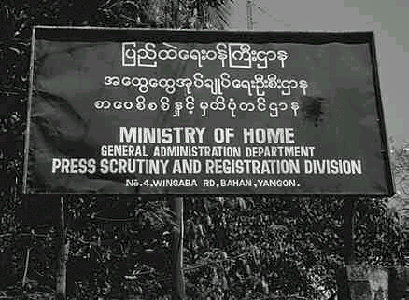
The 1962 Printers and Publishers Registration Law was brought in soon after the 1962 coup to limit and control what was at the time one of the most free and prolific media industries in Asia. The law established the Press Scrutiny Board (PSB) which must censor all books, films, magazines and songs before publication. It also limits the number of copies which can be published. In June 1989 the law was amended to increase the punishments for non-compliance to imprisonment for up to 10 years and fines of up to 30,000 kyats.
11.3 State of the ‘Freedom of Press’ in Burma
SPDC increases surveillance of writers
In February 2000, some writers, poets and novelists met in Rangoon and secretly formed the Litterateurs Association to resist the junta’s persecution of the intellectuals in the country. This association released a statement in May 2000. According to the statement, in the first week of May 2000, Major Aye Tun, a director in the Home Ministry, summoned editors and publishers of magazines and journals and threatened that those periodicals which publish materials that violate the policies of the military junta would be closed and the author, editor and the publisher would be sentenced minimum one year and maximum seven years of prison term. Major Aye Tun is also the Chairman of Press Scrutiny Board (PSB). The editors and publishers were forced to fill up the forms in the meeting itself giving their bio-data in details, undertaking not to print or publish articles, poems, and cartoons critical to the military government and even pledging to disclose the bio-data and activities of those authors wanted by the military intelligence. The statement further said that since after news of the formation of their organization is leaked out, the publishing industry in the country has been facing ever-increasing surveillance from the powerful military intelligence.
It has to secure clearance not only from Press Scrutiny Board
but also from the military intelligence causing heavy expenditure, harassment
and delays. Even after obtaining clearance from the censor board, books and
magazines are subjected to cuts of entire paragraphs by the military
intelligence if they feel that they contain materials critical to the
government. In many cases, the printing of the book has to be repeated and
clearance again sought from the military intelligence as the cuts were so badly
made that the books cannot appear without torn pages and pasting. This process
results in delays by weeks and months. The Litterateurs Association asserted
that the Burmese literature fraternity is in the worst era in history,
struggling hard for survival "against the ruthless aggression, strict
and draconian rules laid down and the verbal or written decrees issued by the
junta….."
(Source: Mizzima News Group)
SPDC control of the only privately owned English newspaper
Launched on March 6 2000, the full-colour weekly ‘Myanmar Times’ promised "independence, authority, and integrity" in reporting. However, even this paper is accused of being tightly controlled by the regime. Sonny Swe, 30-year-old son of Colonel Thein Swe of the Ministry of Defense’s Office of Strategic Studies (OSS), is a partner in the Times. Critics of the paper believe the regime is using the Myanmar Times to improve international acceptance of the country, and that the high price of US 2$ is prohibitive to most of Burma’s population. There have been no articles published since the opening of the weekly which have been critical of the SPDC, instead most articles openly praise SPDC policies, reminiscent of the SPDC own State-controlled media.
Plan for new SPDC controlled English TV channel
At the end of 2000, SPDC announced an ambitious plan for a new English-language television channel, MRTV3, which would be beamed around the globe via satellite to present news and documentaries about life in Myanmar to a world audience. U Khin Maung Htay, Director-General of the Myanma Radio and Television Department said that, "The project has been aimed at giving an objective response to certain western media’s reports about Myanmar."
SPDC bans news of national football team’s loss
In October 2000, the Burmese national football team failed to reach the semi-finals in the 2000 Asian ‘Tiger Cup’. The news of the loss was not reported in Burma, although football fans inside Burma were disappointed when they heard the news on short-wave radio. The Burmese press had been effectively banned from reporting the loss. Shortly after the team lost all hope for the semi-finals after the Indonesia match, the official censorship board in Rangoon quietly issued an order that insisted, "News about the Burmese national football team must be written in constructive ways." Journalists working for local sports journals simply avoided writing about the Tiger Cup matches. "We know we could be shut down," said an editor from one such journal. It was speculated that the SPDC secretly hoped the team would reach the semi-finals to boost national morale. Weeks before the tournament, Colonel Thaung Htike, the head of the Burmese team, received the blessings of Lieutenant-General Khin Nyunt in Rangoon. (Source: Irawaddy)
Prominent writer Tin Maung Than flees to Thailand due to SPDC pressure
In November 2000, writer, noted intellectual and social commentator Tin Maung Than, age 46, fled with his family to Thailand. Tin Maing Than was the editor of a private magazine called "Thinbawa", or "Your Life". Since starting work with the magazine in 1992, he had avoided political subjects and submitted everything to the official Press Scrutiny Board for censoring before publication. The magazine concentrated on health and family issues, writing about the HIV/Aids epidemic and other social problems while steering clear of discussing government policies. His writings also include several books, novels and educational works.
Tin Maung Than is a medical doctor by training and a journalist by choice, he also earned an MBA from Harvard University in 1998. He was involved in the 1988 popular uprisings and he admits to having once been a member of NLD, which he left in 1990.
In August 2000 he was detained and interrogated, along with another publisher, for five days by MIS agents in Rangoon because he made a handful of photocopies of a speech by the former deputy minister for economic development, Brig-Gen Zaw Tun, that was highly critical of the government’s economic policies. The speech, which was eventually picked up by news agencies abroad, led to Zaw Tun’s removal from office and was a major embarrassment for the junta. After five days of continuous questioning, Tin Maung Than admitted to having copied the speech and signed a "confession". As part of the confession he had to state that he knew he would be prosecuted if intelligence agents later concluded that the speech and its release abroad was part of a "political plot". The confession was an open invitation for the military to arrest him at any time.
Fearing arrest was imminent, he left his work at the magazine and planned his escape. Shortly after his arrival in Thailand, his magazine was denied the re-issuing of its yearly liscence. (see below) Tin Maung Than is now living in exile.
‘Thintbawa’ monthly journal stopped from publishing
Following the departure of ‘Thint Bawa’ editor, Tin Maung Than, state-owned newspapers in Burma attacked the journal and Tin Maung Than. Members of the journal’s editorial team were interrogated, and the office closed. The journal was able to publish 2 issues following the incident, under editor Kyaw Win. Yet this proved to be short-lived as there have been no further publications of the ‘Thint Bawa’ journal. The publishing license, which is granted on a yearly basis, was not renewed for the journal for 2001, and the journal was, in essence, terminated. The journal’s first issue was in 1953 and was considered to be one of Burma’s most respected. The ‘Thint Bawa’ had been previously put under scrutiny in 1995 when 58 out of 160 pages had been torn out of a cover story about the education system in Burma, and in 1996, when 72 pages were ripped out of a story about the history of press freedom.
Shan group threatened by MI over a statement
On July 27, 2000, the Shan State (Rights) Committee, an affiliated group under the Shan State Peacekeeping Council (SSPC) issued a statement accusing the SPDC of systematically engaging in an ethnic cleansing programme. This statement was in response to the 2 massacres that occurred in Shan State in May 2000 committed by troops from SPDC LIB 246 and 524 in Kunhing Township. The statement urged the immediate action against those responsible for the two killings. The leaders of the SSPC were then summoned by Brig-Gen Kyaw Win, deputy director of the DDSI. On September 19 2000, he received Sao Shwe Kyi and Sao Kun Yit, chairman and secretary, respectively, of the SSPC and ordered them not to publish any statement that could cause misunderstanding between the army and the people. He also threatened them that if it happened again, the next time it would not be easy. Chairman Sao Shwe Kyi replied that the SSPC could not stand idly by while its own people in the Shan State were being massacred, and that the statement was issued by the popular demand of the people.
The SSPC was formed with a faction of the Shan State Army SSA and the Shan State National Army SSNA in 1996. Due to the threat by the SPDC MI, as of November 30 2000, it was not known whether the SSPC would withdraw its statement or not. (Source: DVB)
11.4 Arrest of Journalists
In the year 2000 the junta continued to strictly censor the media and punish severely those not in alignment with their censorship boards. This is contrary to a document dated 18 January 2000, in which the United Nations Special Rapporteur for the promotion and protection of the freedom of expression and opinion emphasised that "imprisonment as a punishment for the peaceful expression of an opinion constitutes a serious violation of human rights."
In 2000, RSF asked General Maung Aye to secure the release of the twelve journalists and editors they list as currently being detained. Several of these prisoners, among them Win Tin, San San Nweh, Soe Thein and Sein Hla Oo, are in a very poor health condition.
The arrest and long-term imprisonment of Aung Myint (a) Phya Pon Ni Loan Oo
On September 14 2000, PyarPhone NiLone Oo, or Aung Myint was arrested along with 5 other members of the NLD, including his assistant Kyaw Sein Oo, (see below) following a NLD member’s statement of 12 September regarding the military’s prevention of Aung San Suu Kyi’s travel at Dala. The 6 were arrested by MI Unit 14 and detained in Insein Jail. The military court accused the journalist and his assistant of distributing information regarding repression of the NLD to international press agencies and to Western diplomats. On December 14 2000, they were tried in a closed session military tribunal in Insein Jail. PyarPhone NiLone Oo was sentenced to a 21-year prison term for violations of the 1975 State Protection and 1950 5-J Emergency Provision Acts.
Aung Myint, now in his fifties, started his career at the official newspaper "Botahtaung" in the 1980s writing satirical articles and poems. From 1983 to 1988, he worked for "Pay-ful-lwa" (The Message) magazine directed by Tim Moe, a journalist who spent several years in jail and now lives in exile. The monthly was banned in 1990 by the army. In 1988, Aung Myint joined "Cherry" magazine. In 1997, the journalist was arrested by the military and sentenced to two years in jail. After his release, the authorities prohibited him from working for "Cherry" magazine. In 1999, he became the head of the NLD’s information department in Rangoon. His name is banned from all Burmese publications. Recently, he wrote an article entitled "Where are the freedom of movement and freedom of expression in the Golden Land?" that had an underground distribution among NLD members.
The arrest and imprisonment of Kyaw Sein Oo
Kyaw Sein Oo, an NLD member who had assisted in printing a statement about the 9-day stand-off between the junta and Aung San Suu Kyi was sentenced to a 7-year prison term under the Printers and Publishers Registration Act. He had been arrested along with PyarPhone NiLone Oo and 4 other NLD members on September 14, 2000 and was sentenced on December 14, 2000.
11.5 Control of Computer Technology and Communications in Burma
Under existing regulations, only Myanmar Post and Telecommunications (MPT), a state agency, is allowed to provide post, telecommunications and e-mail services. SPDC released a revised set of its 1996 Computer Science Development Law in early 2000 in an attempt to remind people of the penalties associated with uses the junta deems illegal. The regulations stipulate that all computers, fax machines, and modems must be registered with the government, with prison terms of between 7 and 15 years for offenders. On May 13 2000, Brig-Gen Win Tin, minister of communication, post and telegraphs, ordered a halt to unauthorised e-mail and telephone services. In the year 2000 the SPDC made attempts at improving its E-Technology image, yet it has failed to provide internet access to the general public. In 2000, RSF again described Myanmar as one of the world’s "20 worst enemies of the Internet."
The Internet and Electronic Mail in Burma
In January 2000, the MPT installed an internet server and became the sole internet provider in the country, restoring service to the e-mail users cut off by the government in December 1999. (The SPDC had abruptly ordered 5 private e-mail providers to stop operations, their executives and technicians were questioned and equipment confiscated.) With the new MPT regulations, individuals will still have to obtain a license from the MPT and the government will monitor content for any "anti-nationalistic" sentiment. On January 20, 2000, the MPT issued regulations for the internet in which politics were explicitly banned.
(
see Appendix #2)The licenses granted by the MPT are still out of reach for the common citizens of the country. First priority is given to government officials and organizations, then to foreign embassies and foreign businesses and finally to certain local businesses. The cost of obtaining a license from the MPT is another encumbering factor. The new MPT rates see subscribers having to pay a total of US$ 390 for hook-up fees. Installation does not include the price of a modem which retails for about US$100 in the capital, or the Email connection charges, which have been set at US$3 an hour.
There are currently no public places from where internet can be accessed. In mid-October 2000, ‘iCafe’ opened in Rangoon, yet another internet café without access to the internet. If an individual wants to send an e-mail, they must take the information on a floppy disk to an office that has an e-mail server and then pay $1 per page. All the data has to be text only. Access to the World Wide Web beyond e-mail will remain restricted. Currently only the government, 10 state firms and a few select government insiders are allowed Internet access.
On November 24, 2000, the SPDC signed an accord with the other leaders of ASEAN countries, an e-ASEAN Framework Agreement, to promote electronic commerce. Brigadier General David Abel, when questioned by reporters on what would be the requirements to have Internet access in his country, said that Myanmar was in the process of drawing up new laws covering the Internet. He said, "We have the Net set up in Myanmar but we don’t have the law yet…..." He also added that the use of the telephone and fax machines would have to be worked out according to the law.
Lt. Col. Hla Min commented on internet censorship by stating, "Why would we want to collect garbage, as it were, in our own homes? We want to use the Internet for constructive purposes to improve the knowledge of our people, not as a platform for troublemakers to create problems." The regime is not oblivious to the importance of having a Net presence, however, and has their own "official" web-site for Myanmar, at www.myanmar.com.
Fax and other Communications
The SPDC has made international calls too expensive to afford on a regular basis. The average income of a government employee in Burma is $25 a month; applying for an international calling facility costs $1,000 and calls to the United States are as steep as $50 for five minutes.
SPDC restrictions of cordless phones
In June 2000, MPT announced that all users of non-registered cordless phones in the country would face three years imprisonment or a fine of 30,000 kyats or both. On June 19 the department ordered all illegal users of the cordless phones to surrender the devices within 30 days.
Radio Broadcasts
On January 19, 2000, U Than Chaun of No 3 Saing-kone quarters, Shwe-goo township, Kachin State was charged sentenced to suffer two years rigorous imprisonment under Section 505 (b) of the Penal Code. U Than Chaun had been a proprietor of a coffee shop, and on December 18,1999 the Shwe-goo Police arrested him and seized the radio in the coffee shop because the radio had been tuned in to Voice of America (VOA) (Burmese Section). While in prison, his distraught wife who suffered from heart ailment and high blood pressure passed away. U Than Chaun who is 70 years old suffers from medical problems. (Source: NLD)
On April 19, 2000, Maj. Aung Min from Brigade 66 and officers from LIB 10 under control of LID 663 entered Wah Mu Mah Lay Leh and May Cho villages, Papun District, Karen State and seized the villager’s radios and banned them from listening to BBC and VOA broadcasting services. (Source: KWO)
On June 2, 2000, SPDC and DKBA officers led by Bo MoJo arrested U Tin Tun of Papun Town, Papun Township, Karen State for listening to a VOA radio broadcast in his home. He was fined 12,000 kyats and sentenced to 5 days in jail. (Source: MICB)
On July 27, 2000, 3 Muslim villagers, U Hla Myint, age 42, U Noor Islam, age 28, and U Khin Win, age 25 from Latpun village, Kyauk So Township, Mandalay Division were arrested while listening to a RFA broadcast by the police and USDA officials led by U Myint Aung. They were accused of having contact with the NLD and handed over to MI officers who put them in Kyauk Se jail. (Source: MICB)
On August 20, 2000, Deputy Commander Brig-Gen Tin Latt and party visited the 104th Light Infantry Battalion based at Tawgye village in Tavoy District and met with junior officers and soldiers. The deputy commander blamed broadcasts from the foreign radio stations for the restiveness within the defence services and strictly forbade all dependents and rank and file inthe battalions and units from listening to foreign radio stations such as the BBC, VOA, DVB, and RFA. The deputy commander issued an order saying that those who listen to these radio stations will be severely punished.
11.6 State of the Freedom of Speech in Burma
As there are laws which clearly prohibit people from saying anything in opposition to the government, the freedom of speech is a definite void in the civil and political rights of the people of Burma. The prevalence of MI has caused people to be cautious in what they say, and open verbal support of groups such as the NLD can, and has led to imprisonment.
(See the chapter on the freedom of association and assembly for a report on an SPDC officer’s wife who was imprisoned for vocally supporting the NLD in June 2000)Brig-Gen Zaw Tun dismissed after criticizing SPDC economic policies
On July 7, 2000, Brig-Gen Zaw Tun, deputy minister of national planning and economic development, in a discussion meeting with businessmen, criticized the existing economic policies and admitted the shortcomings. He openly spoke about the exaggerated growth indicators of the country and the collusion between some entrepreneurs and Defence Ministry personnel to monopolize the market. He said the military’s policies "lacked transparency and consistency" and were aimed primarily at cementing its iron grip on the nation. Brig-Gen Zaw Tun has the reputation of being frank in his meetings with Sr Gen Than Shwe and Gen Maung Aye. Brig-Gen Zaw Tun was summoned and interrogated by the military intelligence after the discussion meeting. Details of his discussions were leaked to the outside, and on August 9 2000, an officer from the MI delivered a retirement letter to Brig-Gen Zaw Tun. Brig-Gen Zaw Tun cheerfully told the military intelligence officer who delivered the retirement letter, " I am prepared to resign and had expected this. I spoke the truth and spoke constructively." According to his close associates, he gathered his personal effects and bade farewell to the departmental personnel with a parting shot: I am the poorest among the generals. In addition to his dismissal, he was also stripped of his home and other benefits that came with his job and military rank of Brigadier General. The sacking had not been officially announced as of September 2000. (Source: DVB)
11.7 State of the arts and freedom of expression in Burma
Writers, poets, film-makers, actors, musicians, painters and other artists in Burma are subjected to numerous restrictions which seriously inhibit their freedom of expression. The paranoid censorship of the PSB censorship has stilted a creativity and variety of art that at one time was famous in southeastern Asia. The censorship board ensures that nothing produced in Burma or imported from outside the country can be interpreted as "anti-military" or "western-influenced" which could be detrimental to "national security" or "culture. " Such censorship is in direct opposition to the very nature of art and artistic expression, as any change to the original piece can potentially ruin a masterpiece. The SPDC lavishes awards, luxuries, and chances to go abroad to artists who choose to be pro-military and who stay away from expressing any ideas deemed political, and those who refuse are isolated and unable to get their artistic work in the public eye.
Censorship of Film and Television and restrictions on actors/actresses
Film-makers in Burma are required to submit the script to the PSB, and the censorship boards are notoriously sensitive to what might be interpreted as "anti-regime." The filmmakers are then restricted in how much film they can buy, and after the shooting, the completed film is again presented to the censors before it is released. Film-makers are required to occasionally produce government propaganda films, and likewise actors and actresses who work in these propaganda films receive benefits and recognition. It has been the case that actors who have participated in pro-military films have won the Burmese academy awards. It is common also for actors and actresses to be seen in posters or TV specials, which promote the army, for beautiful young actresses to be dressed in military uniform on calendars saying, "We’re with you!" Such actors and actresses are given opportunity for great popularity and wealth.
The 2 Television stations in Burma are known for their propaganda, and most of the programming is dedicated to showing the "achievements" of the military. There are a limited number of Chinese TV programs and foreign cartoons which make their way onto the airtime. Foreign films are also subject to censorship:
Destruction of videotapes and other items
On April 7, 2000, authorities destroyed thousands of videotapes, videodiscs and frowned-on fashions ahead of the traditional New Year. The military government’s official newspapers reported that 14,305 videotapes, 36,132 videodiscs, and other items, including flags and masks, were put to the torch in a police compound while high level officials of the military regime looked on. Youths in recent years have taken to wearing Halloween masks and wrapping themselves in U.S. and British flags during the holiday. Col. Than Tun, head of the Office of Strategic Studies, part of military intelligence, said that illegally imported tapes and disks might inspire youths to copy bad behavior and harm Myanmar’s culture. Over the past week, newspapers have carried warnings to preserve "national culture" and avoid "decadent culture." (Source: AP)
Censorship of Music and Musicians
Musicians face many difficulties in finding ways to express themselves through their music in Burma. The economic situation has made music a formidable occupation as instruments and music lessons are prohibitively expensive for all but the people belonging to the wealthy military elite, and finding venues at which to play is a rarity. Lyrics to music are put through the same censorship as other writings, and even the musical style itself is often censored. Rock and Roll music is now common in Burma, and other western influenced styles, such as rap, are making their way in, but most western music is not available in Burma. Instead, Burma has an active "copy" industry, where original western melodies are converted into Burmese lyrics deemed un-harmful to the regime or the "national culture." The regime continues to monitor dress styles of musicians, and forbids them to dance on stage. The regime encourages (through the offering of privileges) musicians to sing government and pro-military songs and sing at government sponsored events, and those who try and refuse are threatened with not being able to have their music produced.
U2’s newest album banned in Burma
In mid 2000, U2’s new album, ‘All That You Can’t Leave Behind’, was banned in Burma by the authorities because of a song entitled "Walk On", which is dedicated to Daw Aung San Suu Kyi.
Censorship of Painting, photography, sculpture, other visual arts,
and performance art
Painters, photographers, sculptures, and other visual artists are also subjected to military scrutiny. As visual art played an important role in the 1988 uprisings, along with the other arts, the regime has aimed to put an end to art in the revolution. After the military re-took power in 1988, the fine-arts building at Rangoon University was destroyed and the fine arts program discontinued. Today it is only possible to study visual arts under private tutorship, or at the Cultural University in Rangoon. The Cultural University (CU), a military institute, is a prime example of the situation of artistic expression in Burma. According to the ABFSU 2000 report, ‘The Current Education System in Burma’, the CU only accepts 100-150 students per year, who are required to be USDA members. The authorities at the Cultural University admit students to CU according to such requirements, without first learning of the applicants’ artistic qualities. In addition, the Minister of Culture of the SPDC has told CU students that if they do not participate in any student strikes or demonstration, the regime will ensure them positions as gazettes officer in government administration. In the 1998-99 academic year, 27 students were enrolled for the Arts (Music), 48 Students were enrolled for the Arts (Performance), 29 students were enrolled for the Arts (Painting), and 5 students were enrolled for the Arts (Sculpture). At the CU, students of Music and the Dramatic Arts are denied the chance to study international music and western plays, according to the prohibitions of the military regime. The professors, lecturers and schoolmasters of the university are academics from the elite military society and military servicemen.
According to research done by Christina Fink for her book, ‘Living in Silence’, art exhibition organizers are required to submit a detailed written description of each of the art items to the Information Ministry prior to any art exhibition in Burma. Then, before the exhibition opens, the authorities come to do a final inspection. If any of the art pieces are considered to be "subversive", the art is not only taken down or away, but also stamped "censored" on the art work itself.
Performance art in Burma has also been restricted. The SPDC has promoted dance as part of its campaign to retain "national culture", yet dancers are only given career opportunities in such government sponsored campaigns or events. Comedy also suffers under the military eye, and comedians who make jokes, however innocent, that are considered to be "disruptive" are often threatened, interrogated, or even detained.
Other acts infringing on the freedom of expressionBan on displaying foreign flags
On March 24, 2000, Nine 10th standard students were arrested and sentenced to three months in jail. They were arrested as a result of an incident on March 13, in which they had led a group of motorcyclists around Mergui, Tenasserim Division, with US flags tied to their motorcycles. The authorities took the incident as an act of political defiance aimed at disparaging the image of the military government through nonviolent means. The SPDC then issued a decree banning the display of foreign flags on festival pavilions and cars and prohibiting the wearing of flags as headbands during the Thingyan [Water] Festival. The SPDC also put its Union Solidarity and Development Association members and military intelligence units on alert to watch foreign revelers participating in the Water Festival. (Source: DVB)
Appendix # 1
On January 20 2000, Myanmar Post and Telecommunications [MPT] issued regulations for users of its Internet service. They are:
- Any writings detrimental to the interests of the Union of Myanmar are not to be posted;
- Any writings directly or indirectly detrimental to the current policies and secret security affairs of the government of the Union of Burma are not to be posted;
- Writings related to politics are not to be posted;
- Only the person who is given Internet account is to use the Internet; no other persons is allowed to use the Internet;
- The person who is granted an Internet account is held responsible for all Internet use on that account;
- A person with an Internet account is prohibited from hacking the web and entering and destroying the security system of MPT;
- Hacking the web and entering and destroying the security system of other Internet users is prohibited;
- Persons who hold an Internet account are forbidden to misuse the account of other Internet users;
- Internet users are to inform MPT of any threat on the Internet;
- Internet users are to obtain prior permission from the organization designated by the state to create web pages;
- Applicants for an internet account are held accountable for the veracity of facts contained in the application form;
- MPT has the right to amend and change regulations on the use of the Internet without prior notice;
- Application can be filed for compensation for any damage or loss;
- Internet use will be terminated and legal action will be taken for violation of any of these regulations.
|