ISBN 974 – 90881 – 1 – 5
Printed
in Bangkok
|
ISBN 974 – 90881 – 1 – 5 Printed
in |
Smokescreen
The generals are pulling every trick out of the hat that
they can to block democratic changes and national reconciliation in
Meanwhile, the SPDC is deflecting attention away from the
home front by fueling the border battle with
Although Daw Aung San Suu Kyi is allowed to travel, there are conditions placed on her movement and has been subjected to harassment and inappropriate conduct by military officials. The SPDC has been releasing trickles of political prisoners and been adorned with praise, yet when citizens asserted their freedoms, the SPDC demonstrates their intolerance with a rash of detentions and arrests.
SPDC’s powerful
Despite fancy word games and clever diversions, the reality is that the SPDC has yet to show any proof of good faith or commitment to democracy and national reconciliation. It is time to put out their fire of deceit, clear the smokescreen and demand genuine and irreversible actions.
DEMOCRACY & DIALOGUE
______________________________________________________________________
* Improving R Stagnant * Deteriorating
Stonewall
Nearly 5 months after Daw Aung San Suu Kyi declared that the “confidence building stage” was complete and SPDC launched promises of “turning a new page,” nothing has happened. No talks have taken place and no timeline for dialogue or concrete developments have been set. As NLD Spokesman, U Lwin said, “Of course we have had talks. But this has been a confidence-building period…and it has not been very easy. Maybe the other side is counting that as a political dialogue, I really don’t know.”[1]
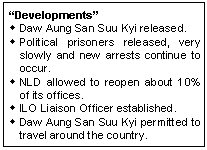 It is questionable how much progress can be
made when the SPDC continues to deny all types of oppression and violations.
The Myanmar Information Committee, a mouthpiece of the regime, said, “They
[international community] have falsely accused Myanmar of infringing democratic
practices, violating human rights, of using forced labor, of producing narcotic
drugs, dealing in human trafficking and mistreating the ethnic races.”[2]
With agreement from Malaysian Prime Minister Mahathir Mohamad, the SPDC said
that democracy has to be implemented slowly or it could become anarchy. Daw
Aung San Suu Kyi rejected that notion and said it was “patronizing to the
people of
September marked the 14-year anniversary of the NLD and of the military’s coup and stranglehold on power. To mark the occasion seasoned journalist Larry Jagan reported that NLD spokesman U Lwin said, “Everyone knows the dialogue process has stalled,” and a senior SPDC official saying, “Gen Than Shwe intends to hold on to power for another 10 years… his main strategy is to drag the dialogue process out and retain power as long as possible.”[4]
Razali – Inside negotiator or SPDC’s fool?
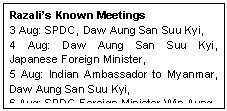 UN Special Envoy Tan Sri Razali Ishmail made
his 8th trip to
Razali
mentioned the idea of Daw Suu traveling to Asean countries based on a mutual
agreement between the SPDC and Daw Suu to ensure her re-entry into
Tripartite
There has been no reason to believe the SPDC has any plans to enter into tripartite dialogue. However, some ethnic nationality organizations continue to form greater alliances to strengthen their voices as well as relations between ethnic nationality groups.
United Nationalities Alliance (UNA) was organization formed in July and represents the Zomi National Congress (ZNC), Chin National League for Democracy (CNLD), Mon National Democratic Front (MNDF), Arakan League for Democracy (ALD), Karen National Congress for Democracy (KNC), Kachin State National Congress for Democracy (KNCD) and Karenni State All Nationalities League for Democracy (KNLD). It is a temporary organization to provide a mechanism to represent ethnic nationalities in a tripartite dialogue[02]. On August 21, UNA met with Daw Aung San Suu Kyi and NLD leaders to develop a working relationship between the organizations[03].
Working for National Reconciliation
Daw
Aung San Suu Kyi displayed her willingness to negotiate with the SPDC when she
accepted their invitation to visit a bridge and hydroelectric power plant
during her trip to
On
July 22-23 Daw Suu made a trip to
Daw
Aung San Suu Kyi continues to emphasize individual responsibility for creating
positive developments in
Political Freedoms
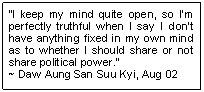 It appears that only Daw Aung San Suu Kyi and
the NLD are allowed political freedoms. U Lwin said, “We don’t even have full
rights yet and if we talk about the others like the Shan and other
nationalities’ political movements, they have been deregistered. So it will be
a case of reconsidering those registrations.”[8]As
of July 11, only 50 of the NLD’s 500 offices have been permitted to reopen.[9]
Daw
Suu is still required to give 12 hours notice before traveling to
Political Activity Resurfacing Inside
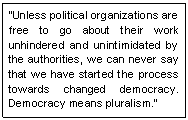 Shortly after Daw Aung San Suu Kyi was
released she said, “The National League for Democracy (NLD) cannot do much for
the people at this time…it is up to the people themselves to also help.”[11]
It was reported that in July students from various universities began
collaborating to revive the student movement inside
Reportedly,
small student gatherings, focusing on the political situation of
These
actions demonstrate the growing outrage and discontent with the lack of
progress towards democratization and reconciliation inside
Political Prisoners - Releases Just A Public Relations Exercise
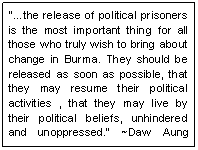 The release of political prisoners is an
expectation and a basic step to begin the process of democratization and
national reconciliation that the junta pretends to be committed to. The
international community should recognize that political prisoners are being
used as pawns to influence their relations with the junta. As long as the SPDC
has political prisoners in custody, they can stall on making concrete
developments towards democratizing
The SPDC continues to release trickles of political prisoners coinciding with international visitors and meetings. The SPDC appears to time these releases to lessen the condemnation and increased action threatened against the SPDC.
New Arrests
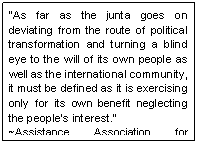 While there have been releases the rate of
current arrests related to political activity is rising at an alarming rate.
Between July and September 2002, the SPDC released 87 political prisoners but
made at least 53 arrests or detentions. The real number of arrests and
detentions maybe higher, but with no freedom of press in
[See Human Rights for more discussion on political prisoners]
Jun 15: U Htwe Myint was informed that his prison
sentence due to expire on
Jul: Thaw Thaw Myo Han arrested for his part in publishing the “Universities Literary Journal” and was later released.[16]
Jul: NLD members Aung Thein and Kyaw Naing Oo arrested and beaten for possessing the “New Era Journal” and sentenced to 3 years imprisonment.[17]
Jul 9: 10 NLD members released: U Htay Lwin,
Daw Hla Hla Win, U Kyaw Kyaw, U Ba Soe, U Aung Kyaw Soe, U Yar Tin, U Min Aung,
Daw Tin Win Yee, U Soe Naing and U Thant Sin.[18]
Jul 28: 32 released including 14 NLD members. Largest amount freed at one time since the talks began[19]
Jul 29-30: ASEAN Ministerial Meeting.
Aug 2-6: Razali visits
Aug 3-5: Japanese Foreign Minister Yoriko Kawaguchi visits
Aug 9: 14 released. NLD members released: U Zaw Win Tint, Ko Win Tun, Ko Than Swe, Ko Myint Aung, U Than Tun, and Ko Win Zaw. The released students Ko Aung Kyaw Zaw, Ko Zaw Myint Htwe, Ko Thiha, Ko Lay Hlaing Oo, Ko Chan Nyein Wai, and Ko Thet Khaing. The political affiliations of Daw Le Le Win and Daw Thawda are not known.[20]
Aug 16: 5 released including CRPP member U Aye Thar Aung.[21]
Aug 17: Thaw Thaw Myo Han was re-arrested and Htoo Kyaw Win was arrested for their connection with the illegal university student publication “Universities Literary Journal” and suspicion of planning protests.[22]
Aug 18: Thet Naung Soe and 17 others, including Khin Maung Win and Taung Hteik, were arrested arrested for non-violent protest. Thet Naung Soe and Khin Maung Win remain in detention and rumored to have been sentenced to 7 years imprisonment each.[23]
Aug 18-19: Malaysian Prime Minister Mahathir visits SPDC.
Aug 23: 20 students released after a few days of detention. [24]
Aug 29: Reported that 44 women prisoners were released on “humanitarian grounds.” These women were not political prisoners. [25]
Sept 5: NLD members and 1 student released: U Tin Hlaing, Myo Thant, Tint Tint Han, Khin Swe Yin, Pyi Thein Soe Oo, Khin Zaw Aung and Soe Htet Khaing. The student released was Yee Yee Tun.[26]
Sept 8: European Union (EU) team visited to collect information for the Oct 29 EU policy review meeting.
Sept 13: Senior NLD members detained: U Sai Pa and U Saw Nan Ti.[27]
Sept 18: 14-year anniversary of military coup that was marked with significant international condemnation.
Sept 23: 18 released. NLD members released: Kyaw Soe, Khine Ko Oo, Thein Aye, Kyaw Khine Win, Soe Than, Aye Myint, Daw Khin Mar Yee, Daw Ei Shwe Sin Nyunt, Daw Thandar Oo and Daw Thin Aye. Also released were Aung Aung, Nyi Nyi Htwe, Myo Hto, Sein Hlaing Tun, Ye Lin Aung, Win Min Thein, Aung Nay Myo and Daw Yu Yu Hlaing.[28]
Sept 25: 30 activists arrested. It is not know how many remain in custody.[29]
Sept 27: NLD 14-year anniversary
MILITARY THREAT
______________________________________________________________________
R Strengthening * Stagnant * Deteriorating
Growing Military Power
Burma’s military force is the second largest in the region and actively growing and developing more capabilities. The International Crisis Group (ICG) released a report, “Myanmar: The Future of the Armed Forces,” on September 27[08]. It looks at the structure and role of the Tatmadaw (armed forces), the future view of the military from the NLD perspective as well as possible compromises and problem areas.
Burma’s armed forces number about 400,000. The SPDC considers the Myanmar Police Force, Myanmar Red Cross and Myanmar Fire Brigade as part of their “Defense Services” and provides basic military training to members.[30] The Auxiliary Fire Services, with more than 200,000 personnel and only 158 fire engines, are being transformed into a structure like the armed forces.[31]
SPDC naval bases at Munaung, Hainggyi, Katan Island, Zadaikyi Island and Mergui are reportedly being upgraded by China with more than US$2 billion. Some SPDC military officers are currently receiving training at Pakistan’s Military Staff College and technical training to operate tanks, that SPDC apparently acquired from China in 2002. China, Poland, Yugoslavia, Russia and Pakistan have all been involved in training SPDC military officials.[32] It is known that Burma’s main arms suppliers are China, Yugoslavia, Poland, Russia, Singapore, Pakistan, North Korea, Vietnam and Israel.[33] It has been reported that SPDC is modernizing its weapons factories with the help of China and Singapore.[34]
The ICG report also says “…the military has the firepower and ability to deal with internal uprisings and with ethnic insurgencies. It is also in a much better position to fight on multiple fronts at the same time.” In September it was reported that over 1,000 acres of land was seized in Mon State to build 4 more heavy artillery bases. The new bases will be near Kamarwet Village in Southern Mudon Township, Waegalee Village in Southern Thanbyuzayat Township, in Northern Ye Township and Southern Ye Township.[35] While the number of combat units have increased, few units are operating at full strength.
The military has “…a modest capacity to conduct information warfare. Also, Myanmar’s electronic surveillance capabilities have been enhanced significantly, at both the strategic and operational levels[09].” The Defense Ministry has been attempting to gain sophisticated military satellite communications to cover the whole country, it is unknown if this has been achieved.[36]
In mid-August, 5,000 electronic passports with bio-metric features were issued under a pilot program. SPDC’s contract with Iris Corporation, that UN Special Envoy Tan Sri Razali is Chairman and a stockholder, which can further enhance SPDC’s ability to track and monitor the people of Burma.
Coup Plot Trial - Round 1 Over
Ne Win’s family, U Aye Zaw Win, Aye Ne Win, Kyaw Ne Win and Zwe Ne Win, all pleaded not guilty to the various charges including, plotting against the state, enticing members of the military to stage a coup on their behalf and economic crimes[010]. The sentences rendered in late September were harsher than many people expected. Ne Win’s family reportedly filed an appeal. It is unlikely that any others implicated on charges were afforded rights to appeal their verdicts.
Despite the innocence or guilt of the accused, they were not afforded a fair or just trial. Nearly all the evidence was circumstantial, witnesses were of questionable credibility, the supposed mastermind, Sandar Win, was not even brought to trial and the trial was only open to a group of handpicked diplomats and journalists.
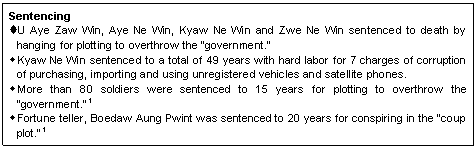 Whether this trial was about business, power
or crime, it was obviously a way for the “Big 3,” Sr-Gen Than Shwe, Deputy
Sr-Gen Maung Aye and Gen Khin Nyunt, to reassert their power and send a strong
message to anyone with a will to challenge them or their policies. Josef
Silverstein, an analyst of
Reshuffle – Internal Distress or consolidation?
Some battalions are locking up soldiers’ weapons at night due to increased desertions, usually among lower ranks. In July, interviews with defected SPDC soldiers reported forced recruitment, bribery, forced portering, brutal living conditions, severe beatings, illness and death within the ranks. They said soldiers are forced to commit human rights abuses upon each other, on villagers and ethnic nationality resistance groups, and that recruiting child soldiers is common. Suicide is a prevalent within the ranks. It was reported that there is support for Daw Aung San Suu Kyi, especially among the lower ranks.[38]
The SPDC underwent some restructuring which has been seen as another way for the top leadership to centralize power. On September 14, SPDC announced a long list of promotions, new assignments, reassignments and people who were “allowed” to retire.[39] These promotions are seen as a way to pacify people and avoid power challenges. A few highlights:
w Army Commander-in-Chief General Maung Aye was promoted to Deputy Senior General and Lt-General and Chief of Military Intelligence Khin Nyunt was promoted to General.
w Maj-Gen Saw Lwin for Ministry of Hotels & Tourism & Maj-Gen Tin Ngwe for the Prime Minister’s Office, were both “allowed” to retire.
w Brig-Gen Thein Zaw assigned as Minister for Communications, Post & Telegraphs concurrently assigned Minister of Hotels & Tourism.
w Maj-Gen Kyi Aung reassigned as Minister for Culture from Minister for Information.
w Brig-Gen Kyaw Hsan assigned as Minister for Information.
w Maj-Gen promoted to Lt-Gen: Kyaw Win, Khin Maung Than, Maung Bo, Aung Htwe, Ye Myint, Thura Shwe Mann, Soe Win, Thein Sein, Thiha Thura Tin Aung, Mynt Oo and Tin Aye.[40]
Salaries for armed forces personnel have risen, widening the already large gap with civilian incomes[011]. Sr-Gen, Deputy Sr-Gen and General’s salaries were raised from 100,000 kyat/month to 150,000 kyat/month. Even within the military there is gross disparity of salary, with all ranks below Maj-Gen receiving tiny raises and recruits salary remaining the same at 3,500 kyat/month. However, deserters report that after the SPDC’s various “deductions,” most officers only receive about half their salary.[41]
Backstabber
The United Wa State Army (UWSA) is known to be close
allies and conglomerates of the SPDC. In September, the UWSA complained to
Military Intelligence (MI) that the police unit in Tachilek,
Na Sa Ka Border Security Forces
Little is formally documented about the SPDC’s Na Sa Ka
Border Security Forces, but they are well known for their human rights abuses
and corruption. Most reports of their brutalities and corruption come from
w In
Myawaddy, near the Thai-Burma border, forces are accused of abducting and
raping 3 women for 2 days that were repatriated from
w Na Sa Ka Headquarters at Kyi-gan-braung issued an order not to allow NGOs to work without an official permission from Na Sa Ka.
w Tourists
have been denied entry to
w Refugees
in
Na Sa Ka continue to:
w Seize goods and perpetrate vast extortion of money on commodities and travel.
w Harass and detain UNHCR employees.
w
Lay landmines along the Burma-Bangladesh border.
w Solicit forced labor to build Na Sa Ka structures.
w Perform forced relocation.
THAI-BURMA RELATIONS
______________________________________________________________________
* Improving * Stagnant R Deteriorating
All 26 of the border checkpoints remain closed since it
was slammed shut without notice by the SPDC on May 22 and more than 5 billion
baht (US$119million) in revenue was lost between May and August. SPDC released
statements to suggest that if
SPDC Pushing the Limits
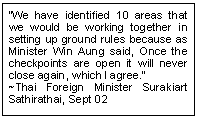 In May, 18 Thais were arrested in
Making Friends
On August 5, Thai Foreign
Minister Surakiart Sathirathai joined the party of diplomats visiting Rangoon
(Japanese Foreign Minister and UN Special Envoy Tan Sri Razali) but in-line
with the “secrecy of negotiations” engendered by Thaksin’s government, the
activities of his trip are unknown. On September 6, SPDC Foreign Minister Win
Aung was scheduled to visit
However, the delay may have been to see how the Thai Government would respond
to the “License to Rape” report that was released in Thai on September 5. [See
Women for further discussion].
In efforts to show
The Thai and Burmese cabinet
members will hold a “familiarization” meeting on October 4, a gesture that is uncommon
and quite excessive as noted by Defense Minister General Chavalit Yongchaiyudh
who said, “If this is really going to take place, it would mean that
All About the Money
The
Thai-Burmese Cultural and Economic Cooperation Association met in
w A
loan of US$7,142,857 to build a 200km road, connecting Mae Sot District in
w To build the first 18km of the connecting road for free.
w Airline
cooperation for the Mae-Sot –
w Cooperation on fisheries.
On August 14,
After the association offered
“gifts” to put the SPDC in a good mood, SPDC Foreign Minister Win Aung visited
Thai Prime Minister Thaksin and Foreign Minister Surakiart Sathirathai in
Playing Hardball
On
August 22, Prime Minister Thaksin told the Ministry of Foreign Affairs that he
wants “unity” in foreign relations with
Crackdown
In
early August, Defense Minister Gen Chavalit Yongchaiyudh ordered the leaders of
Burmese and ethnic nationality groups to be monitored and arrested if found in
On
August 13 it was reported that Thai authorities were planning a “massive
crackdown on Burmese dissidents and ethnic leaders based in
As
the SPDC’s conflict with the Shan worsens, so does the relationship between the
Thai Government and Shan people. In July, after complaints from the SPDC, the
Thai Third Army began a search and destroy mission in Mae Rim District of
Chiang Mai for Shan radio stations and leaflet production.[56]
Gen. Chavalit Yongchaiyudh blamed previous Thai support for Shan’s as the cause
of the SPDC’s suspicion and hostility towards
Arrests
Thai authorities appear to be ‘helping out’ the SPDC by increasing
arrests of people from
Thai Military – “Business Diplomacy” For You Too
 “The Royal Thai Army is not the Thai Rak Thai
Army,” read a flier circulating the Defense Ministry. This statement is in
response to the government’s Thaksin-led, insistence that military affairs
answer to political ambition before national security and interests, following
Thaksin’s “business diplomacy” plan.[59]
On August 5, it was announced that Thai Army General Somdhat Attanand
will replace General Suraud on October 1. General Suraud is known for his
hard-line on
Drugs – It’s all part of the game
Although
Surakiart claims the Thai Government and the SPDC have agreed to cooperate on drug
suppression, this “agreement” is unlikely to stop the flow of drugs from
Thaksin’s Profit
In May, SPDC signed a contract with Shin Satellite, a company
affiliated with Shin Corporation, which is controlled by Thaksin’s family[016].
Then in August, Foreign Minister Surakiart said, “The Thai premier [Thaksin]
asked me to relay a message to the Burmese leaders that both countries should
cooperate in developing the area in Kachin State once relations return to a
normal situation,” referring to a proposal to build an international ski
resort.[63]
While Thaksin has clearly dismissed the NLD’s call for a hold on investment, he
should at least insist on the inclusion of Kachin leaders in the decision
making process. Prime Minister Thaksin has made no secret that he is not
interested in democratization and national reconciliation in
Wa Threat
Thai academics are calling for Thai policy on dealing with the Wa
ethnic group that is separate from policies dealing with the entire country.
According to Pornpimol Trichote, from
Thai Solidarity
As Thaksin and his boys get chummy with the SPDC, they face increasing
criticism at home for undermining national security and “giving in” to the
SPDC. When the Thai language edition of “License to Rape” was released, it
garnered a great deal of support from Thai society. Over 93 civil society
organizations submitted a petition to Thaksin to protect activists in
Ad Carabao, a Thai pop star, released a music album in July with bold lyrics that depict the struggles of the Shan people promote solidarity[017]
DRUGS
______________________________________________________________________
* Improving R Stagnant * Deteriorating
“On the one hand I’m a happy man but on the other hand I’m a very worried man because the results are there but my thoughts are – my goodness, how have you done this, how can you sustain this?” ~Jean Luc Lemahieu, UNDCP
OPIUM SURVEY 2002 [67]
On August 27, the United Nations Office for Drug Control
and Crime Prevention (ODCCP), in conjunction with the United Nations
International Drug Control Programme (UNDCP) and SPDC’s Central Committee for Drug
Abuse Control (CCDAC) released a report, “Opium Survey 2002.” It claims to be
the “first comprehensive survey implemented throughout
Structural Problems
It is important to note that 169 of the field surveyors
were classified under the SPDC. The report specifically says, “The CCDAC had the
overall management of the survey.” UNDCP did some verification in the areas,
but not in the northern region of
On the surveys that were given to each village head, categories to describe opium buyers only included traders visiting the village, villagers and people at the market and left out government officials or “others.” The report did not differentiate between voluntary and forced cultivation. In addition, there were no questions about how opium cultivation was learned. There are reports of SPDC instructing and forcing villagers to grow opium as well as junta officials being major tradesmen in the drug trade.
Basic Data for 2002: (1 hectare = 2.471 acres)
|
Number of opium fields |
17,608 |
|
Opium poppy cultivation |
65,600 – 97,700 ha |
|
Opium production |
670 – 992 tons |
|
Opium
yield in |
6.9 – 13.1kg/ha |
|
Opium yield in Wa region |
9.63kg/ha |
|
Farm gate value |
US$151/kg (US$217/kg in March 2001 before the devaluation of the kyat). |
|
Farm
gate value in |
US$425/kg (close to Thai border) |
|
Total farm gate value of opium |
US$100 – 150 million |
|
Households
in |
5% (241,700 of 5,000,000 inhabitants) |
|
Household
income in |
US$400-600 |
|
Eradication of opium fields reported by SPDC |
7,469 ha or 8% eradication level |
|
Eradication of opium fields reported by Wa |
94 ha |
Drug Use and
Addiction Data for 2002
|
People in |
1.6% or 80,000 people |
|
People
in |
2.4% |
|
Opium
addicts in |
90% male, 10% female |
|
Wa Region opium addicts |
84% male, 16% female |
|
Percentage
of addicts per age group in |
60-64 years 8.5%, Below 20 years >1% |
* The smaller villages, higher opium addictions
Focus on the Wa
The report focused in detail on the Wa Special Region. While the SPDC claims to be actively combating drugs, UNDCP reports “few government officers working in the Wa Special Region.” In this region, members of the Wa Central Committee (WCC) accompanied all the surveying teams and appear to have had authority on all collected and released information. In wealthier Wa towns, particularly Pang Kham, Nam Tit and Hkwin Ma, the report cites an “obvious effort” to reduce opium cultivation around the towns, which implies that cultivation could merely be moving to areas outside of formalized towns.
DRUG DECLINE?
In March, the U.S. State Department said the decrease in poppy production could largely be due to the three-year drought. [69] Information collected by surveyors for the “Opium Survey 2002” reported that 98% of opium fields rely on rainfall for water source[018]. The U.S. State Department also noted that while productivity appeared to decrease, the acreage of cultivation remained the same[019]. The international community and drug eradication agencies should heed this information and be critical of the SPDC’s wild claims of drug reduction.[70]
To mark the International Day Against Drug Abuse on July 24, the SPDC claims to have burned 3 tons of opium, 240kg of heroin and 35 million stimulant tablets valued at US$1.1 billion[020]. These bonfires are merely for public consumption to give some nonsensical proof that the SPDC is serious about drug eradication.
Thai
border police reported that drug smugglers are asking for help from the DKBA to
fire into
The New Drug Front
While even the true reduction in poppy cultivation is
questionable, it is clear that the new wave of drug production lies with
amphetamines. UNDCP’s website on
The SPDC has focused concerted efforts in recent months to build new power plants and expand electricity supplies. It is interesting that UNDCP has found that “Methamphetamine production usually occurs in or near settlements that have a reliable supply of electricity[022]” This gives yet another reason for investors and funders to be wary of engaging with the SPDC. [73]
While the SPDC are not the only actors in the drug business, they certainly are involved at an individual and institutional level. The Shan Herald Agency for News reports that SPDC military units are the main security force for the drug factories, citing a specific example of 2 methamphetamine factories in Mongpan and 2 heroin factories in Loinoi Tract.[74]
SPDC , Wa
Renown drug lords, Lo Hsing Han, Wei Hsueh-kang and Khun Sa, as well as many Wa Chinese appear to be part of the new business class, often entering into partnerships with the generals. UNDCP’s Jean-Luc Lemahieu conceded that the specter of these drug lords enjoying full protection from the government as they conduct money laundering on a grand scale “is highly embarrassing”.[75]
The
new Mayflower Bank is reportedly under the control of drug-linked Wa businessmen[023].
Lo Hsing-han’s family runs
SPDC’s
Mongton Infantry Battalion 65 (IB 65) is said to be “up to the neck” in drug
trafficking Wa and Chinese manufactured drugs. IB 65 Commander is Lt-Col Hla
Myint and Captain Han Sein reportedly transports the heroin from the factories
to a warehouse in the IB 65 compound. When a new shipment arrives in the
warehouse a plane consistently arrives and is said to go to
Drug Clinics
Under the Ministry of Health, the SPDC claims that “major drug treatment centers” have been opened at 20 public hospitals throughout the country as well as 44 “small centers” in various locations. It is unknown if admittance is voluntary or forced, what the fees are, what the criteria for eligibility is, if patients’ privacy is protected and if patients face any legal ramifications. According to the SPDC, the doctors will receive training in cooperation with the World Health Organization.[79]
ETHNIC RELATIONS
______________________________________________________________________
* Improving R Stagnant * Deteriorating
Inter-ethnic nationality relations has been receiving
increased attention and effort. In July, the United Nationalities Alliance
(UNA) was formed as a “temporary measure” to represent ethnic nationalities if
there is tripartite dialogue in the future. UNA represents Zomi National
Congress , Chin National League for Democracy , Mon National Democratic Front,
Arakan League for Democracy, Karen National Congress for Democracy, Kachin
State National Congress for Democracy, and the
Shan
Reports of arbitrary killings, rape, sexual abuse,
beatings, torture, detention, forced labor, land confiscation, restriction of movement
and extortion by SPDC officials continue be filed.[81]
As the border battle with
The Kengtung “urbanization project” has resettled approximately 500 families with plans for another 2,500 families. This resettlement project will change the ethnic proportions in the area and is an unwelcome project to the Shan residents.[83]
The day after SSA forces killed an SPDC soldier,
retaliation attacks on villagers occurred. On September 21, SPDC soldiers led
by
Karen
The Karen National Union (KNU) continues to call for “meaningful dialogue” to resolve “political problems” with the SPDC. KNU Chief Commander, General Bo Mya referring to SPDC’s empty promises of peace and development with other ethnic nationalities said, “The KNU will never accept the fraudulent attempt to make us surrender with the expression of “Exchanging Arms for Peace.”[85]
The SPDC and the Democratic Karen Buddhist Army (DKBA)
offensive against the KNU accelerated since late May when the border with
In June, forced relocation of over 5,000 people in Kya Inn
Seik Kyi District was reported, during which 12 villagers were shot, 9 injured,
3 pastors arrested and 17 structures destroyed. Gruesome photos of the victims
were released by a volunteer medical agency, the Free Burma Rangers. The
atrocities sparked criticism from
Mon
Killing, rape, torture, forced labor, land confiscation
and extortion by the SPDC continue to be consistently reported. A large
proportion of extorted money is used to build schools. A primary school in Ye
Township was banned from teaching Mon language by SPDC’s Light Infantry
Battalion 587.[88] In
September, it was reported that over 1,000 acres of land was seized around Ye,
Nai RotSa, the Secretary General of the New Mon State
Party (NMSP) and his assistant, Mon Saw Noi, were abducted and held for 3 weeks
by a breakaway group, the Hongsawatoi Restoration Party (HRP). Nai RotSa was
released on July 6 and taken to
Kachin
Forced labor continues throughout
An
Rohingya & Rakhine
News sources from
According to the
Wa
A major decrease in the presence of merchant Chinese has
been observed in the Wa Special Region, going hand-in-hand with severe economic
decline.
Chin
On August 26, 4 SPDC soldiers were killed and 4 wounded in
a battle with the Chin National Army (CNA).
Amnesty International (AI)
In July, Amnesty International released a report, “
w
w 90%
of civilians interviewed that migrated from
w Some civilians reported hearing about the Order 1/99 banning forced labor, but reported that nothing changed.
w In
Abuses by armed opposition groups to civilians
AI received reports of abuses by the Karen National Union
(KNU), Karenni National Progressive Party (KNPP) and an unnamed Mon armed
group. The abuses occur most often in highly militarized areas in Karen,
Karenni and
w The Mon armed group reportedly collected illegal fees under threatening conditions and performed unlawful killings.
w The
KNU reportedly conducted unlawful killings, torture and forced labor in Camp
201 in
w Member of KNPP reportedly performed an unlawful killing of a KNPP soldier. The KNPP leadership conducted an investigation and imprisoned those found guilty.
UN Special Rapporteur Professor Pinheiro’s said he is “concerned at reports of abuses of civilians and refugees on the part of armed opposition groups, notably the Karenni National Liberation Army which has been accused of forced conscription of males villagers, levying taxes in rice and money, laying mines…detention and forced labor of refugees suspected of drug trafficking and in some cases killing villagers.”[97]
RELIGION
______________________________________________________________________
* Improving * Stagnant R Deteriorating
Muslim
In July, Human Rights Watch (HRW) appealed to the UN
Special Envoy Razali Ishmail to discuss with the SPDC and Muslim communities
about the religious attacks against Muslims in
Immediately after
ECONOMY
______________________________________________________________________
* Improving * Stagnant R Deteriorating
UN Rapporteur Professor Pinheiro said, “…the economy has continued to suffer the effects of a growing deficit, rising inflation…and shortfalls in foreign exchange.”[101]
The Crisis & The Kyat
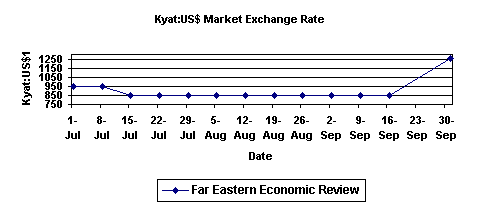
The economic crisis continued to deepen with the Thai-Burma border closed for 5
months. The Thai Chamber of Commerce estimated more than 5 billion baht
(US$119million) was lost in revenue between May and August.[102]
In
 Economic Development Outlook
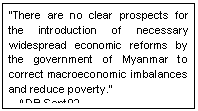
The Asian Development Bank’s (ADB) “Asian Development Outlook 2002” report said the SPDC, “lacked the necessary policies, and it’s strategies are ad hoc and respond to a variety of problems in, at times, contradictory ways. Moreover, the capacity to implement policy is lacking.” The report cited the dual exchange system as a specific practice that is distorting prices, hampering resource allocation and stunting growth. The SPDC claims that a transition to the market based rate, without approximately US$3 billion in international financial assistance, would create difficulties in loan repayments.[105] However, the SPDC declared they would eliminate fiscal debits in a 5-year period, which the ADB called a ‘laudable intention.’ The Minister of Commerce, Brig-Gen Pyi Sone said the trade deficit was reduced nearly 75% between fiscal year 1999-2000 and 2001-2002 and could be completely eliminated by the end of the fiscal year 2002-2003.[106] Even if such figures are accurate, the strategies required would appear to be dangerous and unsustainable. However, even if the SPDC was able to swindle foreign assistance, the mechanisms for maintaining economic stability and growth are not in place.
Daw Aung San Suu Kyi appears to agree with the ADB when she said, “I don’t think that more open trade will benefit the people; it has to be accompanied by political changes.”[107]
(as of
|
|
Sector |
No. of Loans |
$ Million |
% |
|
|
Agriculture and Natural
Resources |
15 |
316.1 |
59.5 |
|
|
Social Infrastructure |
6 |
99.1 |
18.7 |
|
|
Transport and
Communication |
2 |
42.5 |
8.0 |
|
|
Energy |
5 |
31.8 |
6.0 |
|
|
Industry and Nonfuel
Materials |
2 |
21.4 |
4.0 |
|
|
Finance |
2 |
20.0 |
3.8 |
|
|
TOTAL |
32 |
530.9 |
100.0 |
Trade
In efforts to increase trade and to regulate the high
level of illegal border trading, the SPDC opened ten new border-trading points
were opened with
Imports & Exports
According to the Ministry of National Planning and Economic Development, imports and exports for fiscal year 2001-2002 rose 22% from 2000-2001 to US$4.4 billion.[110] Customs duties for the fiscal year amounted to US$805.8 million.[111] Imports rose by 16.4% and exports by 28.4%. Asean countries account for 47% of imports and 30% of exports. To increase exports, the Ministry of Commerce exempted tariffs on 282 products to Malaysia.[112] SPDC also awarded prizes for the biggest multi-million dollar exporters. The winners were: Asia Industrial Company, Diamond Star, Today’s Star. Prizes also awarded to foreign companies based on their purchases from Myanmar Agricultural Produce: Swiss-based Louis Dreyfus Trading, Keonogoo Malaysia Company and Singapore’s Agrocrop International.[113]
There are 15,000 companies registered with the SPDC Trade Ministry for import and export business and 299 are being investigated for conducting import/export without a license. Nine companies have already been indicted and their assets seized.[114]
Where possible, the SPDC is using barter for trade, with rice being the main commodity Burma trades. However, there is great concern about rice sufficiency for domestic consumption. A researcher said that due to the floods, “There is a very real danger that next season’s rice crop will fail and for the first time in years there will be people starving in Burma for the lack of food.” In all 17 townships in Arakan State, the SPDC erected signs threatening severe consequences for building shrimp farms on rice paddies. The SPDC in Arakan State have authorized the destruction of many shrimp farms, saying they were built illegally and hampered rice production.[115]
industry
|
2001-2002 |
change from previous year
|
|
Sugar |
113,828 tons |
+22.4% |
|
Cotton yarn |
4,881 tons |
-19.7% |
|
Cotton fabrics |
N/A |
-18.7% |
|
Teak |
283,707 tons |
-8.1% |
Divestment
US corporation Amerada Hess exchanged its 26% equity in UK-based Premier Oil’s Yetagun Project in Burma to a Premier project in Indonesia. The 26% stake was purchased by Malaysian state oil company, Petronas International Corporation.[116] The transfer was announced after the Burma Campaign UK gave US investment funds information that Amerada Hess might be in violation of US sanctions.
Federated Department stores, the second-largest sporting goods chain store in the US, quit selling goods made in Burma saying, “What is going on there [Burma] is a violation of the philosophy and spirit of our vendor supplier code of conduct.”[117] The Italian Trade Commission also agreed not to sell products made in Burma after Women’s Wear Daily made an inquiry into handbags they were selling that were made in Burma.[118]
According to the Myanmar Marketing Research & Development Co, foreign brands being advertised in Burma decreased over 60% between 1997-2001[026].
Investment
A sector that is likely to be on the rise in the coming years in the gem and mineral industry, however the infrastructure is underdeveloped. The SPDC is offering 42 exploration blocks for foreign companies: 23 in Kachin State, 11 in Sagaing Division, 3 in Mandalay and 3 in southern and 2 in northern Shan State.[119]
Myanmar Posco Steel Company was formed in a joint-partnership with Pohang Iron and Steel Company from South Korea and Union of Myanmar Economic Holdings Unlimited.[120] Vietnamese companies, Vipesco and Song Gianh will invest US$3-5 million in a fertilizer and agrochemical factory in Burma in 2003.[121]
Asia World Company is upgrading the 71-mile highway connecting Mandalay to Naung Cho, Shan State at the cost of US$7.5million. The Hong Pang Company is building an airfield at Pakokku, Magwe Division as well as being 1 of 7 companies constructing a 372-mile highway from Rangoon to Mandalay, both to be completed in 2004.[122]
The Monywa Copper Project, which is a 50% partnership with Canadian Company Ivanhoe Mines and the SPDC is trying to negotiate enough energy supply for the second phase of production. More than US$150 million was invested in the first phase and it is estimated that a US$300 million hydro-electric plant is needed to fulfill the energy requirements.[123]
Malaysia – The big winner
Prime Minister Mahathir Mohamad helped secure numerous contracts after he led a business delegation to Burma in August. [See International Relations] Contracts:
w Offshore oil exploration with Malaysian State owned company, Petronas
w A mini hydro-power damn in conjunction with Myanmar Oil and Gas Enterprise
w Town planning for Rangoon with Yangon City Development Committee and Malaysian Industry-Government Group for High Technology and UTM’s Institut Sultan Iskandar
w Telecommunications with Malaysia’s Maxis International Sdn Bhd
w Rice industry with Padiberas Nasional Bhd (Bernas) and Myanma Agricultural Produce Training
w Information communication technology with Skali with Myanmar World Distribution Co Ltd.[124]
w Trade electronic data interchange with DagangNet
w Public key infrastructure via MSC Trustgate.[125]
The SPDC also inquired about relocating Malaysia’s labor intensive industries to Burma.
Tourism
Tourism was identified as a competitive sector for economic development and there are several plans being considered. In cooperation with US-based Global Spectrum and VIP Travels, the SPDC is trying to attract more US tourists[027].
Thai Prime Minister Thaksin and the SPDC are discussing the development of a national heritage site in Kachin State into a ski-resort. Mt Victoria in Chin State and trekking sites in southern Shan State are also being considered for tourism development.[126]
Petroleum
Since 1988, there have been 49 oil and gas exploration contracts. In 2001, Burma earned US$523.13 million in exporting natural gas. Burma produced 4.7 million barrels of crude oil in 2001, but had to import 5 million barrels to meet domestic consumption.[127]
Myanmar Daewoo, an affiliate of Daewoo International, will drill a test well costing US$10 million in Nov 2003 in an offshore gas field near Sittwe, Arakan State, which is thought to be much larger than Yadana or Yetgun fields. Daewoo International has a joint production-sharing contract with the SPDC Ministry of Energy and assigned 10% shares to S. Korea’s KOGAS and 30% shares between 2 companies under India’s Ministry of Energy.[128] The Thaton pipeline, from the Yadana field, is being extended and linked to a gas-fire generator at Hlawga. The gas is being purchased from TotalFinaElf.[129]
SPDC appears to have found a new market for natural gas with the Gas Authority of India Ltd (GAIL).[130]
A World Market Analysis report said, “Unocal, Brown & Riot and the Indian government are believed to have conducted initial feasibility studies for the construction of a 1,100km undersea gas pipeline from Burma to India,” that would cross through Bangladesh.[131]
AID
“However, the cumulative effects of economic and social hardships can only be
addressed through a process led by the Government in partnership with
community-based organizations and all relevant political and ethnic groups, and
with the support of the international community, which in the long run should
underpin the strategy for transition from humanitarian aid towards sustained
economic growth and the development of human resources.” ~ UN Rapporteur Prof.
Pinheiro Jul 02
Voices
for Transparency and Accountability
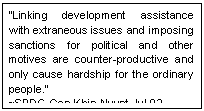 Despite most aid agencies “political
neutrality,” the SPDC has used them as political scapegoat for their malicious
behaviors. In regards to the “License to Rape” report a statement by the SPDC
said, “The international organizations such as the International Committee of
the Red Cross, the NGOs and the UNDCP are visiting Shan State….if the reports
on the rape cases were real, these organizations would have heard about them.
But these organizations said nothing about the rape cases.”[132]
Shan Women’s Action Network said, “In view of this, we reiterate the demand in
“License to Rape” for the international community to withhold all forms of aid
to the regime until irreversible
changes are made towards democratic reform in Burma.”[133]
The National Council of the Union of Burma urged UN agencies and INGOs to
“adhere to their mandates of transparency, accountability, rights and
witnessing,” reiterating that there is an “urgent need to change the root
causes…through political change.”[134]
The National Council Government of the Union of Burma (NCGUB) released a “Memo on Humanitarian Policy Initiative for Burma” in August.
w
Humanitarian crisis root causes are a lack of a democratic
government accountable to the people & the SPDC’s narrow focus on power
w Reiterates the Strategic Coordinating Committee of the Burmese democracy and ethnic movements statement on humanitarian aid from 20 Jan 02 calling for: consultation with NLD and community leaders, delivery directly to the people through credible INGOs without involvement of SPDC, deliver aid to border areas and to be monitored by an independent body
w Concerted attention needs to be given to Internally Displaced People and those in conflict zones
w Proposal of a Joint Consultative Mechanism/Committee at the national level of NLD, UN and SPDC representatives
w Establish NLD technical teams for humanitarian themes and have access to technical experts
w To achieve lasting results, aid must promote the sustainability and empowerment of the people
w Donors should highlight root causes in dialogue with the SPDC
w SPDC should be asked to match funds as means of making it spend more on the social sector
Japan
After the Foreign Minister Yoriko Kawaguchi’s visit to Burma, Japanese officials said, “She (Kawaguchi) said she (Daw Aung San Suu Kyi) does not oppose foreign assistance which will reach really needy people, but in that process transparency and accountability should be guaranteed.”[135] This was misconstrued as a green light for an influx of aid instead of a request for a review in the way aid is being given.
“If progress in policy dialogue in the humanitarian areas’ between the government and Daw Aung San Suu Kyi brings to light basic human needs projects which the people of Myanmar really need, Japan is prepared to actively support such projects.” Kawaguchi called this “effective use of aid in diplomacy.”[136] However, comparable to previous years, the Japanese government’s Overseas Aid Agency will give more than US$21 million to Burma during the 2002-2003 fiscal year. It remains to be seen how Japan will alter aid grants to ensure their “effectiveness.”
China
The Chinese government granted US$10 million to 5 SPDC ministries to purchase office equipment from Chinese companies and to fund human resource technicians in China.[137] A US$80,000 grant was also given to Myanma Agricultural Services to build greenhouses.
European Union (EU)
The EU allocated nearly US$2 million to the Rangoon office of the International Committee of the Red Cross for malaria and treatment programs.[138]
United Nations
The new head of UN AIDS, Australian native Eamonn Murphy, is seeking US$34 million to use in conjunction with the SPDC Ministry of Health to fund the UN-Myanmar Joint Action Plan on HIV-AIDS.[139]
Asian Development Bank (ADB)
On September 25, the ADB held a meeting with Greater Mekong Subregion (GMS) countries, including Burma, with bilateral, multilateral and donor country organizations. While ADB is not currently giving aid to Burma, meetings such as that one help facilitate private donors to fund the projects that fall within Burma’s territory. Plans for a corridor connecting Burma and Vietnam were among those presented at the meeting.[140]
INTERNATIONAL RELATIONS
______________________________________________________________________
R Improving * Stagnant * Deteriorating
The National Council of the Union of Burma urged Australia, Japan and ASEAN members to “take into serious consideration these actions and total disregard of the regime to the reconciliation process” in terms of their cooperation with the SPDC.[141]
United States
The US is emitting incongruent messages on its current
stance and future direction with Burma. In reaction to photos taken by the Free
Burma Rangers, Congressman Joseph Pitts said, “While the military regime woos
diplomats, business guests, and others in downtown Rangoon, Burma’s people are
fleeing in fear of intensifying and acute repression. …[it] provides
incontrovertible evidence of the SPDC’s horrifying human rights abuses and
crimes against humanity as they continue their attempt to subjugate the entire
country through whatever means they see necessary.” [142]
Congressman Chris Smith also threatened to press for increased sanctions and
efforts to freeze SPDC overseas bank accounts if they persist in their
“deceptive tactics and continued persecution of ethnic minorities.”[143]
However, the Drug Enforcement Agency has increased its lobbying to 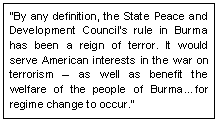 permit greater engagement with the SPDC under
the pretext of drug eradication. A senior US diplomat reportedly said, “there
was no evidence of institutional involvement in the drug trade,” so US
President Bush believes engaging with the SPDC on drug eradication can work.[144]
It would be wise to conduct an in-depth investigation before declaring the
exclusion of institutional involvement.
High-level US and Thai officials consulted on strategies to jump-start the national reconciliation process in Burma. Thai Prime Minister Thaksin told US Secretary of State Colin Powell, “Everyone should push to create national reconciliation in Myanmar by supporting negotiations between the government, Aung San Suu Kyi and at least three minority groups.”[145]
Malaysia
As the bad boys in green find themselves drowning in the economic crisis they have created, Malaysian Prime Minister Mahathir Mohamad rushed to their rescue. Mahathir led about 300 businessmen to Burma on August 18-19. Mahathir seems to believe bribing the SPDC will promote reforms when he said, “Economic development changes a lot of attitudes, perceptions.”[146] Malaysian companies were awarded numerous business contracts. [See Economy] This business revelry was followed up by a trade and investment seminar on September 19 in Burma with 18 participants from Burma and 31 participants from 17 Malaysian companies[028].
Mahathir publicly snubbed Daw Aung San Suu Kyi and hence the national reconciliation process when he cancelled their meeting at the last minute. Mahathir claims to be encouraging democratic and reconciliation processes but when he says, “We know from experience it is not easy to handle democracy. If we do not know how to handle it we will end up with anarchy,” it is reasonable to wonder if Mahathir is doing more harm than good.[147]
In 2001, about 3,500 employment visas to Malaysia were granted under the direction of the Myanmar War Veterans Organization (MWVO). However, in the first half of 2002, over 8,000 employment visas were granted.[148] In yet another moneymaking scheme, these workers are required to submit 50% of their salary to MWVO.[149]
India
India continues to deepen its relationship with the SPDC with a focus on border security, drug trafficking and trade. The Indian Commerce Ministry will open a Letter of Credit (LoC) system with SPDC to facilitate better export with Burma[029]. The United Bank of India provided training to 5 officials from Myanmar Economics Bank on LoC system and plans to host more trainings in the future[030].
During a time of rice scarcity, the Indian government is considering importing 50,000 tons of rice yearly from Burma.[150]
In July, Mr. Rajiv Kumar Bhatia was appointed the new ambassador in Burma and on September 16, the SPDC reopened their consulate in Calcutta, India[031]. According to Mr. Bhatia, over 300 officials from Burma have received training in Internet Technology, Scientific Research and Management in the past three years.[151]
European Union (EU)
An EU team went to Burma to get “first hand information on the political and human rights situation” before the EU policy review on October 29. They met with Daw Aung San Suu Kyi, ethnic nationality organizations and SPDC ministers, but a scheduled meeting with Gen Khin Nyunt was cancelled due to “bad weather.” NLD Spokesman, U Lwin hit the nail on the head when he said, “The EU has only been meeting with salesmen and not with the manager. How can you consider this to be significant.”[152] Yet the EU representatives maintained the notion that the, “European Union stands ready to respond positively and proportionately to substantive improvement in the political climate of the country.” [153]
Japan
Japanese Foreign Minister Yoriko Kawaguchi made the first FM visit to Burma since 1983. Between August 3- 5, she met with Daw Aung San Suu Kyi and Sr-Gen Than Shwe separately as well as UN Special Envoy Tan Sri Razali[032]. Kawaguchi encouraged more political and ‘policy’ dialogue, tripartite reconciliation and economic reforms in order to attract more foreign capital. The SPDC assured Kawaguchi they have dialogue with Daw Suu and would continue to pursue it. Japan is cooperating with Thailand on an opium substitution project. The Japanese government is collaborating with officials under the SPDC approval to develop an “Economic Structural Adjustment of the Myanmar Economy” strategy to be completed in December 2002.[154]
China
Although relations between the SPDC and China continue to grow, they are often underreported and underestimated. In August, the Sino-Myanmar Chamber of Commerce was established in Rangoon.[155] China is spending over US$2 billion in renovating 5 of SPDC’s naval bases. [See Military Threat] The Chinese Government is also constructing a road and waterway link from southern Yunnan Province to the Rangoon Port, allowing greater access to the India Ocean via the Bay of Bengal.[156]
Vietnam
It was reported that a two-year agreement in agriculture
and forestry was signed between Vietnam and the SPDC beginning in 2003, which
will explore the possibility of obtaining UN funds.[157]
Bangladesh
In late September Foreign Minister Morshed Khan paid a “goodwill visit” to the SPDC. This follows a visit by Communications Minister Mr. Barrister Nazmul Hudu in August. Mr. Hudu met with Gen Khin Nyunt and ministers of commerce, construction, national planning and economic development.[158] The Bangladesh Government appears keen to increase trade with Burma as a land port has already been established at Teknaf and there are plans to establish a seaport there also.[159]
South Korea
South Korean government and SPDC signed a cooperation agreement to provide the SPDC with loans to implement electronic-government projects with fiber optic links.[160]
Israel
Israel’s Center for International Cooperation (CIC) will provide 25 training scholarships, up from 20 of previous years, which will be channeled through SPDC agencies.[161]
Singapore
The SPDC’s State Labor Department and Overseas Employment Company are engaged in sending SPDC- selected workers to Singapore. These workers are required to pay 10% income tax to the SPDC and remit 50% of their salary to their families living in Burma, similar to what the MWVO is coordinating in Malaysia.[162]
In business with Burma Singapore functions as an intermediate salesman. According to Mr. Oui Kee Lai, the VP of Malaysian Association in Rangoon, “The trade between Myanmar and Malaysia is unusual because we do not trade directly – we trade through Singapore.”[163] Also, US$17 million of Iranian tar was purchased by the SPDC through Singapore’s Sin International Pte[033].
Bhutan
Foreign Minister Jigmi Thinley’s made his first official visit to Burma from August 6-11. He led a 12-member delegation of government ministers, corporate representatives and media with expectations to increase cooperation between countries. On August 7, an agreement on international air services was signed.[164]
United Arab Emirates (UAE)
Like the SPDC’s arrangement with Singapore, selected workers are being sent to the UAE with conditions to channel money back to Burma.[165]
Greece
Aung San Suu Kyi was awarded the 1ST “Athens International Prize for Democracy” on behalf of UNESCO[034].
International
Actions
On September 18, the US Circuit Court of Appeals ruled that
Unocal can be sued for providing assistance to the SPDC.[166] The case will
be presented in court in 2003.
Association of Southeast Asian Nations (ASEAN)
Asean Ministerial Meeting took place July 29-30 in Brunei. Meetings with US, EU and other trading partners were held on the sidelines of the meeting. It is shameful that Asean members allowed the SPDC to block the inclusion of a paragraph on the “reconciliation process” and the release of Daw Aung San Suu Kyi, in the joint communique released after the meeting. An Asean official said, “Any mention of Myanmar may open the floodgates for a no-holds barred discussion on the political and human rights situation there when Asean Ministers meet their Western counterparts.”[167]
A US-Asean Joint Declaration for Cooperation to Combat International Terrorism was signed after the Asean meeting on August 1. The Declaration calls to “counter, prevent and suppress all forms of terrorist acts…acts of terrorism in all its forms and manifestations, committed wherever, whenever, and by whomsoever, as a profound threat to international peace and security.” There is no protection mechanism to regulate the use and abuse of these measures by state actors.[168]
Burma now hosts presidency of the Asean Chambers of
Commerce for the next two years. Information on past and upcoming Asean
meetings can be found at: www.aseansec.org
HUMAN RIGHTS
______________________________________________________________________
* Improving R Stagnant * Deteriorating
On June 19, the United Nations Working Group on Arbitrary Detentions reiterated that the SPDC has not signed or ratified the International Covenant on Civil and Political Rights. It was also declared that Daw Aung San Suu Kyi’s house arrest in 1995 and from September 2000 to May 2002 is considered an arbitrary detention that not only violates the International Covenant on Civil and Political Rights, but also several articles of the Universal Declaration of Human Rights.[169]
The Australian Government initiated and Premier Oil Company sponsored the 8th and 9th “Human Rights and Responsibilities” workshop, offered to select SPDC officials, took place from July 22-26 in Mandalay and again in early August. One of the implementers, Professor Soreil, claims the workshop’s curriculum is for participants to acquire knowledge to ratify UN documents, however, most of the participants are not in a position to actually do so.[170] To date, a follow-up study has not been published on their effectiveness or progress. It has also been discovered that the Australian Government and United Kingdom based Mines Advisory Group, conducted a workshop on landmine awareness in February 2002.[171]
Lack of
Security in Counter-Insurgency Areas [See
also Ethnic Relations & Displacement]
On July 17, Amnesty International released a report, “Myanmar: Lack of Security in Counter-Insurgency Areas.” The report states that, “Forced labor, extortion and land confiscation by the Tatmadaw (Myanmar military) are continuing to have a grave impact on the lives of civilians,” particularly in eastern Burma where armed resistance groups operate. The report found that:
w Many migrants reported continual, widespread use of forced labor in Burma, particularly near military installations.
w Forced labor is in fact arbitrary detention.
w In addition to forced labor, many people had to pay arbitrary fees or had money extorted from them.
w Extrajudicial killings still occur, most often in southern Shan State where the Shan State Army operates.
w Land confiscation is committed most often by the SPDC and the United Wa State Army.
w There is no mechanism for people to register complaints.
Recommendations to the SPDC: [Complete listing in Appendix]
w To abide by the Geneva Conventions Common Article 3 in treatment of civilians in areas of armed conflict.
w To investigate all reports of abuses, enforce a strict chain of command and bring those found guilty to justice.
w To ratify important and applicable United Nations Conventions.
w To implement the International Labor Organization’s recommendations.
Pinheiro & UNGA[172]
There
was an uproar from the international community after the release of “License to
Rape.”(see section on Women) The SPDC invited UN Special Rapporteur on Human
Rights in Myanmar, Professor Paulo Sergio Pinheiro, to visit from October
12-22. SPDC spokesman Col Hla Min said, “The government welcomes Professor
Pinheiro for further cooperation and to witness the ongoing progress with
regards to human rights on behalf of all Myanmar citizens.” Obviously, the
junta feels confident that Pinheiro will “see things their way.”
On July 31, Pinheiro submitted a formal statement to the United Nations General Assembly on the situation of human rights in Burma.
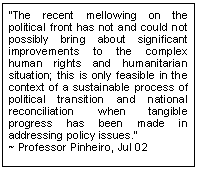 Pinheiro outlined necessary events that must
occur for improvements in human rights:
w Unconditional release of all political prisoners (possibly through amnesty)
w End restrictions on exercising basic human rights and freedoms
w End restrictions on operations of political parties
w Establish a functioning system of rule of law
w Expand talks to a tripartite dialogue to include ethnic nationalities
w Advances on constitutional and electoral issues
w Increasing the pace and modalities of transition to democracy
His statement listed specific international standards and conventions that the UN and international community should provide assistance to the SPDC to implement. Professor Pinheiro stated the SPDC intends to ratify to International Covenant on Economics, Social and Cultural Rights, although he give no indication of when this might happen.
At a time when political arrests, detentions and torture are still occurring, Pinheiro said the SPDC has acknowledged some cases of torture by policemen. He was reportedly shown a record of 3,646 policemen that have been tried and imprisoned since 1995 for misconduct, abuse of power or torture. It should be noted that it does not mention any military intelligence or military officers being tried or brought to justice.
He acknowledged that human rights abuses are still occurring, “especially in areas where military operations continue.”
In the absence of any notable efforts by the SPDC, Professor Pinheiro continues to solicit on the international community to, “strengthen contributions from its various actors in the context of principled engagement with key players in the country.”
International Labor OrganizAtion (ILO)
On September 4, it was announced that Vietnam national, Ms. Hông-Trang Perret-Nguyen, was appointmented as the ILO Liaison Officer to Myanmar, beginning in October 2002.[173] The most notable action the ILO has had in Burma was their investigation into the 7 villagers in Kengtung, Shan State, that were killed for reporting forced labor. Since that time, it has been reported that forced labor in Kengtung has decreased.[174] It can be said that the ILO’s intervention and the international attention this rallied were the primary factors in the reduction of forced labor in that area.
Forced Labor
Even though the SPDC is peripherally working with the ILO, reports of forced labor, especially in ethnic nationality areas, are not declining and those who report cases are being threatened and intimidated.
On August 22, the UNHCR reportedly approached the SPDC about reports of extensive forced labor in Arakan State, but their comments were not well received. SPDC’s Na Sa Ka Security Forces are accused of using large numbers of forced laborers for construction. Between July 25 and August 4, over 135 people were used to build a Na Sa Ka camp in northern Maungdaw. Kathay, a new model village in Muangdaw Township, was built between July 1-28 with 703 forced laborers.[175] In the capital of Arakan State, Sittwe, people were forced to build sidewalks in front of their houses on August 10 or face eviction and jail time of 3 years or more.[176]
Earthrights International (ERI) has collected “credible evidence” that since May, forced labor is being used to build a hydroelectric dam on the Shwe Gin River, near Kyaut Nagar in Eastern Burma. The area is reportedly heavily militarized and the project is overseen by Myanmar Electrical Power Enterprise (MEPE). The construction is scheduled to finish in 2005. An undisclosed Japanese company conducted a survey for the project in 2001, in which no social or environmental impact assessment was done.[177]
Forced Portering
The SPDC is using prisoners as forced porters for their military operations against ethnic resistance groups. It is unknown if the International Committee of the Red Cross, who is visiting prisons and labor camps in Burma, or UN Special Rapporteur Professor Pinheiro have addressed the SPDC on these accounts.
In June, SPDC Infantry Battalions (IB) 244 and 245 officials took 300 prisoners from a prison in Keng-Tung Town to Murng-Sart Township to gather 500 more prisoners. These 800 prisoners were forced to carry rations and ammunition to battle areas where the SPDC and Shan State Army were fighting.[178] Amnesty International reported that in May and June, “…prisoners convicted of common law crimes were taken from Insein Prison and used as porters by the Myanmar army in this offensive against the SSA-South.”[179]
Freedom of Expression and Information
Daw Aung San Suu Kyi has called for individual civic responsibility and for impartial information. She said, “Freedom of information is one of the fundamentals of a democratic system. If there is freedom of information then the people will be better informed and they can effectively undertake their democratic responsibilities.”[180] Perhaps this is exactly what the SPDC is afraid of, as freedom of expression and information continues to deteriorate.
SPDC’s Ministry of Communication, Posts and Telegraphs issued rules for use of Wide Area Networks (WAN), which uses radio, telephone and satellites frequencies, to allow information to be transmitted between businesses and SPDC agencies. U Kyi Than said, “We want to prevent any undesirable activities.” The rules were published in the July 12 issues of the New Light of Myanmar, in the Burmese edition.[181] As of July 10, the ministry deemed it illegal for companies to have unlicensed private computer networks linked to overseas offices as it can be used to access the internet. Acts via computer technology that negatively affect the stability and peace of the state or national culture are formally banned. Those found in violation can be imprisoned for 15 years. However, if the network is licensed, it is subject to checks by the ministry. In 2002, SPDC has flaunted the opening of internet cafes, however they operate on a closed circuit network and if someone is authorized to have email, they must give the SPDC their password![182]
Tighter scrutiny of journalists is likely as on August 12, the SPDC Literary Works Scrutinizing Committee issued an order for all publishers and chiefs to submit personal history forms as well as the nom de plume of writers and journalists.[183]
On September 16, SPDC officials confiscated over 300 cell phones from people in Kawthaung, southern Burma as it was reported they were being used to inform news services about abuses and corruption occurring in Burma.[184] Increased reports of threatening and intimidation have occurred, primarily in ethnic nationality areas, for those who report violations of human rights.
U Ba Gyan, Burma’s Poet Laureate, also known as U Tin Moe, received a Hellman/Hammett grant, which is given “in recognition of the courage with which they faced political persecution[035].”
Extortion
The SPDC boasted of progress on their “10-year water supply project,” with funds that were “donated by the public.”[185] The SPDC wants to finish the project in half the estimated time. The solicitation of funds from the public needs to be monitored to ensure that intimidation and looting are not being utilized to obtain “donations.”
Forced Relocation
In Tamu, Sagaing Division, residents will be forced to
relocate to Natmyin Village without any compensation. Chairman of Division
Peace and Development Council U Maung Maunt Myint threatened that, “Whoever
apprises the BBC or the RFA of the forced relocation planned will be punished
severely.”[186]
Trafficking
Police Brig-Gen Zaw Win said there have been “no” instances of large scale trafficking of women and children. SPDC claims that since 1999, there have been 64 cases involving nearly 200 victims and 104 brokers.[187] However, SPDC is using the international concern against forced trafficking to legitimize its propaganda campaign. Maj-Gen Kyaw Win said the “Anti-Human Trafficking Campaign” would include efforts to teach people about the “negative consequences of working abroad.”[188] This information has been a mixture of threats and scare tactics aimed at keep people from leaving Burma, and thus keeping information from being reported.
The SPDC has vowed to “punish severely” those involved in
trafficking people.[189]
It is unclear if the SPDC is punishing only those who are the traffickers or if
they are also punishing those being trafficked. Not all trafficking is forced
as some people are paying to be transported into neighboring countries, which
has increased since the border closed and the consequent economic crisis. While
forced human trafficking is a real and serious problem, these two types of
trafficking need to be defined separately. SPDC reported that 8 people were
arrested for attempting to smuggle 191 people to Thailand from Mon and Karen
States.[190] It
is unknown what consequences the 191 people faced.
Political Prisoners
The SPDC and NLD have agreed that as of July 9 the total number of NLD members in prison is 275. However, NLD members comprise of only a portion of the political prisoner population. AAPPB placed the total number of political prisoners at 1,573 as of June 1, 2002.[191] There has not been any agreement between the SPDC and NLD on the total number of political prisoners. That agreement is likely to be quite difficult as Daw Aung San Suu Kyi said, “Some of our political prisoners were arrested on grounds other than those associated with political activities, but we all know that the real reason for their imprisonment was their political affiliations.”[192] Daw Suu also continues to have meetings with families of political prisoners to offer support through the NLD Humanitarian Assistance Committee.[193] [See Democracy & Dialogue for more discussion]
Health and Death in Custody
July 31: Reported
that Mai Ai Pan, Joint Secretary of Palaung State Liberation Front, died in
Moulmein Prison.[194]
July
31: Reported that Cho Lwin died in Moulmein Prison.[195]
Sept
17: U
Aung May Thu died while being held 2 years past his prison sentence.[196]
UN Special Rapporteur Paulo Sergio Pinheiro, reported that there is an “apparent lack of proper medical treatment.”[197] While some prisoners get transferred to the hospital, they do not always receive proper care. A doctor reported that, “U Htwe Myint and U Win Tin were sent back to prison not because of their health’s improvement but could be of other reasons.” Dr. Than Nyein who is suffering from heart disease, a liver problem and hypertension is the only prisoner receiving treatment at Rangoon General Hospital’s Prison Ward and doctors believe he will be returned to prison soon[036].
International Concern
Professor Pinheiro made inquires into 16 incarcerated journalists and called for the release of 30 prisoners whose sentences were extended for communicating prison conditions to United Nations Officials. He has also received “credible reports” that some detention centers exist that are not on the list of facilities provided to him.[198]
Amnesty International released a statement of concern about the rash of new arrests inside Burma as well as their “...fear for the safety of eight men who are at risk of being tortured by military intelligence.” They listed those men as Thet Naung Soe, Thaw Thaw Myo Han, Nyunt Win, Htoo Kyaw Win, Khin Maung Win, Thoung Htite, Kyaw Swa and Kyaw Zin Oo.[199]
55 French mayors signed a Reporters Without Borders (Reporters Sans Frontieres) petition calling for the immediate release of Burmese journalist U Win Tin who has been imprisoned for 13 years and is now 72 years old[037].
Watchdog
Sr-Gen Than Shwe called for faster implementation of government projects because he does not want Burma to fall behind in development.[200] This mandate may cause SPDC officials to produce results at any cost, including forced labor, extortion, forced relocation, etc.
WOMEN
______________________________________________________________________
* Improving * Stagnant R Deteriorating
Naang Hla was 16 years old and 7 months pregnant. SPDC soldiers entered her home and “ten soldiers raped her while others stood outside the hut, laughing while she cried and shouted. They had tied her husband near enough to the hut to hear everything happening to his wife. They treated her as though she were not a human being, and raped her from 8am until 4pm. Naang Hla lost consciousness several times.” Her husband was taken by the soldiers and she suffered from constant headaches, violent dysentery and bled profusely. 4 days later, she gave birth and her child is very ill. ~ “License to Rape”
No More Shame & Silence
On 19 June 2002, the Shan Women’s Action Network (SWAN) and the Shan Human Rights Foundation (SHRF) jointly released License to Rape: The Burmese military regime’s use of sexual violence in the ongoing war in Shan State. The report charges the Burmese military with systematic and wide-scale rape. The report documents 173 incidents of rape and other forms of sexual violence, involving 625 girls and women committed by Burmese troops in Shan State. Examining international jurisprudence, License to Rape effectively argues “there is a strong case that war crimes and crimes against humanity are being committed by the Burmese army in Shan State.”[201]
w Rape often involved extreme brutality like beating, mutilation and suffocation.
w Some bodies were deliberately displayed to local communities
w 61% of the cases documented were gang-raped.
w 83% of the perpetrators were military officers.
w 173 cases were documented, only 1 perpetrator was punished.
w Victims who complained were often fined, detained, tortured or killed.
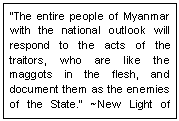 The SPDC dismissed the report as “nothing but
unverified testimonies”, “of so-called victims.” On July 12, the SPDC statement
said, “These allegations are completely false, and we refused to be deterred by
those who would stand in our way of seeking cooperation with the United States
on drug eradication, terrorism and promotion of human rights.”[202] SWAN and SHRF
have been described as “anti-Myanmar Government organization”, supporters of
the Shan army – accussed of terrorist activity and drug trafficking. The SPDC
also attacked individuals from NGO’s in Thailand and the US and the Prime
Minister in exile Dr Sein Win from the National Coalition Government of Burma
(NCGUB). The SPDC declared, “The allegation concerning the rape of Shan women
was a plot suggested by some foreign nations.”
[203]
An ‘investigation’ was performed by the SPDC with the declared intention to “refute…proposterous accusations.” The investigation dismissed any information that suggested sexual violence. SWAN reported that this ‘investigation’ was intimidating and that large numbers of people were forced to sign documents and perform chants stating that rape does not happen. (A similar tactic was used as an attempt to refute forced labour.)
Smokescreen
The SPDC insinuated that rape was not occuring in Shan State by declaring it “co-operates” with the UN, is a party to the Convention on the Elimination of All Forms of Discrimination Against Women (CEDAW), hosted UN Special Rapporteur Prof. Paulo Pinheiro and allows INGOs and NGOs to operate in Shan State. This statement suggested that these bodies would witness and report rapes and other human rights violations that took place. [204] There is no indication however that any international agencies in Burma, UN or NGOs, have policies regarding responses to human rights abuses.[205]
International Outcry
“License to Rape” made huge waves in the international community with a lot of fingers pointing at the SPDC asking for some answers. The US State Department said, “We are appalled by reports that the Burmese military is using rape as a weapon of war against civilian populations in the Shan States.” On August 31, Women’s League of Burma (WLB) calls for UN Special Rapporteur on Violence Against Women to conduct a fact-finding mission to investigate sexual violence. The Blue Ribbon Panel formed at the Burma Summit in Copenhagen, Denmark, on September 22, concluded there was compelling evidence of brutal and systematic sexual violence against the women of Burma.[206]
Many women survivors flee to Thailand in hopes of a safe haven. Although Thailand was in “appease” mode with the SPDC, the people of Thailand spoke out. In August, the Thai Senate Committee on Foreign Affairs, led by Chairman Kraisak Choonhavan, made a trip to the Thai-Burmese border and confirmed human rights abuses, including rape, by Burmese troops. [207] On September 5, 93 Thai women’s groups submitted a petition to Thai Prime Minister Thaksin to pressure the SPDC for political reform and to protect Burma peace and democracy activists in Thailand, especially those in SWAN and SHRF. Forum Asia demanded Thailand guarantee protection of rape victims fleeing abuse by Burmese soldiers.
Recommendations & Demands Made Within Licence To Rape[208]
Complete listing in Appendix]
w demands that the Burmese military regime stops sexual violence against ethnic women, and immediately implements a nationwide ceasefire to stop increased militarization and anti-insurgency campaigns in the ethnic states, and also begins tripartite dialogue with representatives of non-Burman ethnic nationalities and the democratic opposition on the country’s political future.
w appeals to the Thai government to allow Shan refugees, particularly women and children survivors of sexual violence, to access refugee camps in Thailand and receive aid provided by international humanitarian organizations.
w urges the international community to discontinue all financial assistance and other forms of aid to the regime until the restoration of peace, democracy and the rule of law in Burma.
www.shanland.org/shrf/License_to_Rape/license_to_rape.htm
ENDEMIC
Rape of women in Burma is endemic with the largest perpetrators being SPDC military officials. “License to Rape” is the first compiled document since 1998’s “School for Rape” that gives a birds-eye-view of rape inside Burma. Both reports support the assertion that rape, particularly as perpetrated by security forces, is endemic throughout Burma. The National Coalition of the Union of Burma (NCUB) said, “Systematic rapes of women and girls…are also happening around the country especially in Karen, Karenni, Chin, Arakan and Mon areas.”[209] After the release of “License to Rape,” Refugees International documented 34 cases of rape or attempted rape by SPDC soldiers of Shan, Karen, Karenni, Mon and Tavoyan women. SWAN and SHRF also documented another 10 cases of rape in Shan, Arakan, Karen, Karenni and Mon States and Tennessarim Division.[210]
“The ‘lucky’ women and girls are
those who are forced to porter for the army or labor on their projects. The
unlucky ones experience much worse: women and girls are raped as they walk to
and from their fields, in their houses, while they are engaged by the army in
forced labor on roads and other projects, and in military barracks and camps.”
~Karen woman (RI)
Rape
of ethnic women can also be looked at in the wider scope of subduing and
destroying ethnic nationalities, “Sexual violence serves the multiple purpose
of not only terrorizing local communities into submission, but also flaunting
the power of the dominant troops over the enemy’s women, and thereby
humiliating and demoralizing resistamce forces. It also serves as a “reward” to
troops for fighting.”[211]
Not Safe Anywhere
‘Caught with their pants down’
The South African police are conducting a “high-level probe” into a September 20 rape report of a 15-year old girl by Myanmar embassy officials in the city of Pretoria. A report filed by Pretoria district surgeon said the girl was “sexually abused and possibly been misused for the purpose of prostitution.” Embassy spokesman, Hla Myint said, “Your allegations are shocking to us. We are diplomats and we do not sexually abuse women.” Raising further inferences of guilt, embassy representatives gave contradictory information about the girl’s employment and history with the embassy. [212]
A senior official at the Department of Foreign Affairs
said if found guilty, they would act “decisively” against the embassy
officials. He also noted that such action would likely strain relations between
countries, which currently have full diplomatic ties.[213]
Handed to Rapists
Thai authorities repatriated over 100 migrant workers to
Myawaddy, Burma on August 24. SPDC’s Na Sa Ka security forces abducted 3 of the
repatriated women on August 25 and raped them for 2 days. The officers gave
them 1500kyat (US$1.50) and threatened them not to report the rapes.[214]
There have been no further reports of an investigation.
World Vision
A 12-year old migrant girl living in Mae Sot, Thailand reported being raped by a volunteer worker for World Vision on August 5. The accused man absconded and World Vision spokesman, John Whanyoon said, “We haven’t followed up on it as fast as we should have.” The family reported that World Vision said they would provide assistance to the girl, but nearly 3 weeks after the incident, World Vision had not contacted them.[215]
DISPLACEMENT
______________________________________________________________________
* Improving * Stagnant R Deteriorating
UN Special Rapporteur on Human Rights to Myanmar, Paulo Sergio Pinheiro said that people from Burma continue to move to Thailand, which is “a symptom of a complex internal situation which is essentially man-made, and whose roots are as economic as they are political.”[216]
Concurrent with all the recent reports condemning the SPDC, the SPDC has stepped up its campaign of threats and misinformation to incite fear to prevent people from escaping Burma to neighboring countries. A local military authority in Shan State reportedly said, “But let it be the last time. From now on, anybody who still cherishes dreams of leaving the country can expect harsher penalties, from imprisonment to capital punishment.”[217]
Refugees & Asylum Seekers
Thailand
The border brawl between Thailand and the SPDC, the increased hostilities on the Shan State Army by the SPDC and the rapidly deteriorating economy have caused numbers of asylum seekers entering Thailand to increase. In July alone, 1,018 Shan refugees entered Thailand from areas of forced relocation in Shan State. [218]
On July 15, Thailand banned foreign journalists from visiting all refugee camps in a bid end negative reporting on conditions. [See Thai-Burma] On July 4, Thai authorities and UNHCR decided to relocate and merge 4,500 refugees from Karenni camp 3 to camp 2, a camp vulnerable to attacks by the SPDC, beginning September 26. Camp leadership was not directly consulted and was warned by Thai authorities to not speak out against the relocation.[219] Thai human rights group, Forum Asia, called on Thai authorities to, “…reconsider their decision to relocate the camp, and instead, to increase Thai support and protection for refugee population.” Forum Asia said Thai authorities have an “increasingly hostile attitude” towards Karenni refugees since the rape of two Karenni women from camp 2 by Thai soldiers was publicly exposed.[220]
Severe floods in September devastated Ban Sala refugee camp in Mae Hong Son Province. More than 14 people were killed, 20 went missing, 300 buildings destroyed and over 1,000 became homeless.[221] In Mae Khong Kha camp, in Mae Sariang Province, 14-16 people died, 12-26 missing, 202 houses destroyed, 121 houses damaged and 10 buildings destroyed.[222]
Bangladesh
The extremely slow repatriation pace of approximately 22,000 Rohingya refugees to Burma is angering authorities in Bangladesh who are pushing to get rid of all the refugees. Asylum seekers continue to arrive due to starvation and forced labor, mostly by SPDC’s Na Sa Ka border security but they are not being considered for refugee status[038]. However, the refugees are desperate not to return to the horrendous conditions and abuses in Burma and have conducted protests.
During a high-level visit to the Nayapara camp by the World Food Programme, UNHCR, US Embassy and the Ministry of Relief, refugees conducted a protest calling for Bangladeshi citizenship, which ended in a brawl between the police and some refugees.[223]On July 5, 300 refugees refused the relief materials in continuation of their protest for citizenship.[224] In September, refugees in Nayapara Camp protested the Bangladesh Government’s repatriation plan. On September 14, a protest by the refugees ended in a clash with the police where 20 people were injured, including 5 police. On September 21, authorities raided the camp and reportedly seized over 160 weapons and arrested 8 people.[225]
Korea
For the first time, South Korea is likely to give refugee status to 3 people from Burma.[226]
Migrants
Thailand
Migrants continue to flee to Thailand to escape human rights abuses and an economy in crisis. However, according to a report released by Amnesty International in July, “Myanmar: Lack of Security in Counter-Insurgency Areas,” migrants in Thailand face many difficulties and abuses. AI interviewed 100 migrants from Burma that now stay in Thailand who reportedly paid 4,500-10,000 baht (US$104-233) to be transported to Thailand. As one migrant worker said, “The Burmese do all the three ‘D’s’ – dirty, dangerous and difficult.” Many migrants face abuses such as when a migrant teenager was burnt to death after being doused with gasoline[039]. Likewise, a woman was set on fire and killed by her employer who accused her of stealing[040]. Thailand’s legal minimum wage is US$3.30-4.20 per day but migrants are paid as little as US$1.25 AI called on the Thai government to ratify the international convention on the protection of migrant workers and their families. Amnesty also highlights concerns of ‘illegal’ migrants being forcibly returned to Burma as many have a “well-founded fear of persecution if they were to be returned.”[227]
Thai authorities announced they would not register any new migrant workers but will begin a process of reviewing and renewing migrant workers already in Thailand.[228] The renewal period for “Irregular Immigrant Workers” is September 15 – October 15, but a new form, Tor Dor 13, must be filled out in which applicants must declare their address in their home country. Some fear the SPDC will be given the information and their families will face harassment or if they give a false address, the SPDC will be able to bar them from returning to Burma in the future.[229]
On June 10 Thailand’s Interior Ministry forbade staff from issuing birth registration documents to children of undocumented migrants, although it is permissible under Thai law to issue the papers. Without that registration, children are barred from access to welfare, health and education services. Protection needs to be provided for the registering parent as many fear arrest and thus don’t attempt to register their children. It would behoove Thai authorities to register these children as it can help in the repatriation process when the appropriate time comes.[230]
In an precedent-setting case, 30 Karen women from Burma represented by the Foundation for Child Development and Foundation for Women took the owner of a garment factory on the Thai-Burma border to court for imposing slave-like conditions on the women workers. The women were awarded 2.1million baht (US$48,837) to be paid in monthly installments but the women were repatriated back to Burma. The company has stopped paying retribution fees after only a couple of months. The Foundation is pursuing the case with the Legal Execution Department.[231]
Malaysia
On August 1st, the Malaysian Government
implemented a “zero-tolerance” policy towards “illegal workers” and their
employers. The policy calls for up to 6 months imprisonment and caning for a
worker without proper documentation and US$13,157, six months imprisonment and
up to 6 whacks of the cane for the employer. Authorities have acted on the new
policy and on August 21, sentenced 5 ‘illegal’ workers from Burma to 6 months
imprisonment. [232]
Life is not much better for those migrants who attempt to leave Malaysia as
most have to arrange their travel through brokers who charge them about US$263.[233]
Internally Displaced Persons (IDPs)
As the SPDC continues to commit human rights violations and force people to evacuate their homes, more people will continue to seek refuge in neighboring countries. As the Free Burma Rangers said, “All IDPs are potential refugees.”
In September, “Internally Displaced People and Relocation Sites in Eastern Burma” was released, exposing the number and situation of IDPs in Eastern Burma. IDPs are divided into 3 categories: those displaced for political reasons, those displaced for economic reasons, and those displaced as a direct result of military operations. All of these reasons for displacement are rooted in the policies and procedures of the SPDC. It found that over 1 million people in Eastern Burma have been displaced since 1996 with a current total of 632,978 IDPs located immediately adjacent to Thailand. More than 268,000 IDPs are living on the run, in hiding and some 365,000 IDPs living in the 176 SPDC forced relocation sites. In relocation sites regular work, clean water, affordable education, medicine and control of farm land and produce are rarely available. IDPs are found in fenced-in relocation sites usually managed by SPDC forces but the United Wa State Army is also known to have relocation sites. IDPs are valuable to the SPDC as, “In all cases, the primary objective is the control of populations, in order to extract labor and other resources, and to deny villagers contact with insurgent groups.”
Earthrights International asserted that thousands of IDPs are likely being used for forced labor or being forced to relocate again as a new hydroelectric damn on the Shwe Gin River is being built where they were living.[234] [See Human Rights] Free Burma Rangers estimate that in Karen State, 170 villages have been burnt down and 300 villages forced to relocate between January and July 2002.
Repatriation & Deportation
On August 24, the Thai authorities repatriated over 100 migrant workers to Myawaddy and it was reported that the next day 3 women were abducted and raped for 2 days by SPDC’s Na Sa Ka security forces.[235] [See Women]
Since the Thai-Burma border has been closed and the fighting between the SPDC and Shan State Army have escalated, increasing numbers asylum seekers and migrants are crossing into Thailand. Thai authorities vow to repatriate over 600 Shan refugees, which raised a lot of concern for their safety. Kobsak Chutikul, Vice Chairman of the House’s Foreign Affairs Committee said, “This is a humanitarian matter and [there are] internationally accepted norms for civilians fleeing armed conflict,” further insinuating that Thailand was being watched by the international community and did not want to be seen as caving into the SPDC.[236]
EDUCATION
______________________________________________________________________
* Improving R Stagnant * Deteriorating
Education continues to be a mechanism of indoctrination and surveillance by the SPDC. At a training course in August teachers were told, “they need to organize and lead their pupils and local people to participate in undertaking regional developments and tasks. Therefore, the teachers need to have national awareness and carry out organizational tasks…for national solidarity and Union Spirit to flourish.”[237]
A professor at Rangoon University of Technology admitted, “We have been given a list of students and were ordered to provide information about them.”[238]
Students in Shan State are being forced to repeat propaganda on Burma-Thai relations and were threatened by local officials that, “Anyone who fails to comply shall be regarded as taking sides with the Yodayas (derogatory term for Thai people) and shall be taken action commensurate with the offense.” An ‘incorrect’ answer costs a student 7000 kyat (US$7).[239]
Discrimination of education continues to be a serious issue. In July, the Ministry of Health announced it would provide financial assistance for education for children of military staff.[240] In a less overt form of discrimination, the Institute of Economics evening course only accepts applicants with at least 8 years experience in executive-level positions.[241] This requirement essentially disqualifies anyone not closely affiliated with the military junta.
HEALTH
______________________________________________________________________
* Improving R Stagnant * Deteriorating
Arsenic levels in tube wells in the delta and coastal regions of Burma were found to be 50 times higher than the safe level determined by the World Health Organization (WHO). The SPDC Department of Health Planning said, “The local community were unable to be informed about arsenic when the water samples were collected, as the confirmatory tests needed to be conducted first.” It is unknown how many people have been poisoned but the SPDC has not publicized any state-sponsored medical treatments for those people.
The WHO reports about 20,000 deaths per year due to tuberculosis with an average of 85,000 cases annually. WHO continues to set up “TB control centers” with a goal of establishing one in every township.[242]
UNAIDS is suggesting the incarceration of youth HIV positive drug users into Burma’s youth correctional facilities as a means of controlling the spread of HIV/AIDS. [See Drugs]
LANDMINES[243]
______________________________________________________________________
* Improving R Stagnant * Deteriorating
The International Committee to Ban Landmines (ICBL) released their Landmine Monitor Report 2002. Burma is not a signatory to the Mine Ban Treaty and was one of two Asean countries that did not attend the seminar, “Landmines in Southeast Asia,” hosted in Thailand. The SPDC will not give any information about the types and quantities of its landmine stockpiles.
The SPDC and various armed groups continue to use and stockpile landmines. Since 2001, SPDC has had a plan to “fence the country” with landmines. The Coastal Region Command Headquarters ordered troops in Tenasserim Division to lay mines along the Thai-Burma border. SPDC’s Na Sa Ka border security forces appear to have stopped laying mines on the Burma-Bangladesh border and inside Bangladesh although there are still reports of Na Sa Ka forces using landmines in other areas.
Thirteen ethnic and rebel armed groups are believed to use landmines. Pa’o People’s Liberation Front, All Burma Muslim Union and Wa National Army have been discovered using landmines for the first time in 2002. The other previously documented landmine using groups are: Rohingya Solidarity Organization Chin National Army, Shan State Army, United Wa State Army, Karenni Army, Karen National Liberation Army, Democratic Karen Buddhist Army, All Burma Students Democratic Front, People’s Defense Forces and Myiek-Dawei United Front. In 2001, Lahu National Organization committed to a non-mine-use policy.
According to the report, former DKBA soldier reported some Thais in the logging business sell landmines and another ethnic armed leader reported a local Thai military commander offering to sell landmines. Some groups say they use landmines to protect people from attacks by the SPDC and other rival groups as well as their income generators, such as timber. However, as there is no systematic marking of mined areas, landmines continue to kill and maim innocent people. There are still reports of the SPDC and DKBA using human mine sweepers. The landmines in paddy fields makes it dangerous for villagers to grow crops so some grow opium instead, which takes less space to grow. Landmines are reportedly being used to protect amphetamine factories in Namsan, Shan State and His Hseng. After forced evacuation of villages, landmines are often being used to prevent people from returning to their villages.
Victims
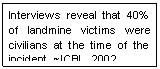 There are no disability laws in Burma. The
International Committee of the Red Cross (ICRC) works in partnership with
National Rehabilitation Centers to provide survivor assistance, which is run by
the SPDC’s Ministries of Defense and Health. The Myanmar Red Cross registers
and refers amputees to ICRC, which allows for discrimination against SPDC
opposition forces as well as access to these people for interrogation.
Victims can receive some treatment in neighboring countries, but the demand greatly outweighs the supply.
Since June 2001, Handicap International has hosted Mine Risk Education programs in a few refugee camps on the Thai-Burma border. From February 18-20, the Mines Advisory Group, funded by the Australian Government (AusAID) provided a workshop to some staff from SPDC police, fire brigades and Myanmar Red Cross.
Recommendations of the “Impact of Landmines in Burma 2002” Report
w Stop using landmines
w Protection of children under the age of 16
w Improve
access to medical care in
w Meet economic need of mine survivors
w Eliminate the socio-economic impact of mines
w Peace settlement
ENVIRONMENT
______________________________________________________________________
* Improving * Stagnant R Deteriorating
Plans for building a giant hydropower damn in Southern Shan State on the Salween River at Ta Sarng have begun. It is necessary for an environmental impact survey to be completed as likely impacts are: “flooding of arable land, reduction of bio-diversity, destruction of livelihoods, riverbank erosion, saltwater intrusion in the Salween delta around Moulmein City, increasing the serious earthquake risk, spreading of water-borne disease, etc.” GMS Power Public Co. Ltd of Thailand are the constructors and Lahmeyer International from Germany and Electric Power Development Corporation from Japan are consultants.[244]
The UNDCP report, “Opium Survey 2002” reports advanced environmental degradation in the northern Wa Special Region. Shifting cultivation has caused poor soil fertility and intensive logging has cleared most of the forests. Chinese technicians have reportedly been hired to manage forestry programs that are planting commercial softwood species in this region.
The Myanmar Times reported that 1 million acres of land were affected by the ‘worst flooding in 30 years.’ The worst flooding was reported on the Sittaung River in Bago Division and the Thanlwin River in Karen State[041]. An assessment of the damage has not been conducted.
Deforestation, mainly from illegal logging projects, continues to cause soil erosion, sedimentation of rivers, flooding and water shortages in the dry seasons. In Karenni State, it is estimated that 60% of the forests have been logged. To combat this environmental destruction, illegal logging productions must be stopped. However, illegal imports to Thailand generates US$112 million per year.[245]
CHRONOLOGY:
1 July ~ 30 SEPTEMBER 2002
______________________________________________________________________________
30
Jun Daw Aung San Suu Kyi returned from
her trip to Mandalay. Tehran, 9Jul
July
Thaw Thaw Myo Han arrested for his part
in publishing the “Universities Literary Journal” Irrawaddy, 22 Aug
July
NLD members Aung Thein and Kyaw Naing Oo
arrested for possessing the “New Era Journal” and sentenced to 3 years
imprisonment. Irrawaddy, 27Sept
July
Thai authorities raided an Arakanese
Muslim organization office in Chiang Mai and arrested staff members. FT, 22Aug
July
The United Nationalities Alliance was
formed representing 7 ethnic groups. DVB, 5Aug
July
The International Committee to Ban
Landmines (ICBL) released their Landmine Monitor Report 2002.
1-7
Jul Reported that the SPDC also awarded prizes
for the biggest multi-million dollar exporters. MyanTimes, 1-7Jul
2
Jul Reported that the SPDC boasted of
progress on their “10-year water supply project,” with funds that were “donated
by the public.” Xinhua, 2Jul
3
Jul Reporters Without Borders submitted
petition for release of U Win Tin. RWB, 3Jul
4
Jul Thai National Security Council
issued an official policy to restrict activities of human rights groups working
on Burma issues. FA, 10Sept
4
Jul Thai authorities and UNHCR decided
to relocate and merge 4,500 refugees from Karenni camp 3 to camp 2, a camp
vulnerable to attacks by the SPDC, beginning September 26. AFP, 25Jun
5
Jul 300 refugees in Nayapara camp
(Bangladesh) refused the relief materials in continuation of their protest for
citizenship. Indep Bang, 13Jul
6
Jul Nai RotSa, the Secretary General of
the New Mon State Party and Mon Saw Noi were released from abduction by the
Hongsawatoi Restoration Party. Kao Wao, 9 Jul
6
Jul During a high level visit to the
Nayapara camp, refugees conducted a protest calling for Bangladeshi
citizenship, which ended in a brawl between the police and some refugees.
Narinjara, 6Jul
9
Jul 10 NLD members released: U Htay Lwin, Daw Hla
Hla Win, U Kyaw Kyaw, U Ba Soe, U Aung Kyaw Soe, U Yar Tin, U Min Aung, Daw Tin
Win Yee, U Soe Naing and U Thant Sin. MyanTimes, 15-21Jul
9 Jul The SPDC and NLD agreed that the
total number of NLD members in prison is 275. UN Wire, 6Aug
11 Jul 50 of NLD’s 500 offices have been reopened. NYT, 11Jul
12 Jul 15 Thai journalists banned from Burma for writing “anti-Myanmar”
articles. AFP, 12Jul
12 Jul SPDC’s Ministry of Communication,
Posts and Telegraphs issued rules for use of Wide Area Networks that allow
information to be transmitted between businesses and SPDC agencies to prevent
any “undesirable activities.” MyanTimes, 29Jul-4Aug
12
Jul The SPDC statement responding to
“License to Rape” report said, “These allegations are completely false, and we
refused to be deterred by those who would stand in our way of seeking
cooperation with the United States on drug eradication, terrorism and promotion
of human rights.” AFP, 12Jul
15 Jul Thai National Security Council Chief announced border area under
“martial law” and banned journalists from the area. AFP, 15Jul
17 Jul Amnesty International released a
report, “Myanmar: Lack of Security in Counter-Insurgency Areas.” It documents
abuses and hardships of migrant worker and focuses on abuses in ethnic
nationality areas by the SPDC as well as armed ethnic resistance groups. AI,
17Jul
17
Jul The Italian Trade Commission also
agreed not to sell products made in Burma. Women’s Wear Daily, 17Jul
20
Jul Human Rights Watch appealed to UN
Envoy Razali to address protection of the Muslim communities in Burma.
RAusNews, 20Jul
21
Jul Reported that the SPDC opened ten
new border-trading points were opened with China, Thailand, Bangladesh and
India. Xinhua, 21Jul
22
Jul Daw Aung San Suu Kyi left for
Moulmein, Mon State. DVB, 22Jul
22
Jul Daw Aung San Suu Kyi visited Win
Phanone Dam site. AP, 22Jul
22-26
Jul “Human Rights and Responsibilities”
workshop held in Mandalay for SPDC officials. Sponsored by Australian
government and Premier Oil. MIC, 12Aug
24
Jul International Day Against Drug
Abuse. SPDC claimed to have a bonfire of heroin and amphetamines valued at
US$1.1 billion. Tehran, 29Jul
25
Jul Thai pop star Ad Carabao released a
music album in solidarity with the struggle of Shan people. BKK, 25Jul
25
Jul Reported that U Ba Gyan, Burma’s
Poet Laureate, also known as U Tin Moe, received a Hellman/Hammett grant, for
“recognition of the courage with which they faced political persecution. HRW,
25Jul
28
Jul 32 political prisoners released
including 14 NLD members. Largest amount freed at one time since the talks
began. VOA, 29Jul
28
Jul The Indian Commerce Ministry will
open a Letter of Credit (LoC) system with SPDC to facilitate better export with
Burma. Mizzima, 28Jul
28
Jul A World Market Analysis report said,
“Unocal, Brown & Riot and the Indian government are believed to have
conducted initial feasibility studies for the construction of a 1,100km
undersea gas pipeline from Burma to India,” that would cross through
Bangladesh. Mizzima, 28Jul
29-30
Jul ASEAN Ministerial Meeting in Brunei.
29
Jul Thai Prime Minister Thaksin told US
Secretary of State Colin Powell, “Everyone should push to create national
reconciliation in Myanmar by supporting negotiations between the government,
Aung San Suu Kyi and at least three minority groups.” AFP, 29Jul
29Jul-4Aug Reported that Sr-Gen Than Shwe called for
faster implementation of government projects because he does not want Burma to
fall behind in development. MyanTimes, 29Jul-4Aug
31
Jul Mai Ai Pan, Joint Secretary of
Palaung State Liberation Front, died in Moulmein Prison. AFP, 27 Aug
31
Jul Reported that Cho Lwin died in
Moulmein Prison. AAPPB website
31
Jul National Coalition of the Union of
Burma said, “Systematic rapes of women and girls…are also happening around the
country especially in Karen, Karenni, Chin, Arakan and Mon areas.” NCUB, 31Jul
31
Jul The National Council of the Union of
Burma urged Australia, Japan and ASEAN members to reconsider their engagement
with the SPDC in light of SPDC’s total disregard of the regime to the
reconciliation process. NCUB, 31Jul
31
Jul UN Special Rapporteur Professor
Pinheiro’s statement on Burma presented at the United Nations General Assembly.
UNGA, 31Jul
31
Jul “The recent mellowing on the
political front has not and could not possibly bring about significant
improvements to the complex human rights and humanitarian situation.” UNGA,
31Jul
31
Jul Professor Pinheiro stated the SPDC
intends to ratify to International Covenant on Economics, Social and Cultural
Rights, although he give no indication of when this might happen. UNGA, 31Jul
August
“Human Rights and Responsibilities”
workshop for SPDC officials held. MIC, 12Aug
August
The National Council Government of the
Union of Burma (NCGUB) released a “Memo on Humanitarian Policy Initiative for
Burma.”
1
Aug Malaysian Government implemented a
“zero-tolerance” policy towards “illegal workers” and their employers. DPA,
23Aug
1
Aug A US-Asean Joint Declaration for
Cooperation to Combat International Terrorism was signed.
2-6
Aug Razali visits Rangoon.
3
Aug Razali met with Daw Aung San Suu Kyi
and SPDC separately. VOA, 3Aug
4
Aug Razali met with Daw Aung San Suu
Kyi. Kyodo, 5Aug.
4
Aug Razali met with Japanese Foreign
Minister Kawaguchi. DPA, 5Aug
5
Aug Razali met with Indian ambassador.
DPA, 5Aug
3-5
Aug Japanese Foreign Minister Yoriko
Kawaguchi visited Rangoon, first FM visit to Burma since 1983. She encouraged
more political and ‘policy’ dialogue, tripartite reconciliation and economic
reforms in order to attract more foreign capital. AFP, 5Aug
5
Aug Thai Foreign Minister Surakiart
Sathirathai visited Rangoon. DPA, 5Aug
5
Aug Reported that 5 billion baht
(US$119million) was lost in revenue in Thailand between May and August from the
Thai-Burma border being closed. BKK, 5Aug
5
Aug Announced that Thai Army General
Somdhat Attanand will replace General Surayud on October 1. DPA, 7Aug
5
Aug A 12-year old migrant girl living in
Mae Sot, Thailand reported being raped by a volunteer worker for World Vision.
AFP, 22Aug
6
Aug Razali met with SPDC Foreign Minster
Win Aung. AFP, 6Aug
6
Aug FM Win Aung cancelled trip to
Thailand. MyanTimes, 9-15Aug
6
Aug Reported that Assistance Association
for Political Prisoners placed the total number of political prisoners at 1,573
as of June 1, 2002. UN Wire, 6Aug
6
Aug Reported that the Japanese
government is collaborating with officials under the SPDC approval to develop
an “Economic Structural Adjustment of the Myanmar Economy” strategy to be
completed in December 2002. FAJapan, 6Aug
6
Aug Japanese Foreign Minister said, “If
progress in policy dialogue in the humanitarian areas’ between the government
and Daw Aung San Suu Kyi brings to light basic human needs projects which the
people of Myanmar really need, Japan is prepared to actively support such
projects.” Kawaguchi called this “effective use of aid in diplomacy.” FAJapan,
6Aug
6-11
Aug Bhutan’s Foreign Minister Jigmi
Thinley’s and 12 other government ministers made their first official visit to
Burma. Kuensel, 6Aug
8
Aug Announced that Thai and Burmese
cabinet members will hold a “familiarization” meeting on Oct 4. Nation, 8Aug
8
Aug Reported that Thai PM Thaksin
approached SPDC about interest in a joint tourism development in Kachin State.
DPA, 8Aug
8
Aug SPDC announced that Muslim
terrorists were operating on the Burma-Bangladesh border. AFP, 8Aug
9
Aug 14political prisoners released. NLD
members released: U Zaw Win Tint, Ko Win Tun, Ko Than Swe, Ko Myint Aung, U
Than Tun, and Ko Win Zaw. The released students Ko Aung Kyaw Zaw, Ko Zaw Myint
Htwe, Ko Thiha, Ko Lay Hlaing Oo, Ko Chan Nyein Wai, and Ko Thet Khaing. The
political affiliations of Daw Le Le Win and Daw Thawda are not known. DVB,
13Aug
10
Aug Reported that The SPDC insinuated
that rape was not occurring in Shan State by declaring it “co-operates” with
the UN, hosted UN Special Rapporteur Prof. Paulo Pinheiro and allows INGOs and
NGOs to operate in Shan State. SWAN, 10Aug
10
Aug Shan Women’s Action Network said,
“We reiterate the demand in “License to Rape” for the international community
to withhold all forms of aid to the regime until irreversible changes are made
towards democratic reform in Burma.” SWAN, 10Aug
12
Aug Reported that the Sino-Myanmar
Chamber of Commerce was established in Rangoon. Thai-Press, 12Aug
12
Aug Reported that foreigner(s) were
working with the Karen National Union. DPA, 15Aug
12
Aug SPDC Literary Works Scrutinizing
Committee issued an order for all publishers and chiefs to submit personal
history forms as well as the nom de plume of writers and journalists. DVB,
15Aug
12-18Aug
Reported that Myanmar War Veterans
Organization is cooperating with Malaysian authorities to send workers to
Malaysia. The workers have to submit 50% of their salary to MWVO. MyanTimes,
12-18Aug
13
Aug Reported that Thai authorities were
planning a “massive crackdown” on Burma activists. BKK, 13Aug
16
Aug 5 political prisoners released
including CRPP member U Aye Thar Aung. AP, 16Aug
16
Aug Reported that Burma’s new Mayflower
Bank is controlled by drug linked Wa businessmen. AsiaTimOn, 16Aug
16
Aug Reported that The SPDC’s State Labor
Department and Overseas Employment Company are engaged in sending SPDC-
selected workers to Singapore who must send 60% of their salary back to Burma.
Xinhua, 16Aug
16
Aug Federated Department stores, the
second-largest sporting goods chain store in the US, quit selling goods made in
Burma. LATimes, 16Aug
17
Aug Thaw Thaw Myo Han was re-arrested
and Htoo Kyaw Win was arrested for their connection with the “Universities
Literary Journal” and suspicion of planning protests. Irrawaddy, 22Aug
17
Aug Reported that Thai Senate Committee on
Foreign Affairs, led by Chairman Kraisak Choonhavan, made a trip to the
Thai-Burmese border and confirmed human rights abuses, including rape, by
Burmese troops. BKK, 17Aug
18
Aug Thet Naung Soe and 17 others,
including Khin Maung Win and Taung Hteik, were arrested for non-violent
protest. Thet Naung Soe and Khin Maung Win rumored to have been sentenced to 7
years imprisonment each. Irrawaddy, 27Sept
18-19
Aug Malaysian Prime Minister Mahathir
and 300 businessmen visited SPDC and made numerous business contracts. He
cancelled a meeting with Daw Aung San Suu Kyi at the last minute. AFP, 19Aug
19
Aug Reported that Malaysian PM Mahathir
said, “We know from experience it is not easy to handle democracy. If we do not
know how to handle it we will end up with anarchy.” AFP, 19Aug
20
Aug 31 people from Burma arrested in
Sangklaburi District, Thailand for “illegal entry.” Over ½ were from
pro-democracy organizations. AHRC, 22Aug
21
Aug United Nationalities Alliance met
with NLD & Daw Suu. DVB, 23Aug
21
Aug Malaysian authorities sentenced 5
‘illegal’ workers from Burma to 6 months imprisonment. DPA, 23Aug
22
Aug Reported that a Professor in Burma
said teachers being ordered to monitor and report on students. Irrawaddy, 22Aug
22
Aug Thai PM Thaksin said he wants
“unity” in foreign relations with Burma and that he was the only one
“accountable” for relations between the countries and he would not tolerate any
dissent. FA, 10Sept
22
Aug UNHCR reportedly approached the SPDC
about reports of extensive forced labor in Arakan State. Narinjara, 23Aug
22
Aug Reported that the company that 30
women from Burma that won a law suit against their factory employer for
slave-like conditions, stopped paying retribution fees. BKK, 22Aug
23
Aug 20 students released after a few
days of detention. RWB, 24Aug
23
Aug Amnesty International released a
statement of concern about the rash of new arrests inside Burma and their fear
for the safety of eight men who are at risk of being tortured by military
intelligence. Reuters, 23Aug
24
Aug Thai authorities repatriated over
100 migrant workers to Myawaddy, Burma. MuslimInfo, 20Sept
25
Aug SPDC’s Na Sa Ka security forces
abducted 3 of the repatriated women and raped them for 2 days. MuslimInfo,
20Sept
27
Aug United Nations Office for Drug
Control and Crime Prevention (ODCCP), in conjunction with the United Nations
International Drug Control Programme (UNDCP) and SPDC’s Central Committee for
Drug Abuse Control (CCDAC) released a report, “Opium Survey 2002.”
29
Aug Thailand arrested 9 Italian medical
volunteers for illegally crossing the border.
29
Aug Reported that 44 women prisoners
were released on “humanitarian grounds.” These women were not political
prisoners. People’s Daily, 29Aug
30
Aug Reported that Wei Hsueh-kang has
replaced his former drug front business, Hong Pang trading company, with
Greenland Company. BKK, 30Aug
30
Aug Reported that in Burma the cost of
medicine has doubled, petrol and diesel increased 50% since May, food prices
are 2 to 3 times higher and housing costs have risen 100% in some places. BKK,
30Aug
31
Aug Women’s League of Burma called for
UN Special Rapporteur on Violence Against Women to conduct a fact-finding
mission to investigate sexual violence.
September
Reported that in June over 800 prisoners
were used by the SPDC as porters to battle areas between SPDC and SSA. SHRF,
Sept
September
Severe floods devastated Ban Sala
refugee camp in Mae Hong Son Province and Mae Khong Kha camp, in Mae Sariang
Province. BBC(Thailand), 4Sept
September
“Internally Displaced People and
Relocation Sites in Eastern Burma” was released, exposing the number and
situation of IDPs in Eastern Burma.
2-8
Sept Reported that the SPDC is offering
42 exploration blocks for gems and minerals for foreign companies. MyanTimes,
2-8Sept
2-8
Sept Reported that Myanmar Daewoo, an
affiliate of Daewoo International, will drill a test well costing US$10 million
in Nov 2003 in an offshore gas field near Sittwe, Arakan State. MyanTimes,
2-8Sept
4
Sept Announced that Vietnam national,
Ms. Hông-Trang Perret-Nguyen, was appointed as the ILO Liaison Officer to
Myanmar, beginning in October 2002. ILO, 4Sept
5
Sept NLD members and 1 student political prisoners
released: U Tin Hlaing, Myo Thant, Tint Tint Han, Khin Swe Yin, Pyi Thein Soe
Oo, Khin Zaw Aung and Soe Htet Khaing. The student released was Yee Yee Tun.
DVB, 5Sept
5
Sept Thai version of “License to Rape”
released.
5
Sept 93 Thai women’s groups submitted a
petition to Thai Prime Minister Thaksin to pressure the SPDC for political
reform and to protect Burma peace and democracy activists in Thailand, especially
those in SWAN and SHRF.
7
Sept Reported that the SPDC seized over
1,000 acres and is building 4 new artillery bases in Mon State. DVB, 7Sept
8
Sept EU team visited to collect
information for the Oct 29 EU policy review meeting. BKK, 10Sept
9-15
Sept Reported that UNAIDS in Burma
suggested to admit HIV positive youth drug users into youth correctional
facilities. MyanTimes, 9-15Sept
10
Sept Reported that U Htwe Myint’s prison
sentence would be extended for another 6 months until Jan 03. DVB, 10Sept
10
Sept Refugees International released a
report documenting 34 cases of rape or attempted rape by SPDC soldiers of Shan,
Karen, Karenni, Mon and Tavoyan women. RI, 10Sept
10
Sept Reported that Bangladeshi Foreign
Minister Morshed Khan will pay a “goodwill visit” to the SPDC. This follows a
visit by Communications Minister Mr. Barrister Nazmul Hudu in August. BKK, 10
Sept
12
Sept Reported that villagers in Kachin
State being threatened to not report forced labor to the media. Mizzima, 12Sept
13
Sept Senior NLD members detained: U Sai
Pa and U Saw Nan Ti. Irrawaddy, 27Sept
13
Sept Earthrights International reported
having “credible evidence” that forced labor is being used to build a
hydroelectric dam on the Shwe Gin River, near Kyaut Nagar in Eastern Burma.
ERI, 13Sept
13
Sept US Senator Mitch McConnell called
SPDC’s rule a “reign of terror” and called for regime change.
14
Sept SPDC announced promotions and
reassignments. MIC, 14Sept
14
Sept A protest by the refugees in
Nayapara Camp (Bangladesh) ended in a clash with the police where 20 people
were injured, including 5 police. Reuters, 22Sept
15
Sept Aung San Suu Kyi was awarded the 1ST
“Athens International Prize for Democracy” on behalf of UNESCO. DVB, 15Sept
16
Sept SPDC officials confiscated over 300
cell phones from people in Kawthaung, southern Burma as it was reported they
were being used to inform news services about abuses and corruption occurring
in Burma. NetworkMedia, 20Sept
16
Sept Reported that the World Health
Organization reported about 20,000 deaths per year due to tuberculosis with an
average of 85,000 cases annually. Xinhua, 16Sept
16
Sept SPDC reopened their consulate in
Calcutta, India. MyanTimes, 23-29Sept
17
Sept U Aung May Thu died in jail, 2
years past his prison sentence. Irrawaddy, 18Sept
18
Sept 14-year anniversary of military
coup
18
Sept The US Circuit Court of Appeals
ruled that Unocal can be sued for providing assistance to the SPDC. The case
will begin in 2003. Digtal Freedom, 26Sept
18 Sept Reported that Asian Development Bank’s “Asian Development Outlook 2002” report said the SPDC,
“lacked the necessary policies, and it’s strategies are ad hoc and respond to a
variety of problems in, at times, contradictory ways. AFP, 18Sept
19
Sept Trade and Investment Seminar held
in Burma with SPDC and Malaysian participants. MIC, 20Sept
19-21
Sept Thai and Burmese Cultural and
Economic Cooperation Association met in Rangoon. BKK, 19Sept
20
Sept Shan State Army kills a SPDC
soldier. SHAN, 27Sept
20
Sept A report was filed in Pretoria,
South Africa of a 15-year old girl being raped by Myanmar embassy officials.
Mail & Guardian, 27Sept
21
Sept SPDC shot 10 villagers in Kholam
during a Buddhist Lent ceremony and 2 novice monks and 5 villagers disappeared.
SHAN, 27Sept
21
Sept Bangladesh authorities raided the
Nayapara refugee camp and reportedly seized over 160 weapons and arrested 8
people. Reuters, 22Sept
23
Sept 18 political prisoners released.
NLD members released: Kyaw Soe, Khine Ko Oo, Thein Aye, Kyaw Khine Win, Soe
Than, Aye Myint, Daw Khin Mar Yee, Daw Ei Shwe Sin Nyunt, Daw Thandar Oo and
Daw Thin Aye. Also released were Aung Aung, Nyi Nyi Htwe, Myo Hto, Sein Hlaing
Tun, Ye Lin Aung, Win Min Thein, Aung Nay Myo and Daw Yu Yu Hlaing. DPA, 23Sept
23
Sept Nine companies, of 299 being
investigated, have been indicted and their assets seized for conducting
import/export without a license. Narinjara, 23Sept
23-29
Sept Reported that US corporation
Amerada Hess exchanged its 26% equity in UK-based Premier Oil’s Yetagun Project
in Burma to a Premier project in Indonesia. The 26% stake was purchased by
Malaysian state oil company, Petronas International Corporation. MyanTimes,
23-29Sept
24
Sept SPDC FM Wing Aung visited Thai PM
Thaksin and FM Surakiart Sathirathai. VOA, 25Sept
25
Sept The Asian Development Bank held a
meeting with Greater Mekong Subregion (GMS) countries, including Burma, with
bilateral, multilateral and donor country organizations. Xinhua, 25Sept
25
Sept 30 activists arrested in Burma.
Irrawaddy. 27Sept
26
Sept Reported that Ne Win’s relatives
sentenced to death by hanging. BBC, 26Sept
27
Sept International Crisis Group (ICG)
released “Myanmar: The Future of Armed Forces.”
27
Sept NLD 14-year anniversary
30Sept-6Oct
Maj-Gen Kyaw Win said the “Anti-Human
Trafficking Campaign” would include efforts to teach people about the “negative
consequences of working abroad.” MyanTimes, 30Sept-6Oct
