 MONTHLY HUMAN RIGHTS SITUATION REPORT
TENASSERIM DIVISION
Mergui-Tavoy
District Information Department, Karen National
January 2003
(Villagers in
Tavoy district try to seek work in
-- News from the past months ----
FORCED LABOUR
Karen villagers forced to construct new
artillery battalion for Burmese troops
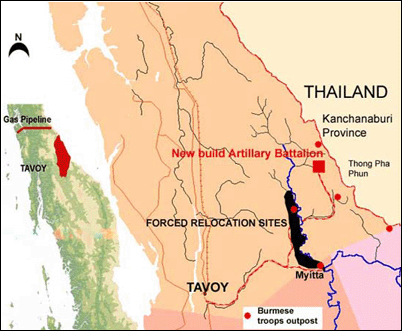
The Burmese troops forced local
villagers in Kawpaw village tract in the east of Tavoy to construct a military
camp, close to the Thai border, starting from
According to a local villager in
Kawpaw village tract, starting from January 10, the Burmese troops have been
building a new artillery battalion at the place between Kaymoechon and Dahthway
Kyauk, the deserted Karen villages. The area is a half day walk from the Thai
border Thom Pha Phum district, Kanchanaburi province.
Villagers from Kawpaw village tract were forced to construct the camp. They
have to build food store, including artillery battalion camp.
There are 12 villages in Kawpaw
village tract. Since last year, the Burmese troop planned to build an artillery
battalion in the east of Tavoy. They have planned two sites. Another site is
the place between Taung Tho Lon and Hindan Chaung, which are closer to Tavoy
town. Those artillery battalions are nothing to do with the KNLA (Karen National
Liberation Army) movement in that area. According to the local villagers, the
Burmese troops use to propagate that Yodaya (
Villagers in forced relocations sites forced to work on Burmese military's
rice farming project
In the beginning of January
2003, the Commander of Burmese troops No.1 Strategic Command, which based in
Myitta village about 37 kilometers in the east of Tavoy, ordered local
villagers in Kamoethway area to work for the army’s rice farming project in
Kamoethway area.
According to a local villager
from Pwaypoeklah (Pyinthadaw) village, in Kamoethway area, the Burmese troops
from Infantry Battalion 104, which is responsible for
Kamoethway area, ordered the Pwaypoeklah villagers to work for their rice
farming project beside the village. Those troops designated a place for
the villagers to make a rice farm. Each household was ordered to make one acre
of rice farming. There are about 50 houses in Pwaypoeklah village. The villagers
have to finish clearing the place in March. When the raining season comes, the
villagers have to continue to work on that rice-farming project.
Burmese troops forced more than 200
villagers in the east of Mergui to serve as porters
On
According to a villager from Ta
Hpo Hkee area, Ta Hpo Hkee village has to send 50 people, Pler Hta, Pway Plaw,
and Ka Wei have to send 50 people, Dalein Da has to send 45 people, Ta Hpo
Hta's Karen ward has to send 45 people, Ta Hpo Hta's Burmese ward has to send
45 people, Ta Mla has to send 45 people, and Ler Kaw Htee has to send 30 people
to the Burmese troops outpost. Those demanded porters were forced to carry
military supplies to Htee Mu Hkee camp on the Thai-Burma border in the east.
Those who did not want to go have to pay 20000 kyats for their replacement.
Villagers' long tail boats forced to
transport Burmese troop's petrol
On January 11, 2003, Operation
Commander Soe Thet from Burma Army's No.1 Strategic Command, which based in
Myitta village about 37 kilometers to the east of Tavoy, demanded 5 long tail
boats from Katawni village which is in the south of Myitta village. He forced
the long tail boats to transport diesel to Mawhta, a deserted Karen village
down south of Tenasserim river. The diesel is for the
construction of the road for military transportation. The villagers received no
payment. The distance will take at least four days back and forth. On January
16, he demanded seven more long tail boats from Katawni and two long tail boats
from Htoo Ler village to transport diesel to Mawhta again.
Villagers forced to farm rice and
give the rice quota to the
The Commander of No.12 Military
Training Center, which based near Pasawoak (Wanzawoak) village in Palaw township, Mergui district, forced the local villagers to
make rice plantations and give the rice quota to the army.
According to a local villager
from forced relocation site in Palaw area, started in the beginning of January
2003, No. 12 Military Training Center ordered the villagers in Paycha village
tract, and Pasawoak village tract to make rice plantations at two places. One
place is between Pasawoak village and Panywepoeklo village, and another is
between Paycha and Nya Htaw (Ngatek) village. Each family has to make at least
four acres of rice plantation, and after the harvest, they have to pay the army
4 baskets (A basket is the standard unit of measurement of rice. 1 basket = 46
pounds or 21 kegs.) of rice per acre. (Pasawoak village tract = Pasawoak
village, Panwepoeklo, Mawkakleh. Paycha village tract = Paycha, Nya Htaw,
Paycha Maw, Myitchinsut, Lerpahdoh, Katawni).
According to the source in
Paycha village, after the harvest of rice, the Burmese troops came and ordered
the villagers to sell their rice or pay the rice quota to the government. The
farmers had to pay 12 baskets per acre as the rice quota. Although the market
price of rice was kyat 3000 a basket, the military officers paid them only kyat
370. The military officers told the villagers that anyone who failed to supply
the rice had to give in money - kyat 3000 for per basket. In Paycha village,
the Burmese troops could buy about 1360 baskets of rice.
The source added that the
Burmese troops forced the villagers from Paycha village tract, Pasawoak village
tract, and Palauk village tract to build bridges between Paycha village to Ya Wah Mountain. There are 13 bridges the
villagers have to finish. (Palauk village tract = Palauk, KehMa, Pawkato,
Kwakeh).
The Burmese troops are also
doing logging business. They cut down the trees in the betel nut plantations,
which were left by villagers who were forced to relocate to other places. Many
villagers' coconut trees and betel nut trees were damaged because of the
logging activities.
Every day two villagers forced to
work for Burmese troops, coal exploration
Burmese troops from Infantry
Battalion 104 forced villagers from Htoo Ler village in
TORTURE
People militia tortured a Karen
villager and demanded ransom
On January 6, 2003, a group of Pyithusit
(people militia backed by Burmese army) from Burmese village Kyauk Taung led by
Ah Ngwe came to Karen village Eh Eh to the south of Theyetchaung township,
Tavoy district, and arrested a villager (Saw Kxxx), accused him of
collaborating with the Karen soldiers. They took him, tortured him, and asked
for ransom for his release. Four
villages collected and gave the money to the Pyithusit and Burmese
troop's officers, and he was released. The Burmese troops and People Militia
officers warned the villagers that if some one told the Karen soldiers about
the amount of the money they gave, they would face extra punishment.
When asked the source how much
money they had to give, he refused to answer, fearing the Burmese troops.
It was not known why the Burmese
troops wanted to conceal the amount of money. There may be two reasons: because
of the corruption among the officers, or concerned about the case’s being
reported. This is the first time that the Burmese troops threaten the villagers
not to tell the amount of money they ask from the villagers.
According to a local villager in
that area, those Pyithusits were given order to do this by Khin Maung
Aye, who is the Commander of Infantry Battalion 280 and responsible for that
area.
EXTORTION
Burmese troops
extorted kyat 25,000 from a sawmill owner, demanded kyat 50,000 from the
villagers
On January 8, 2003, a group of
Burmese troops from Light Infantry Battalion 410, led by 2nd Battalion
Commander Kyaw Min, entered to Pasawlaw (Michaunglong) village in Yebyu
township, Tavoy district, and extorted kyat 25,000 from a sawmill owner. The
name of the sawmill owner was not known. Those troops accused the villagers in
Pasawlaw of hiding the KNLA (Karen National Liberation Army) soldiers, and they
fined the villagers kyat 50,000.
Burmese troops
asked roofing leafs because they did not get the chicken
On
Burmese troops
demanded roofing leafs for their camp
On January 15, 2003, Camp
Commander Sein Than from Burmese army Light Infantry Battalion 403, which based
in Aye Bay village in Theyetchaung township, Tavoy district, demanded 2500
pieces of roofing leafs from Saw Kay and Htee Pah Doh villages. The villagers
had to send the roofing leafs on the 18th of January without
delay. The roofing leafs were for
the military camp.
Burmese troops
demanded betel nuts
On
BURNT DOWN AND DESTRUCTION
On
MIGRANT
Peasants facing
problem with government’s forcibly buying rice with unconditional low price
Since before the harvest season,
the price of rice had been rising in Tavoy district's four townships because of
rice shortage, said one of Taung Min Byaung villagers from Launglon Townhip, on
Even after the harvest, the
rising prices did not go down in Tavoy, Launglon, Ye Byu and Theyetchaung
townships in Tavoy district, because the authorities of State Peace and
Development Council (SPDC) had monitored all the rice fields and bought all the
paddy, leaving only the amount of rice fit for the peasant's a year consuming
as it was done in the era of Burmese Socialist Program Party (BSPP) said the
source.
He also said that all the
peasants had to sell all their surplus paddy to the SPDC's buying centers with
the price set by the government, and the set price as 400 kyat/basket, while
the local price was 2000 to 2200 kyat/basket. Selling the paddy to the
government create deeper poverties while the hiring charges and the seed and
fertilizer prices are very high as other commodity prices are soaring up.
Therefore the price paid by the government is not comparable to daily needed
commodity prices. Even in the raining season, some farmers frequently need to
pump water into their rice fields. During the summer, the farmers will need to
hire water pumps to water their fields as there is a very poor irrigation
system in that region.
The worst thing is the four
township PDCs instructed all the local peasants to grow rice in the summer time
as compulsory task accordance with the order from the Divisional PDC chairman.
The lands of those who denied implementing this task will be confiscated as
military property.
The reason the military
government purchased all the surplus rice (apart from a year need for every
peasant's family) from the peasants is to feed their 54 IB and LIB battalions
and the expanded Air Force, Navy, artillery battalion, and police forces.
According to the analyses, all the armed forces in Tenasserim division would be
more than 25,000 plus their families, and the forcibly purchasing more rice is
to feed them for a year round and to sell it out to foreign countries to get
hard currencies.
At present the price of 1 pyi
(2kgms) of white rice in this region are as follow,
1. Paw Hsann Hmway =
680 Kyat/pyi
2. Nga Kwe =
500 kyat/pyi
3. Ek Ma Hta =
550 kyat/pyi
4. Nga Sein =
500 kyat/pyi
5. Kamakyi =
600 kytat/pyi
6. Sticky rice (white) =
500 kyat/pyi
7. Sticky rice (black) =
550 kyat/pyi
45 villagers seek
work in
On
Those villagers were taken to
Tavoy, and they were charged with illegally trying to sneak into another
country and put in prison by the SPDC (State Peace and Development Council)
authorities.
Those villagers are from
Why they come to
People from 4 townships of Tavoy
district seek the way and enter into Thailand almost every day because
livelihood in Burma are not enough for them to fill the need of their concerned
family, said a Maung-mae-shaung villager who arrived at Thai-Burma border in
search for work in Thailand on January 16, 2003.
The man, who came along with
other 18 people from Maung-mae-shaung village, said that living in their
village was no longer easy because occupations are scarce and the prices of
compulsory commodities are also rising up day by day. When a family needs to
spend at least 1500-2500 kyats per day, the daily income is only round about
1000 kyats for most families. Such people risk entering into
His fellow villagers said that,
at present situation, the authorities do not summon military porters but they
still demand forced labours from the villagers in the township. As for
Maung-mae-shaung village, the village authorities collect kyat 500 per month
from every household.
For those villagers, traveling
from their village to Thai-Burma border is also not easy unless they pay money
to the armed forces. When they arrive the checkpoint
at the eastern edge of Tavoy town, the personals form No.19 Intelligent Unit
and the police force alleged them that they intend to go to Burma-Thai border
area, and they stopped the villagers there. After that, the officer would tell
them if they pay kyat 2000 each, they would be allowed to go. Therefore, the
villagers have to pay 2000 kyats each to the checkpoint officer so that they
can proceed their journey. Traveling on, they have to
pay 500 kyats each to the police checkpoint at Pakayi village as well as at
Kyauk-mae-taung village. Arriving at Myaykanbaw village, the village Anti
Destruction Element armed Group (SPDC's people militia) ask them 3000 kyats
each for SPDC troops and their group. From Myaykanbaw village to
FORCED RESETTLEMENT
Eleven Tavoyan
families were forced back to resettle in a deserted Karen village
Thai authorities, cooperating
with Burmese troops, forcibly sent back 11 families of Burmese illegal migrants
in Ban Bongti, Kanchanaburi province, to
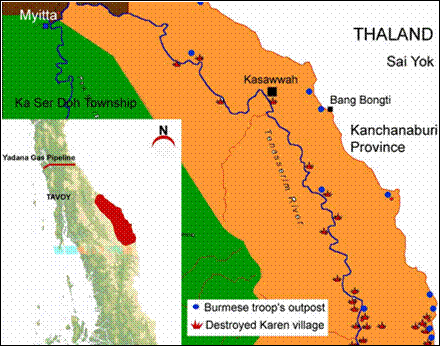 The
resettlement of those families was carried out by the local Thai authorities
and the Burmese troops from Infantry Battalion 108, which stationed at Bongti border.
They were Tavoyans who illegally stayed in a Thai village to earn their living
in
In the beginning of 2003, the
Burmese troops forcibly brought 20 Burmese families from Taung Thone Lon
village and resettled them at Kawsawwah. The Burmese villagers did not want to
come and settle in this place because this village was a Karen village, which
was destroyed by the Burmese troops. The owners of the plantations and farms
fled, and they are now living as refugees in
Those resettled villagers do not
have security, because this is a free fire zone.
The local Thai authorities are
planning to send back more villagers who sought asylum in
Burmese troops
inform the Burmese villagers and the refugees in
Burmese troops base in
Kamoethway area, in the east of Tavoy, Tenasserim division, inform the
villagers fleeing Burmese troops, hiding in
According to a source in
It is not learned why the
Burmese troops allow that only the villagers in Thailand and the refugee camp
can go back only to such three designated villages while the villagers who are
in forced relocation site cannot. Those three villages are located in the middle
way between the forced relocation site to the west of
After the Burmese troops had
occupied some parts of KNU's Mergui-Tavoy District controlled area in 1997,
they tried to resettle the refugees who fled to
FORCED TO JOIN MILITIA
Villagers forced to join propel
militia
Villagers in Kamoethway area, in
the east of Tavoy, Tenasserim division were forced to join Pyithusit
(Burmese troops backed people militia) according to a source from that area in
Waku village.
According to the source, Waku
village headmen asked his villagers to join Pyithusit 3 weeks by one
person in turn. Those who do not want to go on his turn must give 3500 kyat on
behalf of him. Those who do not want to join in the whole year have to give
30000 kyat. The village headman was ordered by The Burmese troops that the
villagers must join Pyithusit, as compulsory duty. If they do not want,
they have to pay the money.
The village headman complained
bout the Pyithusit and said that the Burmese troops said the forming of
people militia is for the peace of the community, but some of the people
militia became oppressor on the villagers, became corruptor and opportunist,
like the Burmese troops.
BURMANISM
Burmese soldiers try to marry Karen
women
Burmese troopers in Myitta
village about 37 kilometers in the east of Tavoy tried to marry Karen women
since they arrived and setup their base in the village in 1997.
According to a source from
Myitta village, since the present of Burmese troops in their village, male
villagers lost their freedom of enjoying their lives, while the Burmese
soldiers roaming and enjoying their lives in the village freely. The Karen men
have to live always in fear of the Burmese troops.
The source said the Burmese
troopers tried to marry the Karen woman. In the year of 2002, at least four
Karen women got married to the Burmese soldiers.
Burmese troopers try to marry
the Karen women is a part of Burmese army's ethnic cleansing campaign. The
children they got have to be named in Burmese. The ethnic groups in
LIVING STANDARDS
Money
Kyat rate
100 Thai baht = 2,350 Kyat
(Thai-Burmese border, Na E Tong)
100 Thai baht = 2,450 Kyat
(Thai-Burmese border, Three Pagodas pass)
100 Thai baht = 2,500 Kyat
(Tavoy town)
1
Price of commodities
Rice
1. Paw Hsann Hmway =
680 Kyat/pyi
2. Nga Kwe =
500 kyat/pyi
3. Ek Ma Hta =
550 kyat/pyi
4. Nga Sein =
500 kyat/pyi
5. Kamakyi =
600 kytat/pyi
6. Sticky rice (white) =
500 kyat/pyi
7. Sticky rice (black) =
550 kyat/pyi
(1 pyi = 2 kilogram)
Meat
Pork = 1,500 kyat/viss
Chicken = 1,600 kyat/viss
Goat = 1,800 kyat/viss
Beef = 1,500 kyat/viss
(1 viss = 1.6 kilogram)
Cooking oil
Bean oil = 1,900 kyat/viss
Sesame oil = 3,000 kyat/viss
Coconut oil = 1,400 kyat/viss
Palm oil = 2,000 kyat/viss
Petrol
Thai petrol = 2,600 kyat/gallon
Burmese petrol = 2,400
kyat/gallon
Thai diesel = 2,400 kyat/gallon
Burmese diesel = 1,600 kyat/gallon
Daily wages for hired labor
Male = 400-600 kyat/day
Female = 300-500 kyat/day
News from the past months
FORCED
LABOUR
Villagers forced to work on military
farm
Operation Commander Soe Thet from Burmese army's No.1 Strategic
Command, which base in Myitta village about 37 kilometers in the east of Tavoy
forced local villagers in Myitta forced relocation site to work on a military rice farm.
According to a villager in Kamoethway area, on
According to the source, some poor families were facing many
difficulties because they did not have time to work for their own survival.
They did not have enough money to pay and they have to go by themselves. Many
poor families earn their living in relocation site by making charcoal, collect Hker-mee-te
(some kind of wild yam) and sell it.
CORRUPTION
Commander's cattle can go, but the
villagers cannot
Kawpaw Pyithusit accidentally captured a herd of a Burmese army
commander's on the way to
According to a source from
Kawpaw village, on
Burmese troops tried to capture
the cattle from the villagers who earn their living by selling their cattle to
Those 12 cattle probably were taken from the villagers or cattle
traders.
LOOTING/TORTURE
Travelers were tortured and their
properties were taken
Burmese troops tortured a group of travelers and loot their properties on
the way to
According to that victim on
Those villagers were form Heinda village in Tavoy township.
Burmese troops tortured five
displaced people and looted a herd of villager cattle
Burmese troops tortured five villagers and took away a herd of buffalo
from a villager in Taket forced relocation site in Tenasserim township, Mergui district, Tenasserim division.
According to a source in that
area, on
EXTRA
JUDICIAL KILLING
A displaced villager was shot dead
A group of Burmese troops
arrived to a displaced people's hiding site in the jungle of Tenasserim township, Mergui district, Tenasserim division and shot dead
a villager on
On that day Burmese troops from
No.2 Column of Light Infantry Battalion 224, led by Column Commander Myint
Naing arrived to a villagers' hiding site at Laylor Sakaw Lor and shot dead a
villager name Hpati Taru Hpoe on their search, kill and destroy operation.