TENASSERIM DIVISION
Mergui-Tavoy District Information Department, Karen
National
November, 2002
Contact: [email protected]
EXTORTION
SPDC officials buy rice by force.
7.11.02
In the beginning of November, 2002, the township Land and
Agricultural Corporation ( LAC ) officials of the State Peace and Development
Council ( SPDC ) in Tavoy district came to meet the farmers, and restricted
everyone not to sell their rice to others until they finished selling their '
dutiful rice’ (quota of rice) to the government.
According to the source, the LAC authorities from Yebyu,
Tavoy, Laung Lon, and Theyetchaung
townships in Tavoy district arrived in time while the peasants were harvesting
rice in their fields. With the assistance of the village administration, the
LAC authorities started to buy the rice from the peasants. The peasants had to
sell what the authorities called 'dutiful rice’ (quota of rice) to the
government as compulsory deal in confined price. 'Dutiful rice ' means a must
to sell 12 to 15 baskets of rice per acre to the government's Land and Agricultural
Corporation. (A basket is the standard unit of measurement of rice. 1 basket =
46 pounds or 21 kegs.)
The normal yield of rice per acre is 50 baskets if there
are no destructions and the peasants have enough time to tend their fields.
Last year, the government-confined price was 350 kyats per basket of rice while the local market price was
at 850 kyats. In addition to ‘dutiful rice’, the
peasants had to pay rice in confined price for the debt they owed to the
government by purchasing fertilizer from LAC.
As 2002 rainy season brought floods in some areas, the
yield of some peasants' rice fields reduced. They would not get more than 30
baskets per acre; even some abandoned their fields. Most of the peasants
worried that they would have to buy rice from others at local price in order to
fill up their quotas, at government confined price.
On November 4, 2002, the Burmese troops base in Palauk village (in southern Theyetchaung
township, Tavoy district, Tenasserim division) demanded 200 pieces of roofing
leaves, 2,000 pieces of bamboos, four logs and 1,200 slits of bamboos from the
villagers. Everyday three villagers had to report to the army for building the
outpost and doing chores.
On November 6, 2002, the Burmese troops from Infantry
Battalion 104, which bases in Kaw Paw village about 35 kilometers in the east
of Tavoy, demanded fire wood from a local villager in a relocated village Kamaik. Saw Tin Lah (about 38
years old, son of Saw Chaw) was ordered by Burmese troops to send three
bullock-cart-load of fire wood to their base.
On
On November 20, 2002, camp commander Maung Myo Win of
Burmese army's Light Infantry Battalion 410, which bases in Htu Ler (Kyathtu, about 60 kilometers
to the south-east of Tavoy) demanded 100,000 betel nuts from local villagers in
Kaw Htee (Thabyuchaung),
Htu Ler and 100,000 from Kahtawni
village. On the same day the Burmese troops from Light Infantry Battalion 410
led by Battalion Commander Aung Soe forced two
villagers from Htu Ler as guides for their patrol to the
frontline.
FORCED LABOUR
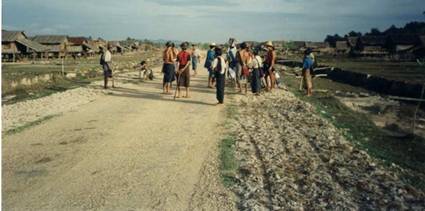
Villagers in forced relocation site gather for forced
labour on the road
On November 4, the Burmese troops who were taking security
in southern Theyetchaung township, Tavoy district,
ordered local villagers in southern Theyetchaung
township to collect and pile up at least 50 zin
of stones beside Tavoy-Mergui car road, which passed through their village. (1 zin, a pile of stones, which is 10 feet long,
10 feet wide and 1 foot high). According to the local villagers, the villages
of little population has to pile up at least 50 zins
of stone and the villages of large population have to pile up more than 50 zins. The village, which could not perform the task, had to
give 500,000 kyats to the army or had to go forced labour
at Tamoak bridge construction. The villagers had to bring along their own
food.
Regional
Development Program in Yebyu township.
7.11.02
As the rainy season had almost gone by, Yebyu township Peace and Development Council instructed all the
village tracts under its control to repair all the bullock-cart tracks so that
motor vehicles could travel.
According to a villager from Natkyizin
village in the northern area of Yebyu township, the
villagers were ordered by the village PDC (Peace and Development Council) to
build a car-road between Natkyizin and Da Ni Chang (a village on the sea beach) along the
bullock-cart track. The distance is 4 miles and the villagers have to build
that road with their own expense - what the government called ' Ko Htu Ko Htaat Saint', which means self supporting system. One
person from each household had to work on that road and had to bring along their own tools and food, including drinking water.
On November 23, 2002, Pa Ti Tah Preh, the leader of Pyithusit
(People militia also known as Thakasapa -Anti
Insurgency Group, which is formed and backed by Burmese troops) from Kaw Paw
village forced villagers of Wahsuhko (Seikpyone) and Kawpaw (Myinkanbaw) to build a monastery in Pawpaw village, about
35 kilometers to the east of Tavoy. Three villagers from each section had to go
and work. There are six sections in Wahsuhko village
and 12 sections in Kawpaw village.
On
On
On
CONSCRIPT TO MILITIA
On