News,
Personal Accounts, Reports & Analysis on Human Rights Situation
In
 Electric Publication by
HUMAN RIGHTS FOUNDATION
OF MONLAND
The
Mon Forum
ISSUE NO. 9/2002;
--------------------------------------------------------------------------------------------------------------
 COMMENTARY:
Who
create humanitarian crisis in
In September
2002, it is a news that a group of Mon villagers including some farmers from
Kamawet village in
The current
regime, SPDC, always blames to democratic and ethnic oppositions for calling
international sanctions for aid to not hand over to the regime. They accused that these groups have created
humanitarian crisis and have less sympathy to the people.
In the case
of farmers, who mainly produce rice in
Every year
after harvest season in December, the SPDC authorities and local army force the
farmers to sell their paddy at low price.
The price is three times lower than market price. Normally, the regime buys 30-50% of the
total paddy products at low price and brings from
The farmers
remained with insufficient rice at their homes. Then, as they have to pay illegal tax and
porter fee to authorities and army very often, again they have to sell their
paddy. As a result they left no more
food. This is the answer for “who make
farmers to be hungry”.
Then, we could find answers for various crisis, such as why the teachers could not send their children to universities and why a nurse in a hospital could not afford to pay hospital cost for her sick children, and other many questions. Furthermore, we could also find why hundreds of thousands of non-Burman people are displaced and faced food-shortage problems.
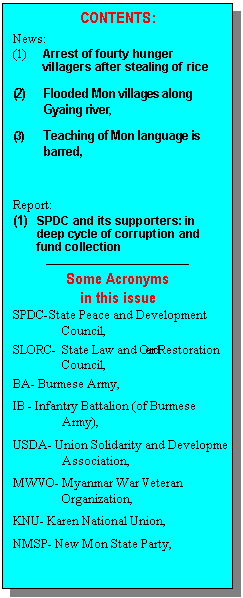
NEWS:
Arrest of fourty hunger villagers after stealing of rice
(
In the morning of
At mid-night of September 17, about
hunger 40 villagers from that village went to railway station and stole rice
which were stored there by a local trader, Nai Pan Htein. Most of them are from Sein-taung new section
in Kamawet village and the police and village authorities rounded them up in
the morning. Then they detained them
the whole day in the police station and brought them to
During August and September, many parts
of
“Now, the rice cost is too expensive
and is about 6000 Kyat per basket (the rice measurement in
Kamawet village is the biggest village
in
Unlikely to the previous years, the
rice price this year has been expensive.
Kamawet village is the biggest village even in
Among 40 villagers, group leaders were:
Nai Halae (38 years), Win Naing (26 years), Shwe Aung (36 years) and Nai Win
(25 years).
Until the end of September, those
villagers were in detention and the police did not bring them to court to face
trail. According to local authorities to
their families, these villagers must face punishment or imprisonment with charge
of stealing other people's properties.
While many poor families in towns and
villages are facing food-shortage problem and paddy plants are under water, the
authorities planned to make contract with local farmers to sell their paddy at
low price after harvest.
Flooded Mon villages along Gyaing river
(
About 11 Mon villages situating along
Gyaing river in
Gyaing river flows from
This year floor disaster destroyed
paddy in many hundreds area of farmlands along Gyaing river and unusual flood
also drove the villagers to move to higher part of the area. The villages which have been suffered by
flood in the recent months and number of families (estimated) are as below:
Name
of villages Number of families
1. Kanni 500
2. Thayet-taw 400
3. Kyon-doe 400
4. Nyaung-yake 50
5. Kharit 150
6. Kaw-ka-taw 50
7. Kaw-go 300
8. Kaw-bein and Min-ywa 1,
000
9. Doe-pyar 150
10. Kwan-poe 150
11. Mon-suu 200
Over 3000 families from above mentioned
village had to flee from their villages and moved to hilly area nearby. Although the local authorities from
Depending on the water level, some
villagers displaced over one month and some displaced nearly two months. During their displacement, many families
faced food-shortage problems and other diseases because of flood and lack of
shelters.
Additionally, on August 14, a strong
storm also destroyed about 54 houses and a primary school in Kyon-doe
village. No assistance for those who
lost the houses were provided by the local authorities. Villagers themselves helped each other.
The floor also swept many thousand
acres of lands in
Teaching of Mon langauge is barred
(
In late September, a Township appointed
a school headmistress in Mar-tay village, Kyaikmayaw Township of Mon State,
ordered a Mon teacher to not teach Mon language in school.
According to villagers,
That school was created by the
community for many years and all school building and materials were provided by
Mon villagers. First the Mon national
school was established when the
In last dry season, the Township
ordered the villagers to rebuild new school with villagers' own fund and made
with iron sheet roof. Then the
authorities planned to occupy the whole as government school and kick out Mon
teacher and ban the teaching of Mon language after the new school was
built.
-------------------------------------------------------------------------------------
REPORT:
SPDC and its supporters: in deep cycle of corruption and fund collection
I. Practices of fund collection in southern part of Burma
Since the current military regime, SLORC/SPDC, seized the
power during 1988, it has had insufficient budget for administrative and other
several purposes. In 1997, it found a
serious conditions and it have no any budget for administrative purposes, as
the regime has spent a lot of money during early 1997 offensives against the
ethnic armed force.
When it found shortage of budget, SPDC in
Later, as they have good momentum, the fund collection
processes involved of setting gambling dens in various towns and villages in
With an objective to grip in power, the regime also formed
handpicked organization, USDA (Union Solidarity and Development Association)
and they also organized veteran and disabled soldiers of Burmese Army (BA) to
be their supports. While these
organizations occurred and for operations, the regime adopted plan to allow
fund raising in the community.
Therefore, the people in southern
On the other hand, due to rebellion in rural areas, the
movement activities of civilians were against restricted by the local
authorities, soldiers and other security force.
This makes to civilians to face less and less income and to lose their
crops.
II. Different types of fund collections by authorities
When the local authorities collected fund from the
civilians, they invented many types of activities in the area concerned and
tried to collect fund from civilians by giving any reasons.
In some areas, the authorities staged the boxing or invited
the well-known singers for live singing of the songs. For these boxing shows or live song shows,
the authorities and police officers forcibly sold the tickets to the
civilians. In this case, the authorities
conducted these boxing and stage shows in the center of the town and sold
tickets to every villager forcibly, who came from rural villages. Or, sometimes, they gave these tickets to
village headmen and let headmen paid the money. Because of difficult communication and
security, most villagers who were forced to buy the tickets could not come and
enjoy in the shows. As the authorities
knew well most villagers could not come and enjoy in the shows, they always
sold the over-number of tickets, and so received a lot of income.
In most cases of administrative purposes, the authorities
have continuously collected tax or fund from the civilians. However, the authorities did not make for
any accountability for the fund they collected from the civilians. Even for the small purposes of
administration, they collected fund from the civilians.
As an instance,
“In
early January 2002, when the authorities in Ye Township authorities declared
for notification of fire in 10 town quarters in the area, they also collected
fund from the civilians. The collected
9, 000 Kyat from each town section and they totally received 90, 000 Kyat from
10 sections. In this case, the
authorities did not have to spend too much money to rent a loud speaker
equipment and an announcer. But they
collected a huge amount of money.”
In every entrance of towns in
As an instance,
“In
the entrance of Ye Town,
“According
to a ferry driver, the authorities have collected this type of tax for over 10
years. They always said that they would
build the roads and football grounds.
But he said the ferry drivers and passengers did not see any progress in
the road construction. Most roads
became ruin and the authorities did not really construct any football ground.
“Many
passengers and ferry owners believed that the authorities have involved in deep
corruption and they took most money.
There are nearly 200 ferry cars passed this check-point and they
collected 150 Kyat for small passenger car and 1000 Kyat for some big
truck. The authorities could get at
least 40, 000 Kyat every day and could get many million Kyats every year in
this check-point alone.”
Since 2000, SPDC ordered every Township to equip the
computer system to improve their education study and to have know-how of the
computer use. Under the name of
upgrading education system by using computer, the SPDC ordered the local authorities
concerned to collect fund from the civilians.
The regime just informed for ‘self-help’ in the education program.
As an instance,
“In
early July 2002, Ye Town’s Basic High School No. 2 and Township education
committee planned to equip computer system in their school accordingly to
instruction by Mon State Education Department.
“In
this case, the
“After
equipping the new equipment in school, the higher authorities and army
commanders in the area would come and hold a ceremony for opening of computer
system and multimedia room like other Townships in Rangoon Division.”
In every case of fund collection, the civilians, the
authorities always take the extra money to their pockets. They never reported to the people how much
they have spent for which purposes and when.
The authorities involved and took the money not from the administrative
fund, but the fund they collected for education and health care purposes.
III. Illegal Gambling by SPDC Authorities
According to the Burmese customary laws, the conduct of
illegal gambling by any citizens is illegal and The State law enforcement police bring those who conduct and
involve in the gambling to court. In
traditions of non-Burman ethnic and Burman people in
Even in BSPP ear, the regime authorities and law enforcement
police involved in oppressing illegal gambling and tried to keep ‘rule of law’
in the community for the well being of the civilians.
However, since over five years, when SLORC ordered their
concerned State, Division, Township and Village level authorities, for a
fund-raising program in their own area for expenses of administration, the
authorities have found many ways to raise.
The State regime SLORC also could not provide the administrative
departments concerned with enough budget and instructed them to spend from
their own fund.
Since then, the authorities collected various types of fund
from the civilians including fund to provide money for the purposes, from the
construction of roads to monthly security fee for village/ town
militiamen. But the authorities have
not just satisfied with only collecting fund/ tax from the civilians, and
developed other way getting money.
In 2000, the local authorities have invented or allowed the
illegal gambling into the center of the community. Recently the gambling dens were outside of
village, in bushes or in hidden places in where that made the law enforcement
authorities to be hard to find.
Currently the gambling dens in the middle of the town, or in important
public rest places.
Generally, the local authorities initiated gambling,
especially card game and other games for collecting fund or tax from
gamblers. To have a huge amount of fund
or tax from them, the authorities have allowed gambling for several days.
As an instance,
“During
the early of February, 2002, Navy Battalion No. 37 based in an island in
Chaung-zon Township, western of Moulmein (see
in Mon State map), coordinated with Township authorities set the gambling
den near battalion headquarters and allowed 10 days gambling. During these days, the authorities and army
commanders collected tax from the gamblers.
They set many gambling dens especially playing card game and collected
3000-5000 Kyat per night from one den.
They allowed about 40 dens every night and could receive a lot of fund
from them.
“Not
only near the navy base, the authorities also extent their activities of
setting up gambling dens. In Mon
traditions, the Mon people cerebrated their villages’ pagoda festival and new
year festival (Songkharam) in dry
season especially from January to June.
Where there was a village’s pagoda festival, the Township authorities
negotiated with village authorities and set gambling dens in the ground of
festival. As they agreed to share the
fund among them, village authorities also allowed for setting up gambling dens.
“During
February and early March, the authorities moved from one Mon village to another
in island and set gambling dens and collected tax from gamblers. Starting from March 17, while there was a
pagoda festival in a new town section in
Actually, SPDC authorities also catch the chance for getting
money from the civilians especially farmers in those gambling. The farmers completed their harvest in
December and they might have some amount of income after selling their paddy
crops. Normally, the farmer families
spent money during dry season pagoda festival and the authorities know about
this situation and they tried to set gambling den in various villages or town
quarters while the villagers were celebrating pagoda’s festivals to exploit
money from farmers illegally.
Similarly to
In some area, there was conflict between the groups of
gamblers and after many competitions and tricks used in gambling, they created
tensions. As a result, the violent
fighting among the gamblers occurred and some of them also got serious
injuries. The authorities and militia
force also took action against the gamblers who involved in violent fighting.
As an instance,
“In
the first week of December 2001, Village authorities set playing game in
Zee-pu-taung village, Ye Township of Mon State, set gambling games in village
for one week and collected tax from gamblers.
Many villagers from the surrounding villagers came and involved in
playing card game. In this gambling,
there was an argument occurred between villagers from Zee-pu-taung and Azin
villages. After argument, the villagers
also fought each other in violation way.
Because of fighting, one villager from Azin village got serious injury
after his chest, and a woman near a fighting place was stabbed in stomach by a
knife when a villager tried to stab his enemy.
Then, the authorities brought those injured man and woman to Ye town’s
hospital. The authorities and
militiamen also arrested all villagers who involved in fighting and brought
them to Ye police station. They
detained them for some days and fined them to pay 15, 000 Kyat each person. Then, they released those villagers.”
In
As an instance,
“Village
authorities from Township and Wae-ka-lee village conducted a gambling from
March until July 2002 continuously and many villagers from the area nearby came
and involved in playing card and many other games. The villagers from 10 villages also came and
gambled. Due to long day casino, the
authorities received about 2 million Kyat in total accordingly to a village
headman in the area. Some villagers
hugely lost in gambling and had to sell their houses and properties. 7 families in Wae-ka-lee lost about 8. 5
million Kyat and most of families had to sell their properties. Some villagers also had to escape into
This was a huge gambling according to the villagers in the
area and they believed it was set with a purpose that the authorities planned
to exploit money or properties from the villagers. For losers, they also had quarrels in their
families when they tried to sell properties.
Similarly to many Townships in
As an instance,
“From
16 to
The higher authorities in Mon State although knew about
gambling in Township and rural village areas, but they blinded their eyes
because they could not provide any required budget for all administrative
sectors and let the authorities did what they liked to get any fund.
IV. USDA and its activities
USDA is mainly formed for support of the military regime,
SPDC and most of its executive members in higher State, Division and Township
levels are handpicked by the military commanders in the area concerned. Since the USDA leaders who have the highest
decision-making power in the organization are under the control of SPDC
leaders, the regime has encouraged them to widen their organization and extent
membership systematically.
In the village or even in Township levels USDA, they allowed
the members to freely elected their leaders.
Since the formation of this organization, the regime provides fund to
the organization to operate their function, organize members, travel and run
their offices. To have sufficient cost
for organization running cost, the authorities also provided them with cost of
administration activities and self-reliance activities.
While the whole population are facing hardships for
operating their business, are suffered from forced labour, paying regular tax,
and movement restriction, the USDA members have the best opportunity and they
are free of these SPDC’s conscription.
But in reality, USDA itself closely corroborated with SPDC and has
helped implemented the oppressive administration. In strategy of SPDC rule, the regime has
used ‘divide and rule’ method and created huge disunity especially between USDA
members and general population.
In some Townships in
As USDA has better opportunity, has some authority for
decision-making process in their own area and could spend money, many
opportunists tried to join in organization.
Or, some people who would like to be free of constant conscription of
forced labour and paying various tax to the authorities, also decided to join
USDA, although they do not like the organization.
When more and more opportunists went into organization,
there has been more corruption in there and it also makes for Township
authorities hard to keep the organization on the track. The re-election of the executives in village
or Township levels have been regularly conducted.
As an instance,
“In
January 2002, as the Chaung-zon Township USDA was not well operated due to
Committee Members’ involvement in corruption and Township authorities decided
to conduct re-election although the annual meeting time did not reach. Four executive members of Township USDA took
some organization fund and it run out for expenses in organization. Township authorities knew deep corruption in
organization and dismissed all executive members and arranged for new
election. As the former USDA executives
could not paid the organization fund back, the authorities also confiscated a
ice-making mill owned by the parents of a former executive, Ne Zin Twe, in
Town.”
Accordingly to the instruction and order by SPDC, the
Township and Village USDA tried to increase the number of its members with a
main objective to have huge number of SPDC-supporters. It is also for the future plan of USDA
itself. If USDA is reformed as a political
party and participated in the future elections, they expect their members would
vote them to win in elections. Thus, the
USDA registered the young age population in villages and towns and organized
them to become members of USDA.
The plan of USDA to increase the number of its members in
most towns and villages in
V. Role of police in money extortion
Similarly to many State servants under the supervision of
the regime SPDC, the police also received insufficient amount of salary, it is
also impossible for them to feed their family, to spend educational costs with
this small amount of salary.
The main duty for police is for law enforcement in towns and
in villages and guard the well-being of civilians. However, the people in
For criminals, if they have enough money to pay to the
policemen, they could be free from any punishment or they must not be brought
to courts. There has been a deep rooted
corruption in the circle of law enforcement police force and all ranks of
policemen from ordinary police to top police officer ask money from
criminals. Thus, most poor criminals
would face different imprisonment terms and most who could afford to pay will
free from any charge.
As instances,
“On
In some case when there is a crime, if the police could not
arrest the criminal, they also arrested one of family members of that criminal
and extorted money from them.
As an instance,
“On
On the other hand, the law enforcement police also protected
their SPDC authorities, veteran members of Burmese Army and other SPDC
supporters including USDA members, and do not bring to courts although they
committed crimes. If some crimes are
committed by these members, the police officer even do not come and check what
happened. The victims or plaintiffs
themselves do not dare to inform to the authorities or police station about the
case, because the police will not bring the defendants or the person committing
the crimes into courts. Accordingly to
a word spoken by civilians that ‘the rainy will fall unequally’, which means
the law will not treat the people equally.
As an instance,
“There
was a fire incident happened in Lamine village, Ye Township, on
“According
to the laws or in normal situation, the police officer must arrest the head of
families that made flame separating to other houses and bring him/her with fire
careless charge. However, in this case,
the police officer and village authorities did not arrest veteran soldiers and
ordered the two families to not make any complaint to Ye Township authorities
or MI. So, he did not face any
charge. Two families who lost every
thing also did not get any assistance from authorities and no compensated cost
was considered.
More terribly, when a soldier of Burmese Army committed any
crime from stealing the civilians’ properties, rape ethnic women in rural
areas, the law enforcement police officer could not apply any punishment
against the soldiers. According to the
laws, the police could arrest anyone if they found strong evidence where there
is a crime. But this could not apply to
solders or members of Burmese Army.
Both police and plaintiffs have to keep silence when they are abused by
soldiers.
VI. Involvement of veteran BA soldiers/ disabled soldiers in fund collection
During SPDC is attacked from various frontline by democratic
and ethnic oppositions for a democratic reform and for respect of human rights,
the regime has tried to keep unity among members of Burmese Army and
veterans. As they believed the veteran
soldiers are the main supporters to regime and the future role of Burmese Army,
SPDC has given the special opportunity to those veterans who had served in army
for several years.
Since BSPP time, they formed ‘Burma War Veteran Association
(but currently it is called as Myanmar War Veteran Organization – MWVO)’ and
have put all the names of veteran soldiers as members of this
organization. SPDC also founded the
fund raising program for the organization and let them conduct in many
activities to get available fund or to run businesses to raise income with
objectives to have enough pension support for veteran or to run their
organization.
Therefore, SPDC local authorities have encouraged them in
various ways to raise their fund especially to sell publicity, calendar, and
other posters in expensive price.
Normally when MWVO members sold these publications, they always forced
the civilians to buy them.
As an instance,
“On
February 18, 2002, MWVO members from Kyit-myin-taing Township, Rangoon
Division, came to Ye Township and negotiated with Township authorities to
collect fund from the civilians.
Accordingly to agreement with authorities, they allowed MWVO members to
sell the picture poster of Buddhist to civilians. MWVO members and local authorities went every
house and forced the civilians to buy the poster with expensive price, 600 Kyat
per sheet. Even the civilians in town
could buy such type of poster in town with 100 Kyat per sheet, however they
needed to buy from MWVO. From selling that poster, MWVO could raise fund about
800, 000 Kyat within two days in Ye Town.
After Ye Town, these MWVO members will move to another villages and
continued selling the posters.”
In most cases, the veteran soldiers, who have been in army
in army for several yeas could not be familiar with business that happen in
community or in a specific area. On the
other hand, they have not much interested to do farming. Thus, the
Similarly to veteran soldiers, SPDC authorities and Burmese
Army also have to take responsibility for the fund of disable soldiers. As the Burmese Army has increased the number
of their army and intensified offensives against the ethnic armed forces, they
have a lot of disabled soldiers. Yearly or occasionally, the athorities or
Burmese Army collected fund for those disabled soldiers by selling some
materials to civilians.
Once, when the new business opportunity occurred, they
always offered to members of MWVO to take it.
As an instance,
“In
January 2002, SPDC officially planned to send migrant workers to
During the majority of civilians are facing economic
hardship in the whole country, SPDC monopolize all economic activities and
prioritized for the business opportunity to their close supporters and
relatives. For those their supporters
or close relatives, they could get fund contribution or could take corrupted
money.
VII. SPDC authorities’ restriction against the civilians
In
In
To prevent the possible attack against the motor road,
railway road, bridges and other important places, the authorities also forced
the local civilians for guarding these communication infrastructure. Additionally, the authorities also make
registration of travelers who arrived into villages and village leaders have to
report to MI or local military battalions if the guesses sleep at night in
village. This restriction also makes a
lot of effect to the local civilians.
As an instance,
“On
“The
impacts of this order were too much.
First the farmers in the area could not move easily from one place to
another. Normally, the farmers used the
roads to go their paddy farms or fruit plantations, which are far from their
villages. When they left to farms, they
were always investigation by soldiers or guards in bridges or along the
road. Additionally many villagers
disappointed with this security order and have less paid visits to their
friends or relatives in another villages and this restriction also effected to local
traditions of relative visits and Buddhist festivals.”
Again, from this restriction, the authorities could also
make money. In the period from December
2001 until July 2002 during the Burmese Army’s various battalions based in Ye
and
Due to unemployment conditions in
As an instance,
“On
“The
police also interrogated them and requested about 12, 000 Kyat from each of
them. The men and women refused and
said they did not try to go to
In July and August, 2002, the SPDC also oppressed the
migrant workers to
VIII. Conclusion
Under the rule of the military regime, the people have no
any rights of freedom of expression and access to justice. Although they have faced illegal and
unlawful tax collection and other treatments such as movement restriction and
torture, the people have no place to complain any of their cases.
Unlawful fund collection, operating of gambling and movement
restriction by SPDC authorities in various parts of southern
-------------------------------------------------------

Information about Human Rights Foundation of
Monland
&
Invitation for feedback from readers
Dear Readers,
Human
Rights Foundation of Monland (HURFOM) was founded in 1995, by a group of young
Mon people. The main objectives of
HURFOM are:
- To
monitor human rights situations in Mon territory and other areas southern part
of Burma,
- To
protect and promote internationally recognized human rights in Burma,
In
order to implement these objectives, HURFOM has produced “The Mon Forum”
newsletters monthly and sometimes it has been delayed because we wait to
confirm some information. We apologize
for the delay.
However,
we also invite your feedbacks on the information we described in each
newsletter and if you know anyone who would like to receive the newsletter,
please send name and address to our address or e-mail as below:
HURFOM,
P. O. Box 11, Ratchburana P. O.
Bangkok 10140, THAILAND
E-mail: [email protected]
With
regards,
Director
Human Rights Foundation of
Monland