News, Personal Accounts,
Report & Analysis on Human Rights Situation in Mon Territory and
Other Areas Southern Part of Burma
The Mon Forum
Issue No. 12/2001
December 31, 2001
The
Publication of Human Rights Foundation of Monland (BURMA)
Contents
News:
(1)
Less forced labour, but more fund
extortion for road constructions,
(2)
Chaung-zon township farmers are
forced to grow bean in drought lands,
(3)
Farmers in Mon and Karen States are
forced to sell their paddy at low price,
(4)
December 31, deadline for migrant
workers,
Report:
(1) Collective human rights abuses in Ye
Township after military deployment and hew armed conflict, PART I: forced
labour and porter service
Some Acronyms in This Issue
SPDC- State Peace and Development Council,
IB - Infantry Battalion (of Burmese
Army),
LIB- Light Infantry Battalion (of Burmese
Army),
MOC- Military Operation Command (of Burmese
Army),
AR- Artillery Regiment (of Burmese Army)
USDA- Union Solidarity and Development Association
(of the regime)
NMSP- New Mon State Party,
KNLA- Karen National Liberation Army,
ILO- International Labour Organization,
___________________________________________________________________
News
Less forced labour, but more fund extortion for road constructions
(December
2001)
On
A local five miles long road is well known as Zathapyin -
Kaw-hnut motor road. The authorities planned to build this road with only fund
collected from the civilians and they would provide construction facilities but
all costs would be paid with civilians' money. As the road passes four Mon
villages, namely, Kado, Kaw-hnut, Kwan-tar and Thankapaing, the villagers from
these villages must have to pay all the costs.
The fund for this road was started collecting from every
household on December 5, each household have to pay 2500 Kyat. However, for the
poor families, the authorities set the deadline on December 12.
The authorities received fund in estimation about 1.25
million Kyat from Kado village; which has about 500 households; 1
million Kyat from about 400 households of Kaw-hnut village; about 250, 000 Kyat
from about 100 households of Kwan-tar village; and about 500, 000 Kyat from
Thankaping village respectively. The authorities received totally 3 millions
Kyat of money from the civilians to construct that road.
The authorities had not only collected fund from the
civilians, they also used villager labourers to clear the route of roads. The
authorities had forced 30 villagers from these villages everyday since December
5 for two weeks and the village headmen had to manage to send their villagers
to workplaces.
Similarly, when the authorities in Kawkareik township also collected fund to build a road from Kanni to
Kawkhaik villages which is also about 5 miles long. This road also passes four
Mon villages and the authorities have collected fund from 4 villages. These
villages are Kanni, Kawkyaik, Kaw-khaik an and
Kaw-lyan, and the authorities collected 2000 Kyat per household. The
authorities had collected about 2 million Kyat from 1000 households in Kanni
village; 600, 000 Kyat from 300 households; 200, 000 Kyat from 100 households
in Kaw-khaik village and 600, 000 Kyat from 300 households. Therefore, the
authorities collected about 3.4 million Kyat totally to build this road, however, they had not used any villagers as forced
labourers.
After SPDC's Ministry of Home Affairs declared Order 1/99
and their authorities' explanation about to halt the practices of the
requisition of forced labour, some local authorities tried to avoid using
forced labour and used hired labourers and pay labour cost. To get labour cost
and to buy the required facilities, the authorities had collected fund from the
civilians. Although the use of forced labour was reduced, the authorities had
collected more money from the civilians for road construction and other
development projects.
Chaung-zon Township farmers
are forced to grow bean in drought land
(December;
2001)
In December, after farmers reaped their
paddy crops in their farms, the local authorities again in Chaung-zon
township's farmers to grow some bean and vegetables according their projects to
increase the amounts of crops in township.
Chaung-zon township situates in an
island western part of
However, this year, as Mon State PDC plans to produce more
raw materials of bean to produce cooking oil and have forced the farmers in
Chaung-zon through township authorities, without inquiring whether their lands
would be possible to grow bean after paddy harvest and what assistance they
would need to grow these plants.
The township authorities have forced the farmers to grow
sunflower plants and some other types of bean which they could produce cooking
oil. They forced all farmers in township to grow these plants without fail, and
instructed the farmers to buy seeds from authorities. The farmers are forced to
buy sunflower seeds with price 1000 Kyat per basket. Although most farmers have
not grown any plants during dry season because of land drought but they have no
choice and grow these types of plants for one to two acres. If they failed to
grow, they would be punished and their lands could be confiscated.
During they are planting sunflower plants and other types
of beans, they are not provided assistance for plowing
their hard lands or to give fertilizers for
their
plants. They have to hire some tractors to plow their hard lands. In case, the
farmers have to spend a lot of money in plowing their lands and buying
fertilizers.
Additionally, the authorities also extorted various types
of fund for the expenses used in township's administration and other occasions.
In October, 2001, the authorities collected 100 Kyat from every household in township to hold
township sports. The authorities received about 6 million
Kyat totally from 60000 households in the whole township.
On
Farmers in Mon and Karen
States are forced to sell their paddy at low price
(December 2001)
Like the previous years after harvest of paddy crops, Mon
State and Karen PDC authorities ordered the farmers in every township, to sell
their paddy at low price to the nearest paddy-buying centers set up by the
respective township authorities.
Started since November 2001, the authorities in Mon State
and Karen State established the same number of paddy-buying center like last
year, normally one center in every village tract, and forced the farmers in
that village tract to sell the complete the set amount of paddy.
In an SPDC order, which the authorities in Kya-Inn-Seikyi township,
In that order, Township authorities also made a restriction
against the farmers that if they do not complete their duties of selling the
set amount of paddy, the authorities will not issue a permission to husk their
paddy. Actually, each farmer in both Karen and Mon States, they needed
permission from village authorities even to husk their own paddy and to get
polished rice. Now, Township authorities have instructed to village authorities
that if one farmer does not complete his duty of selling the set amount of
paddy, the village headmen must not issue him paddy-husking permission to him.
So, that farmers could not husk his paddy even his own. This restriction also
makes effectiveness for authorities in pressuring the farmers to complete duty
of selling of paddy.
Similarly in Mon State, the authorities set up many
paddy-buying centers in all townships and forced the paddy growing farmers to
sell their paddy at low price. As an instance, in Kyaikmayaw
In Mudon township, the authorities
have planned to buy about 1.2 million basket of paddy from farmers through
their 13 designated paddy buying centers in the whole township area. The
authorities instructed to farmers to sell 16 baskets of paddy per acre, because
land soil in Mudon is good, if compared with other township.
According to a farmer from Ye township, Mon State, now, the
authorities have ordered the farmers to sell their paddy with 10 baskets per
acre. Ye township authorities also set up about 8 paddy-buying in the whole
township area and forced the farmers to sell their paddy.
The authorities have bought paddy from farmers with a half
price of market price. While the market price for one basket of paddy is
700-800 Kyat, the authorities buy only 350 Kyat per
basket from farmers. Some farmers who lost the crops because of floods and
insect attacks could not make any complaint but they have to complete their
duty of selling full amounts of paddy set by authorities. Some farmers, who
lost crops or who got less crops, have to sell crops
from markets with high price and then sell to paddy-buying center at low price.
December 31, deadline for
migrant workers
In November and December 2001, Mon State PDC authorities
issued warning order that migration to neighbouring countries illegally to seek
work must be stopped, if not, these illegal workers would be punished.
Those migrant workers who worked in Thailand and Malaysia
must return to Burma before the end of December and if they refused they must be
punished with an imprisonment term, mentioned in the order. Similarly, the
migrants workers who tried to illegal go into these neighbouring countries must
be punished similarly. Traffickers who brought these migrant workers must face
more punishment accordingly to the order.
The township authorities in every township also instructed
USDA members including town ward and village level members, to explain about
this order to civilians and inform them to organize their family
member, who are in neighbouring countries to return to native country as
quickly as possible. If they might face punishment accordingly to immigration
laws existed in Burma.
The order also added that if the Burmese people are working
in other countries, they could face various types of difficulties and dangerous
conditions. If they served for the country with their physical and mental
labour to the country, their native Burma must be developed.
USDA members also explained about this order in every
village in Mon State. USDA is formed for over 8 years and it is a supporting
organization to the current military regime, SPDC. Although USDA tried to
organize the people to bring their family members back to Mon State, no migrant
worker arrived back, according to a village in Ye Township.
He added, "some USDA members
have the family members working in
Due to economic mismanagement and serious unemployment in
Burma, hundreds of thousands of civilians migrated into Thailand to seek jobs
in construction and fishing industries. As an unofficial estimation, there are
about 1 million Burmese migrant workers in Thailand and over 300, 000 workers
are Mon people.
After SPDC's General Secretary No. 1, Lt. Gen. Khin Nyunt
visit to Thailand in November, Thailand has put pressure to Burma to terminate
the migration of illegal workers into Thailand, who take some of Thai workers'
works. Thai employers are happy to
employ Burmese workers, because they have to pay low wage and do not have to
offer even minimum allowance package for these workers.
However these migrant workers create unemployment for Thai
workers and so Thai government put pressure to Burma to terminate illegal
migration to Thailand. Thai government also registered the number of Burmese
workers and planned to gradually deport them back to
___________________________________________________________________________________________________________________________________________________________
Report
Collective
Human Rights Abuses in Ye Township, after Military Deployment and New Armed
Conflict:
PART I:
Forced labour and porter services
I. New Military Deployment in Ye
Township
Ye Township is in the southernmost of Mon State and it is
the largest township among 10 townships in Mon State. The local inhabitants are majority Mon
people and some Karen people inhabited in northeastern part of Township
area. As the Township has large lands,
the civilians in the are farmers who grew rice in the
western area along the seacoast and some grew rubber and fruit trees in eastern
part of the areas.
Location
map of Ye township and new military deployment
|
|
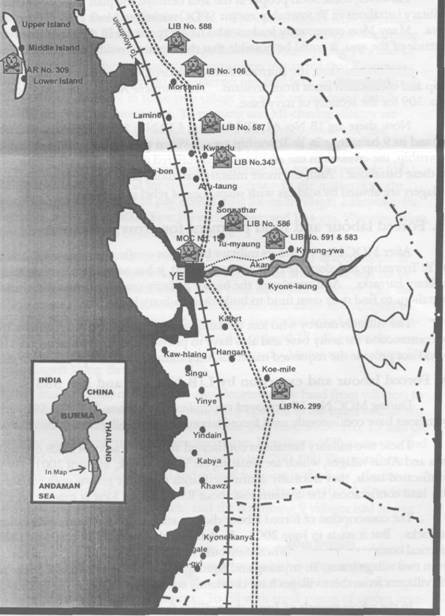
As many parts of township area are occupied with thick
forests, the rebel armies, KNLA and MNLA troops, have constantly used the area
to deploy their military bases and through there, they have operated military
operations against the Burmese Army and the successive military regimes in
Rangoon.
For over many years, although Burmese Army suppressed the
rebel group, especially, New Mon State Party (NMSP) and its army faction, MNLA,
however, the regimes could not cease the rebel activities. During the course of civil war, the Mon
civilians in this township areas had been suffered from abuses, such as,
arbitrary killing, arrest, tortures, that relating to suspicion to
NMSP-supporters. While BSPP regime and Burmese Army launched "four cuts
campaign" against the civilians to cut off their supports to NMSP and MNLA
troops, many villages in this township were relocated to the new resettlement
area that close to army outposts or along Thanbyuzayat - Ye motor road, in
which they could control.
In June 1995, after several rounds discussion and pressure
from Thailand, NMSP agreed for ceasefire with SLORC to stop fighting. Since
then, many parts of township have less fighting
and some villagers who displaced also went back to their villages and settled
in there again.
However, the peaceful conditions had not taken long. In 1997, due to SLORC/SPDC's serious human
rights abuses especially constant conscription of forced labour in building
Ye-Tavoy motor road, some retired Mon commanders rose up to fight against the
regime by organizing former soldiers.
As the fighting grew up even in some parts of Ye township where the
Burmese Army had semi-control, SPDC reinforce more its army battalions.
So that in 1999, the Burmese Army's Southeast Command
deployed a new military battalion, LIB No. 299 in southern part of Ye township.
However, the Burmese Army still could not control the whole area of township
and rebel armies still could operate guerrilla fighting against Burmese Army.
In 2000, Southeast Command confiscated lands near Aru-taung
village along the motor road owned by Aru-taung villagers. The army did not give any compensation cost
to those land loss civilians.
Additionally, in April 2001, SPDC's new Military
Operational Command (MOC) No. 19 and its nine battalions confiscated many
hundreds of lands from civilians again in the northern and eastern parts of Ye
township area. In this land
confiscation and new military deployment, SPDC showed the reason that they
deployed more troops close to border to prevent foreign invasion. At that time, SPDC has border tension with
Thailand and they preferred the possible foreign invasion was Thai army. Thus, by taking good opportunity about
border, SPDC deployed about 10 battalions more in Ye township.
However, some Mon people in the area believed the plan of
deployment of MOC No. 19 and its military battalions in Ye township
meant SPDC wished to block NMSP bases and MNLA authorities in the area. Many
Mon community leaders who have experience in the past said after the Burmese
Army blocked outside of the area, it could be possible that the regime would
force MNLA troops for surrender.
At the same time, the Burmese Army also deployed some naval
force in Kalar-gote island, Ye township and
confiscated lands from civilians. The
Burmese Army deployed a new Artillery Regiment (AR)* No. 309 for the security
of navy base.
Now, there are IB No. 61, IB No.
106, LIB No. 299, LIB No. 343, AR No. 309, and MOC No. 19 and its 9 battalions
in Ye Township area. When there more
military battalions and new deployment in township, the civilians in the area
have been suffered more to provide labour and payment for the expenses of these
battalions. And, the more military battalions launched offensives against the
rebel armies, the local villagers are abused by soldiers with suspicions of
rebel supporters.
II.
Forced labour and fund payment for army deployment
After MOC No. 19 and its military battalions confiscated
about 2000 acres of lands in northern part of Ye Township and along Ye river (see
in the map), it has no enough budget to complete building of their military
barracks. As normal way, the higher
military commanders just ordered the concerned military battalions to find
their own fund to build their military barracks.
The villagers nearby who lost the lands were again forced
to contribute their labour in various types of construction for army base and
also have to provide the materials requested by SPDC soldiers. If they could not provide the requested
materials, they must to find and pay fund for the equal amount of materials.
A. Forced labour and extortion by LIB No. 591 and No. 583
During MOC No. 19 deployed two military battalions, LIB No. 591 and
583, these two military battalions have continuously used forced labour from
the villages near their battalions.
These two military battalions confiscated about 153 acres
of lands owned by villagers from Kyaung-ywa and Akan villages, which are
situating on Ye river bank, in April 2001.
When Southern Command confiscated lands, they normally confiscated lands
that were grown with rubber and fruit trees.
Because this land confiscation, the civilians lost about 83. 6 million
Kyat at market price accordingly to villagers.
The conscription of forced labour did not start soon after
land confiscation to construct the military barracks. But it starts in June 2001. In that month, both LIB No. 591 and No. 583
planned to build "tactical command office". When they built military barracks, the
commanders have forced the civilians from two village tracts, Tu-myaung and Kyaung-ywa. These two village tracts have about 19
villages and the villagers from these villages have constantly suffered from
the use of forced labour by battalions.
In the whole month of June, the civilians from Kyaung-ywa
and Akan villages have to provide 6 men everyday to work cleaning the grounds,
cutting trees and bushes, leveling the grounds, carrying earth and others. To help these men, the commanders from
battalions also conscript two oxen-carts everyday. As they needed to carry various construction
materials, including woods, logs, stones and sands, they used these carts. The commanders also ordered the villagers
form 18 villages in the surrounding area to provide them with bamboo, lumbers
and thatches, and carried them by the conscripted oxen-carts.
In July, after collecting required materials, they planned
to. actually build the barracks. On July 7, the
battalion commanders called a meeting with village headmen from 19 villages
nearby and instructed to villagers to build three barracks of "tactical
command office" in their confiscated lands. The commanders who involved in the meeting
are: MOC No. 19 commander Col. Than Soe; LIB No. 583
commander Lt. Col. Soe Naing Oo; and LIB No. 591 commander Lt. Col. Myo Win,
and the village headmen from Kyaung-ywa and Tu-myaung village tracts attended
the meeting. In the meeting, the
commanders instructed that Kyaun-ywa village had to construct one building;
Tu-myaung village had to construct one building; and the remaining 17 villages
had to build the third building.
Actually, in these two village tracts, there are many small villages,
while only three or four villages, such as Kyaung-ywa, Tu-myaung and Mi-chaung
villages are bigger. After instruction,
the commanders instructed to village headmen that if they could not take
responsibility to complete building the barracks, they may have to pay 326, 000
Kyat as fine.
Additionally, the army commanders also requested fund from
the village headmen to provide for expenses required spending during the
construction and for construction costs.
In the instruction, the villages such as Sonpatauk, Akan, Kaingtaw,
Kanni had to pay 30000 Kyat for each village; Lakepoke, Pa-Ian, Yit-chaung and
another three villages had pay 20000 Kyat for each village; and Pha-gyi,
Wae-yee-haing, Ngakalay-chaung and Naing-gout had to pay 10000 Kyat for each
village.
In August, the commanders have used more villages for the
security of the road that connects Ye and Kyaung-ywa.
On August 11, there was a bomb blast near Akan village and an army truck was
hit by blast. As their military bases
close to this road, the commanders from both battalions concerned for the
attack against the base. Thus, the
commanders issued a curfew order and did not allow any villagers to move out
from their villages after 6:00 p.m. in evening time. At the same time, they asked three passenger
trucks of Kyaung-ywa village and used them with payment. They also ordered 18 villages in the area to
provide 2 men from each village for every day to take security along the
road. Motor road is about 10 miles long
and the soldiers put the villagers along the roads.
During this month, the authorities and army commanders also
extorted some fund from villagers to pay for the construction of army hospital
in Ye township and a small army hospital in the bases of LIB No. 591 and No.
583. On August 19, 2001, Tactical
Commander, Col. Than Toe, from MOC No. 19 and the commanders from these two
battalions called a meeting with headmen from 19 villages of Kyaung-ywa and Tu-myaung
village tracts and instructed to villagers that they would have to pay 700, 000
Kyat totally to build a main hospital in Ye town, in MOC No. 19 compound and a
small hospital in the base. In the
meeting, the commanders also instructed that such big villages, four villages,
had to pay 40000 Kyat from each; middle size village, 6 villages, had to pay
30000 Kyat each; and the remaining 9 villages had to pay 20000 Kyat each.
The Burmese Army has extorted fund not only for
construction purpose, they also collected fund from civilians in the area to
construct a proper road from Ye to Kyaung-ywa, which is very important for
their logistic and communication purposes.
In the recent years, this road was roughly built with forced labour and
it has remained to fill hard rocks onto its embankment. To fill with small
pieces of stones onto embankment of this road, the commanders ordered 19
villages to provide 2000 kyins of stones (one kyin of stone is 100
cubic foots volume in measurement of 10 foot in length, 10 foot width and 1
feet in height). In decisions, some
small villages such as Sonpatauk, Akan, Kanni and Kaing-taw needed to provide
150 Kyins from each village; Lake-pote, Pha-lan and Yit-chaung needed to
provide 100 kyins from each village; and the remaining small villages
needed to provide 75 kyin from each village. However, the commander said they did not
need stones brought them but needed money that cost for total 2000 kyins of
stones. One Kyin of stone has
price about 1200 Kyat and the villagers had to pay money instead of
stones. Thus, the village headmen had
to collect fund again to buy these stones to use in laying
on road embankment.
Why the military battalions did collect fund for
stones? According to villagers, the
army battalions also provide works for their soldiers and let them collect
stones from rivers, then forced the villagers' oxen-carts to carry them to
designated places, and paid the cost for stones to soldiers with villagers'
money. In this case, the army
battalions, which could pay little amount of money to soldiers as salary tried
to provide works for soldiers.
In August, these two military battalions continuously
collected construction materials from civilians from these 19 villages. On August 22, Captain.
Aung Thaik of LIB No. 591 ordered to all village headmen to provide them with
different type of lumbers, because he said the previous provided lumbers were
not enough. On August 25, the same
commander called a meeting with village headmen and asked to provide them with
thatches, bamboo and wooden poles. On
that day, he also forced the village headmen to pay the expense for the costs
of stones as quickly as possible. He
added every village must complete paying at the end of October 2001.
B. Forced labour by LIB No. 586
The civilians in Tu-myaung village tracts have been not
only suffered from by the use of forced labour by LIB No. 591 and No. 583, but
they were also suffered by LIB No. 586.
The new battalion, LIB No. 586> under the command of MOC
No. 19, confiscated about 300 acres of land on Thanbyuzyat-Ye motor road, in
the northern part of Ye town and about 5 miles far.
This military battalion built their barracks in July and
August 2001, the battalion commander, Lt. Col. Ngwe Soe had constantly forced
the villagers from 17 villages in their construction works. Among 17 villages, only 4 villages, Paw-taw,
Kyone-paw, Lit-kataing and Tu-myaung villages are big villages, and more
villagers from these villages were forced for this battalion.
According to a villager from Kyone-paw village, he
mentioned that:
"Our village has 70 households. In July and August 2001, our villagers had to
work jive days. Another villagers had to work on
another day. During five days, one
person from one house had to go and work and so, totally 70 villagers had to go
and work in the battalion headquarters. As many men had to work their own works
for income, there were 20 children and 30 women among 70 villagers went for
work. We had to work from 7: 00 a.m. to
11: 00 a.m. every day. We did not
receive any payment for our work and we were not fed with foods and water in
works. Other villages also had to work
like us for five days on a rotation basis that included all villages in the
surrounding area. The main works we had
to work were to build the road in battalion compound, clear bushes, dig
trenches and bunkers, and build the barracks and roof them."
C. Forced labour in, naval base in Kalar-gote island
The Burmese Army and MOC No. 19 not only confiscated the lands
in strategic places along the main road and lands grown with valuable trees,
they also confiscated some lands situated in an island in northwestern part of
township (look in the map), to deploy their naval base, as a sub-base of
Myawaddy navy force, which headquarter is in Moulmein, the capital of Mon
State.
On August 15, 2001, the army commanders from LIB No. 343
and MOC No. 19 came to this island and confiscated about 300 acres of lands in
island, by putting a mark as "army area". Most confiscated lands were grown with fruit
trees. The Burmese Army confiscated the
lands with plan they would deploy both navy force and an artillery
regiment. In that island, there are three
villages and they are called as Upper Island village, Middle Island village and
Lower Island village according to the villagers. There are about 700 families in these three
villages and a few number of them are farmers who grow
rubber and fruit trees and rice in island while many of them are traditionally
fishermen.
After land confiscation, before the naval regiment came and
took base, a military column of LIB No. 343 have taken
base together with new Artillery Regiment No. 309. These two military have
mainly taken responsibility to conscript the villagers from three villagers in
preparation of battalion ground for Artillery Regiment
(AR) No. 309.
In August, after land confiscation, LIB No. 343's Maj. Aye
Thein and AR No. 309's Maj. Min Ko forced the
villagers from three villages to clear all bushes and small trees in the confiscated
area.
They had asked 50 villagers everyday to come and clear the
ground. Upper Island village and Lower
village provide 20 villagers everyday, while Lower Island village provided 10
villagers to work-place. The army had
used the villagers until the middle of September.
In mid-September, the soldier decided to build their
military barracks in some space of confiscated lands. They started building barracks at 5
villagers' owned lands and these villagers were: (1) Nai Min - Mi Than Ye; (2) Nai Shwe Tun - Mi Kae; (3) Nai Gled-Mi Kyuu;
(4) Nai Shwe - Mi Shwe Mi; and (5) Nai Klar Htee - Mi Pyar Shin. First, these five families lost about 54. 5
acres of land and the army ordered the villagers to clear lands in that
specific space and to cut all trees in the places they planned to build
barracks but did not cut fruit trees to get crop for the battalion fund.
Similarly in September, these battalions built a new road
from their bases to Lower Island village and Middle Island village to get
better communication. In the
construction of these roads, the commanders asked 57 villagers everyday for the
whole month. They asked 20 villagers
from Lower Island village, 20 villagers from Upper Island village and 17
villagers from Middle Island village respectively. Normally, in using forced labour, the
villagers had to bring their own foods and tools. They were needed to work for the whole day.
III.
Porter service for Burmese Army
After a Mon splinter group split from NMSP, it launched new
military activities against the regime. Burmese Army, Southeast Command and MOC
No. 19 also launched the counter offensives this Mon army In October and
November 2001, that Mon army took their temporary in
eastern part of township area and so, the Burmese Army had followed to fight
against them.
During the Burmese Army was launching offensives against
Mon rebel, they have constantly arrested the Mon and Karen villagers who stay
along motor and the area between Ye river and motor road.
There are many cases various battalions, IB No. 61, LIB No.
299, LIB No. 343, LIB No. 591 and LIB No. 583 had arrested many villagers and
used them as porters to carry their ammunitions and food supplies.
During the offensives, Southeast Command ordered LIB No. 343
first, which was familiar with the area, to launch the offensives against the
Mon rebel as initial activity. Whenever
LIB No. 343 launched offensives, they always arrested some villagers and used
them as porters.
As
an instance,
"On November 3, 2001, when LIB No. 343 troops led by
Maj. Lin Oo launched the offensives, the soldiers also met two farmers, Nai H—
— (38 years old), Sonpatauk villager and Nai M— — (25
years old) Nga-kalay-chaung villager on the way from their plantations near
Wae-yee-haing village and asked them where was the base of Mon army. When the farmers they did not know, both men
were beaten and were taken as porters for 7-
days-
along with troops. Nai H------was
ordered to carry about 8 kilograms of rice and six motor shells, while
Nai M— was ordered to carry about 30
kilograms of food supplies, especially, rice, milk and cooking materials.
"On November 7, when the soldiers went around and
returned to Nai H -- 's hut,
the soldiers took his belongings even in front of him but he was afraid to tell
to commanders. He said they took his
cooking pots, plastic sheets, rice and even his digging tools.
"On
"During they were taken as porters, the soldiers did
not feed them with enough foods and sometimes, they tied them up at night
because the soldiers worried they would flee from porter service. Sometimes, they even have to walk at night
time with heavy load and dark sight.
Even some porters are sick on the halfway, they were not released by
soldiers, said Nai H --."
Some battalions, which involved in the military operation
arrested some farmers and interrogated them about the activities of rebel
armies. When they could not get
satisfied answers from the farmers, the soldiers arrested those farmers along
with them and used them as porters.
As
an instance,
"On
"Then, the soldiers arrested them and interrogated
them about the activities of Man army led by Col. Pan Nyunt. When the farmers could not give answers
related to rebel armies, the soldiers took them for 7 days and used them as
porters to carry ammunitions and food supplies. "
Similarly to LIB No. 343, LIB No. 299 also launched the
offensives in eastern part of township area.
During offensives, the soldiers from LIB No. 299 also arrested some
villagers and forced them as porters.
Before ILO High Level Team made a visit to Burma, the
authorities from Ministry of Home Affairs also came to Ye Township area and
explained about the Order 1/99 and supplementary Order to village headmen from
every village in township and told them that any type of requisition of forced
labour, including requesting porters in villages, is illegal. Thus, some brave village headmen also argued
to military commanders about Order 1/99 and complained that they would not like
to provide porters for army's porter service.
As
an instance,
"On
"And, the commander asked the village headmen to
provide them with 15 porters and 5oxen-carts. And, the village headmen also
argued against the commander by telling about the Order 1/99.
However, the commander replied to village headmen that
these orders were not their concerns.
They also threatened to village headmen, if the headmen did not
cooperate with them they would consider they were rebel-supporters, and so the
headmen had to stop his arguments. Then the commanders asked for foods, and the
headmen had to provide with pork and chicken.
“The soldiers kept the villagers for the whole day until
the sun set. However, as the army slept
one night at village, they did not bring these villagers as porters. And, the
village headmen asked them to release villagers and to let them sleep them at
homes. The commanders told village to
guarantee fir these villagers to return to that football ground on the next
day's morning.
"In the morning of December 4 about 6 o'clock, as the
army had to leave from village due to order from tactical command, the soldiers
angered to villagers who came late. And so they arrested the villagers before
they waked up. Many villagers fled and, they shot their guns to air. Then, they could arrest five villagers,
namely, Nai Tae, Nai Ta, Nai Han, Nai Kun Prin and Nai Ong. The soldiers also took an oxen-cart and its
owner Nai Chao along with them."
As the Mon splinter groups are not only active in forest
area and the Mon villages in rural area, some group also used sea to travel
from one place to another. When the
rebel soldiers passed from northern part of township to southern part, they
always traveled by boat in sea.
To suppress this type of rebel activities, the soldiers
also took fishing boats and followed to these rebel soldiers. When they conscripted the boat for
transportation, they not only conscripted boats, but also arrested the
fishermen to drive boats equipped with engine propellers. When the fighting happened in the sea or in
seacoast, sometimes, the arrested fishermen are also killed or injured because
they could not flee and hid.
As
an instance,
“On October 10, 2001, when 20
troops of LIB No. 586 was launching offensives against a Mon rebel group, who
traveled in sea western part of Ye township area, a 19 year old boy, Mehm Lu
See and his parents' boat were taken by soldiers. They forced him to drive into the sea in the
evening about 7 o'clock. After 15 minute drive, the soldiers and the boats are
shot by rebel soldiers. Because of
fighting three soldiers and the boy were seriously wounded. Then they were brought to Te public hospital
and the boy died in hospital."
In this case, the parents of the boy could not find for
justice and did not have chance to complain about the army use of forced
labour, conscription of the boy to be driver in dangerous situation, without
his own desire.
Although the regime, SPDC's Ministry of Home Affairs tried
to impose the rules of requisition of forced labour, however, the army, which
has constantly relied on the porters for their logistics in offensives, has not
followed the rules. However, nobody
could punish the commanders who used forced labour, before and after ILO visit.
The Burmese Army has launched offensives not only northern
part of township area, but also southern part of township area. In southern part of township area, another
Mon splinter group has operated military activities and the Burmese Army tried
to launch offensives against that Mon splinter group.
Thus, the villagers in southern part of township have been
constantly suffered from the abuses related to suspicion of
rebel-supporters. Additionally, the
villagers are always arrested as porters and were taken for many days to carry
ammunitions and food supplies for soldiers.
While the Burmese Army was launching the military
offensives against Mon splinter group in southern part of Burma, it also
brought some military battalions from Arakan State. However, the soldiers and commanders from
these battalions also have the same behavior like other military battalions and
the civilians in southern part of Ye Township have constantly suffered from
various types of abuses. The
battalions which brought from Arakan State, western part of Burma are LIB No.
528 and No. 378. Besides these battalions, the military column of local
battalions such as LIB No. 299 and No. 343 sometimes launched offensives in
this area.
During these battalions have used the villagers in porter
service, sometimes, they also used them as mine-sweepers or human shields to
walk in advance.
As
an instance,
"On September 23,2001, while
a military column of LIB No. 299 led by Maj. Pho Shwe entered into Kyon-kanya
village, they arrested villagers, namely, Nai Zon Taing, Mehm Htaw Mon (18
years old) and Nai Ong Kyi: When the
soldiers were in the village, they have news from their radio intercept massage
that the Mon splinter group planted landmines along the roads in the
surrounding area. As the soldiers tried to go to another village, Mihtaw-hla-gale, they used these three men
to walk in advance to use them as mine-sweepers. Then when they climbed a mountain, the border
point of two villages, they forced these villagers to climb in front of them
and used them, as human shield. If the rebel soldiers shot to them, the bullets
will would hit to villagers first. But lucky, the
villagers were not hit by bullets or mine explosion."
On the other hand, the battalions which launched the
military offensives in southern part of township always required porters to
carry their ammunitions and food supplies. So, the commander of battalions also
instructed to village headmen to provide them with exact number of porters
from-the villagers. That is, the
village headmen had to manage on a rotation basis to provide these battalions
with the required porters.
As
an instance,
"On
Due to this constant conscription of forced labour and
porter service, the civilians in Ye Township lose their time to do their own
works. The soldiers arrested many
villagers from the various villages in southern part of Ye township and brought
them for many days. When the men are away for Burmese Army's porter service,
women and children had to work in their farms or fruit plantations for
income. In some families, as the women
are busy with their babies and can not take care their
farms or plantations, they also lost their crops.