News, Personal Accounts,
Report & Analysis on Human Rights Situation in Mon Territory and Other
Areas Southern Part of Burma
The Mon
Forum
Issue No. 11/2000
November 30, 2000
The
Publication of Human Rights Foundation of Monland (BURMA)
Contents
News:
(1) SPDC Plans to construct a gas-pipeline,
lands and houses are confiscated,
(2) LIB No. 299 ordered to fence villages,
Report:
(1) Conscription of forced labour and tax
collection in Kawkareik township,
Some Acronyms in This Issue
SPDC- State Peace and Development Council,
SLORC- State Law and Order Restoration Council,
BSPP- Burmese Socialist Programme Party,
IB- Infantry Battalion (of Burmese Army),
LIB- Light Infantry Battalion (of Burmese Army),
NMSP- New Mon State Party,
MNLA- Mon National Liberation Army,
KNU- Karen National Union,
DKBA- Democratic Karen Buddhist Army
News
SPDC Plans to Construct a Gas-pipeline, Lands and
Houses are Confiscated
(Tenasserim Division,
Mon State, November 2000)
Since
November 19, 2000, SPDC'S some government departments and army have planned to
construct a gas-pipeline and bring natural gas from Yadana gas field via Kanbauk
area of Tenasserim Division to Pa-an township of Karen State to provide the
required energy for an extent cement production factory. In Myaing-kalay area
of Pa-an township of Karen State, there is an existing cement factory and now
SPDC extended another factory and so for the operation of this factory, SPDC
planned to construct a gas pipeline from Tenasserim Division, and passes into
Mon State and then connect into Karen State.
To
implement this pipeline construction project, SPDC'S Nationality Race and
Border Area Development Ministry, Construction Ministry and Southeast Region
Military Command (Southeast Command) have coordinated each other and
formed a gas pipeline constructing corporation and planned all rough
construction processes to complete within 7 months. Thus, the concerned
ministries' department and army battalions have participated in this project.
The
corporation have planned to construct the pipeline
along Yebyu-Ye motor road that connects Tenasserim Division and
\
The
curren
proposed
gas-pipeli
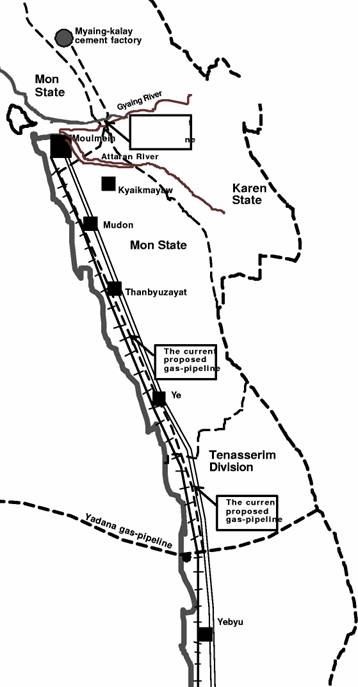
Location
map where the pipeline route passes through
When
corporation officials cleared the route for pipeline along Yebyu-Ye motor road,
it had passed into Yapu village tract and the lands and fruit plantations owned
by villagers were also confiscated by the authorities. When the route passes
into villages, the officials ordered to cut down trees that lied in front of
their house surrounding. The bushes and trees along the motor road were also
cleared by villagers without payment.
When
the route passed between Ye -
Similarly
when the route passed Wae-thun-chaung village, near Thanbyuzat town, about 10 houses and lands were confiscated
on November 29 and the villagers were ordered to destroy their houses, cut
their trees and leave their houses within three days. Among the villagers, the
houses and lands owned by (1) Nai Mun Tin; (2) Nai Nai Nyan Sein; (3) Nai Ai; (4)
Nai Pyin; (5) Nai Kyaw Aye; (6) Nai Ohn; and (7) Nai Sein were also confiscated
and they became homeless within three days. As common abuse by government
authorities in Burma, no land and house owned by villager were compensated and
they also did not provide any new space of lands. Then, the villagers suddenly
displaced due to this government development projects.
Accordingly
to villagers, these confiscated lands have price about 0.5 million Kyat to 2
million Kyat per plot of lands. The lands price differs because of different
land spaces and trees have been grown in lands. The villagers have been resided
with their families in these spaces of lands for over one hundred year and now
they displaced within 3 days.
Then,
when the route passes into Kyaikmayaw township along
the motor road, although it does not cross into a village, about 50 feet of
lands which have some fruit trees and paddy farmlands owned by the villagers in
Kyaikmayaw township were confiscated.
As
estimation, about 200 acres of lands with fruit trees and rice-fields along the
motor road are confiscated in Kyaikmayaw township and
nobody received any compensated cost.
Therefore
in the official pipeline construction conducted by SPDC, some hundreds of
civilians in Tenasserim Division, Mon State and Karen State have lost their
lands, trees and houses. The government officials never take responsibility for
these victims and just gave a complaint that all lands in Burma are own by the
State.
LIB
No. 299 Ordered to Fence Villages
(Southern Ye
Township, November 2000)
To
beef up the security and prevent the possible entry of the rebel members, a
SPDC military battalion, LIB No.299, that bases in
southern part of Ye Township ordered all villages in the southern township to
fence their own villages by finding facilities. The order was given before the
end of October and instructed that all villagers must complete fencing their own
villages in the first week of November.
LIB
No. 299 thought that after rainy season, the rebel troops from one Mon armed
group could have some activities and enter these villages to ask for tax and
foods. To prevent these possibilities, Burmese Army has found a way to fence
the villages. About 10 small and big villages in this area such as Khaw-za, Kha-pya, Yin ye,
Yin-dein, Hangan, Kalort and Kaw-hlaing villages have been suffered from this
order. Although the village headmen complained to army commanders that as they
were quite busy with their own farms because of harvest season, however the
commanders just ordered that to complete building offence on the set date. In
some village, if the fences were made, these could destroy their paddy outside
of villages and complained to commanders to allow fencing after harvesting
crops. But the army still did not accept any better suggestion. Therefore, the
villagers have to find fencing facilities as quick as possible and fenced their
villages according to order. Some villagers who have no time to find facilities
also paid to headmen and they have to buy some bamboo and wooden poles used in
fencing.
Besides
fencing the villages, the army has made some restriction against the villagers.
They also instructed to all villagers that they must not stay at their farms at
night and must not keep extra foods in their farms. Whenever the villagers went
to their farms or fruit plantations, they must take permission letters from the
own village headmen and if not, they could be accused as rebel-supporters. In
various types of restriction against the villagers, the villagers could not
work at they like at their farms or they have less time to work in there.
Some
villages were forced to form militia force in their own villages and instructed
the villagers to pay for salaries and foods for these militiamen. To suppress
the Mon armed troops that have been active in Ye and
Report
Conscription of Forced Labour and Tax Collection
in Kawkareik Township, Karen State
I.
Background of Kawkareik Township
Kawkareik township is a large
township situating in the southern part of
Along the river in the township area, there are over 20 Mon
villages situating and the majority of Mon inhabitants are paddy growing
farmers and fishermen. Karen villages
are situating in the eastern part of this township and the majority of Karen
inhabitants are farmers. Economically,
this township has a lot of food resources and these could provide enough for
the survival of the local inhabitants and for other required the accommodation
cost. If there is no control by the
Township PDC (Peace and Development Council), the local people could have
stayed in the community peacefully and without trouble.
However, since 1993-94, SLORC have reinforced its military
battalions in this area and tried to take more control of the area, because at
that time, the Burmese Army launched big offensives against KNU to occupy many
parts of KNLA control areas and its bases. In 1994, with objective to keep
control the whole of township area and use them as liaison base, the Burmese
Army deployed two military battalions, LIB No. 545 and No.546, in Kyone-doe
area, near Kawkareik town, which is on the main road to Thai-Burma border. Since the initial deployment of the
battalions until now, the local villagers from nearly all villages in township
have been constantly suffered from the conscription of forced labour for these
battalions.
Meanwhile, whenever the military regime tried to extend itscontrol over one area, it needs to spend more expenses
for both administration and army battalions.
As the regime always instructed order to collect tax or fund from
civilians for these expenses, the people in Kawkareik township
have been constantly asked by authorities or army to pay various types of tax
or fund or paddy to them. Additionally, one DKBA battalion have
taken base in this area and they also collected the similar tax like the
Burmese Army's battalions.
In 1997, after SLORC instructed for self-reliance program
for their military battalions, LIB No. 545 and No. 546 confiscated about 200
acres of lands in Kyone-doe area, near their military battalions and made their
own farms. However, the soldiers who
do not know about paddy cultivating or farming technique,
have conscripted the villagers nearby to work without any payment in their
farms to produce crops for them. These
produced paddy crops still do not enough to feed all soldiers which regular come to this township for offensive purpose
and so the authorities also forced the local Mon and Karen farmers in township
to sell their own paddy at low price to authorities' designated paddy-buying
centers.
The following facts are the accounts that how SPDC'S
Kawkareik Township authorities and army battalions, LIB No. 545 and No. 546
have conscripted the villagers to contribute unpaid labour, to pay for tax and
fund for several purposes in township and have forced the farmers to sell their
paddy during Year 2000.
II.
Conscription of Forced Labour by LIB No. 545 and No. 546
In this Kawkareik Township area, LIB No. 545 and No. 546
are the main military battalions that have taken base for some years and have constantly
forced the local civilians to contribute unpaid labour in their needed various
types of works. In Year 2000, these
two military battalions mainly forced the civilians in township to cultivate
paddy in their confiscated about 200 acres of lands.
Since June/July 2000, Township authorities or battalion
commanders have requested many hundreds of local villagers from Kyone-doe, Kharit, Kaw-bein village tracts that close to their farms
to do farming in their own farms. In
this case, at least 15 villagers from each village tract or sometimes from a
village have to go and work in the army's farms. From these village tracts, the villagers
from Kanni, Kaw-kyaik, Kawpareik, Meekalong,
Kawlyan, Ngar-taing, Inn-gyi, Kaw-go, Thayet-taw,
Kaw-bein, Kharit and others have been suffered from
the forced conscription of the labour.
In June, when the rainy season started, the battalion
commanders asked the villagers from Kanni, Kaw-go, Kaw-pauk, Thayet-taw and
Kyone-doe villages to bring their own oxen and tools to plough their
lands. Thus, the villagers from these
villages not only had to bring their oxen and tools, but also to bring their
own foods from their houses to eat in the workplaces. In ploughing lands, the villagers needed to
spend for over 15 days to complete this process.
After the lands are completely and properly ploughed, the
army and the authorities again ordered the local headmen to send many another
hundreds of villagers to sow seedlings onto grounds, take small seedling plants
and transplant them in the prepared places.
In Burma, since the farming is not improved like many other major paddy
growing countries, it needs a lot of human power in every process of
cultivation. Every thing has been done
by hands.
So, whenever the battalions asked the labourers from the
villages, they have asked at least about 15 villagers for one day work in 100
acres of lands, to plough the lands or to transplant small paddy plants. When
works such as growing paddy plants were quite huge in the farms, the army
conscripted about 50 labourers from a village for one day work. On a rotation basis, the headmen have to
manage to send the required number of villagers to workplaces.
In any order which the authorities asked for forced
labourers, the authorities or the army commanders always mentioned the number
of labourers they required; the dates those villagers had to go which
battalion's farms; and the works they needed to work in farms.
In an order dated on August 15, given by a commander from
LIB No. 545, Maj. Moe Thwin, it described as below: (See
the attached Order No. 1 in Burmese version on Page 5.)
To
Chairman
---------------Village
Subject: To help sending unpaid labour
1 As the
subject mentioned above, your---------village must send the required villager
labourers
accordingly to
the following instruction and dates:
(a) On September
18, 2000, to send about 50 men to weed out the paddy plants,
(b) On September
19, 2000 to send about 50 women to grow paddy plants.
2. To manage
doing these types of works, one village leaders must lead the group of the
villagers.
Signed -
(a Commander) LIB No. 545
Depending on the types of work, how was feasible to men or women,
the commanders decided to have men or women to complete their works properly
and easily. The works such as taking
the paddy seedling plants and carry them to the places for growing paddy was
little harder and so commanders instructed the village headmen to send only
men. Generally, in transplanting paddy
plants, the women could work very quick and so the
commanders instructed to send only women.
As an instance,
On July 27, 2000, in an order given by a commander from LIB
No. 545, the commanders requested only 15 women to grow paddy. So, in this case, they have not requested any
man to work in farms.
Since July until the end of September, the commanders from
both LIB No. 545 and LIB No. 546 have requested many villagers to do various
types of works in their farms, including, ploughing lands, growing paddy
plants, creating water canals and other works. Since the farms owned by these battalions
are quite large, they needed many people to work in the farms as the soldiers
never work any work and they have even no tools for farming.
For the village headmen, as the military battalions
requested labour continuously, they have been quite busy and headache in
managing of sending the required number of labour to the workplaces. Every village, the headmen have to send the
set number of labourers to both battalions of LIB No. 545 and No. 546. In sending the villager labourers, the
headmen had to use a rotation basis and rotate the villagers, whose needed to go on which dates. For small villages, where they were less
population, it makes too difficult for headmen to manage sending the set number
of villagers.
As
an instance,
Tha-yet-taw village is in Kyone-doe village tract and it
has about 150-200 households residing on the Gyaing river bank. Since July, the army commanders from both LIB
No. 545 and No. 546 instructed the village headmen in this village to send
villagers regularly to work in their farms without payment. Thus, thevillage
headmen have to manage sending villagers to both battalions' farms and they
were quite busy.
Since July LIB No. 545 requested village headmen to send 15
villagers (men and women) on July 22; 12 women on July 27; 50 villagers on
August 18; 15 villagers on August 22; 50 men on September 18; and 50 women on
August 19. Similarly, LIB No. 546
commanders requested 50 villagers every time and the same village headmen have
to manage sending 50 villagers on July 18; July 25; August 1; August 13; and
Sept ember 27 respectively.
From reviewing the above constant conscription of forced
labour from Tha-yet-taw village by two military battalions, the village headmen
must be hard to manage properly for every thing that required by army. The headmen needed to write down all
possible of villagers who can work in farms and forced the villagers to go and
work for army.
Not only the villagers from this Tha-yet-taw alone suffered
from the conscription of forced labour, other villagers from about 20 villages
have been similarly suffered from the same contribution of free labour in
army's farms. During the period from
July to September while the army battalions were forcing the villagers to work
in their farms, the villagers themselves were quite busy in their own farms. Both able-bodied men and women were in the
farms to complete their own works of cultivation.
Thus, sometimes, the headmen could not manage sending the
set number of villager labourers to workplaces on set date. When the village headmen could not manage
sending the set number of villagers on set dates, the authorities and army
angered to them and always gave threatening letters to concerned village
headmen.
As an instance, the army commander from LIB No. 545 also
sent a threatening letter to a village headmen as below, when he could not manage
sending the set number of villagers to workplace. (See Order No. 2 in
Burmese version on Page 7.)
To
Chairman
- Village
On August 18, 2000, we asked your help to provide about (50)
villagers as labourers to work in our LIB No. 545 farms, to take seedling
plants and grow them in farms. But you
didn't send any villagers to the workplaces, and you must explain why you could
not send the set number of villagers. As our works in farms were quite
important and busy, so we really need some villagers to grow the paddy plants.
Signed -
A Commander, LIB No. 545
Date: August 18, 2000
III.
Tax and Material Collection
After more army battalions have taken control in the area,
there have been more tax collection taken by army or
the authorities for the military purposes.
Each household in a rural village or a town section, at least has to pay
about 200-500 Kyat porter fee to authorities or nearest military outposts,
which have been spent as a main military purposes.
Now, not only the porter fee for the military offensives
purposes, Township authorities also collected administrative fee for various
purposes of administration or to provide some fund for their government
servants or for township fund.
As an instance,
On April 28, 2000, in an order given from Township's
General Secretary, U Aung Lin, to all village headmen, he instructed to them
that as a monthly basis, each village headman must bring 500 Kyat to provide
fund for government servants in Township administration departments. The deadline for providing the fund is April
20 for every month. The authorities
aimed that after they have collected this fund, they will use it as investment
fund in some government sponsored income-generating program.
Besides the regular porter and administrative fees, when an
occasion is held by Township authorities, such as Karen State Day ceremony,
Union Day celebration, welcoming the SPDC higher authorities or army commanders
and others, the authorities always collected fund from the town section and the
villagers in the whole Township.
As
an instance,
In an order dated on January 14, 2000, given by Township
authorities to all village headmen and town section leaders, they instructed
that to hold Karen State Day celebration, each village must have to provide 3,
000 -10, 000 Kyat fund to authorities.
Depending on households and populations in each village, even a smallest
village, with less than 50 household must have topay
at least 3, 000 Kyat, while some other villages had to pay 4, 000 Kyat, 5, 000
Kyat, 7, 000 Kyat and 10, 000 Kyat. The
authorities showed the reason that in this
On the other hand, sometimes, when Township authorities
adopts or are ordered to implement a development program, such as building
schools, clinics and self-help road building; tree growing; maintenance of some
important building; construction of military barracks; creating dry season
crop-growing and others, the authorities always have tried to collect fund from
the civilians.
As
an instance,
On July 24, 2000, when Township chairman gavean order to all village headmen to attend monthly
meeting, he also instructed that all village headmen needed to bring 2000-5000
Kyat cash along with them to support tree-growing program conducted by forestry
department.
Sometimes, unlikely to the above instances, the authorities
also collected huge amount of fund or tax from villages for special purposes,
such as launching military offensives; maintaining and rebuilding roads and
bridges; building and maintaining military barracks or other buildings; and
other purposes.
Kawakareik
Township area is stratedgically very important for
SLORC/SPDC to launch the military offensives against KNU and KNLA which takes
bases in eastern part of Karen State, along Thailand-Burma border. Thus, the Burmese Army also kept extra foods
in this township area and requires maintaining or repairing the supply
buildings every year. When the
authorities require rebuilding or repairing these buildings, they always
ordered the village headmen to provide for fund.
As
an instance,
In an order dated on
And, the authorities instructed 22, 000 Kyat each from Kaw-nwe, Ye-gyaw-gyi, Yan-koke, T aung-kya-inn and Myauk-kya-inn
village respectively. Kyone-doe village
tract (there are about 5 villages) also have to provide 110,000 Kyat; and
Kaw-bein village tract have to provide 110, 000 Kyat and it shared as44, 000
Kyat from Kaw-bein village; 25,000 Kyat from Kaw-pauk village; 25, 000 Kyat
from Min-ywa village; and 16, 000 Kyat from Kaw-go village respectively. So, from 7 town sections and three village
tracts, the authorities took about 440, 000 Kyat, a hugh amount of tax, from the civilians.
Not the tax or fund are for authorities and army battalion,
the police in Kha-rit police station that bases on
Gyaing riverbank also collected tax from the fishermen in river who are
traditionally working as fishermen for several years. Fisherman who owns one boat and net have to
pay 2000 Kyat tax and fisherman who owns only one net have to 500 Kyat for
every six month to police station. The tax have been used for police station fund.
Thus, every month, the village headmen collected 2-3 rounds
of tax or fund collection for authorities and army battalions in this township
and these are quite a burden work for them. Each household, even
a poor family have to pay about 500-1000 Kyat every month to headmen for
tax or fund.
IV.
Paddy Tax Collection
Besides fund or cash tax collection conducted by the
authorities, the army, Township authorities and police department also have
forced the farmers in the whole township area to sell their paddy at low price
to them and it is meant also "yearly paddy tax" to authorities.
In Kawkareik, there are a large paddy farms along Gyaing river and the paddy is also the main crop production of the
area. Thus, the higher authorities also
instructed Township authorities instructed to collect a hugh amount of paddy from the local farmers. Karen State PDC instructed that it required
about 150, 000 baskets of paddy (one basket is about 46 pound in official
measurement) and ordered Township PDC to force the farmers to sell this amount
of paddy to their designated paddy-buying center.
Why the government authorities have taken this huge amount
of paddy? Because, as mentioned above,
this township area strategically, militarily and in communication important to
have control and every year, many thousands troops of the Burmese Army, besides
two main bases in township, have come and stayed in township when they prepared
to attack KNU along Thai-Burma border.
And a main motor road that connects to the border is also in this
township and the army has to take security for this road. Many traders moved along this road and the
authorities and army also received tax from them.
Whenever the authorities extend their administration or
army extends it military control, they both needed more government servants and
armed forces. So, this
privileged groups of servants and armies could not produce any foods for
themselves and the farmers have mainly to provide all required foods for
them. Since the beginning of 2000, in
January, the authorities have created many paddy-buying center
in each village tract of township area and forced the farmers to sell their
paddy as quick as possible. February 15
was the deadline for all farmers.
After deadline, when farmers from some villages could not
complete selling their paddy, because those farmers lost some of their crops
during rainy season, the authorities also wrote a threatening letters to village
headmen. They also asked village
headmen that to make a detail list of their villages' farmers and the amounts
of paddy each village headmen sold to the paddy-buying centers.
As an instance,
In an order dated on February 15, Township PDC's General Secretary, U Aung Lin, mentioned that
Kawkareik township was requiring to buy 150, 000 baskets of paddy totally from
the farmers in township. But the
authorities still had not received this amount of paddy and so the concerned
village headmen have responsibility to complete this task. Thus, township authorities must makea detail list of farmers and how many baskets they sold
to which paddy centers. A U lists must
arrive to township office on February 20 as deadline.
That was an action taken by Township authorities and the
headmen again had to force the farmers who failed to complete their duties of
selling the set amount of paddy to government. So, the farmers who lost the crops during
the last rainy season also had to sell their belongings and bought paddy at
high price in market and sold them to paddy-buying center at low price.
Additionally, separating from paddy bought by Township
authorities at low price, some police stations at villages or town section also
asked supplies without payment from farmers in the respective village tract and
town sections. The paddy is food supply
for police members in station and their families.
As
an instance,
In February 2000, the police chief in Kha-rit police station ordered the village headmen in Kha-rit village tract to provide the police and their families
with 300 baskets of paddy. In his
instruction to headmen, he asked for 60 baskets of paddy from Kha-rit village, 60 basketsfrom
Kaw-ka-taw village, 60 baskets from Mon-hlaing village, 40 basketsfrom
Kyauk-ye-twin village, 50 baskets from Ngar-chun-gone village and 40 baskets from Kyauk-ka-pin village.
In Kawkereik township,
the land soil for growing paddy is not quite good as lands along Andaman
seacoast and the paddy production is not so high. The farmers could produce not more 40-50
baskets of paddy from one acre of lands.
However the authorities instructed the farmers to sell about 10 baskets
of paddy for one acre of lands in Year 2000. After selling paddy at low price
to government, paying for labour cost to labourers for farming, spending
various costs for farming in the whole year, buying fertilizer and other
materials, the farmers left nothing but debts.
V.
Conclusion
In case of conscription of forced labour, each family have
to work for army or authorities about 5 days at least every month and sometimes
nearly two weeks. Sometimes, if the
Burmese Army planned to launch the military offensives against KNU and KNLA,
many thousands of civilians in this township were arrested as "frontline
civilian porters" again.
Because of government or SPDC'S shortage of budget to
provide their subordinated administrative office and army battalions, the
collection of tax or fund have been increased and the local civilians have been
suffered to pay a huge amount of tax which they have never to pay during BSPP
era.
However, the
Karen and Mon civilians in Kawkareik township have been similarly suffered from
the various of unlawful and illegal tax collection by the authorities and
constant conscription of forced labour, while some Karen villagers in rural
areas are additionally suffered from cruel, inhumane and degrading treatments
by the Burmese Army's troops with accusation they are rebel-supporters.