News, Personal Accounts,
Report & Analysis on Human Rights Situation in Mon Territory and Other
Areas Southern Part of Burma
The Mon Forum
Issue
No. 9/2000
September 30, 2000
The
Publication of Human Rights Foundation of Monland (BURMA)
Contents
News:
(1) Rape attempt to a Mon
woman during the conscription of forced labour,
(2) Illegal tax payment in Pegu Township and
poverty,
Report:
(1) SPDC'S conscription of forced labour and
other abuses related to suspicion of rebel-supporters in Kya Inn Seikyi
Township, Karen State.
Some Acronyms in This Issue
SPDC: State
Peace and Development Council,
SLORC: State Law
and Order Restoration Council,
LID: Light
Infantry Division (of Burmese Army)
IB: Infantry
Battalion (of Burmese Army),
LIB: Light Infantry Battalion (of
Burmese Army),
KNU: Karen National Union,
DKBA: Democratic
Karen Buddhist Association,
NMSP:
New Mon State Party.
News
Rape Attempt to a Mon woman during the
Conscription of Forced Labour
(Yebyu
Township, September, 2000)
During LIB No. 282 was conscripting forced labour to grow
palm trees in their own battalion's plantation, some Mon villagers from
Kwe-tha-lin village in Yebyu township, Tenasserim
Division were forced to work in the plantation in the last week of September.
During they were in the work-place, one SPDC commander, Sergeant San Win
attempted to rape a Mon woman, Mi San Htay (28 years old).
LIB No. 282 is taking base in southern part of Yebyu
township, in "52 Miles" area, near Yatana gas pipeline route and this
battalion is the main battalion that have to take responsibility to take
security of gas pipeline. On the other hand, LIB No. 282 took some wild lands
around the battalion headquarters near 52 Miles area and the battalion
commanders constantly forced the local villagers from many villages in Yebyu
township area to grow palm trees in these lands and created palm plantation.
On September 20, army commander from LIB No. 282 asked
Kwe-ta-lin village headmen to provide 25 villagers from the village to
contribute free labour in growing palm trees in the plantation. The commander
also instructed to village headmen that the villagers must contribute their
labour for three days from 21 to 23, and they could return on 24 September. He
also ordered the villagers to carry their own foods from homes. The village
headmen needed to send the requested villager labourers on 20th
evening.
Among 25 villagers, there were 12 men and the remaining 13
were women. That group of villagers worked together in the plantation for three
days. Their main works were to clear grasses, dig holes and plant small palm
trees. After that group of villagers completed their work-duties and before
they returned to their village, the attempt of rape case happened in the
workplace in the evening of September 23.
On that day evening, about 7 o'clock, after the group of
villagers completed having dinner, the commander Sergeant. San Win asked the
group leader, Nai Maung Sein that he would like to meet with Mi San Htay (the
victim), to give some palm trees for her as a gift. And, the leader said
that as the night already fell, it was not polite for meeting with a woman and
suggested him to meet tomorrow's morning. But, he refused. So group leader went
back the labourer barrack and told Min San Htay to meet with Sergeant and
suggested to take an accompanied girl with her. When she arrived to the
barrack, the commander ordered the girl to stay outside of the barrack and he
would like to meet only Mi San Htay in private. Then the commander brought Mi
San Htay to a kitchen building near barrack. Then, he pushed her and tried to
rape.
The Mon woman also shout for help
and called the name of her accompanied girl. The girl was afraid to help her
and run back to the building, where all villagers were staying. The girl also
explained to the group of villagers about Mi San Htay's shouting for help and
then group leader and some elder women quickly went to the kitchen building
after arguing with some soldiers who took security outside barrack. When the
group of villagers arrived close to the building, the commander stopped his
attempt.
Some elder also told to commander that such attempt to rape
the woman was a rude behavior. He also asked the group leader, Nai Maung Sein
and other villagers to not tell about that case
to commander. However, after incident, the group of villagers
also complained about the case to battalion commander to take actions on him.
After two days of the case, the commander was moved to another area and the
villagers have not heard any action taken to that Sergeant.
Normally, in the work-places where SPDC battalions are
conscripting the villagers for labour, women are quite vulnerable to be
victimized. They could be raped because of unsafe building or taken by pointing
guns by soldiers for rape when they could not protect themselves. So, while the
soldiers are away from their families or no place for visiting to have sex with
prostitutes, women in the work-places, in porter services and in conflict areas
are quite vulnerable to be victimized with rape abuses. Because of ashame for the rapes
according to tradition and cultures in
Illegal Tax Payment in Pegu Township and Poverty
(September,
2000)
In both Pegu city and the villages in township area,
because of government's huge illegal tax collection, which are not in the laws
and unemployment conditions, the civilians in the most part of township have
faced more deeper poor situation, while many families
in the town faced food-shortage problems. Pegu is a capital city of
As a monthly tax, Township police department collects about
500 to 1, 000 Kyat per household depending on the economic situation of each
household and the police requests this fund from the civilian to cover all of
their activities and department's expenses. As yearly tax, Township authorities
collected 1, 000-5, 000 Kyat from all shops or other service to cover all expenses
used in the whole township's administration and distribute fund to all
departments. Some departments also collect some separate funds that are
different from tax collected by township. For example,
forestry
department also collected tax from wood traders and lumber sawing mills, with
5, 000 Kyat to 10, 000 Kyat depending on the sizes of economics of those
traders and mills.
In Pegu township, if compared with
village communities, who are working in tradition paddy-growing farms, the
communities in town have found more and more unemployment conditions in Year
2000. They almost tried to seek work as hard and day labourer to get daily
income but many could not get jobs on daily basis. Some poor families could
raise income only about 150 - 200 Kyat per day and this income could not
support them enough to buy rice, other supplement foods and clothes for each
whole family, while all prices of rice and daily used groceries are quiet
expensive.
Additionally, the Township PDC also requires arranging various
types of ceremonies that are not related to community's religious and other
affairs. The ceremonies include welcoming of SPDC executive military leaders;
meeting, seminar and conference against NLD and other democratic oppositions;
opening of new self-help roads and other activities. In each ceremony, the
Township PDC requires some hundreds of thousands Kyat budget to cover all
expenses and whenever it was celebrated, the authorities collect fund from
every household. Even in Anti-NLD Signboard Putting ceremony, the authorities
asked fund for civilians. In each ceremony, one family has to provide fund from
50 Kyat to 100 Kyat. In each ceremony, the authorities forced all families
especially in city to attend ceremony and instructed one member from each
family must attend. If one family failed to attend a ceremony, that family
needed to pay fine from 100 Kyat to 500 Kyat depending on how important of
ceremony. The civilians had no choice, they tried to
attend any ceremonies to avoid payment.
In building of self-help roads, the civilians in township
have to provide their unpaid labour, take their own foods and build the roads
as ordered by Township authorities. The family who failed to go and work in
road construction needed to pay 300 Kyat per day. And, by showing the reason to
hire the labourers in taking security for railway road and for preventing fire
flame in city, the authorities asked 30 Kyat as fund from every household every
month.
Besides illegal tax for ceremonies, whenever a development
project have conducted for this township, the government never allocates a
complete budget, and just orders Township PDC to collect fund from civilians.
In July, 2000, when SPDC ordered to build a public hospital in city, each
family has to provide about 50 - 500 Kyat funds for that building depending on
the family's economic conditions.
In July/August 2000, by following SPDC policy, Township
authorities also created "free tax market" in a place that far from
the city center and public buyers. After creation of this market, the
authorities have forced all small vendors to move to new market. They have to
abandon their former market places and moved to new places where very less
buyers come and buy their groceries.
Therefore many small vendors are disappointed with this
situation.
Because of the government's continuous and huge tax collection;
mismanagement in administration; corruption among the authorities; the people
in the whole township have faced more and more poor.
Report
SPDCs Conscription of Forced Labour and Other
Abuses Related to Suspicion of Rebel-supporters in Kya Inn Seikyi Township,
Karen State
I.
Gross Human Rights Abuses in Kya Inn Seikyi Township
Geographically, Kya Inn Seikyi township
locates in the western part of
Since over 50 years, after Burma retained Independent from
British Colony, this area has been remained as conflict area because it has
been used as main bases for Mon and Karen ethnic armed forces. Because of civil
war, the area is under-developed and the civilians in the area have been
constantly suffered from various types of abuses committed by Burmese Army.
In 1995, although a Mon armed political organization, NMSP
entered into ceasefire with SLORC, the Karen main armed political organization,
KNU (Karen National Union) has still remained as a main group in this area,
which has been waging war against SLORC and SPDC until now. In the situation while NMSP is ceasing
fighting and KNU is still fighting against KNU, most Mon population have been
suffered from some abuses and violations from the conscription of forced labour
and portering, while Karen villagers have been suffered from arbitrary killing,
arresting, torturing and rape by the SPDC soldiers because they are under the
suspicion of rebel-supporters.
II. Continuous Conscription
of Forced Labour by IB No. 32
IB No. 32 is a permanent or regular
military regiment that have taken base in Kya Inn Seikyi town for
several years and it has responsibilities in managing in township administration
and has a high authority. However, it has rare duties to launch or involve in a
larger scale military operation against KNU/KNLA in the forest areas far from
the town.
Since the battalion has taken base in this area for several
years, it has lots of experience in collecting various types of taxation both
legally and illegally from the civilians, and has involved in businesses to
raise the battalion fund. For example, since 1992, until now the battalion has
received about 50-100 Kyat from one passenger through gathering tax from ferry
drivers who charge for transportation of passengers between Kya Inn Seikyi Town
and Mudon, a small town in Mon State.
Additionally, the battalion could involve in business by giving shares
in transportation business that has operated in the areas.
In 1997, when the respective military command that has
supervised to local IB No. 32, Southeast Region Military Command (Southeast
Command), ordered all local military battalions that have taken bases to create
self-reliance or self-support for their soldiers and families in the respective
battalion. The main activity of raising
funds for the battalion is to raise fund and foods for their own battalion. In
this case, the supervised military command has allowed or given chance to
battalion to confiscate lands, to involve in businesses, to collect tax from
paddy-growing farmers and rubber plantation owners and other types of tax.
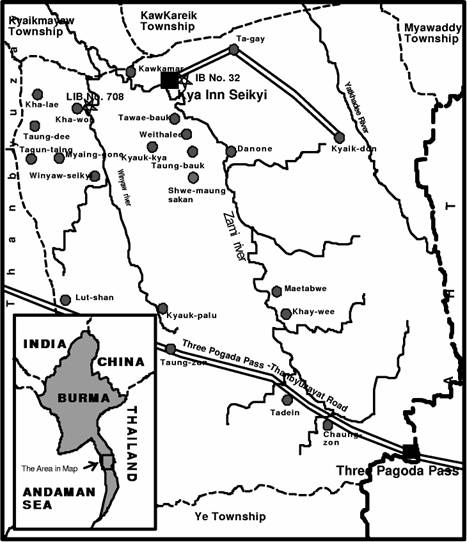
Location map of Kya Inn Seikyi Township and IB No. 32 and
LIB No. 708
Therefore, since 1997, IB No. 32 has created about 100
acres of paddy-growing farms from the confiscating lands from the local farmers
and then cleared about 50 acres of wild-lands for rubber plantations. Every year since 1997, the battalion has
forced many hundreds of local Mon and Karen civilians^ from the villages close
to Kya Inn Seikyi town and villages resided between Zami and Win yaw river (look
in the location map).
In Year 2000, the use of forced labour in these
paddy-growing farms and rubber plantation has continued and the following
accounts are the information, which have been collected from the fields. Since
May, when the rainy season started, the commanders from IB No. 32 have ordered
the respective village headmen in the area to provide the requested number of
villagers to send to the designed work places.
As
instances,
On May 3, 2000, Maj. Than Yin of IB No. 32 asked about 100
villagers from Shwe-la-inn, Htee-paukhlo, Wae-krai, Kaw-krot and Ohn-khataw
villages to clear grasses in the battalion owned rubber plantation and used
them to grow vegetables in their own battalion compound.
Similarly, on June6, a commander from IB No. 32 also
requested Htee-paukhlo village headmen to send 7 pairs of oxen and plowing
equipment to battalion farmland to plow lands.
During June, as many farmers from that village were quite busy in
plowing their own farmlands they could not provide the requested numbers of
oxen pairs to the military battalion and informed to commander the reason why
they could not provide oxen. Then, the battalion instructed to give fines for
their failure to provide oxen as 1, 000 Kyat for one pair of oxen. The headmen
had to collect this cash fine from villagers and paid them to army battalion.
The army battalion, which created paddy-growing farms, does
not have any facilities such as machines to plow lands or other farming
facilities, and even they have no human resources to complete all processes of
cultivation. In such conditions, army
commanders just give orders to village headmen to contribute free human and
oxen labour in their farms.
In July, after more rain, the battalion also required to
extend its field of rubber plantation and forced the villagers again to grow
more rubber trees in cleared wild lands to grow rubber plants. Thus, the battalion also forced the local
villagers to grow the small rubber plants.
As an instance,
On July 4, a commander of IB N o. 32, Lt. Col. Win Bo,
asked about 20 villagers from Htee-paukhlo village to clear grasses and grow
rubber trees in the battalion owned rubber plantations. The villagers had to carry their own foods
from their homes and cleared grasses and bushes, and grew rubber plants for the
whole day.
After rotation of other villages, the villagers from this
village were again
forced to contribute their labour. On July 9, the same commander
asked about 50 villagers from Htee-paukhalo village again to grow rubber
plants. The villagers had to carry their own foods and worked for the whole
day.
In using or conscription of forced labour from the
villages, the army commanders have used a rotation basis and instructed many
villages to send the set number of villagers to workplaces. In this Htee-paukhlo village case, the
villagers were forced to work on July 4 and then the battalions have used
villagers from other villages from 5th to 8th of July and
then used Htee-paukhlo village again on July 9 for one day. The conscription of
forced labour for planting trees had been taken for nearly 3 weeks to complete
growing about 10 acres of land, the battalion commanders have forced about 200
villagers from about 10 villages. Among them, Htee-paukhlo village was the
biggest village with over 300 households while some small village has less than
50 households.
Similarly, after plowing lands, the battalion also required
villagers to grow the paddy plants in their farms. Therefore, the battalion had ordered to
village headmen to send the set number of villagers to battalion farm to grow
small paddy plants.
As
an instance,
On July 7, the commander of IB No. 32, Lt. Col. Win Bo
asked about 50 villagers from Htee-paukhlo village, to come to battalion to
plant their paddy. Thus, the village
headmen had to arrange 50 villagers to send to farmlands owned by IB No. 32,
while most villagers were very busy with their own farming activities.
By analyzing this case, the commanders already ordered the
villagers to work in the rubber plantation just on July 4 and again used them
in July 7, for the whole day. And, the
villagers had to go and work again on July 9 in the rubber plantation
again. So, the villagers have been
often forced by the local military commander in contributing their unpaid
labour in army's workplaces.
Not only Htee-paukhlo village, other villagers were also
forced similarly to regularly contribute their labour in IB No. 32 paddy farms
and rubber plantation. Because when the
time is quite busy for the local villagers to contribute their labour in
battalion farms or plantations, sometimes, the village headmen were in the
difficult role in managing the villagers to send them to the workplaces
on a rotation basis. If the village
headmen failed to provide labour for the army, they must have to pay fine (in
cash).
As
an instance,
On July 20, when a commander from IB No. 32, Maj. Tin Oo
asked about 30 villagers from Kyaukpone village to contribute labour in
planting paddy plants in army's farms, the headmen could not manage to send
these villagers. The commander
instructed that they must have to work in the workplace only for one day, however, the headmen could not manage because all
villagers were busy with their farming activities. After the headmen informed
to the commander that they could not provide the requested number of villagers,
the army ordered to pay fine with 500 Kyat per head. The headmen have to collect 15, 000 Kyat from
the whole villager and paid them to the commander as a fine for their failure
to send the defined labourers to the workplaces.
Normally, the village headmen always tried to send the
villagers on a rotation basis, because it was also quite hard for them to
collect money from the villagers.
Besides two villages, Htee-paukhlo and Kyaukpone, mentioned above, the
villagers from many other villages, such as, Shwe-la-inn, Pyaw-yar-gone,
Kyatu-yawe-taung, Weithalee, Kawkamar, Pyoe-lin, Pyoe-daw, Shwe-daung-baw,
Thanbyaya and Bada-gyi villages have been constantly used as labourers during
the whole of July in working in army farms.
The following accounts show how a large number of villagers
near Kya Inn Seikyi town were forced to contribute labour in army's farms.
On July 20, about 16 villagers from Shwe-la-inn village
were conscripted by the commander of IB No. 32, Maj. Tin Oo to contribute
unpaid labour in battalion paddy-growing farm, especially to grow paddy plants.
Only July 21, about 20 villagers from Pyaw-yar-gone village were forced to work
in the same farms with the same work.
From July 22 to 30, the villagers from Wei-tha-lee,
Kawkmar, Pyoe-lin, Pyoe-daw, and Shwe-daing-baw villages were forced by IB No.
32 in their farming activities. The
village headmen had to send different numbers of villagers to the set
workplaces, with 70, 60, 50, 30, and 15 villagers depending on pieces of works.
Sometimes, after some villagers from the villages in the
conflict zone were arrested by the other battalions, they sent these villagers
to IB No. 32, to use them as permanent labourers in paddy farms or rubber
plantation. As an instance, on July 28,
about 10 villagers from Yale and Mae-tha-krae villages were and sent to IB No.
32 to use them in farming and plantation.
They were used as permanent labourers in the battalion for over two
weeks until most works finished in the battalion's farm and plantation.
III.
Conscription of Forced Labour by LIB No. 708
LIB No. 708 is a new battalion that have
been taken in Kya Inn Seikyi township area only about one year. After many armed oppositions in the northern
and eastern parts of Burma entered into ceasefire with SLORC prior to 1995, the
Rangoon military regime has not had to use much military forces in these area.
Therefore, many military battalions were withdrawn from other parts of Burma
and deployed them in Mon State and Karen State to launch the military
offensives in keeping KNU to not get control in rural areas. For example, LIB
No. 299 and LIB No. 343 were deployed in the new confiscated lands in Ye
Township of Mon State, while the Burmese Army deployed LIB No. 708 in
confiscated lands in Kya Inn Seikyi township of Karen State.
Whenever a military battalion is deployed, the local
villagers nearby are always forced to build the military barracks, making
fences and others. The villagers from
villages near the new village might have been constantly conscripted by the
local military commanders to contribute free labour in various constructions in
the battalion. For example, when the
Burmese Army deployed a new military battalion, LIB No. 299 in southern part of Ye
Township, the villagers from Mun-aung, Koe-mile, Kalort and Han-gan villages
were forced in the workplaces.
Normally, the soldiers forced the villagers to find building facilities
and build the barracks, dig bankers and trenches and make fence.
Similarly, while LIB No. 708 was being deployed in Kha-won
village of Kya Inn Seikyi township, the villagers from the nearest villages,
such as, Winyaw-seikyi, Win-htaung, Myaing-gone, Taung-dee, have been
constantly forced to contribute unpaid labour to the battalion.
As
an instance,
On July 24, a commander from LIB No. 708, Maj. Ye Htun,
asked and conscripted about 60 villagers from Kha-won, Win-yaw, Win-htaung and
Myaing-gone villages to build the military barracks in their army camps. These villagers had to find some building
facilities and built the barracks.
Depending on work-duties, some villagers had to work for 3 to 7 days in
the barrack construction. In each
barrack construction, the villagers were forced to build a 50 feets long
barracks with two roles. The villagers
themselves had to find woods, bamboo and thatches for building. Prior to building a barrack, the army already
requested these types of building facilities from villages nearby.
When the soldiers conscripted the villagers to be labourers
in building of their military barracks and others, they always ordered the
concerned village headmen to send the set number of villagers. Sometimes, when the headmen failed to manage
for their requirement, the soldiers made a threat against the headmen.
As
an instance,
On July 24, when a group of soldiers arrived into
Myaing-gone to inform about their request for villager labourers, they did not
meet with village headmen. Then they
also accused that the headmen were trying to escape or to not meet with them.
And, they called some villagers to collect in middle of village, shot their
guns on the villagers. This was a type
of threat to obey their order. After
their return, the headmen urgently arranged to send the requested villager labourers
to workplaces.
In July, after the battalion completed all building of military
barracks, villagers were required to do another works in the army base of LIB
No. 708. Besides the battalion's
commanders forced the villagers to build many military barracks, the villagers
were continuously used to dig a long trenches rounded the base's compound and
some near the military barracks. Some
villagers were used to made to dig and maker bankers and make fence.
As
an instance,
On August 18, LIB No. 708 's
commander Maj. Ye Htun asked about 50 villagers from Taung-dee village to construct
a long trench by rounding the bases.
The soldiers instructed the villagers, to dig a 5 feet width and 5 feet
depth trench round the base, and pieces of works were shared to villagers to
complete for 5 meters to 10 meters feet long. Depending on the number of
village labourers, the different pieces of work were defined. So, the villagers have to complete their
pieces of works from 3 to 7 days in workplaces.
Some villagers were used to dig trenches round each military barracks,
while some dug and made bankers. In
building fence, the villagers themselves have to bring tree poles and bamboo
from their villages and then made fence in the base.
All of these work in the military base such as building the
barracks, digging trenches and bankers, building fences were all hard works and
the villagers have to work in one piece of work at least about 3 days and
sometimes, have to work over 7 days.
Among many villages in the surrounding area who were
forced to
work, the villagers in Kha-won village where the army takes base has been
suffered more from the constant conscription of labour. Whether other villagers were forced to work
or not, the headmen in Kha-won village have to provide at least 10 villagers
every day to the bases to do every thing for soldiers including cooking,
carrying water and other daily works.
LIB No. 708 also took fine from the village headmen, if
they failed to manage or provide the requested number of villager labourers. In
most cases, the villagers were quite busy with their own works in farms or
other places to get foods or incomes for their families and it made quite
difficult for village headmen to get the requested number of village labourers
for any construction in the base. For
example, whenever the army commander asked for 30 villager labourers from one
village, normally the headmen could not manage to get this number of villagers,
and could provide about 20 or less than 20 villagers to the workplaces. Thus, the army commander took fines from the
villagers who failed to come and work in the base. The commander instructed to pay 300-400 Kyat
fine per day fine for one village who could not
come. And, the headmen collected money
fines from villagers and then paid to battalion. From taking fines, the battalion could earn
about 40, 000 - 50, 000 Kyat every month from 4-5 villages in surrounding
areas. By this way, the new battalion
had taken both villagers' labour and cash for their own battalion buildings and
fund.
IV.
Taxation by Army and Township Authorities
In raising the battalion fund, the regular battalion
especially IB No. 32, has not only used one or two methods, it also used
various methods to get enough income to operate all their purposes in their
battalion. On the other hand, the light infantry battalions, such as LIB No.
284 and a new battalion, LIB No. 708, which are taking bases in the township,
have relied on the fund provided by IB No. 32.
If compared with other two battalions, IB No. 32 has main
responsibility to seek fund and it has used various methods to raise fund
including collecting tax from rubber plantation owners and paddy-growing
farmers. After negotiating with local
Township PDC authorities, IB No. 32 found opportunity to collect tax from
rubber plantation owners from many Mon and Karen villages in the surrounding of
Kya Inn Seikyi town.
In Kya Inn Seikyi Township, some villagers from over 20
villages, in surrounding area of town, but some are far from town. For the nearer villages, Township PDC or IB No.
32 ordered the concerned village headmen to give the set amount of rubber as
yearly tax or they asked that tax to pay by cash. Rubber plantation owners from villages such
as Kha-le, Tagun-taing, Weitha-lee, Taung-dee,
Winkabar, Kyauk-pone, Kyuauk-kya, Kyatu-yawe-taung, Htee-paukhlo and other
villages close to town have to give the set weight of rubber or the equal
amount of money to IB No. 32 or Township SPDC’s Agriculture Products Trade
Department, as tax.
In March, 2000, IB No. 32 instructed to all villages which
owned rubber plantation outside of their villages, to give rubber tax to the
battalion. It also set the amount of
rubber weight (which was measured in Pound) to give to the military
battalion. When it ordered, it
mentioned the set amount of rubber it required as tax and calculated them into
cash, and also mentioned the set amount of cash instead of rubber tax. Actually, the army did not want drought
rubber sheets from the villagers but really required some equal amount of cash
to the costs rubber sheets.
According to an order by a commander from IB No. 32, it
mentioned as below: (Look the Burmese version order No. 1, on Page 6)
To
Date: March 3, 2000
Chairman ---------------------Village
Subject: To complete the duty of giving rubber tax.
As the subject mentioned above, I inform you that soon
after you received this letter, you needed to find the IB No. 32 military
patrol forces and to give 104 pounds of rubber (or) 8, 064 Kyat (eight
thousand, sixty-four Kyat totally) that your village remained to pay off.
Signed -
(Maj. Ko Ko Aung)
IB No. 32
In this case, although army commander mentioned the set
amount of rubber to be given to battalion as tax, he also added the amount of
money in order. Since the military
patrol of IB No. 32 led by Maj. Ko Ko Aung, moved from
one village to another, it might be quite hard for the village headmen to track
him. So, instead of carrying 104 Pounds of rubber sheets, the headmen would
bring 8, 064 Kyat tax for the battalion.
In collecting this type of tax, IB No. 32 tried to get the
set amount of tax in cash, when they launched the military patrol in the
area. Many villages which are far from
the town or IB No. 32 headquarters failed to give this type of tax and whenever
its military patrol arrived close to these villages, the operation commanders
sent letters and asked for tax.
Sometimes, the commanders also made threats against village headmen who
have been delayed to complete their duties of giving rubber tax.
In an order dated on March 13, sent to a village chairman,
the commander mentioned, the village headmen must need to discuss with them
about giving yearly rubber tax. Its also threatened that "if the headmen failed to meet
with commander, it was their own responsibility", which means that they
must face punishment if they did not continue to complete their duties of
giving rubber tax to army. (Look
the Burmese version of Order No. 2, on Page 7)
Similarly to rubber tax, army or Township PDC authorities
also asked yearly paddy tax from paddy-growing farmers, by using a forced
purchasing of paddy from farmers at 2-3 times low price every year. In most
case, the army does not directly handled this collection of tax, but Township
PDC's Agriculture Products Trade Department or Township council itself takes
responsibility in forcing farmers to sell the set amount of paddy to designated
paddy-buying center created by authorities.
As an instance,
On January 1, 2000, Kya Inn Seikyi PDC Chairman sent an
order to Winyaw-seikyi village tract to sell 2, 000 baskets of paddy to
designated paddy-buying center. In this
village tract, there are about 4 villages and the headmen of all villages
needed to discuss to share the amount of paddy tax that required to sell to authorities.
The deadline to give this tax was January 15, 2000.
In this case, both army and authorities do not need cash
instead of paddy. They really required
to collect over 30, 000 baskets of paddy as their food supplies in township to
provide army battalions, government servants in different departments and other
Burmese Army's troops, who often arrive to township to launch offensives
against the rebel force in township area.
V.
Cruel and Inhumane Treatments During SPDC'S Military
Offensives
As Kya Inn Seikkyi township area
is a larger one and KNU/KNLA troops have been active for several years and now,
SPDC have tried to clear all their enemy's roots and have regularly launched
offensives. The regular military
battalions, such as IB No. 32, LIB No. 284 and LIB No. 708, have no direct
responsibility to launch regular military offensives, but Southeast Command
bring other battalion outside of Kya Inn Seikyi township, especially from Karen
State and Mon State, to operate military offensives against KNU. The main duty of the military battalion in
Kya Inn Seikyi township is to operate military patrol
in the surrounding areas of their bases.
When the other military battalions came into this area,
their main duty is to launch military offensives against KNU. During the beginning of Year 2000, LID No.
44 and some battalions, such as LIB No. 703, LIB No. 705, LIB No. 707 had
launched the military offensives against KNU in areas along Zami river and
along Three Pagoda Pass - Thanbyuzayat motor road. During this dry season offensives, many
Karen and Mon villagers were displaced and some of them were killed and
inhumane tortured with accusation, they were rebel-supporters. (All detailed report is described in
"The Mon Forum", Issue No. 7/2000, produced in July, 2000.) This military have been taken place until
the end of June.
From July until September, another three military
battalions, LIB No. 703, LIB No. 208 and IB No. 31 have launched military
offensives in many parts of rural Kya Inn Seikyi township area.
During the military offensives launched by any battalions,
the villagers in the conflict area, or free-fire zones
have been constantly suffered from various types of human rights abuses and
violations that related to accusation of rebel-supporters. The villagers are not treated as humane,
like the people in the government control areas. Many villagers are killed, tortured and many
women are also raped by SPDC commanders and soldiers.
Along their routes, SPDC soldiers arrested all villagers
with suspicion of rebel-supporters, they used them as
porters to carry their ammunitions and food supplies. They never select whether
man or woman, they arrested all villagers who they met. The porter service is
the most terrible and hard for all porters.
According to a villager from Yale village, who had
experience about porter service, he said,
"In the first week of July, when the Burmese soldiers
from LIB No. 703 passed near our village, I was arrested as porters. They took me about 7 days totally and the
soldiers used me to carry about 25 viss (about 40 kilograms) of ammunitions or
sometimes, food supplies or even their boots for the whole journey. Another about 60 porters had to carry all
loads together and the soldiers kept us to walk with a heavy load for 12-14
hours a
day. If we could manage to walk or walking rate
was slow down, we must be kicked. One
porter was terrible kicked and beaten by soldiers in front of me, after he
failed for attempt to escape.
"Later, while I was at my farm, my daughter, Naw Nu
(19 years old) was also arrested by Burmese soldiers from another battalion
(which he did not know). She and another
five women from our village were taken by that battalion for 5 days. They also had to carry heavy loads for
soldiers."
During the porter service, if the fighting or attacks
occurred, the soldiers also pushed porters to walk in advance to use them as
shields or mine-sweepers. Some civilian porters also died because of gun-shoots
or land-mines.
As an instance,
On July 14, when troops from LIB No. 703 move from Three
Pagoda Pass area to Apalon village along the motor road, the soldiers also
arrested two women and one men who they met on the road near Tadein village.
These women and men were working in their farms and raising their cows, they
were Naw Phar Tu Klaing (31 years old Karen woman),
Naw Swe Nyunt (30 years old Karen woman) and Nai Ah Maung (about 34 years old
Mon man). The soldiers brought them as porters
and let them carry some food supplies that they looted from other villages.
On the name day in the evening about 6 o'clock, before the
SPDC troops entered into Apalon village, they faced with an ambush attack from
Karen (KNLA) troops. In the fighting,
the SPDC soldiers pushed some porters to stay in front of them and used as
human-shields. So, some bullets also hit
to Naw Phar Tu Klaing. After 10 minutes
ambush attacks by rebels, the fighting ceased.
But the soldiers did not take the injured woman porter and went into
village. She was left behind with
serious injuries and died at night. On
the next day morning, the villagers took corpse back to village.
In this case, the SPDC soldiers did not care any life of
the villagers in the conflict area because all villagers were accused having
connection with rebels. Additionally,
because of accusation against the villagers as rebel-supporters or rebels, many
villagers were also killed during three months, from July to September,
military offensives launched by LIB No. 208.
As
an instance,
During three months while LIB No. 208, led by Maj. Aung
Htun Khaing, was taking base in Taung-zun village, and launching offensives in
the surrounding area of their base, the soldiers also killed about 5 villagers
from Kyuak-palu village with accusation of rebel-supporters. Taung-zun village is on the Three Pagoda
Pass -Thanbyuzayat and Kyauk-palu village is not on the motor road and is far
about 6 miles from Taung-zun. Kyauk-palu village is a Karen village and most
villagers have their farms outside of their farms. The villagers who were killed by LIB No. 208
soldiers were accused as rebel-supporters for their staying in their farms or
walking along the jungle roads to their farms.
Initially, the soldiers from LIB No. 208 arrested Saw Pae
Din on a jungle and interrogated him about the activities of KNU and Karen
soldiers. Since Karen villager could not
speak Burmese well and the soldiers dissatisfied for his answers and accused
him as a rebels' informer. During
interrogation, the soldiers tortured him with various methods and after one-day
interrogation, the soldiers killed him.
Secondly, another villager, Saw Kyaw Myint was arrested about
5 o'clock in the evening on the way to his home. The soldiers accused him that
he was a informer for Karen soldiers and kept rebels
in his farm. After severe torturing, he
was also killed similarly to the first Karen man. Additionally, another three Karen villagers
from the same village, Saw Kalar Pyaung, Saw Aung Myat and Saw Phar Kalort were
also arrested and killed by LIB No. 208 soldiers with accusations they were
rebel-supporters.
This violations is a part of "ethnic cleansing" plan
of the Burmese Army, and put threat to all different race of ethnic people to
not contact with concerned rebel forces and keep them to be frightened. The
killing of villagers is also a part of "four cuts campaign", which
has been implemented since BSPP era, that the Burmese
Army has tried to cut supports and information between villagers and rebel
armies.
Not only villages' men have been suffered from killing,
many Karen ethnic women are also suffered from rape and killing because of
their ethnicity or race. In many rural isolated villages, while the women are
working and staying at homes, they are always suffered from sexual abuses by
SPDC soldiers.
During LIB was launching offensives, some women from
Kyauk-palu village, from which five men were killed, were also raped and
killed.
The
complete incidents are:
During three months while LIB No. 208 was taking base in
Taung-zun and launching offensives around
Kyauk-palu village, about 5 young women were raped by
soldiers in their farms, on the way to their village and in the village. Some
were killed after rape, because those women are accused as rebels' wives or
relatives to rebel soldiers.
Firstly, in July the soldiers arrested N aw Paw Sa (about 21 years old) in her farms and accused her having
contact with rebels. And, some soldiers
raped her. Secondly, in late July, the
soldiers arrested another one girl, Naw Ba Baw near the village and raped her
again. Then in August, the soldiers
arrested another girl Naw Kyin Shwe (15 years old) in the village with accusation
she was a rebel's relatives and raped her.
Then they killed her after rape to close all cases. Similarly another two sisters, Naw Tin Nyunt
(18 years old) and Naw Tin Hla (16 years old) were arrested at their farms and
were raped by soldiers.
In the cases of killing villagers with accusation of
rebel-supporters and made sexual abuses against ethnic women, all battalions,
which launched offensives, have been involved.
It means not only LIB No. 208, another battalion, IB No. 31, which
headquarters is in Thanbyuzayat town of Mon State, have similarly mistreated
against Karen villagers while it was launching offensives against KNU.
The
incidents are:
In August, when 60 troops of IB No. 31 launched offensives along
the motor and close to Zami river, the soldiers also arrested some villagers
with accusation of rebel-supporters and killed them. In first week of August, when they entered
into a Karen village, Win-laung, all men in village fled to escape from torturing
or arrest for porters. When the
commander asked to meet with village chairman, he was also in his farm. Then the soldiers let some women asked
chairman to return homes to meet with commander. When the village chairman, Saw Lat Kae(54 years old) arrived into village, the soldiers
arrested and tied him up. Then the
commanders accused and said that he was rebel-supporters and a
informer accordingly to news he received.
They detained him for six days without feeding any foods and forced him
to tell true. After he could not give
satisfied answer to soldiers after six days, he was severely tortured by
soldiers. They cut his body with knifes and sometimes
they burnt him to admit he was a rebel-supporter. After 9 days interrogation and severe torturing,
the soldiers killed him.
Similarly when a Karen farmer, Saw Phar Tort (40 years old)
returned to his village from farm, he was arrested on the way and the soldiers
accused him that he was having contacts with Karen rebels. After he refused that he did not know
anything, he was tortured. At last, the
soldiers opened his mouth and shot into his mouth with pistol gun with one
round of bullets. He died on the spot
.
The soldiers also arrested one woman, Naw Laung (about 50
years), on her way to home in Win-laung village and raped her. And, they also killed her with accusation of
a rebel's informer.
In a large Kya Inn Seikyi township, there are various types
of human rights violations have been committed by the government soldiers
against ethnic people in the township, Mon and Karen. Because of NMSP-SLORC/SPDC ceasefire
agreement, the Mon people have been less suffered if compared with Karen
villagers.
Mon ethnic communities in this township area have suffered
more from conscription of forced labour, forced portering and porter fees,
payment of various taxes and forced displacement. Differently to Mon people, Karen communities
in Kya Inn Seikyi Township area have been suffered more violations that related
to accusation of KNU-supporters, such
as killing, torturing,
rape, forced relocation, and others.