News,
Personal Accounts, Report & Analysis on Human Rights Situation in
The Mon
Forum
Issue
No. 7/2000
The Publication of
Human Rights Foundation of Monland (
Contents
News:
(1) Forced
farmers to sign a contract to sell paddy to government,
(2) Fund
collection for education facilities and student sports,
(3) Tax
collection from rubber plantation owners in
Report:
(1) Human rights
violations and population displacement in
Some
Acronyms in This Issue
SPDC:
State Peace and
Development Council,
SLORC:
State Law and Order
Restoration Council,
LID: Light Infantry
Division (of Burmese Army)
IB:
Infantry
Battalion (of Burmese Army),
LIB:
Light
Infantry Battalion (of Burmese Army),
KNU: Karen
National
KNLA: Karen
National Liberation Army,
NMSP: New
News
Forced Farmers to Sign A Contract to Sell Paddy to
Government
(July,
2000, Mon State)
In June and July, SPDC'S Township authorities in
As an instance, on June 2, Ye Township's an official from
Paddy-buying Management Committee, U Htay Naing and his 10 policemen went to
Duya village, about 20 kilometers northwest of Ye Town and asked all farmers to
meet him. In the meeting, he also explained the government policy on purchasing
paddy from farmers and about advance payment to farmers. Then the authorities
gave advance payment to farmers and asked them to sign a contract agreement
that giving promise they must sell the set amount of paddy to authorities'
designated paddy-buying centers in November and December, 2000, after
harvesting crops. These processes of forcible purchasing of paddy have been
taken for three days in this village and the authorities moved to another to do
the same things. On June 5, the authorities and township policemen arrived in
An-din village and forced the local farmers to sign a contract agreement and
paid some advance payment.
In
In buying paddy from farmers, the authorities pay only 350
Kyat per basket, while one basket of paddy in the market price is about 1,000 to 1,200 Kyat per basket. The price paid by
government's paddy-buying center is three times less than the market price. So,
when a farmer is ordered to sell 10 baskets of paddy per acre he could get 3,
500 Kyat totally for one acre. When the authorities forced them to sell the
paddy, they gave them 1,000-1,500 Kyat of advance payment, which was nearly
half of cash amount they would get after selling paddy.
Although many farmers would not like to
accept the advance payment from authorities, but could not refuse. The
authorities say everybody must accept this advance payment and must sell the
set amount of paddy. The farmers refused to take this payment because of many
reliable reasons. In
According to last year experience, after the authorities
paid advance payment, many farmers could not afford to sell the set amount of
paddy to government. After those farmers failed to sell the set amount of
paddy, they also faced arrest and detention by authorities. During Year 2000,
there are some evidence of arrest in
As an instance,
On February 11, 2000, a Mon farmer, Ned Tun Shwe, from
Kawpee-htaw village in Kalortort village tract of Mudon Township, was arrested
by authorities and polices after he failed selling some remaining amount of paddy.
In December, village headmen and paddy-buying authorities set for him to sell
192 baskets of paddy for his 12 acres of land. Before the end of rainy season,
some of paddy crops from his farm were destroyed by rain and he lost some
crops. However the authorities have not sympathized and asked the full amount
of paddy that he needed to sell. From December to January, he could manage
selling about 131 baskets of paddy at low price and remained about 61 baskets.
On Februarys, village headmen warned him to sell the remaining as quick as
possible But he could not manage. Then, the authorities and polices came and
arrested him on February 11, at his house. He was detained for 25 days and
during he was in detention, the authorities forced his family to sell the
remaining paddy. After his wife sold full amount of paddy, then they released
him
Such type of arrest always occurred to farmers during the
whole period of paddy-buying season, especially from November to March, every year.
Besides arrests, the farmers who failed to sell the set amount of paddy were
always threatened to complete selling paddy. Sometimes the authorities also set
deadline for them.
As an instance,
During a period from April 20 to May 10,
In most cases, for the farmers who really have no more
extra paddy at their houses, have to buy substitute paddy from markets at high
price and sell it to paddy-buying centers at low price again. To buy paddy from
the market, the farmers also have to sell some of their belongings or
properties first. Sometimes, they also have to sell some pieces of their
farmlands and then buy paddy from markets. Therefore, under the rule of
military regimes, many farmers also abandoned their lands and changed to new
jobs, which they have no skill, or send some of their family members to
Thailand to seek jobs and send money to the remaining families for survival or
to continue working in paddy growing farms.
Fund Collection for Education Facilities and
Student Sports
(June,
2000,
In June, to buy computer systems, computing facilities and
others to use in Government High Schools, Paung Township PDC authorities have
attempted collecting many million Kyat fund from the town residents and
villagers. Since the military government, SPDC, has no enough budget to support in promoting education in the whole
country, it has adopted a "self-help" policy to their subordinate
administrative bodies to create self-help program in their own area. Because of
this policy, Township authorities in
At the beginning of June, Mon State PDC authorities
instructed
In collecting fund, the government collected from every
household and depending on each family's business conditions, the amounts of
fund to be paid are different. In this case, the Township authorities
themselves have collected fund in town wards and ordered village headmen in
rural area under their administration to collect fund.
In town, the authorities collected fund from every
household. A shop, which sells daily use groceries, foods, betel-nuts and
clothes have to pay to authorities from 500 Kyat to 1, 500 Kyat depending on
their shops' sizes. Some similar big shops and stores have to pay 2, 000 Kyat
to 4, 000 Kyat for one shop. A gold-wares selling shop, car and motorcycles
repair service and other service businesses have to pay about 5, 000 Kyat to
10, 000 Kyat. Even from trishaw owners and other day-labourers, the authorities
collected about 500 Kyat - 1,000 Kyat respectively.
In rural villages, in where almost farmers and fishermen
are inhabitants, the authorities collected 500 Kyat from every household. If one farmers owns a small shop selling groceries and service,
that farmers needs to pay 1, 000 Kyat to 2, 000 Kyat. The headmen also
collected 5, 000 Kyat to 10, 000 Kyat from paddy-husking mill depending on how
each mill could husk how many baskets of paddy. Sometimes, the authorities also
used forces when they did not receive the fund on time. In second week of June,
when some paddy-husking mills delayed paying fund to headmen, the authorities
ordered to shut down these mills and stopped operating their mills. After the
mill owners paid the requested amount fund, the authorities allowed them again.
Within two months, June and July, Mon State PDC authorities
ordered
Tax Collection from Rubber
(June,
2000, Mon State)
Under the name of battalion fund, similarly to paddy
growing farmers, rubber growing farmers in some parts of Mon State are also
pressured to pay rubber tax or to sell their rubber sheets, (after pressing
rubber into sheets) at low price to their respective or nearest military
battalions.
In June, SPDC'S a local military battalion IB No. 62 and
No. 5 Weapon Repairs and Engineering Battalion, that base in Thanbyuzayat and
IB No. 62 and Engineering Battalion collected ordered every
rubber plantation owners to sell about 70 pounds rubber from each acre of land
at price 50 Kyat per pound, while the market price is about 80-100 Kyat per
pound. However, all rubber-growing farmers have to sell their rubber sheets to
battalion at low price. If the farmers would not like to sell their rubber at
low price, the army also instructed they could pay with cash instead of rubber.
Thus, for one acre of land, the army asked to pay 3,000 Kyat cash as tax.
Similarly, No. 4 Central Military Training School bases
near Thanbyuzayat township similarly collected tax
from rubber-growing farmers who own about 500 acres of rubber plantation near
its base. The rate of tax collection is about 250 Kyat per acre and the farmers
have to pay every month. It is equal to 3, 000 Kyat tax from the whole year for
one acre of land. IB No. 32 that bases in Thanbyuzayat town also collected similar
tax from 2, 000 acres of rubber plantations in western part of township areas.
IB No. 32 normally bought rubber sheets at low price from farmers and then re-sell it at market price.
Since 1997, after SLORC ordered its local military
battalions and commands to create self-reliance program among their bases and
the army battalions have found various ways to have regular income. In some
areas, the battalions themselves confiscated some lands or explored new lands
and grow rubber. Like Mudon and Thanbyuzayat township,
there is no more lands and the battalions in these areas used this type of tax
collection from rubber-growing farmers.
When the government
authorities and army are raising fund for operating of their administration and
for feeding of soldiers and their families, the local paddy-growing and
rubber-growing farmers have been terribly suffered from paying huge amount of
tax.
Report
Human Rights Violations and Population Displacement in
I.
The Background of
Geographically, Kya Inn Seikyi is a large township area in
Recently, both NMSP (
Because of war, the local Mon and Karen inhabitants have
been maltreated by the Burmese Army's military battalions with accusation of
rebel-supporters. Because of these
accusations, some local villages are generally relocated or burnt into ashes,
the villagers are forced to dislocate after arbitrary killing, arrest and
torturing, and villagers' belongings are looted. On the other hand, with objectives to cut
off contacts and supports from civilians to KNU and KNLA, the Burmese Army
always implements "four cuts campaign" against the local civilians.
Under this instruction, the government troops conducted various of movement
restriction against the local villagers such as force them to not stay at their
work-places, arrest during traveling, burn their rice stored in low-land farms
or hilly areas, rape against women, and use of villagers to be porters for carrying
ammunitions and food supplies or cleaning mines or shields for bullets, and
others.
Q
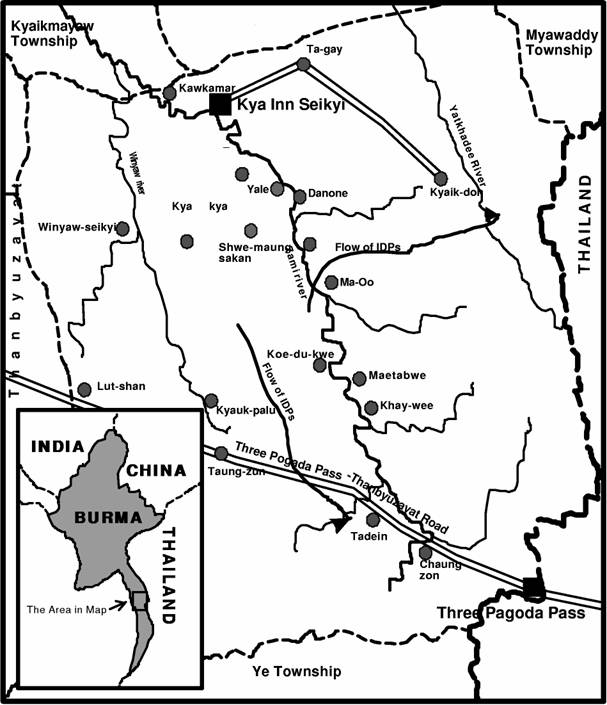
The location map of
In this township area, forced relocation
of the local villages often made by the Burmese Army's military battalions,
with objective to destroy the bases of KNU and to cut off people support to
KNU. The Burmese Army
also deployed more and more battalions in this township area and operated more
intensified offensives since 1997. The 1997 dry season tatmadaw military
offensives drove out many thousands of Karen villagers and some Mon villagers
from this area and these displaced persons fled into
There were many cases of recent forced relocation of Mon
and Karen villages in this area. On
October 15, 1997, LIB 355's Tactical Commander Col. Zaw Lin Htun ordered Mon
and Karen villagers from 13 villages in township, such as (1) Lake-pyort, (2)
Kalort-tort-chaung, (3) Thar-shay, (4) Htipho-hut, (5) Kyaik-round, (6) Ahkyar,
(7) Htipalay, (8) Htipataw, (9) Yale, (10) Tharya-gone, (11) Chilaungchi (12)
Taungale and (13) Shwemaungsakan, to move into three villages, (1) Weithalee,
(2) Taung-bauk and (3) Htipaukhlo. In
the new resettlement sites, LIB 355 confiscated some lands from villagers
without compensation cost and let the relocated villagers stay there.
The forced relocation of the villagers has been continuous
whenever the Burmese Army launched offensives in this area. In the first week of April, 1999,
Southeastern Region Military Command, which bases in Moulmein ordered its
battalions, IB No. 97, IB No. 32, LIB No. 230 and LIB No. 284, to relocate
about 12 Mon and Karen villages situating along Three Pagoda Pass -Thanbyuzayat
motor road into five designated villages under the army firm control. The relocated villages were: (1)
Zee-hnit-pin, (2) Law-shan, (3) Rat-phaw, (4) Yathay-taung, (5) Ka-kathit, (6)
Ta-nyin, (7) Thanpaya, (8) Sin-pyay, (9) Khon-khan, (10) Ma-kw, (11) Pan-aung,
and (12) Ta-dein. The villagers from
these villages were instructed to move into 5 designated villages, such as (1)
Yatagon, (2) Anan-gwin, (3) Taung-zun, (4) Maezalee and (5) Chaungzon, where
the battalions had their outposts.
When the order was taken place, the villagers from these
relocated villages had to decide whether they would move into SPDC battalions'
instructed resettlement sites or not.
The villagers who decided who would not like to join the resettlement
sites, had to hide in the forests or fled to another areas, such as, NMSP or
KNU control areas, to villages and city under SPDC firm control in which the
conditions were better than in the resettlement sites, and into Thailand to
seek works or to take refuge in the refugee camps.
However, those displaced persons have always tried to
return to their home villages, because they have properties such as farms,
houses, gardens and others in there. When the SPDC military battalions ceased
operating military offensives or launching no military activities, the
villagers went back to their homes.
Sometimes, when the rainy season started, the villagers went back to
their homes and do farming again.
Anyhow, the population displacement always occurs every year in
II.
SPDC Military Offensives in Late 1999 and 2000, and Human Rights Violations
As the armed conflict between KNU and SPDC troops is
on-going situation, Burmese Army (tatmadaw) has operated military operations
against KNU every year. After the end
of rainy season, October 1999, tatmadaw resumed its military offensives against
KNU again. At the beginning of military
offensives, SPDC sent LID No. 88 (Light Infantry Division) and its military
battalions LIB No. 120, LIB No. 703 and LIB No. 284, to clear KNU bases in Kya
Inn Seikyi Township area. This military
operation had operated offensives in this township area from October to
February and it main duties are to stop KNU's military activities in eastern
part of Zami river and along Zami river and along
From February until the end of April, Burmese Army turned
its head to take security along
Following these intensive military operations, the local
ethnic villagers, Karen, Mon and Lao Shan, from villages along motor road,
along Zami river and other parts of township areas
have been constantly suffered from various types of human rights violations
that related to accusations of rebel-supporters, or sympathizers. Most terrible gross human rights violations
are arbitrary killing, arrest, torture, forced relocation or dislocation,
conscription of forced labour and porters, and looting of villagers' belongings
and foods. All of these human rights
violations have been the main causes of population displacement.
(a)
Killing
Whenever a military offensive was operated, the local
villagers who accepted the rebel soldiers to come into their villages were
always punished by the tatmadaw or
SPDC soldiers for the acceptance of rebels. They were normally accused as
rebel-supporters and some villagers were severely punished and the most
inhumane treatment was killing.
During the course of offensives from the fall of 1999 until
the first half-year of 2000, there have been many evidence that SPDC soldiers
killed innocent villagers, community leaders and religious leaders with
accusation of rebel-supporters. During
a battalion of Burmese Army, LIB No. 120 under the command of LID No. 88
launched the military activities in eastern part of Zami river,
the tatmadaw killed many Karen villagers with accusation of rebel-supporters.
As instances,
On October3, when LIB No. 120 led by Lt. Col. Maung Maung
Oo went into Kyme-sein village the soldiers arrested 12 Karen villagers
including two women with accusation that they were rebel-supporters. The soldiers also tortured them while the
soldiers were interrogating them to give satisfied answers. Some villagers were beaten, burnt with fire,
cut with knife, and were treated with many cruel ways. The soldiers also cut one pastor's ear. The soldiers also accused two arrested women
that their husbands in KN U forces and they repeatedly raped these two
women. The two women were Naw B—B—
(16 years old) and Naw M—K— (17 years old) and the soldiers also cut Naw B—B—'s
breast with knife They also poured hot
water onto women's noses until they lost consciousness. And, on October 10, the
soldiers killed two men, Saw Lay Doe (17 years old) and Saw Kaw Kaw (40 years)
after various types of torturing, with accusation they were Karen rebel
soldiers.
On October 25, when LIB No. 120 troops went into a Karen
village, Palaw-toki, in Mae-sakit village tract, the soldiers arrested
villagers altogether who were suspected as rebel-supporters and interrogated about
the KN U activities and its strength After the soldiers did not satisfied
answers, they also killed three villagers, Saw Pel Khaw - 40 years, Saw Thaw
Hoe -35 years, and Saw Chit Chit - 28 years with accusation of they were
rebel-supporters.
These torturing and killing were the most
crudest ways that the tatmadaw soldiers have maltreated the local
Karen villagers to halt them to not contact with any KNU/KNLA troop. Not only LIB No. 120 troops alone, the other
troops that operated military activities during in 2000 also maltreated
villagers and then killed.
Sometimes, while the troops from the tatmadaw continuously
launched the military offensives, they were also ambushed and attacked by Karen
rebel soldiers. The tatmadaw soldiers
also wounded or died during fighting.
As a result, soldiers angered to villagers from the villages nearby,
where the fighting happened and killed villagers instead of rebels, with
accusation those villagers have allowed rebel soldiers to stay in their
villages and to have opportunity to attack them.
As an instance,
From May until June, LIB No. 703 troops have been active
and operated military operations from the top of Zami river
to down part of it, and they faced various attacks by KN U forces. On June 15, that battalion was attacked by
KN LA troops near Apalon village, and on June 20 and 22,
it was again attacked by KN LA troops near Lay-mile and Pone-khaw villages
respectively. As revenge to KNLA forces,
villagers in the area are suffered from various types of torturing by
soldiers. On June 22, after fighting
and retreated from the battle-fields, the soldiers also rounded Mae-ta-bwee
village and the soldiers shot and killed one farmer when he came out from
village.
Sometimes, when tatmadaw troops heard KNLA soldiers
were taking bases in a village, they also shelled into villages with motors and
rifles, and killed some innocent villagers.
During this case, whenever the tatmadaw soldiers shot into a
village, the shells hit very little numbers rebel soldiers but hit to a lots of villagers.
Then villagers died because of this shelling and shooting.
As an instance,
On June15, when LIB No. 284 heard that KNLA troops were
taking bases in the monastery of Tawae-pauk village near Kya Inn Seikyi town,
they also came into that village and shot into monastery compound where they
have suspected the Karen soldiers were there After several rounds of shooting into
monastery, one novice (12 years old) and two other villagers got serious
injuries and died on the spot. Actually,
Karen soldiers already left from the monastery and however, some innocent
villagers died.
Although several Burmese Army's
battalions have arbitrarily killed the villagers, these battalions were not
taken actions from their higher authorities.
Whenever the battalions' soldiers killed some villagers, they always
reported to their respective commands that they killed only Karen
soldiers. Sometimes, the battalions did
not report to higher commands about killing.
(b)
Conscription of Forced Labour and Porters for Military Purposes
While the Burmese Army is launching military offensives
against the KNU troops in the whole township area, at the same time, the local
military battalions, such as IB No. 32 and LIB No. 284, that base near
In conscription of forced labour, the local military
battalions, IB No. 32 and LIB No. 284 have always taken responsibility and the
villagers in this village are mainly used to build the roads, military
barracks, daily works in army camps and in army farms. To support for the better communication, the
army has ordered the local village headmen to send the villagers to re-build or
widen the roads from Chaung-htitkwa and Kya Inn Seikyi, to connect
In
Among the use of forced labour in many cases, the local
battalions also have used many hundreds of villagers in farming of army's paddy
farms during in the beginning of 2000.
As an instance,
After IB No.32 harvested their paddy in May, they started
growing rainy season crops in June, when the rain started falling In cultivation of paddy in these lands, the
local military battalion, LIB No. 32 has constantly forced the local villagers
near Kya Inn Seikyi town to contribute free labour. Depending on them villages' population, the
army has instructed the nearer villages close to battalion base to send 20-50
villagers from one village as one round to work in farms for 3 days to
weeks. The village headmen from
Htipaukhlo, Winye, Pyawyagone, Shwe-la-inn, Thanbaya, Bada-gyi and Nonepharpoe
villages have to send the villagers for the whole month of June
Besides forcing the local villagers contributing forced
labour in farming, the villagers were also forced to work for daily works, such
as cooking, carrying water, collecting fire-woods and other works.
According one woman from Tawae-bauk village:
"Since March-April (before the new year festival of
Burma), the Burmese commanders from LIB No. 284, that bases in east of Kya Inn
Seik town forced us to work in their battalion base In the beginning they ordered village
headmen to send 5-6 men every day to work in base As our village is dose to
base our headmen had to arrange to send the villagers regularly on the rotation
basis. In May, soldiers also beat some
men whenever the KNLA troops went into our village Later, when the soldiers asked from villages
to work in their bases, the men were not dared to go and work there Once at the beginning of May, when one man
from our village was working in the military camp, the soldiers also
interrogated him about KN U activities, the soldiers also beat him Later the men from village were not dared to
go to army base When the soldiers could
not get men, they also ordered women to work instead of men.
In the army camp, we have to work various works including
from cooking for soldiers to hard works to fence the compound of base and to
build new military barracks. If the
soldiers have no hard or special works in military base, they also used the
villagers to work daily works such as cooking carrying water and finding
firewoods. Everyday, the villagers have
to go to army base early morning to reach there about
During the whole period of military offensives, before the
end of 1999 until June 2000, the Burmese Army battalions which launched
offensives against KNU troops in Kya Inn Seikyi township have been constantly
arrested the local village civilians to use them as frontline porters to carry
ammunitions and food supplies.
When the army arrested the villagers as porters, normally
they have used two ways. If the Burmese
army has semi-control in one village, the battalion commanders just instructed
the local village headmen to prepare for a ready to give 2 to 10 villagers as
porters for the battalions when arrived to villages. Thus, the village headmen have to stop some
villagers to not go to their work places and waited for army battalions. When the battalions arrived into village, the
headmen have to provide army with the set numbers of villagers for porters.
As an instance,
In June LIB No 707 led by Lt. Zaw Tun instructed the local
village headmen from Mepran and Wae-sop to provide2 porters from each village,
and from Win-yaw village to provide -whenever their troops came into their
villages. If the village headmen failed
to provide the set number of porters, they might have to pay 15,000 Kyat per
porter. These porters were brought by
army for several days and it could harm the life of porters. So, if possible, the headmen always paid
commanders to avoid from the porter service At the beginning of June, Mepran and
Woe-sop village headmen paid 30,000 Kyat for each village, while Win-yaw gave
three villagers for porters. After a
half-month, the battalions returned to these villages and requested porters
again from village headmen.
Sometimes, the battalion could not have any control to
villages and could not order the headmen to prepare for porters. Then, when the soldiers came into a village,
they suddenly arrested all men and used them as porters. Some military battalions even arrested
children under l7 years old and have used them as civilian porters in frontline
for several days. When the military
battalions went into a village, the soldiers also rounded the village first and
then arrested all men in village. Sometimes, the soldiers could get about 20
porters from only one village.
According to an escaped porter from Kyun-chuang village;
"Soldiers from LID No. 44 arrested me in my village in
the third week of May, because the soldiers already rounded cur village and we
last chance to escape. The soldiers took all men as porters. I was taken for 21 days when the soldiers
launched the military operation along Three Pagoda Pass - Thanbyuzayat motor
road I had to carry about 50 kilograms
weight of motor shells in my backs. My
back and shoulders was getting pain and pain.
Along the way, the Burmese soldiers were also attacked by Karen
soldiers, and whenever fighting happened they shout us to move advance and to
walk quickly. On porter died because he
was hit by a bullet. When I arrived to Kyun-dhaung village, I escaped. If I didn't escape I must be used as porter for several
days for sure"
Normally, if they met the villagers outside of village, or
in their work places such as in paddy-farms and fruit and rubber plantations,
the soldiers beat those villagers and interrogated them about KNU activities in
the area. Then, those villagers were
brought by them and used as porters. Then,
the villagers even had no time to inform about arrest to their families at
villages. So, the villagers lost their
opportunities in their farms whenever they heard that the Burmese Army's
military operations were taking place near their areas.
As an instance,
In the period from June 10 to20, the Burmese Army's LIB No.
703 have been active along Zami river and have had regular fighting with KNU
troops and so the villagers who went to their farms and setting groceries and
foods along the river worried for the arrest and they could not to their work
-places. The soldiers also destroyed
the villagers' flooding houses along the riverbank with accusation these houses
were used as temporary bases for Karen soldiers.
Besides men, when the villagers could not get any man in
the village and really required some porters, the soldiers also arrested women
and used them as porters. Women porters
also had to carry the same weight to men and they were used for many days along
with military operations.
According to an escaped villager from Khay-wee village;
"In the third week of April, when a group of Burmese
soldiers from LID No. 44 arrived to our village, they also arrested about 20
women. As the women realized that the soldiers have never arrested women, all
women stayed in the village. Most men
except elder persons already fled from the village to escape from the
arrest. When the soldiers did not see
able-bodied men, they angered and arrested all women. The soldiers gave their loads to these women
and let them carry like men. These
women were brought by army for three days and then were released after soldiers
could replace them with other villages' porters.''
Sometimes, the soldiers took not only men but also forced
the villagers to give their oxen-carts to bring the materials and ammunitions
for soldiers. The forcible use of oxen-carts was always taken
when the soldiers are too tired or were faced attack by the rebel
troops.
As an instance,
On June15, SPDC troops from LIB No. 703, led by Lt. Col. Ye
Zaw were attacked by Karen troops near Kydn-chaung village and the troops also
moved down along Zami river. Then when the troops arrived into Pone-k haw
village, they destroyed all civilians owned water rafts in river to prevent the
coming of Karen troops. When they
entered into Pone-k haw village, they arrested all men and also tortured some
of them and took all oxen-carts to carry their supplies.
Anyhow, because of constant arrest of porters and the
village headmen's provision of regular villager porters, the villagers in every
village have to escape and hid in the jungle to avoid from arrest. Along the period in the offensives, the
villagers have been not safe to stay in the villages or to hide in the jungles.
(c)
Looting of Villagers' Properties
In the rural villages, where the Burmese Army has no firm
control, the government soldiers always think or accuse the villagers that they
have supported the Karen rebel soldiers with foods and provision of fund. On the other hand, they always believe some
villagers in the villages are the relatives of Karen soldiers and they always
support Karen soldiers anyhow.
Because of this accusation, whenever the government or SPDC
soldiers went into a village, they always looted villagers' belongings and
properties including foods, vegetables, livestock and others.
They believe if they didn't take these foods and materials,
the Karen soldiers will take them.
Normally, the villages that close to town have been
suffered less from looting because the soldiers believe the rebel soldiers
could arrive to that village less time if compared with villages that far from
towns or military bases.
Additionally, according to Burmese Army's initial plan to
launch "four cuts campaign" against the rebel troops, it also
includes to cut food supplies to rebel soldiers supported by villagers. So, because of this belief, whenever the
Burmese Army's soldiers went into a village, they also confiscate foods from
the villagers and gathered them in one place and gave the villagers with
ration.
Sometimes, if the villages is close to their bases or has
convenient way to their bases, they brought all food supplies from village to
their bases.
According a villager from Khay-wee village;
" When the
Burmese soldiers arrived into village on June 19, all villagers are a/raid of
being arrested by soldiers and many men hid in the forests nearer to
village. Soon after the soldiers arrived
into village, they looted all villagers' rice.
They climbed onto houses and took all polished rice and they also went
to hand-made paddy-husking mill owner house and took all rice. This rice was owned by villagers and it
remained in the mill after husking The soldiers could collect about 700-800 baskets of polished
rice from the whole village. And, the soldiers also took some chicken, pigs and
ducks from villages for their foods. The
soldiers also looted some goldwares and money from some flooding houses in the
river."
These conditions are the normal situation, which the army
from every battalion of Burmese Army has looted from every village. Besides the soldiers used the looted foods
for their own foods, they also sold extra foods in towns or in the village
where they have base with money.
Sometimes, the commanders officially declared to villagers
that all of their foods must be gathered in one place in the middle of village
and the soldiers shared again to them.
They estimated and gave the villagers for one month or a halt month
foods and took the extra foods.
Because of these constant violations of looting villagers' belongings,
the villagers have faced food-shortage even in their own villages. On the other hand, because of army
restriction against them, they could not go to their farms to take back foods
to villages. During the army instructed
movement restriction against the villagers, they also took foods and other
villagers' belongings, which are remaining in farms or plantations. As a result, when the villagers could not
tolerate longer from food-shortage problems and could not move to the places
they like, they also abandoned their villages and became displaced persons.
III.
Population Displacement and Flux to
Because of various types of human rights abuses, the local
villagers in many rural areas of Kya Inn Seikyi township
could not tolerate these conditions longer and all villagers felt they were not
safe in their home villages. Whenever one villager is killed or the headman or
one villager is severely tortured by the soldiers the villagers feel more fear
and the families of victims tried to move from their villages to another.
From May until the end of June, when Burmese Army escalated
their military activities in many parts of
During May and June 2000, the new arrivals who arrived to three Mon villages, under NMSP control in
Now, the villagers from these villages have left from their
villages nearly almost 75% of the total population. Only 25% of villagers
remain in the villages who would not like to abandon their houses, farms,
live-stocks and other properties. Among
displaced villagers, only 20-25% arrived to three Mon villages in
The comparison of the village situation of the origin
villages of IDPs comprising the origin households in normal situation and in
the current time shown as below:
|
No. |
The names of villages |
Ethnic Nationalities |
Households in normal situation (Estimation) |
House in current time (Estimation) |
|
1. |
Yalae |
(Lao Shan) |
180 |
30 |
|
2. |
Danone (Karen/ Lao Shan) |
200 |
100 |
|
|
3. |
Koe-du-kwe |
(Karen) |
200 |
50 |
|
4. |
Khay-wee |
(Karen/ Mon) |
60 |
20 |
|
5. |
Kawkamar |
(Karen/ Mon) |
70 |
10 |
|
6. |
Maung-yaing |
(Karen/ Mon) |
50 |
15 |
|
7. |
Maetabwee |
(Karen) |
70 |
30 |
|
8. |
Pone-khaw |
(Karen) |
50 |
20 |
|
9. |
Taung-kalay |
(Karen) |
150 |
25 |
|
10. |
Tawae-pauk |
(Karen/ Mon) |
120 |
0 |
|
11. |
Ma-Oo |
(Karen) |
150 |
50 |
|
12. |
Kyauk-palu |
(Karen/ Mon) |
220 |
100 |
|
13. |
Kyauk-kya |
(Mon) |
200 |
60 |
This population displacement occurred since Burmese Army's
biggest offensives in 1997. By
reviewing the information from the listed villages, many families of villagers
have been displaced. The occupations of
almost villagers are farmers and almost families own some land in the native
villages. Before they started their
farming, normally in June and July, when the rain started falling, they have to
abandon their houses and lands, to escape from the abuses. The Burmese Army's human rights violations also
destroyed the community practices of living.
IV.
Conclusion
After those villagers fled from their villagers to reach to
a safe place under a rebel control areas, they are in quite dangerous
situation. The Burmese Army's troops
also crossed and separated in many parts of Kya Inn Seikyi township
and they were always worried they could face with some of government
soldiers. If the soldiers met them in
the jungle or along the roads with small amount of foods and other belongings
they could be accused as rebel-supporters or relatives of Karen soldiers and
they could be killed.
Thus, many of displaced persons have hid in the jungles for
several days without enough foods. If
they heard about the activities of the Burmese Army, the hiding period for them
was longer. According to a villager from
Kyauk-kya, a village close to Kya Inn Seikyi town, he said his family took
about 10 days to reach to a Mon village under control of NMSP in Three Pagoda
Pass. Actually, if there was no activity of Burmese Army, they could reach to
this village with only two days walk.
They had to hide many days and they could carry foods only for five
days. If they took a lot of foods and
were arrested by Burmese Army, it was a serious danger for them.
After displaced persons arrived to new villages, where they
expected safe, they faced another new conditions and new problems. In the new
places of three Mon villages, the villagers could not get job and income. On the other hand, although Mon troops have
control these villages, there are some fighting and military activities were
conducted by KNU and Burmese Army outside of these villages. The villagers are not dare
to go outside of the villages and even gathering forest products is not
easy. So, they face new type of problems
such as lack of work, no regular income and food-shortage problems.