News,
Personal Accounts, Report & Analysis on Human Rights Situation in Mon
Territory and Other Areas Southern Part of Burma
The Mon Forum
Issue
No. 6/2000
The Publication of
Human Rights Foundation of Monland (BURMA)
Contents
News:
(1) Mon State PDC
bars the Mon literacy training in Moulmein,
(2) The military
operations, human rights violations and related population displacement in Kya
Inn Seikyi Township area,
(3) Conscription
of forced labour for water canals near Pegu city,
Report:
(1) Population
displacement in Yebyu Township area, Tenasserim Division
Some
Acronyms in This Issue
SPDC- State
Peace and Development Council,
SLORC- State Law and Order
Restoration Council,
DDSI- Directorate
of Defense Services Intelligence
IB
- Infantry Battalion (of Burmese Army),
LIB- Light
Infantry Battalion (of Burmese Army),
LID- Light
Infantry Division (of Burmese Army)
MLCC- Mon
Literature and Culture Committee
KNU- Karen
National Union,
NMSP- New
Mon State Party,
News
Mon State PDC Bars the Mon Literacy Training in
Moulmein
(June,
2000)
On May 9, 2000, while the members of Mon Literature and
Culture Committee (MLCC), Moulmein, is operating the Mon literacy training in
11 city wards of Moulmein, the capital of Mon State, for Mon children, the Mon
State PDC (Mon State Peace and Development Council) authorities ordered the
activists to stop teaching of Mon literature and forced them to sign a
promising document that they would not continue operating of literacy training.
On responsible person from MLCC (Moulmein) was forced to sign the promising
document in front of General-Secretary of Mon State PDC, Col. Aung Maw Maw and
all activities of operating of Mon literacy training was halted by the
authorities. The authorities and Unit No. 5 of DDSI (Directorate of Defense
Service Intelligence), also threatened to the activists and students that
if someone did not stop teaching or learning of Mon literature, he/she must be
imprisoned.
Since April 24, 2000, the activists of MLCC have been
active in operating the Mon literacy training in 11 wards in Moulmein city.
About 500 Mon students and more have gradually joined the literacy training and
the student numbers has grown in every section class. MLCC also provides about
15 Mon teachers including some monks and the bases of the training are also in
monasteries. The 11 city wards where MLCC conducted the literacy training are:
San-gyi, Daung-zayat, Thiri-myaing, Say-gyo, Myaingthaya, Sayay-gyi-gone,
Thein-gone, Pago-chaung, Shwe-myaing-thiri (1) and (2). In each city ward,
there are about 20-80 students attended the classes and many Mon parents send
their children to these classes to learn how to read and write Mon literature.
Actually, this training is arranged by MLCC (Moulmein) to
operate only for one month period, from the last week of April to the last week
of May, during the holiday of the government school, the operation of the
literacy training has not posed any competition to government education and
school. With objectives to maintain the Mon identity, MLCC and the Mon parents
in city has tried to arrange such literacy training. In every previous years, MLCC (
The arrangement of literacy training is late, if compared
with activities in other Mon villages and towns in Mon State. Other villages
and towns in Mon State started the training soon after the closing of the
government schools and the arrival of dry season holiday. The training started
in March and ended in the last week of April. Mudon Township MLCC also arranged
the huge closing ceremony of Mon literacy training on April 24, 2000.
Similarly, the villages and town wards that have operated the Mon literacy
training hold closing ceremony in the last week of April. Only MLCC (Moulmein)
has lately arranged training due to difficulties in organizing of the city Mon
people to support the training. Normally, some city
Mon people forget their identity and have not given much support or show their
interest to training. However, the MLCC (
In the villages and towns where the SPDC authorities have
less influence or where the local Mon people has strong communities, although
the authorities tried to close down the training, however they could not. Like
in Moulmein, even the capital of Mon State, the Mon communities are weak and
some Mon people are working as government servants and they have less
cooperation each other and this condition is quite vulnerable from the actions
of Mon State PDC authorities to stop the Mon literacy training.
The military operations, human rights violations
and related population displacement in Kya Inn Seikyi Township area
(June,
2000)
As armed conflict between one main rebel group, KNU and
SPDC military government, is on-going situation, the Burmese Army has operated
military operations against KNU every year in all seasons, depending on how KNU
and its troops have military activities. Before the end of 1999 and in the half
year of 2000, Burmese Army has sent many military battalions under the command
of LID No. 88, LID No. 99 and Operational Administrated Command No. 5, into the
rural areas of Kya Inn Seikyi Township to attack KNU and clear its roots.
The military operations have taken place in many parts of
this township, along Zami river, around many ethnic
Mon, Karen and Lao Shan villages and along some parts of Three Pagoda
Pass-Thanbyuzayat motor road. From November 1999 until January 2000, the
Burmese Army's military battalions, LIB No. 120 led by Lt. Col. Maung Maung Oo,
under the command of LID No. 88, operated military offensives against KNU's 6th
Brigade area of eastern part of Zami river areas. Following this offensive, the
villagers who were under suspicions of KNU supporters were killed, inhumanely
torture and some women were raped and killed. Thus, many hundreds of villagers
from Kyaikdon and Kyone-sein village tracts have fled to border area and
displaced.
From February until the end of April, Burmese Army turned the
military turned its head to take security along Three Pagoda Pass and
Thanbyuzayat motor road. The purpose of this military operation was to uproot
KNU activities collecting tax from passengers, traders and trucks, who have
used the road. Thus, the villages along the motor road had suffered from
constant conscription of civilian porters, torturing, forced relocation and
paying various types of tax to Burmese Army's battalions. A few numbers of
villagers also fled into Mon villages under the control of NMSP in Three Pagoda
Pass in March.
From May until June, the Burmese Army sent four military
regiments, LIB No. 703, LIB No. 705, LIB No. 284 and LIB No. 415, under the
command of LID No. 99 and Operational Administrated Command No. 5, to operate
military offensives against KNU along Zami river and many other parts of rural
area of Kya Inn Seikyi Township. Therefore, the fighting between KNU and
Burmese Army regularly happened in the area.
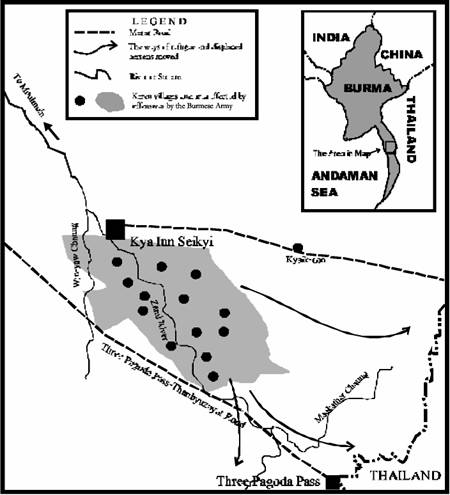
Kya
Inn Seikyi Township area, where the villagers are displaced
For example, when LIB No. 703 operated the military
operation from the top of Zami river to down part, it
faced continuous attacks by KNU forces. On June 15, LIB No. 703 faced fighting
with KNU forces near Apalon village and on June 20 and 22, it also had fighting
with KNU forces nearly Lay-mile and Pone-khaw villages respectively. In these
continuous fightings, some Burmese soldiers hurted and got some injuries. As
revenge to KNU forces, the villagers in the area are suffered from various
types of abuses by that battalion.
As an instance, after fighting with KNU forces on June 22,
LIB No. 703 also shot one villager with suspicion of rebel-supporter. After the
Burmese soldiers left from the battle-field, when they met one farmer near
Maetabwee village, the soldiers shot to that man. The man received serious
wounds and had to take treatment in a hospital in Thailand.
Sometimes, when the fighting happened in the village, the
villagers were also killed. On June 18, when LIB No. 284 went into Tawae-pauk
village, they accused the KNU troops were in the monastery and the soldiers
shot into monastery. After several rounds of shooting into monastery, one
novice and two other villagers got serious wounds and died on the spot.
Actually, KNU forces already left from monastery and KNU troops again shot to
them from a place outside of monastery. However, the innocent villagers were
killed because of mistakes.
Besides shooting and killing of innocent villagers, other
inhumane type of abuse is torturing. Whenever a fighting happened near a
village, the village headmen and suspected villagers were always tortured by
soldiers, such as kicking, beating, pouring water on faces and noses, and other
inhumane torturing, with suspicion they have been keeping the rebel soldiers and
providing them with foods.
The other types of abuses are the constant conscription of
forced labour and arrest of frontline civilian porters in all rural villages.
For the villages, in where the Burmese Army takes base and nearby, the
villagers are constantly forced to work in the military battalion bases, such
as to construct the military barrack, to make fence for compounds and to do
basic daily works, cooking, carrying waters and finding firewoods. Sometimes,
the villagers are also forced to work in army plantations and rice-farms. For
example, LIB No. 284, which bases near Kya Inn Seikyi town always instructed
the Tawae-pauk villagers to go and work in their military bases everyday, and
the village headmen managed to send 5 villagers everyday to the military base.
Later, when the serious arrest of porters happened, the men could not dare to
stay on in villages. Then, the soldiers also ordered the headmen to send 5
women everyday instead of men to the military base.
As most parts of Kya Inn Seikyi township is in Black Area,
the army also has opportunity to arrest every man whom they met in villages and
in the work-places, to use those civilians to carry ammunitions and food
supplies for the military battalions, which launched operations for many days.
The arrested villagers are always taken by soldiers permanently, and if they
could escape from the halfway, they freed from the army. But in the attempt to
escape, it is quite difficult. Some porters were killed, when they attempted to
escape. During the porter service, porters are fed with a few amount of food
every day, and when they are weak and could not carry heavy loads of the army's
ammunitions and supplies, they can be killed or left behind with sickness.
Whenever the government soldiers entered into a village,
the looting of villagers' belongings and properties,
was the common behaviour of the soldiers, as they thought all villages were
supporting KNU forces. Sometimes, the soldiers confiscated all food supplies
from villagers with objectives to stop these supplies to not flow to rebel
soldiers, while some rice kept by villagers in their hilly farms were also
burnt into ashes.
Because of various types of human rights abuses, the local
villagers in many rural areas of Kya Inn Seikyi township
could not tolerate these conditions longer and all villagers felt they are not
safe in their home villages. Whenever one villager is killed or the headman or
one villager is severely tortured by the soldiers the villagers feel more fear
and the families of victims tried to move from their villages to another.
From May until the end of June, when Burmese Army escalated
their military activities in many parts of Kya Inn Seikyi Township area, more
and more villagers left from their villages. Among displaced villagers, many of
them moved into SPDC control areas, where they felt they are not so safe but
expected fewer abuses than in their native villages. Some families, whom their
family members were severely abused by the government soldiers felt they are
not safe in SPDC control areas and decided to move into NMSP control area or
KNU's firm control area. While a few numbers of families
could enter into
Conscription of Forced Labour for Water Canals
near Pegu City
(May,
2000)
Since the beginning of March, the Pegu Township PDC authorities
have forced both town residents and villagers to contribute free labour in
digging water canals in the rice-farms and outside of town, with objective to
prevent flood.
As Pegu city, the capital of Pegu Division, is close to
Sit-taung river and sea , it is easily flooded during
rainy season and so the authorities have planned to dig some old water canals,
which were dug for many years, and use them for the better flow of water. As
the government have not used any type of machine to
dig and carry the dug earth, the civilians have been forced to contribute
labour.
Civilians were also instructed to complete some piece of
works for each family.
Because of this rebuilding of water canal, about 1,000
families, who could not pay fine to authorities and another 1,500 families near
Pegu town have been instructed by the authorities to contribute labour since
March to May. Four villages near Pegu are, (1) Mokala, (2) Naing-tee, (3)
Oh-poe and (4) Kama-nat. Although some town residents who could pay the same
amount of money to required labour could avoid from conscription, all villagers
were forced to do digging the water canal.
The Township authorities also shared work duties to the
respective villages and then village leader have to share pieces of works to
each family in the village again. The village headmen also shared pieces of
work to a non-farmer family, to complete digging 15 Kyins of earth and
carry it away to 20-50 meters. For the farmer family, as they have their own
oxen-carts and owned some lands near the canals, the authorities instructed to
complete digging about 20-30 Kyins of earth. After instructed order, the
village headmen managed to send the labourers on a rotation basis.
For a non-family, they have at least to work in the
construction for 7-10 days while the farmers have to work for 15 days every
month. At least one family has to work for two months to complete their pieces
of works. In one month, one family worked in the construction for 5- 7 days and
they worked their own works for the remaining days. However, for the day
labourers, who work as trishaw drivers, truck drivers, paid day-labourers were
quite difficult to have enough time to do their own works. For the farmers,
they also have less time to work in their farms.
For the city residents also have to pay about 150 Kyat as
fine and some of them also asked the substitutes to dig the earth instead of
them. For the villagers, they could not pay fine, and if they could not work
they have to hire the substitute labourers.
When the civilians went to the work-sites, they have to
bring their own foods, medicines and tools from their homes and the authorities
have not provided any assistance. If one villager was sick, he/she also have to
hire a substitute labour to complete the pieces of works.
Similar to Pegu township , the
civilians in many other townships under SPDC firm control are also forced to
contribute labour in various types of development projects, building roads,
water canals, water dikes, building army barracks and farming and tree planting
for the authorities and army.
Report
Population Displacement in Yebyu Township Area, Tenasserim Division
I. The
Background of Yebyu Township Area
Since over many decades, during the course of civil war in
Burma which has been waged between many different ethnic armed opposition
groups and governments' Burmese Army (BA), nearly all parts of Yebyu township
area is used as battle grounds. This
township is the northernmost area of Tenasserim Division and is connecting with
Mon State (See map). In this
township area, three different ethnic peoples, Mon, Karen and Tavoyan are the
native inhabitants and the Mon people are the majority. During British colony era, to get better
communication, the government also built about over 90 miles-long motor road
that connects Ye and Tavoy towns, or the current
Normally, the Mon villages are situating, along motor road,
between motor road and sea-coast, and along the seacoast. Many Tavoyan villages are in the southern
part of township's coastal area, and Karen villages are in eastern part of
motor road. During the civil war, the
ethnic armed groups, NMSP (New Mon State Party), KNU (Karen National Union) and
MDUF (Mergui-Dawai United Front) have been active in these areas, and the BA
troops have regularly launched the military offensives against these ethnic
groups.
During 1991 to 1992, when the military government, SLORC,
planned to build Ye-Tavoy railway road and invite the multinational oil and gas
companies to exploit gas from Andaman Sea and sell it to Thailand. In the preparation process, the BA troops
also relocated all villages situated in eastern part of motor road by forces to
move and resettle along the motor road.
This was a forced relocation of local ethnic communities to cut off
their contacts with rebel armed groups.
However, NMSP's army faction, MNLA (Mon National Liberation
Army) still controlled many parts of coastal areas and got into sea and could
manage navy operations even in the sea. In 1994, when Thai government agreed
with SLORC for MOU (Memorandum of Understanding), to buy gas from Burma from
Yadana gas field, both Thai government and SLORC had given pressure to NMSP to
agree for ceasefire with Rangoon. According to 1995 NMSP-SLORC
ceasefire agreement, MNLA troops in Yebyu township had to withdraw from
the whole Yebyu township area, and the Burmese Army troops could have more
control.
After the NMSP withdrew from Yebyu township area, the Mon
people in the area also lost protection from Mon troops, the Burmese Army has
more chance to use forced labour in their development works and civilian
porters for military purposes in the army outposts and frontlines. Additionally, the local Burmese Army
battalions also collected various types of tax from the villagers.
After ceasefire, some Mon soldiers from MNLA also went back
to their homes in Yebyu township area and retired to rehabilitate their life in
their home places. They tried to
recreate their own rice farms and fruit plantations. Similarly, the displaced
villagers also went back to their villages and reconstruct their life
again. However, because of the
continuous conscription of forced labour for railway road, motor roads and dike
construction, both retired soldiers and villagers have no enough to do their
own works in rice farms and fruit plantations.
These mistreatments against the villagers also made them dissatisfaction
against the Burmese Army. At the end, a
group of Mon soldiers who could not tolerate longer also rose up with arms to
against the Burmese Army. Thus, the war
in Yebyu township resumed since 1997 again after many
thousands of Mon villagers suffered from the constant conscription of forced
labour in building of Ye-Tavoy railway construction.
II. Rebellion and More Human
Rights Violations in Yebyu Township Area
Since Yebyu Township area is the homeland the members of
rebel group, they could make more effective activities in fighting against the
Burmese Army. Before the end of 1997,
although the group has little number of troops, the members have been grown and
they could extend their activities not only many parts of Yebyu township area,
but also to other parts of Ye Township area in Mon State.
Since the beginning of the rebellion, the local villagers
were terribly and inhumanely treated by the local SLORC/ SPDC troops with
accusation of rebel-supporters to rebel group.
The members of the rebel group have traveled from one village to another
to launch military fighting against the government troops. Whenever, they launched their activities and
passed into a village or outside of the village, the villagers from those
villages were also accused as rebel supporters. Because of this accusation, some villagers
were killed, while many of them were severely tortured by the government
soldiers since 1997.
As an instance,
In the third and last week
of October, 1997, the officers and soldiers from LIB No. 273 killed many
Mon villagers from Mayan village, Yebyu Township, without trails after they
were accused having contact with rebel group.
On October, on column of SLORC troops led by Lt. Col. Myint Oo entered
into Mayan village and arrested Nai Bue with accusation of' rebel-supporter. That villager's house was situating outside
of the village and it was also on the road, which the rebel forces had
regularly used As
the man k new he could be accused as rebel-supporter, he decided to move into
village in the first week of October and had stayed with his relatives. But he was unlucky. The soldiers came into village and arrested
him, and interrogated him about the activities of the rebel soldiers. Then, the soldiers brought him, his wife and
one five months old baby to his farmer house and forced him to tell hew he had
helped the rebel soldiers. After they
could not get satisfied answers from Nai Bue, they brought him into a small
bush and shot him with gun. He died on the spot. Then the soldiers also brought his wife for
investigation and left 5 months old baby alone at home. As all villagers were afraid of being killed
by soldiers after Nai Bue was killed, nobody were dare to go to the man's house
to look after baby. During one day and
one night, small baby also died because of starvation and terrible cold
weather.
On October 25, the soldiers from the same battalions led by
Lt. Col. Myint Oo came into that village again and arrested another 7 men with
accusation of rebel-supporters. Most of
them are young men and were accused of having connection with rebel soldiers.
All of them tied up in the middle of the village and the soldiers tortured him
in front of the villagers. They also
warned the villagers that if someone supported the rebel group, they must
tortured and killed After those
villagers were inhumanely tortured for nearly one hour, the soldiers brought
them outside of the village and shot to their heads. All of them died on the spot.
After many villagers were inhumanely tortured by the
government soldiers, the villagers were afraid of staying on in the village,
and many of them left from the village and abandoned their properties in the
village. Sometimes, although the local
military regiment of the Burmese Army did not order to leave from the village,
because of mistreatments against some villagers including killings, the villagers
automatically left from homes and moved to other areas where they felt more safer than in their villages.
Thus, soon after NMSP-SLORC ceasefire, the population
displacement in various part of Yebyu Township area have happened. They could not stay safely in the own
village and always afraid of being tortured or killed and decided to leave from
the villages.
Such mistreatment against the local
villagers have continuously happened in 1998, the ordinary villagers,
community leaders including monks and headmen were constantly ill-treated by
SLORC/SPDC soldiers with accusation that they were the rebel-supporters. Whenever the fighting happened near one
village or between two villages, the villagers were accused as rebel-
supporters, and the headmen and villagers were constantly tortured.
One instance of arbitrary execution by LIB No. 408 during
1998 was:
In May 1998, one SPDC battalion which took responsibility
to attack the rebel troops, IB No. 61, was ambushed near a Mon village, Kyonekanya, another SPDC'S three battalions went into this
area to take revenge against the rebel troops and villagers. On June 6, one
column (about 60 troops) of LIB No. 408 went into Kronekanya village and
arrested two villagers, namely, Nai Mit (48 years) and Nai Aung Kyi (35 years)
with accusation that they were agents for rebel troops. Actually, these men's rice farms were
situating near the fighting ground and the rebel troops also passed their farms
to pass a stream after ambush fighting. And, so they were accused as
rebel-supporters. After the arrests by
soldiers, they were severely and cruelly tortured During the soldiers were interrogating Nai
Aung Kyi, since he could not speak Burmese language, they did not get satisfied
answers from him and so, the soldiers cut his mouth and face with knives. Due to his refusal that he did not meet rebel
troops passing near his farms, because he was at village, the soldiers
dissatisfied on him and cut and open his stomach with knives. Similarly, the soldiers also cut the face and
throat of another villager, Nai Mit, with knives. Both villagers died in the hands of LIB No. 408 's troops' and treatments. On August 7, when LIB No. 408
entered into Thaungkhun village in the evening time about 7.-00 p. m they also
met two villagers using touch lights.
They accused the villagers as rebel soldiers because they had torch
lights. The soldiers brought these two
villagers outside of village and killed them,
While the fighting between the two factions was escalating,
the SPDC troops demanded more porters from the various villages to carry
ammunitions and other supplies for the military operations. The local battalion troops also instructed
the respective village headmen to prepare to be ready for the set number of
porters to provide them as porters.
Those villager porters were used in the military operations for at least
3 days and sometimes, they brought those villagers to the battlefields and it
lasted for one month to three months or died in the front-line.
As the local military regularly have regularly entered into
villages and launched the constant military attacks against the rebel troops,
the request orders also came to village headmen unceasingly. When the troops
came to a village, the headmen had to manage not only providing villager
porters but also had to feed the soldiers and commanders with foods, liquors
and cigarettes. For the cost of feeding the soldiers, the villagers also had to
pay. When the headmen could not manage
for porters and foods, they also abandoned their duties and resigned as
headmen. In 1998, sometimes, there was
no any headman in some villages, and sometimes the local battalion commanders forcibly
appointed some villagers as headmen to serve for them.
As an instance,
In 1998, for feeding the commanders and soldiers,
Kyonekanya villagers had to pay the cost of foods about 20, 000 - 50, 000 Kyat
every month So, every household in the
village had to pay 500-1000 Kyat to headmen every month Additionally, the headmen also had to manage
in providing at least about 15-20 porters to military battalions. In July,
because of continuous conscription of porters, many villagers fled from village
to escape from the porter service for SPDC troops. Then, the headmen could not provide the set
number of porters to SPDC battalions. In
September, -when the headmen, both village chairman and general secretary,
could not manage to provide the set number of porters, both of them were
severely beaten by commander and soldiers from LIB No. 410. After the headmen could not tolerate torture
and requirement of SPDC battalions, the chairman fled to another village with
his fondly and village general secretary entered into Buddhist monkhood. On October 19, when a column of' SPDC troops
from LIB No. 273, led by second-commander Col. Maung Maung Than arrived into
that village, there was no headman to manage for porters. He angered and asked the villagers where the
headmen went. After inquiry from the village, they also knew that the village
secretary-went into monkhood and abandoned the headman duty. The commander went
to monastery and forced the monk (the former general secretary) to disrobe from
monk and rule the village, especially, to manage foods and porters for the
military operation.
Besides the regular demand of villager porters and porter
fees, the village headmen also had to manage for the regular labourers in
various SPDC local battalions' development projects and to work their own
military outpost. In Yebyu township alone, there are over 10 military battalions and
each military battalion has to take responsibility for at least one development
projects, when they have no duty to launch military offensives against the
rebel bases in other part of
During 1998 and 1999, the local military battalions in
Yebyu township area, LIB No. 404, No. 406, No. 408 and No. 410 have to take
responsibility in rebuilding Ye-Tavoy motor road and railway road. Therefore,
many hundreds of villagers were regularly forced by the local military
battalions to contribute free labour in these construction sites. Besides road
construction, in 1998, the local military battalions also built about four
water dikes to keep water and distribute it to their rice-farms. The villagers were additionally forced by the
soldiers to contribute free labour in these dike constructions. Thus, on the rotation basis, the village
headmen have to arrange to send the set number of villager labourers to the
respective construction. And, every
battalion has asked the headmen to send some villagers to their military
outposts and to do some daily works such as cooking foods, carrying water,
gathering fire-woods, growing vegetables and other works. Because of constant conscription of forced
labour, the villagers have less and less time to do their own works in
rice-farms and fruit-plantations.
On the other hand, the military battalion always instructed
regular movement restriction against the villagers whenever the fighting
happened near a village and around the area.
After a fighting completed, SPDC troops tried to clear the area and
always ordered the local villagers to not stay in their rice-farms and
plantations and instructed all villagers to move into villages and stayed
there. If the soldiers met some
villagers in their farms, they must be severely beaten or killed. Therefore, the villagers also lost
opportunity to do their own works.
The combination of these human rights violations was the
main reason why the local inhabitants have been displaced in their home area
regularly. When the villagers faced
persecution from the soldiers, for example, one of their family members were
killed, the remaining family members also decided to move from their own
villages. Or, when one family had to
work continuously in the army development projects and dike construction, if
they could not pay fine to the concerned military battalion, they have less and
less time to work their own works and receive no income and foods at the
end. Then, these type
of families have to leave from their home villages and moved to another place
where they suffered less abuses.
Similarly, if the villagers have no time to work in their farms or
plantations due to movement restrictions, the villagers also could face
food-shortage problems and have to leave from their home villages. The similar
situation also happened in 2000.
III.
The Population Displacement in 2000
(a) Movement Restriction Orders After Mon
National Day
Since before the end of 1999 until April 2000, when SPDC
withdrew some of its troops from many battalions that took bases in Yebyu
township area, from LIB No. 401, No. 402 to No. 410, by combining with other
forces and have launched the military offensives against God's Army in the
southern mountainous area of Mergui district area. By taking it as a good opportunity, the Mon
rebel troops launch more activities in Yebyu Township area and organized the
villagers to support them.
During the Mon National Day, which was held on February 20,
2000, the Mon rebel group and its leaders also tried organizing the villagers
in Yebyu and celebrated the Mon national day in a Mon village, Paukpingwin. Many villagers and community leaders from
the villages close to Paukpingwin attended the ceremony. Thus, villagers who attended the ceremony
were accused as rebel-supporters or sympathizers to Mon rebel group, by the
SPDC local military battalions.
After the local military battalions heard about the Mon
army and the local villagers celebrated the Mon National Day celebration in
Paukpingwin village, they angered to both villagers in the area nearby and
rebel troops. Recently, SPDC's LIB
No.410 took base near this village and the villagers were regularly used as
unpaid labours in various types of government development projects.
Due to the new activities of Mon rebel forces, LIB No. 410
troops were brought back to take security in the area again. To clear the activities of the rebel forces,
LIB No. 273, LIB No. 410 and IB No. 25 troops were ordered to cooperate each
other. These troops also checked the villagers from which village attended the
national day ceremony and went into all these villages and inquired who were
supporting the rebel force to celebrate the Mon national day.
As revenge, the SPDC from these military battalions have
blocked all villages and conducted new movement restrictions against the
villagers. As a result of this movement
restriction order conducted by the SPDC battalions, about 20 villages in Yabu,
Mintha and Kwethonyima village tracts have been effected
and the villagers also lost opportunity to work in their own farms. According to movement restrictions order, the
army instructed the villagers with three points, such as, (1) the villagers
must stay at homes and must not work in the rice-farms and fruit-plantations,
(2) if the army met someone in these work-places, they must be accused as rebel
soldiers and be executed, and (3) the villagers must not keep any type of foods
in the work-places or outside of the villages.
Following this movement restriction order, the SPDC also
went around many rice-farms and fruit-plantations to find out the rebel bases.
Since the villagers have no chance to stay in their own farms and plantations,
the soldiers from these battalions also took their fruits in the plantations
and sold them for their income. This abuse of looting villagers' belongings is
the regular violation and the soldiers also make profit from this looting.
According Natkyisin villager, explaining about this abuse,
he said
"During April, we (the villagers) were ordered to not
go to our rice-farms and fruit plantations.
I also owned a betel-nut plantation outside of the village, about 1
kilometer far and I lost to harvest my fruit.
When the soldiers from LIB No. 273 came to near our village and they also took our fruits and collected them in one place
and brought to Ye Town. And they sold
them. I lost about 20,000 betel-nut
fruits during 3 weeks and it was equal to about 40, 000 Kyat. This betel-nut plantation is the main income
for my family and Burmese soldiers looted nearly half of my fruits. Before the end of April, I also went to my plantation
secretly and I met about 10 betel-nut trees were cut down to the ground When the soldiers could not harvest the
fruits, they also cut the trees."
When the villagers have no opportunity to go to their
plantations and harvest their fruits, they receive less and less income. Sometimes, some fruits such as durians,
limes and oranges became too ripe and the farmers also lost their fruits. When the farmers have less income and no
foods, they also tried to go to fruit plantations, to gather fruits. Sometimes,
those farmers, who were in the fruit plantations, were arrested in plantations
and they were severely tortured by soldiers for their being in the plantations
and they were also accused as rebel-supporters, by providing foods and shelters
to rebel soldiers.
According a witness from Paukpinwn village, he said about
the Burmese soldiers' maltreatment against a village from his village as below:
"In the last week of April, one of our villager, Nai G— (54 years old) went to
his betel-nut plantation secretly.
While he was gathering betel-nuts, the soldiers from LIB No. 273 came
and met him. Then they arrested and
tied him up. The soldiers made
interrogation to him what he was doing in the plantation and asked him why he
did not listen the order. Although he explained him he
would like to gather betel-nuts to sell them for income to buy rice to feed his
family, they did not trust him and accused him that he provided help to rebel
soldiers. The soldiers also beat and tortured with various types of
mistreatments.
The soldiers also put water on his nose and forced him to
admit that he was supporting rebel soldiers.
After he refused, they also rolled and pressed his knee and shins of
both legs with a round stick of bamboo until he last
consciousness. And, the soldiers left
him behind and went into village. Then
they also warned the villagers that if they went to rice-farms and plantations,
they must be killed or tortured like Nai G—. And, after the
troops left the villagers brought back Nai G— to village
"
Similar torturing also happened
in other villages. Sometimes, the
soldiers tortured the villagers not only because of their instructed movement
restriction order, but also because of some other purposes. Most terrible and inhumane torturing are treated by soldiers whenever they arrested the villagers
with accusation of rebel-supporters.
Sometimes, with accusation of rebel-supporters, some villagers were
disappeared or killed.
As
an instance,
On May 30, 2000, when SPDC troops from LIB No. 273 led by
battalion commander Col. Htin Kyaw, entered to Sinswe village, Yebyu Township,
the soldiers also arrested two men and brought them away with accusation of
'rebel-supporters. Until the end of
June, those two men were not released and some villagers said those two villagers
were killed. According to villagers,
these two men were innocent farmers and they had no background of relationship
with the Mon rebel group. The two men
are Nai Krot (28 years old) and Mehm Kun Bid (18 years) and they born in Sinswe
and helped their families in paddy farms. They were arrested only with
suspicion, and but the soldiers also did not have any evidence they have
contacted the Mon soldiers or joined the Mon army.
After the arrest, the soldiers also tortured these two men
to admit that they were rebel soldiers.
The soldiers beat them with fists, gun-butts, jungle-boots and sticks
several times and also cut Nai Krot face with knives. At the end the soldiers
brought them to other village, even they were painful with several injuries.
After soldiers brought them, the villagers believed they must be killed.
During the military activities
launched by SPDC local troops in rural areas, whenever the troops went into
villages, they surrounded the villages first, shoot the guns outside of village
and make threat to villagers and then went into villages. Soon after the soldiers arrived into the
villages, they also tried to arrest the villagers who are under the suspicion
of rebel-supporters. Then, normally,
the soldiers tortured these suspected villagers in front of all villagers and
make threat against them to stop any attempt to support the rebel troops. Additionally, the soldiers also arrested
many villagers who are in the villages.
As the troops rounded up the village, no man dare to flee to outside of
the village and it makes easier for soldiers to arrest men in the villages to
use them as civilian porters to carry their ammunitions and food supplies along
the military operations.
Whenever the troops of rebel group
passed near a village or went into a village, the SPDC battalions came to these
villages and make various types of threat against the villagers and normally,
the village headmen are severely tortured and beaten. Some villagers are also tortured and beaten
for their failure to inform the SPDC troops nearby about the activities of the
Mon rebel soldiers.
As
an instance,
On May 2, one column of SPDC troops from LIB No. 273 led by
the Second-commander, Lt. Col. Kyaw Myint went into Chabone village, to make village
headmen. Soon after they arrived into the village, the soldiers asked all
villagers, including women and children to gather in the middle of village and
ask ed them about the activities of rebel troops. They also asked headmen why they did not
inform the nearest military outpost about the activities of Mon troops. After
the soldiers did not receive satisfactory answers from the village chairman,
Nai Kyaw Sein, they also beat and slapped him in front of all villagers. And the soldiers also slapped other two women
after they did not receive satisfactory answers from them Then, the soldiers
made a lot of threat to villagers and instructed them that they must inform
about the activities of the rebel troops, whenever they heard their news of
activities. If they failed to inform,
they must be punished.
On May 10, the same troops from LIB No. 273 came to this
village again after they heard that some Mon troops have been active in the
area. Due to the
failure of headmen to inform about the activities of rebel troops, the village
chairman, Nai Kyaw Sein, again.
Then the soldiers arrested all men in village and used them as porters
and moved to another villages.
Sometimes, when the fighting happened near a village, the
village headmen were not only severely tortured but also were arrested by the
SPDC troops and took them away.
Sometimes, the village headmen disappeared after they were brought by
SPDC troops.
As an instance,
On May 26, after a column of SPDC troops from Strategic
Column (2) under the command of No. 8 Strategic Administrated Command, was
ambushed by Mon troops near Mayan village, the SPDC soldiers also angered to
village headmen and arrested chairman, SPDC troops were led by Maj. Soe Thet
and he ordered to arrest the headman with accusation he was the supporters of
rebel group. Until the end of June, he
was not released by the Burmese troops and disappeared.
Because of the movement restriction and various types of
human rights violations committed by the local SPDC troops, the villagers have
been facing more and more difficulties for survival especially to get enough
foods and income. Because of these
conditions, some villagers secretly abandoned their villages, moved to other
areas where they felt that they are more safely.
(b)
Forced Relocation of Paukpingwin Village
For the acceptance of the celebration of Mon National Day
in their own village, the SPDC battalions also gave a punishment to all Paukpingiwn
village to move from their own village immediately with 7 days.
On May 23, the SPDC troops from LIB No. 273 led by
battalion commander, Col. Htin Kyaw, came into Paukpingwin and interrogated the
village headmen why they have supported the rebel soldiers and accused them
that they were rebel-supporters. After
several rounds of interrogation, the commander ordered the village headmen and
the villagers that they must abandon and move from their village within 7 days. Although the village
headmen, Chairman Nai Htun and others, requested the commander to extend more
time for them, but he refused.
Thus, the villagers had to collect their belongings and
moved away within 7 days because if they remained in the village, they must be
killed or inhumanely maltreated after deadline. Normally, the villagers moved to some
villages under the control of SPDC troops or to NMSP control villages.
Actually, Paukpingwin village was established for nearly
100 years ago and it is an oldest village in Yebyu township. Most
Paukpingiwn villagers are garden farmers for fruit plantations and they grow
fruits in many of plantations outside of their villages and few of them are
paddy-growing farmers. In these
plantations, the villagers grow durian, betel-nut, rubber and cashew-nut, and
they receive more income from these fruits and this is the main economy of the
villagers. Because of this forced
relocation order, about 1, 000 villagers had to abandon their own village and
moved to other places.
Since 1993, when SLORC built 110 mile-long Ye-Tavoy railway
construction, the villagers from this village have been constantly forced to
build the railway road. And, in 1998,
when the SPDC local authorities widening Ye-Tavoy motor road, the villagers
have been again forced to build the motor road.
Thus, the villagers have been constantly suffered from continuous
conscription of forced labour.
IV.
Population Displacement
In
After LIB No. 273 ordered Paukpingwin villagers to move
from their village, another 1,000 population displaced again. Very few number of this amount of population
moved into NMSP control area while many of them moved to town and big villages
and stayed with their relatives or their friends.
Normally, the villagers fled from their villages because of
fear for further persecution and some of them also faced food-shortage problems
during they were in their own villages.
Many villagers moved into SPDC'S firm control areas, where they could
face less persecution. However, many
villagers and headmen who were accused as rebel-supporters moved into NMSP
control areas to get protection from NMSP.