* To monitor human rights situations in Mon
territory and other areas southern part of Burma
* To protect and promote internationally
recognized human rights in Burma
human rights foundation of monland
Human Rights Report 8/96 (December 5, 1996)
Some Acronyms
SLORC - State Law and Order Restoration Council;
KNU- Karen National Union;
KNLA- Karen National Liberation Army;
NMSP- New Mon State Party;
MNLA- Mon National Liberation Army;
MAMD- Mon Army, Mergui District;
MNRC- Mon National Relief Committee;
MDUF- Mergui-Tavoy United Front;
CRC- Coastal Region Command of SLORC;
LIB- Light Infantry Battalion of SLORC;
IB- Infantry Battalion of SLORC;
ABSDF- All Burma Student Democratic Front;
Everyone has the rights to own property alone as well as in association
with others. No one shall be arbitrary
deprived of his property.
(Article 17, Universal Declaration of
Human Rights)
The Forced Relocation in the Southern Part of Burma
and Accompanying Human Rights Abuses
Focus of This Report
This report contains several facts concerning to the forced
relocation in the Mergui (Beik), Tenasserim (Taninthayi) and Boke Pyin
townships in Tenasserim Division by SLORC local troops in September, October
and November following the political development in the area. Accompanying with
SLORC's forced relocation program, the local inhabitants in the mentioned area
have been seriously suffered by various kinds of severe human rights abuses.
Since then, the population displacement and refugee flux have been occurred in
the area.
More than 1500 new arrivals has reached
to border area. Because of the internal refugee camps in the southern part of
Burma are no t stable enough to take refuge and shortage of food, several of
them fled into Thailand as illegal immigrants. The most facts in this report
were received from the reliable source of local villagers who were actually
suffered from the forced relocation of SLORC's local troops an d its
accompanying other abuses. We have also asked the concerned local authorities
of armed opposition there to realize the previous political development of the
area and human rights and refugee situation.
In 1995, the SLORC officially set up a military command under the
name of Coastal Region Command led by Maj. Gen Sit Maung in Mergui, the capital
of Tenasserim Division, and it have been active to control the whole area by
operating with its over 50 local battalions. The mentioned forced relocation of
the local population was operated with aim to accept more controls in the area.
Since the process of forced relocation was launched in the area, some villagers
were inhumanely killed and disappeared. They have to hide in the forest of
plantations or rice-farm nearby their villages with shortage of food. After the
forced relocation program was unsucceeded, the SLORC local troops have created
more threats to the ethnic communities and the decade-long community practices
have been destructed systematically within two or three months. The local
inhabitants have became helpless and hopeless. Besides
they faced forced relocation related sufferings, while they fled to the border
they also faced several kinds of difficulty in escaping from mistreatment of
local SLORC troops.
To ensure the real situation and facts concerning human rights
situation, the HURFOM human rights workers conducted interviews with some new
arrivals in the Mon internal refugee camps in the southern part of Burma which
is situated opposite of the Prachuab Kirichan Province of Thailand.
According to the escapees, besides the forced relocation program
of the Burmese Army, they also mentioned about the conscription of forced
labour road construction and portering in the area.
To protect the persons we conducted interview, we did not use
their real names. However, all events mentioned here were true story of the
local population happened in Burma and please feel free. It is hoped that all
information must be useful in helping the international community to halt SLORC
from abusing the human rights violations and promote internationally recognized
human rights in Burma.
The Recent Political
Development in Tenasserim Division
In November 1996, a delegation of KNU flied to Moulmein, the capital town of
Mon State, for ceasefire talks with military regime SLORC. After discussing for
some days with SLORC delegates, the KNU delegation returned back to the
headquarters without reaching any agreement for ceasefire. According to
official statement of KNU, they will find the way to discuss more with SLORC
for ceasefire agreement.
Why the ceasefire agreement did not reach between two those
groups? According to some KNU officials, in every negotiation rounds with
SLORC, the SLORC always forced the KNU delegates to agree on the term
"abandon the armed struggle and enter to legal fold" and that was why
the KNU delegation returned back without any agreement. The agreement must
reach, if the KNU promised to SLORC that it will abandon the policy of armed
struggle and to surrender one day in the future. It is absolutely meant that
the SLORC forced the KNU and its armed fraction KNLA to surrender to Burmese
Army. The KNU and KNLA have fought for full self-determination and equality of
racial rights since the Burma retained independence from British in 1948.
Without solving the political problems, the request for surrendering their arms
is not a feasible political solution to stop the long-protracted civil war in
Burma.
At the same time, as a tactics to achieve ceasefire agreement, the
SLORC have ever used forces to suppress the same ethnic community in pressuring
the ethnic oppositions to soonly agree on ceasefire. Since the situation of
ceasefire talks between the KNU and SLORC have not been improved enough, the
SLORC local troops have planned to launch offensive to the KNU bases again in
November-December. Before launching the military offensive, as a preparation
process, the Burmese Army conducted forced relocation of the villagers in area
under semi-control of KNU in since September 1996.
Moreover, the on-going ceasefire situation
between the NMSP-SLORC have not been so improved in recent November.
According the ceasefire agreement, the area under control of the most southern
military command of MNLA must have to transfer to the SLORC at the end of 1996.
After several rounds discussion with SLORC's Coastal Region Command based in
Mergui, as a result, the NMSP leaders had to agree to withdraw its MNLA troops
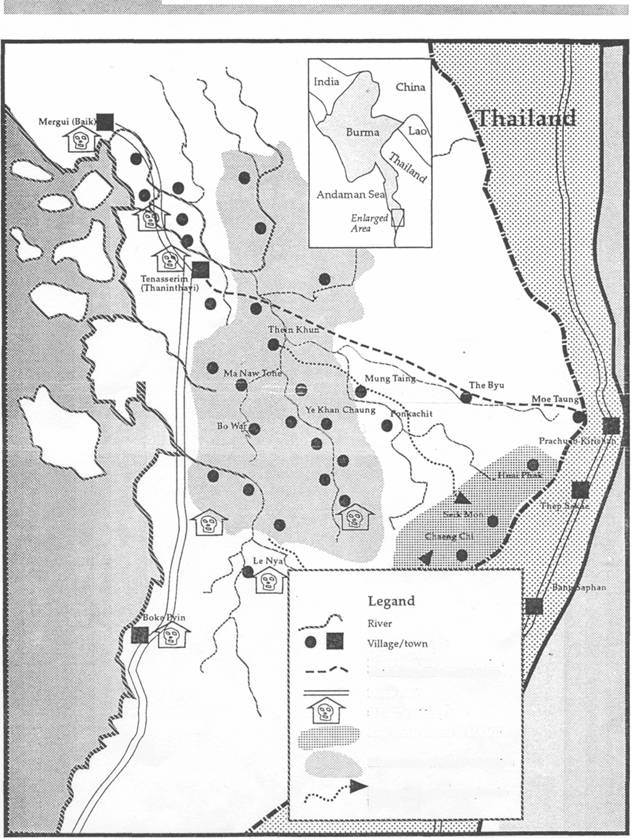
from the area (see map) including the soldiers' families. The area has
been controlled by MNLA for several years and about 2,500 refugees have been
taken refuge in camps under the arrangement of NMSP and MNRC, local Mon relief
organization. Because of the plan to withdraw the Mon troops, the most low rank
Mon officers and ordinary soldiers dissatisfied on the decision of the NMSP
leaders and declared themselves forming the Mon Army, Mergui District (MAMD)
and split off from the NMSP. They also declared to resume fighting with SLORC. Because of the urgent internal problem of the NMSP, the SLORC
confused on the situation for a while. However, soon after the
declaration of MAMD, the SLORC has prepared and launched the military
offensives to MAMD bases in November.
Under the command of the CRC, there are nearly 15 battalions of
Burmese Army have been active in the area. The two IB No. 25 and 17 is based in
Mergui and the most LIB No. 431, 432 up to 440 have
been launched the military operation or patrol in area of Mergui, Tenasserim
and Boke Pyin townships. The two LIB No. 432, 358 and
224 also jointly participated in almost forced relocation program of local
population.
Before initiating operation of military offensives, the SLORC have
prepared to move the population in the area to cut off the contacts between the
local villagers and MAMD or KNU troops. In the preparation process of the
SLORC, normally they forced the villagers to leave the villages. After the
preparation, on November 10, the SLORC joint military operation of troops of
LIB No. 432 and 358, 224 started launching the offensives to MAMD and KNU
bases. Since it prepared to resume fighting, the MAMD has also arranged to be
ready to prevent the advance of SLORC troops. The first fighting occurred on
November 15 with 150 troops of LIB No. 432 led by Col. Win Kyi, in Pohn Kachit
area. The MAMD troops ambushed them on the way. Because of some casualties, the
SLORC troops retreated back. But some small fightings occurred until November
20. On November 20, there was a horrible big fighting happened again between
the MAMD and SLORC joint forces in area called Mung Daing. The SLORC joint
operation of LIB No. 358 and 432, was strong with 300
troops and led by Brigadier Thein Soe. Then, the SLORC troops retreated back
with some casualties again.
In the same time there were some fights between KNU and SLORC
troops in Mergui-Tenasserim area. In the most fightings, the SLORC troops could
not get any victory over its enemy, and rewarded to the innocent civilians, The local villagers have suffered from various kinds of
abuses of the SLORC troops before and after the military operation. Since then,
the problems of population displacement and refugee flux to the border area
were subsequently occurred.
Forced Relocation Program of
SLORC
Since the SLORC prepared military offensives to the area,
initially they moved the local inhabitants of Tavoyan, Karen, Thai (of
Burma) and Mon population there. In such situation, many thousands of local
population have faced various kinds of difficulties.
In preparation for forced relocation, the military came into villages and
ordered the villagers from over 40 local villages to move within one week or 10
days and stay in the defined new resettlement sites. Many thousands of them
were displaced internally after the order was issued. The most villages that
have well-situated in the area for several years became empty with villagers.
The several large villages with over 100 households were also comprised in the
relocation program. (The names of the villages under the forced relocation
program are mentioned in Page14)
According to the escapees, the Karen local troops from Bridge No.
4 have often reached to those villages and the ABSDF, MDUF troops also arrived
just sometime. Similarly the SLORC troops always came to those villages since
the more military deployment was conducted three years ago. According to
reliable source, they have planned the relocation program since 1995. But only
in recent September the SLORC troops came into the villages and issued order to
the villagers to suddenly move from the villages and settle in area close to
town. The SLORC local battalion also instructed two new resettlement sites for
those relocated villagers in a satellite town named Myoh Thit outside of
Mergui town and Moe Taimg, a border village on the border line opposite
of Prachuab Kirichan district of Thailand (see map). But
the military did not provide any assistance in the relocation process and the
villagers would have to move to the new sites by the own arrangement.
Since last year, the SLORC would like to create Moe Taung, a small village with
30 households, to be as a border town for official border trading point with
Thailand.
In draft plan to create new border town Moe Taung, the
SLORC also defined the land spaces or quarters for military barracks, schools,
hospitals, residences for government servants and buildings of town residents, and etc. But no building in any quarter. The military told the
villagers if they moved to Moe Taung, they could get the better
surroundings to stay. But the site is very vulnerable to attack from KNU and
MDUF troops, according to villagers. The Myoh Thit satellite town is situated
in hilly forest area and water for the town is unavailable. The land in
surrounding area is also impossible for farming. The authorities never provided
any shelter. The villagers are well-informed on the real situation of those
resettlement sites and refused to move.
In the instruction to move the villagers, the troops mostly from
LIB No. 432, 434, 358 and 224 have launched the crucial four cuts campaign and
set out order to villagers to move within one week or 10 days. The villagers
from area close to resettlement sites must have to move within one week while
the areas a little bit far from the sites have to move within 10 days. After
deadline, the military will realize the areas as free fire zones and they must
have opportunity to kill everybody whom they met inside any village or
surrounding area.
The ethnic communities have been situated for several decades in
the area and exercised their lives peacefully. The most large
villages have prolonged for more than 100 years and traditionally the native
villagers created various kinds of plantation and rice farms in the surrounding
villages. Those fanning lands are lied in areas of
rich soil and the villagers have been inhabited and survived with farming
activities for several decades. Thus, the villagers in the areas anyhow would
not like to abandon the native villages and living stocks. Since the villagers
would not like to join into the new resettlement sites, the SLORC's forced
relocation program has not been succeeded.
Accompanying Human Rights
Abuses with Forced Relocation
On the last day of deadline, the Burmese troops did come into the
villages and could have chance to kill any villager whom they met inside or
surrounding of villages. Before the deadline, the villagers have to flee into
forests or to the mountainous areas, and displaced there if they refused to
move to military defined resettlement sites. Depending on the activities of the
Burmese troops, those displaced villagers, sometime, could return back to their
plantations or rice-farms. They could get necessary foods in their farming
areas. But if the Burmese troops met them there they must be severely punished
and killed or they were shot to die on the spot. Several thousands of them have
been displaced up to present time and only little percentage fled to the border
area.
According to the escapees, after the deadline, several villagers
have been killed by the SLORC troops while they launched patrol or military
offensives to rebel bases. The two villagers of a father named U Pho Khwe
(52 years old) and his son name Lu Taw (13 years old) were killed by the
Burmese troops of LIB No. 358 in the last week of October. When they were
trying to go to the forest across a rice-farm they were shot by the soldiers
and died on the spot. The native place of those villagers was Phar Ma
We received information from the reliable sources and the
mentioned story was an evidence of the killing abuses of the SLORC. Besides the
apparent execution of the villagers, several villagers disappeared in the area
in which the forced relocation order was issued. In the Ye Khan Chaung area
alone (there were more than 10 local villages situating along the river bank of
Ye Khan Chaung), about 40 villagers were disappeared. It has been still
unknown why they were disappeared. The most of them were men and they must be
arrested and killed or brought along with troops to use them as porters or
forced labourers in the construction site.
At the beginning of November, when the military launched the
offensives to MAMD control area, they have killed some villagers along the way.
When the troops close to Thein Khun village, they met one family in a
plantation and killed all those family members. the
family fled from Thein Kun to escape from the forced relocation. Before they
killed those villagers, they cut all hands and legs of them. They also shot
three women of Thein Khun villagers inside village when they reached to the
village, after the end of deadline of relocation. The both incidents were
happened at the beginning of November and the troops violated the abuses were
LIB No. 432 and 358. They were terribly died because of the refusal to move to
the new relocation site. The all victims are Thai ethnic nationality of Burma.
When the time the Burmese troops instructed for forced relocation
of the villagers, the rainy season was still remaining and it was very horrible
situation for the villagers to flee to the forest or mountainous or border
areas. The most villagers who fled up to border area had to pass across the
wild grass jungles and hard water current of the several streams along their
ways. When they crossed the streams, they had to use hand-made bamboo raft and
sometime the raft was destroyed by the hard current of water and rocks in the
stream. A mother (18 years old) and her one year old daughter were killed
after the raft was destroyed in the Bo War stream (local name) while they tried
to fled into MAMD control border area. They disappeared for some
days and later the villagers met the corpses in the stream bank. The native
village of them was unknown.
Besides the killing and torturing with accusation of
rebel-supporters, the local inhabitant always suffered from the other various
kinds of human rights violations. The local villagers of the areas have been
always used to be forced porters along the military operation of the SLORC. The
Karen troops from KNU's Brigade No. 4 have been active in the area for many
years and the previous MNLA and the current MAMD have launched offensives to
SLORC troops just sometime. In attempts to succeed on the rebels the Burmese
troops always took villagers as porters and brought them to carry their
ammunitions and supplies.
In some cases, the villagers were forcibly arrested by the local
military patrol and sent to the labour camps to be used as forced labourers to
work in the motor road construction. In every year, the SLORC have constructed
the over 80 mile long Mergui-Tenasserim-Moe Thaung road by using manual labour
of conscripted local inhabitants (see map). This road
have been constructed since 1993 and the SLORC planned to connect the
coastal and border areas. In construction of about 50 miles long
Tenasserim-Moe Taung part of motorway, several thousands of local inhabitants
have been conscripted as forced labourers. That road was constructed with
aim to open a commercial route with Thailand. In fact, the villagers have been
fallen as victims of the SLORC troops like other government infrastructure
projects in the whole southern part of Burma.
The most serious abuses were continuously committed nearly two
months by the SLORC troops since they instructed the forced relocation program.
The villagers have to abandon their villages, they
lost all their living stocks and have no more choice except fleeing to the
border area or hiding in surrounding area without exercising the community
life. According to the MAMD officials, there were nearly 1500 local
villagers fled into their control area and about half of them fled into
Thailand for safe haven or to seek jobs. Among the escapees, the most Thai
ethnic villagers have relatives in local community of Prachuab Kirichan
Province of Thailand and they could have more chance for entry. In conclusion,
the recent forced relocation plan of SLORC not only threatened the security of
local population but also forced those villagers to became
illegal immigrants to
Interviews
Interview #l
Name: Saw Ba Dawe
Sex/ Age: Male/ 51 years
Nationality/ Religion:
Karen/ Christian
Occupation: Farmer
Native Place: Ka Ma Like village,
Tenasserim (Taninthayi) township, Tenasserim Division
Interview Date: November 23,
1996.
Under the suspicion of
[being] rebel-supporters and forced relocation program, the local inhabitants
in Tenasserim, Boke Pyin and Mergui townships have been displaced for some
period inside Burma and some of them fled to MAMD control areas. The sufferings
accompanying with forced relocation were described by the escapees as below.
Refugee flux to the border area because of SLORC's forced
relocation program
When did you arrive to
this village and why did you abandon you village?
I arrived here about two weeks ago. The Burmese soldiers destroyed
our village and forced us to move to the town (Myoh Thit of Mergui) but
we refused and fled to here. The Burmese troops from LIB No. 358 came into
village in the third week of September and they told the villagers to move from
the village within ten days. As we could not stay longer in village and we fled
into forest and stayed there nearly one month and then escaped to here.
How many days did you
spend to reach here from your village and what kinds of difficulty did you face
on the way?
We had to take about 10 days to arrive here. When we came we could
not walk up straightly along the way and had to twist all the time not to meet
with Burmese troops. If we met them on the way, they will kill or severely
punish us. At the time we came here, there were intensive military activities
of the Burmese Army and we were in fear of being arrested by the soldiers. If
we walked straight the way, I think we had to spend only five days.
On the way, we faced various kinds of difficulties mainly shortage
of foods. Even we knew the exact location of the villages,
we would never dare to turn into any village to get foods. We worried the Burmese
soldiers took base inside the villages and they will kill us. And we have to
sleep in the forest for many nights and sometimes we walked at night time. We
ate banana fruit with limited rice for many days.
Difficulties and shortage of foods on the way to the border area
Did you come with the
whole family and how many families came along with your family? Besides the
shortage of foods, what other difficulties did you face on the way?
I came with the whole family of me. I came along with other 4 families.
We all together 22 villagers and we were from the same village. There were 7
women and 5 children (under 10 years old) among us and the men helped them
along the way to reach here. We had to pass tall grass jungle, hard water
current (high velocity) of streams and under the cold rain along the way. At
night time, there were wild jungle mosquitoes also bit us. Women and children got sick on
the way and had to treat in this village's hospital (Camp's clinic).
The instruction of local SLORC troops for forced location of
villagers
You said the local Burmese Army tried to relocate your villagers.
How did the soldiers instructed the order for forced
relocation?
The troops from LIB No. 358 came into our village on September 20 and
arranged a meeting with village headmen. At that time, besides the village
headmen mostly elder persons, the male villagers over 13 years already fled
outside of village to escape from the arrest of the Burmese soldiers. Every
time the Burmese soldiers came into village, they always arrested the villagers
to be porters to carry their belongings. After the meeting with village
headmen, they walked around the village and told the rest villagers mainly
women, to leave from the village within ten days. They said to go to Mergui
town and some place close to town was defined as relocation site and to stay
there. They also mentioned that within 10 days all villagers had to move
definitely, they will return back again after 10 days. If they met someone in
the village, they said he/ she must be killed. They stayed in the village for
one hour instructing the forced relocation. Then they moved to other Karen
villages.
After the Burmese soldiers went out from our village, the
villagers were remaining in fear and didn't know how to decide. When the male
villagers (heads of
family) returned back from outside of village, we met each
other and we realized that we could not stay longer in the village. If we
refused to move the soldiers will kill us when they came. Some villagers also
decided to stay with their relatives in Tenasserim or Mergui or Boke Pyin. No
family moved into new resettlement sites. But the most of us decided to stay in
the rice-farms or plantations or in jungle close to village. If the situation
is stable and no more activities of Burmese soldiers we can move into village
again. I moved to my lime plantation about 5 kilometers far from the village.
Population displacement in the whole area of ethnic communities
At the time when the Burmese soldiers instructed the order to move
the villagers by forces, how many villages they gave such order? Did they give
order to your villagers only? Please describe me the situation after the
deadline?
No, they gave the order to other villages also. As I knew, the same
troops of LIB No. 358 also went into other four Karen villages Phar Ma, Pin Le
Gwin, Mee Lung Gwin and Inn Wine Gone and issued the same order to the
villagers to abandon their villages and stay in Mergui.
Displacement and accompanying sufferings and hardships
Before the deadline, we unceasingly carried our belongings to
plantation and I renewed the shelter in there. I moved there with my whole
family. I have one young daughter and two sons. But the hiding place inside the
plantation was not so safe enough. After the end of the deadline, the Burmese
soldiers came into village again and they angered to villagers for the refusal
to move into Mergui town. They knew the villagers were displaced in rice-farms
and plantations and then, they tried to find in surrounding of the village.
They came very close to our plantation and we could not stay longer in there
again. I left from the plantation and moved to a safe place beside a mountain
for many days. We built a small hut in there and brought my family members and
foods. Other villagers also have to move like us and we kept contact each other
to inform the activities of the Burmese troops. In the plantation, we could get
enough vegetables and fishes for curry. When we were beside the mountain, we
could not get vegetables and fishes and, we had to eat plain rice and
fish-paste every day.
While you were beside the mountain, could you return back to your
plantation?
Initially we stayed for five days in the plantation and left to
mountain. We have to stay beside the mountain for several days. As I told you
we kept contact each other and I could return back to plantation alone to bring
rice to temporary place. The other villagers also did face such difficulties
like us and we walked back and forth between the plantation and temporary
shelters beside the mountain. The Burmese soldiers also burnt down three huts
including rice stores in the plantation.
After the deadline, the Burmese Army committed crucial and
inhumane treatments to the local villagers whom they met in villages or other
places where they were displaced. Likely they launched the offensives to the
villagers to uproot the local community by forces.
Killing of innocent local villagers
by SLORC's local troops
Did the Burmese soldiers mistreat to villagers whom they met in
the villages or plantation or rice-farms?
After the instruction for forced relocation of the villagers, the
Burmese soldiers came into our area again and killed some Karen villagers. They
came and took base in our village for several days and launched patrol all the
time and since then I could not move back to the plantation. While we were in temporary shelter, we also
received the reliable news that two Karen villagers of Phar Ma village were
killed by the Burmese soldiers. They were a father and a son. After the
military set out order to move from the villages, those two victims also fled
and stayed in the plantation. In the initial day, when the villagers did not
receive the news of the arrival of the Burmese troops to the area, those two
villagers, father and son brought some rice from the village to the plantation.
While they passed in mid of a rice-farm, they were met by the troops in the
opposite side and they lost chance to flee.
The Burmese soldiers fired on them and they died on the spot. After the
troops left, the villagers met those dead bodies of those Karen villagers.
Disappearance of local villagers after the deadline for forced
relocation
Besides the killing of
those two villagers, what other incidents did you hear when you are there?
According to Phar Ma villagers, there were another two women
disappeared when the Burmese troops came into area. The villagers were sure
that those two women didn't move to the town as they knew,
when those women went back to their village to bring rice to the forest, they
were disappeared. The villagers think those women were arrested. Up to the day
when we came here the women were still disappeared and didn't return back to
temporary shelters.
According to the villagers who came from Ye Khan Chaung village,
in Ye Chan Chaung area alone, the military killed or arrested about 40
villagers. They were also disappeared but didn't clear what happened on them.
They also abandoned the villages and stayed in temporary shelters like us for
nearly one month. At the time they were sheltering in forest, the men had to
return back to villages or rice-farms or plantations to get foods and they were
arrested. Then they disappeared and never return back to their shelters again.
We think those male villagers were arrested and brought by the military or they
were killed.
SLORC's more military deployment and maltreatment against local
villagers
Please describe me the situation of your village and the
livelihoods of the villagers before the army ordered to move?
Our village had nearly 70 households and all villagers are Karen.
Last three years ago, the Burmese soldiers never reached to our village and
sometimes Karen soldiers arrived to village. The Burmese Army defined our
village and other surrounding villages were lied in
Black Area (free fire zone). Since three years ago, the Burmese Army launched
more military patrol and reached to the village very often. When they arrived
they arrested everybody in the village including women and always asked
questions about activities of the Karen troops. They also beat the villagers
and also killed them. Last two years ago, one Karen villager from Mee Laung
Gwin was killed. Some male villagers were arrested and brought by the soldiers
to their headquarters and put them in detention or brought them to build the
road or the military barrack.
Population displacement, refugee flux and abandoned living stocks
in the native area
I owned about 60 acres of rice-farm close to the village and many
catties including water buffaloes. Because of the often operation of the
Burmese Army, last year I abandoned to grow rice in my farm and I moved to the
hilly area and created a new slash and burnt rice plantation there. Then I
spent most of my time in that new farm and I also belong about 2 acres of lime
plantation. My income came from mostly the plantation. When I left here, I
abandoned everything including my catties. All my catties are in the old rice-farm.
Some other villagers also have elephants to product log in the area. I think in
Ye Khan Chaung and our areas have about 50 elephants. After the military
instructed the order for the relocation of the villagers, we had to abandon all
such belongings and living stocks there.
Do you expect you could
return back to your native village one day in the future?
I don't know when I could return back. If the situation is likely
safe enough for us, when there is no more Burmese
soldiers and their activities, I think we could return.
Interview #2
Name: Saw Ba Ngwe
Sex/ Age: Male/ 57 years
Nationality/ Religion: Mon/
Buddhist
Occupation: Farmer
Native Place: Ma Naw Tone
village, Boke Pyin Township, Tenasserim Division
Interview Date: November 24,
1996.
The most ethnic communities
which have inhabited in their native places for several decades have been
destructed systematically by the current SLORC regime in
SLORC's instruction of forced relocation to conduct more control in ethnic
areas
Where is your native
village and why did you leave from your village?
My native village is in Boke Pyin township
and the Burmese Army has planned to relocate all villagers and that was why we
have to come here. The instruction for forced relocation has been in process
since two months ago.
Can you explain me what
happened in your village in recent one months ago?
The area of our village is not so far from Boke Pyin town. Last
three years ago, the Burmese Army of various battalion
came into our village very often. The last time they came to our village was at
the beginning of October. At that time, they didn't launch any military
operation yet. The troops from LIB No. 432 just came into village and forced
the villagers to move. They ordered the villagers that within one week all
villagers must move from the village and when they came back again, they will
kill the villagers who left in the village.
Since then, we had to flee from our village. Our family moved into
forest and then escaped to here. Other villagers also displaced in the jungle
like us. Even in the forest nearby village, it was not so safe for us to stay
there.
Did the Karen or Tavoyan
troops to the village very often and how did they treat to the villagers?
The KNU troops Battalion No. 16 of Brigade No. 4 came into village
only sometimes not so often. When the KNU troops came they asked some foods and
arrested villagers for portering. At the last time in October before the
arrival of the Burmese troops just one week, the Karen troops also came and
stayed in village for one hour.
Protracted civil war and the prolonged suffering of local
population
Did the relocation
process link to activity of Karen troops?
I don't know surely. In recent time, the Burmese soldiers knew the
arrival of the Karen troops into our village, but they didn't instruct for
forced relocation of the villagers. They just arrested the villagers for
portering to carry their supplies or took some belongings of the villagers. But
they never told to villagers to leave the village and move to Boke Pyin or
Mergui.
When they came in October, they asked strangely to village headmen
why the Karen troops came into village and why the village headmen didn't bar
them.
They dissatisfied on the arrival of Karen troops and they accused
villagers as rebel-supporters. They said they will move the villagers if the Karen
came into village again. The village headmen said they could not prevent the
Karen troops. On the next day, they came again and set out order to move from
the village urgently. They said within one week all villagers had to move from
the village.
Decade-long peace and harmony community of mixed ethnic
nationalities
Can you tell me the background of your village?
Our village was a large village in the area. We have about 100
households and various nationalities have inhabited for several decades. The majority are Karen families and also other Mon and Tavoyan
families were staying there. As our village was established for over 100 years
ago, all wooden houses were well built. In Karen community alone, they have
both Christian and Buddhist. We have been harmonily staying in the village and
thus, the village has both monastery and church. Every family have their owned house and rice-farm. But our village have been in black area and we were always terribly
treated by the Burmese Army for several years. They always asked rice from our
village and every time they came into village they arrested the villagers for
porters.
Because of more military deployment in the area, there were more
arrests of forced porters in the area occurred in comparison with the recent
time. Additionally, those arrested villagers were also used as labourers in the
military managed government infrastructure project.
Conscription of forced labour in military managed infrastructure
construction
Did the Burmese Army use the villagers to work in the
infrastructure project of the government?
Sometimes when they arrested the villagers as porters they didn't
use them as porters but as labourers to work in construction site. According to
villagers who were arrested recently told us they were sent to labour camp to
construct Tenasserim-Moe Taung motorway. The most arrested villagers had to
work at least for one month in the construction site. The villagers said they
did not how many labour camps were set up by the Burmese Army. But in each labour
camp they put about 100 villagers who were arrested from several villages. When
the newly arrested villagers reached to the labour camps, the old labourers
were substituted and could return to their home.
Appalling consequences in the construction worksites
What are the condition in the construction and what kinds of work
they have to work there?
The condition in the construction site was normally in appalling
consequences according to the villagers who ever worked there. They said they
have to work in the morning regardless of the rain or cold weather. Normally
they had to dig earth and carried dirt to build embankment for motorway. And
they had to crush the stones to be small pieces and carried it for embankment.
They had to work for the whole day and could take a rest for one hour in the
mid-day. They said there were much numbers of Burmese soldiers along the
construction route and they also guarded villager labourers. It was not so easy
for villagers to flee from the worksite and had to wait for new arrested
villagers for substitution. If someone tried to flee, they will put that
villager in detention and used him more longer than
others in the worksite. One man from our village had to work for three months
there. When I asked what happened to him, he said when they used him as a porter to
carry supplies to worksite, he tried to flee and he was rearrested. Thus, they
put him in construction site for three months.
Regular burden tax collection by SLORC's local troops in the local
areas
Did the local battalion
collect tax from your village and what kind of tax collection you have to
provide them?
Sometimes we have to provide them cash
for portering fee. Besides the portering fee, we have to provide them rice
every month as tax. The village headmen collected rice every month and sent it
to battalion headquarters in Boke Pyin town. There are many military battalion in Boke Pyin but we have to give rice only to LIB
No. 358.
Killing the arrested villagers in rewarding for the refusal of
relocation
Did the Burmese soldiers
kill the villagers from your village after the deadline for forced relocation?
The all villagers from our village already fled outside of village
before the deadline was reached. No arrest and killing incident happened in our
village and surrounding area. But when we fled from village and arrived in
Thein Kun area, we heard about an incident that the Burmese soldiers killed a
Thai family. The military also set out order to Thein Kun villagers to move
into Moe Taung border village. And several families from Thein Kun village have
fled to the border area. The most of them are Thais. After the deadline, the
Burmese soldiers came into that village and met a family in a plantation close
to the village while that family was preparing to flee. The soldiers arrested
all the family members including women and children and cut their hands and
legs. The soldiers told them why they didn't use their legs and hands to move
to Moe Taung. The whole family of the victims died soon after the soldiers cut
their hands and legs because of too much blood came out, according to Thein Kun
villagers. We were very afraid of being arrested by Burmese soldiers while we
were on the way to here.
How difficulties did you
face on the way and how many family together with your
family?
Doesn't matter for the difficulties on the
way. We could pass the
streams and sleep in the jungles. But we were in fear and prayed along the way
not to meet with Burmese soldiers. If we met them on the way, they will kill
all of us. We would never dare to cross into any village we passed closely and
we had to twist the way. So the trip took more days to reach here. We came just
three families altogether with 15 members.
Death case because of the difficulties on the way to the border
Did you hear about the
death of other villagers when they came to the border area?
Yes, I heard. When we came here we also met with other villagers
in jungle who were hiding there and could not return back to their home. They
also told us to make proper bamboo raft to cross the streams along the way. The
water current was to hard at the time we crossed. It
could easily destroy the raft because of too many rocks in the streams. They
warmed us to be careful. According to them, just two days ago they got two
corpses of a woman and a girl in the Bo War stream. They died because their
bamboo raft was destroyed. The woman was about 18 years old and the girl, her daughter, was about 1
year old. The villagers who fled with that woman made a small raft and it was
destroyed by hard water current and rocks in the stream. At that time, there
was too much rain. Although all the men could swim but the woman and her
daughter could not swim and they died after the raft was destroyed. The corpses
were remained on the bank of stream and it lasted there for more two days
before the villagers nearby met it.
We have no problem when we crossed the river but because of long
trip under the rain and cold weather the most children got sick. When they
reached to this village, the medics here treated them for three-four days.
Hopeless and helpless villagers because of SLORC's forced
relocation program
What did you have to
abandon in your village when you decided to come here? Do you expect you could
return back to your home village again?
I have to abandon everything there. My wooden
house, my rice-farm, my plantation, my catties and others living stocks.
Some are belongings that I got from my father when he died. I am really in
depression. I don't know could I get all my belongings again. Before the
beginning of rainy season, I will explore the information and decide could I
return back or not. If the Burmese soldiers took base in village or surrounding
area, I don't think so I could return back.
The names of the villages
under the SLORC's forced relocation program
The numbers of villages which were relocated by local SLORC troops
in recent October and November, 1996
Villages of Mergui. Tenasserim (Taninthayi) and Boke Pyin
Townships
1. Mine Thawe
2. Shan Kone
3. Kaw Ka Nine
4. Kyauk Kone
5. Won Tan
6. Kyauk Thin Pone
7. Myaing Thar
8. Pae Thaing
9. Law Tau
10. Kan Thar
11. SitPuu
12. Tapaung Thaung
13. Chaung Nyi Kuu
14. Leik Yin Kwin
15. Mine Thawe Ywa Thit
16. Kaw Taw
17. Thain Kone
18. Sin Chone Inn
19. Ta Mauk Chaung
20. Kaw Round
22. Phoo
Ai
23. Kya Chaung
24. Kyein Chaung
25. Kya Ai Taw
26. Tarna Ai Taw
27. Ba War
28 Ba War Kwin Chay
29. Ba War Pho Mae
30. Bein Taw 31.Sar Chet
32. Kaw Thin Kone
33. Ko
34. Wan Nar
35. Sin Tin
36. Ye Chae Chaung
37. Sa Wae
38. Pyin One
39. Ban La Mot
40. La Thar
41. Thaung Pyor Kyi
42. Sein Chung
43. Ka Ma Like
44. Pin Le Gwin
45. Naung Pin Gwin
46. Phar Ma
47. Ma Naw Thone
Location map of SLORC's
forced relocation
(These
explanations fit in “Legand” in the map, starting under “Village/Town
Motor road under construction which has used forced labour
Motor road
SLORC's military base
Area under control of MAMD
Effected area of forced relocation
Route used to be escaped to the border area