* To monitor human rights situations
in Mon territory and other areas southern part of Burma
* To protect and promote
internationally recognized human rights in Burma
human rights foundation of monland
Human Rights Report 7/96 (November 24, 1996)
Some Acronyms
NMSP - New
Mon State Party;
SLORC -
State Law and Order Restoration Council;
KNU - Karen
National Union;
MDUF -
Mergui-Tavoy United Front;
LIB - Light Infantry Battalion of SLORC;
Indigenous people have the rights
to the conservation, restoration and protection of the total environment and
the productive capacity of their land, territories and resources, as well as to
assistance for this purpose from States and through the international
cooperation. Military activities shall
not take place in the lands and territories of indigenous peoples, unless
otherwise freely agreed upon by the people concerned. (Article 28, UN Draft Declaration on
the Rights of Indigenous Peoples)
Human
Rights Abuses Related to Total Co and UNOCAL's Gas Pipeline Project
Focus of this Report
In
exploiting the untapped natural gas in Burma's Gulf of Martaban, the Total
Company of France is the operator of the project and the Unocal of United
States is a partner of the project. The main buyer of the natural gas is
Thailand and it must be in need of energy to overcome the critical problems for
its industrialization growth in the future. The three concessionaires agreed to
corporate each other and signed agreement to exploit and buy natural gas from
SLORC, even in situation when human rights situation in Burma is not improved
enough.
Since 1993,
large numbers of SLORC troops have deployed under the name of securing the
project with several battalions. Since then, the ethnic population such as Mon,
Karen and Tavoyan peoples have been suffered with various kinds of human rights
violations. The evidences of such abuses have been regularly provided by the
local sources and even the international community has condemned on Total Co
and UNOCAL for their cooperation with SLORC, however they still maintain their
investment in Burma.
The most
facts contains in this report are provided from reliable source of local
community and it also proved the reality of civilian situation of gas-pipeline
projects. To get such information HURFOM human rights workers have conducted
some interviews from local villagers and they explained the real situation of
area. Because this gas-pipeline project and relative Ye-Tavoy railway
construction, many thousands of local population have been displaced or escaped
into Thailand.
To protect
the persons we conducted interview, we did not use their real names but they
explained the real situation of the area. However, all events mentioned here
were true story of the local population happened in Burma and please feel free
and can change the better usage of English. It is hoped that all information
must be useful in helping the international community to halt SLORC from
abusing such brutal human rights violations and promote internationally
recognized human rights in Burma.
Limited Role of Company, in
Implementing the Overall Project
The
companies have been blinded their eyes regarding to the human rights situation
in the areas and at the same time, they have been likely encouraging the
security forces around the areas guarding the project. Since the Total started
for its implementation of project in 1993-94, the SLORC deployed more troops in
the area in order to guard the project. Thus, that new SLORC military
deployment and its troops have created and increased threats against the
security of local population Mon, Karen and Tavoy ethnic peoples.
The Total
Company's field personnels (both French
and Burman citizens) have
been in limited position in surveying or monitoring surrounding areas to
realize the real situation of the civilians. Total Co ever claimed that:
"Since April 1993, our
engineers have conducted several surveys along the whole length of the Burmese pipeline
route on foot, by car and by helicopter. The area is very sparsely populated.
There are few villages and the region is perfectly calm. No population
displacement should occur anywhere along the pipeline route."
The
statement is unbelievable and impossible. It is very very inconvenient for
Total Co.'s engineers to conduct survey along the route up to Thai-Burma
border. In 1993-94, the large area of the gas pipeline route was controlled by
ethnic armed oppositions of NMSP and KNU. Might be, the company could conduct
survey by helicopter. Before the SLORC signed the contract of exploitation of
the natural gas before 1992-93, the SLORC had already relocated several Mon,
Karen and Tavoyan villages in the area. Since then, the SLORC has planned
putting more military deployment in the area and tried to control the whole
area. (The names of the villages that
were forcibly relocated by SLORC Army before 1994, are listed in Page 14)
However,
the ethnic armed oppositions still launched their activities in the area and it
also impossible for the SLORC army to travel all area around. Despite launching
the offensives to ethnic armed opposition, the SLORC local troops have
inhumanely treated the local ethnic population with various kinds of human
abuses such as killing the innocent villagers, forced relocation of local
villages, forced portering and labour for the military, looting of villagers'
belonging, tax collection and etc..
Before the
New Mon State Party (NMSP) reached for ceasefire agreement
with SLORC, there were several evidences that some Mon villages were
forcibly relocated by SLORC troops. The most of those villagers were under the
suspicion of rebel-supporters and the Mon army ever reached to those villages.
In conducting forced relocation of the villages, the SLORC troops with several
numbers came into villages and set out the deadline to the villagers to
suddenly move from the villages. Last year in March 1995, one Mon village named
Kyauktayan was forcibly relocated (It was
described in 5/95 HURFOM report). The village is about 15 kilometers far from the gas-pipeline
project area. In fear of the Mon troops could get easy access to the
gas-pipeline area and that was why those villagers were forced to move from
their village by the Burmese soldiers. Might be, the Total Co.'s field
personnels will not know this case.
In defining
security reason for gas pipeline, it is not meant just security provision along
the route, the military always have to look carefully
to all ethnic villages situated nearby. If one village was in suspicion, that
village must be forcibly relocated or, some villagers must be arrested or
killed. The several evidences such forced relocation and killing the civilians
related to project ever occurred.
The site
where the Total Co.'s field personnels residing is situated in a restricted
area and they could not get all update information of the whole area. They
could conduct their activities only in area around villages such as Eindayaza,
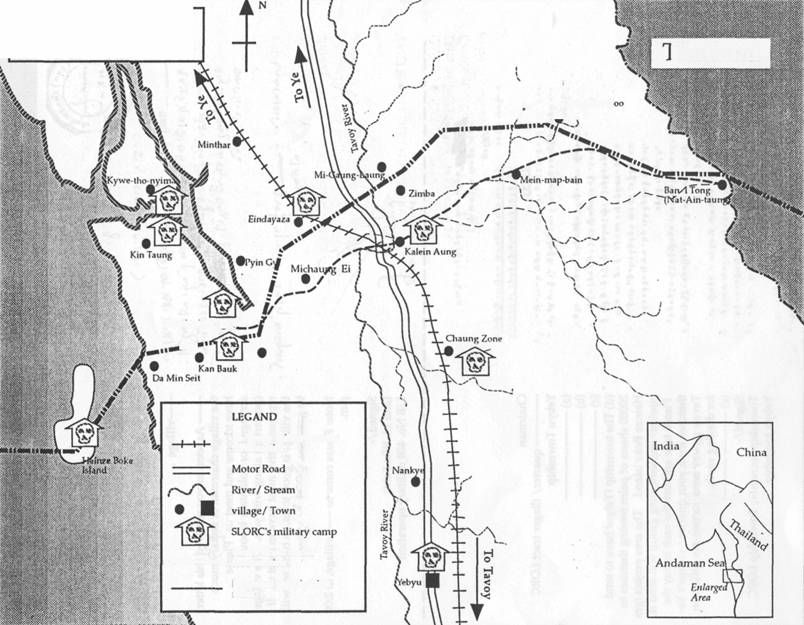
Ohnpingwin and Hpaungdaw (See map). But the SLORC local military
battalions which taking security for the project such as LIB No. 407, 408, 409,
410, 273 and 274 could launch operation or patrol in largest area of the whole
of Yebyu, Thayat Chaung and Tavoy townships and many villagers have been
suffered with various kinds of abuses by those troops. Since Total Co started
the project, the local people have been relatively suffered because of more
military deployment for gas pipeline security. In 1996, the local people are in
suffering such continuous human rights abuses by the SLORC Army.
Relative Tax Collection on Villagers
and Destruction of Community Practices
According
to the local reliable source, the battalions or the soldiers in the battalions
have received some special salary from Total Co for taking security of the
project. The Total Co has provided those soldiers with 6000 Kyat each monthly
salary. Even those soldiers received enough salary,
they never abandoned their behaviour of collecting tax from the local
villagers. Tax collections such as portering fees,
construction fees both railway and military barracks have been largely
collected by the concerned battalions of SLORC Army.
The two
battalions LIB No. 273 and No. 274 has been securing the project site along the
seashore areas both sides of north and south of Hpaungdaw village and. They
also put their troops along a river which reach to Ohnpingwin village (See map). The both battalions' troops have collected tax from
fishermen of local villages such as Hpaungdaw, Ohnbingwin, Mae Taw, Kywe-tho-nyima
and others. Those fishermen have to provide tax to the military with monthly
basis. The amount of tax provision is depended on the size of the boat and the
biggest one have to pay about 2000 Kyat while the smallest one have 500 Kyat to
give them. Besides collecting tax, sometime, those fishermen also have to
provide fishes for daily food supply of the soldiers. Sometime, they
confiscated all fishes in the boats of some fishermen although they already
provided them tax.
To
facilitate for the security of the project, since 1993-94, the military has
planned to construct their permanent bases around the project site. We could
not get reliable information whether Total Co provided donation cash for such
construction of military base or not. But the battalions around the area have
always collected tax from the villagers to built barracks, trends, fences and
etc., in their bases. The bases for LIB No. 408, 409, 410, 273 and 274 have
facilitated building the bases around the area and collected big amount of tax
from the villagers from village tracts close to project site such as
Kywe-tho-nyima, Hsinku, Minthar, Eindayaza, Hpaungdaw and Kalein Aung.
As an
example, to build a military barrack for LIB No. 273 that take
project securing responsibility near Eindayaza village, the commanders from the
battalion asked cash from the villagers of Kywe-tho-nyima village tract to
provide them with 150,000 Kyat. In that village tract, there were about seven
villages comprised and the village headmen collected 1000 Kyat each household
in the villages. The smallest village in the village tract
have to provide at least 20000 Kyat and the biggest village like
Kywe-tho-nyima have to provide about 50,000 Kyat. According to the villagers,
when the village headmen collected 1000 Kyat from each household they could get
more cash than the military defined to them and they also took extra cash.
Normally, the extra cash must be shared among the local commanders and the
village headmen, and anyhow the commanders have chances to take more. In 1996
villagers from Kywe-tho-nyima have to provide such kind of tax for construction
of military barrack for two times. Otherwise, they also have to provide
portering fees with monthly basis.
While some
villages provided them tax collection, other villages also have to contribute
them with labour. In some village tracts the military asked both cash and
labour from the villagers. According to Mae Taw villagers, their village was a
small village with the most poor families, it was hard
to provide them 1000 Kyat per each household. Some a few number of family
provided them 1000 Kyat and the other have to provide them facilities such as
hard-wood, thatch, bamboo, etc., or manual labour in the construction site. The
villagers had to cut young trees and bamboo, to find palm leaves for roofing
thatches and then they have to bring it back with their own ox-carts to
construction site.
Regarding
to porter fees, the villagers of Kywe-tho-nyima, Minthar, Eindayaza, Kalein
Aung, Hpaungdaw village tracts have particularly provided monthly basis
portering fee. They have to provide tax mostly to the battalion
which are taking security responsibility of the gas-pipeline project.
Those troops are actively launching patrol around the area to prevent the
advance of outside ethnic opposition troops. In patrolling for the security of
project site and pipeline route, the troops never needed much number of porters
but asked much portering fees. Every household in mentioned village tracts have
to provide them portering fees at least 200 Kyat up to 500 Kyat to the
concerned battalions. Since then, the military commanders have collected
several thousands Kyat from the villagers by showing for the security of
gas-pipeline.
Since the
security forces and Total Co field personnels were attacked by the KNU
guerrillas in March 1995, the SLORC have beefed up its troops around the area
and carried out more military patrol in the area. To cut off contact between
the guerrilla forces and the local population and to prevent the advance of the
enemy, the local battalions set out order restricting the movement of local
villagers of ethnic Mon, Karen and Tavoyan peoples.
Those
ethnic communities are traditionally farmers and since the military set out order
conducting restrictions on their movement, they have lost chance to work full
time in their farming activities. The critical problems of losing crops in the
harvest time also occurred and they have been suffered from food-shortage for
some period. Besides the rice growing farmers, the are
various kinds of plantation such as vegetables, betel-nut, cashew-nut, rubber,
lime, orange and other fruits in the area. Those farmers also could not work in
their plantations at any necessary time and they lost opportunity to receive
all products of the plantations.
At the end
of the farming activities in March, the most farmers are raising their catties
in the forest area nearby the villages and put those animals there. Because of
the restriction instructed by the military, sometime, the farmers could not
have enough chance to raise their catties. After they put catties in the
forest, and because of the restriction they could not bring it back to the
farms or plantations. Then the catties became wild and they lost it. And the
military guarding patrol around the forest area could have more chance to shoot
those catties for their foods. Because of this restriction of movement of local
villagers, they have faced various problems for their survival since they lost
some income and at the same time they have additionally to provide tax to the
military. They have no more choice and many villagers abandon the traditional
living practices and fled into Thailand.
According
to the situation mentioned above, the villagers have been burden for various
kinds of tax and restriction of movement since the SLORC deployed more military
forces in the area for securing the pipeline project. Those troops are under
loose control of the military command headquarters and they have been making
money from the villagers by collecting tax. Anyhow, because of the gas-pipeline
project there have been more military deployment in the area and the more
sufferings have been felt to the local population.
Execution the Local Karen Villagers
Related to Project
Actually,
the onshore gas pipeline route is lied under loose
control of SLORC. Even though, the SLORC has put more military deployment
around the area and provided intensive guard to the project site, the area has
been totally controlled by the ethnic armed oppositions already and they could
conduct their activities in destroying the project. The most Karen and Tavoyan
villages are used to be under control of KNU or MDUF troops.
In
defending the project, the military offensive of SLORC to suppress the ethnic
armed opposition has been not so effective. Sometime, even it launched large
scale military offensive to KNU's No. 4 Bridge, the Karen troops still keep
control of their headquarters and its troops are also in active around the
gas-pipeline area. The SLORC troops have only one choice, in preventing the
activities of KNU or MDUF troops for approaching into gas-pipeline area, they
must have to suppress on the local ethnic population and halt the activities of
rebel troops taking base around the area or entering to the project site.
On February
2, 1996, a guerrilla force of KNU attacked the Burmese troops of LIB No. 407,
near Eindayaza village of Yebyu township the area (see map). Because of the attack, the Burmese troops from LIB No. 403
and No. 407 arrested about 16 Karen villagers of Eindayaza village including
two women soon after the occurrence of the attack. They were arrested under the
accusation of rebel-supporters and suspicion of relatives of Karen guerrillas.
Among the 16 victims, nine of them were already executed by those troops and
some of them were still detained in Tavoy.
The nine of
executed victims were (1) Saw Kabalar, (2) Saw Kyae Kyae, (3) Saw Lar Kay, (4)
Saw Lar Khu, (5) Saw Shwe Phoe, (6) Saw Kyi Lwin, (7) Saw Dae Ba Rae, (8) Saw
Paw Bo, (9) Saw La Day. Since they were arrested in
February, after severe interrogation to them, they were killed one after one by
the SLORC local troops.
A girl
named Naw S— S— was also arrested along with her father Saw Bakalar (No. l).
When she was detained in military battalion headquarters she was repeatedly
raped by soldiers. And she was accepted pregnancy according to reliable source.
Among the
16 arrested villagers, only two of them were released by soldiers earlier and
the rest four villagers including a women were still
detained by SLORC in Tavoy. This was an inhumane reward of SLORC on villagers
who were victims under the suspicion of rebel-supporters.
Because of
such severe execution on the villagers, the Karen troops are also reluctant to
approach into gas-pipeline area. Actually, in spite of launching offensives to
KNU base, the SLORC local troops ever used this tactic suppressing the same
ethnic community of the rebel, by preventing the outside troops to come in.
Since the Karen villagers were severely killed, the KNU troops have been
carefully active in the area.
Total Co.'s Development Activities
Since
September of 1995, the Total Co has provided some development program to the
population. According to the reliable source, they provide building schools for
Ohnpingwin and The Chaung villages. And, they also provide a generator to
Eindayaza village and contribute electricity to the whole village. Sometime,
the company also distributed rice to villagers and dolls or stationery to children
of those three-four villages. In Christmas Festival of 1995, they also
distributed dolls to the children.
Besides,
the company also provided a hired Burman doctor and he also travelled around the
villages to provide medical treatments to villagers. This is good sign.
According to villagers, the doctor also asked to the villagers what kinds of
abuses committed by SLORC soldiers. But the villagers were very reluctant to
tell the true. They are still confusing to trust that doctor and are in afraid
of being mistreated by Burmese soldiers after they explained their real
situation.
This is all
development activities of Total Co and when they distributed materials to
villagers or children, they could take the smiling photograph of them. Likely,
the villagers are very happy after the company arrived to their area to exploit
their national resources.
In
comparison with the abuses committed by the SLORC troops to local population,
the development program of the Total Co is very limited because the company is
residing in a very restricted area. Anyhow the company field personnels may
know the real situation of the population of the area and but blinded their
eyes.
Without the
investment of the company, there may be no more SLORC troops like the moment
and the people in the area must be suffered less. Those of villagers in the
area must be suffering more and more if the company did not eliminate it
project in the area. Because of this gas pipeline project, the military regime
must be getting strong and more repressions must be conducted to the local
ethnic community. Because of income from the project, the military regime could
hold longer in power and the repression tactics to the ethnic community must be
more terrible.
To improve
for the betterment of the situation of the local population, it must have to
welcome the political changes of Burma. The human rights
situation must be improved first and should discuss such national resource is
owned by whom. And then the investment for exploitation of natural resource in
Burma will be possible.
Interviews
Interview #1
Name: Nai Aung Myaing
Sex/ Age: Male/ 33 years
Nationality/ Religion: Mon/ Buddhist
Occupation: Hard Labourer
Native Place: Kywe-tho-nyima village,
Yebyu Township
Interview Date: September 16, 1996
(When 'we conducted interview
with this villager, he was in a border area tried to enter into Thailand to
seek job. He arrived into Thailand together with his wife and one of his sons,
14 years old. He left one of his sons 9 years old with his mother in native
village)
Because the unstable situation of
Mon refugee camps and NMSP-SLORC ceasefire agreement, several escaped families
of human rights abuses from rural areas of Mon State and Tenasserim Division
have attempted to illegally enter into Thailand despite taking refuge in
refugee camps or NMSP control territory.
When did you arrive this area
(in
I arrived
here about three days ago to enter into
More military deployment and
various kinds of tax collection of SLORC
Did you hear about the gas pipeline project
implemented by French?
Yes. We ever heard, it is
around Kanbauk and Ohnpingwin village. The English men (As Burma was a colony country of British, the people
realize any westerner as English man) also came there to implement the gas pipeline project.
Because of that project I think, many Burmese soldiers came into our area since
three years ago but including to build the Ye-Tavoy
railway. After they arrived and based in this area, the Mon soldiers had to
move from our village and we have to provide to those Burmese soldiers with
several kinds of tax and contribute labour in the railway construction.
Besides the railway construction, have you ever worked
in other construction close to Ohnpingwin village (onshore gas pipeline project
site)?
Yes. Last
year (1995) in the second week of March, I was brought by the Burmese soldiers
for 15 days as forced porter to bring the military supplies along with LIB No.
408 military operation in the area to guard the gas pipeline and then I was
sent to Heinze Boke island for another two weeks to build the military barrack
there.
Economic hardship and
additional conscription of forced labour
Were you a hired porter or they arrested you? Can you
explain me why you was brought by Burmese soldiers
nearly one month?
No. I was
not a hired porter. I had stayed in Kaw Thaung (the most southern border town with Thailand) for four months there working in
harbour as a worker to carry fishes. When I was there, I left my wife and sons
at home. When I worked in a factory there the owner gave me salary quarterly.
Before I sent back my salary to my family, they faced hardships. My elder son had
to work in farming and provide for the survival of his mother and brother. When
I was away, the military and village headmen always asked for labour in railway
construction and porter fees. My wife also informed me to return back. If I
returned home, I will lose my salary and I had to stay in the factory longer.
When I arrived back home, my wife did not give them (village headmen and local military officials) monthly portering fees and labour
fees for railway construction. Then the village headmen informed me to come and
meet him. When I met him, he said I have to pay them 10,000 Kyat as I was away
to work in the railway for three months including the portering fees. I was
shocked. I brought back only 11,000 Kyat for my family after I paid back some
6000 Kyat to factory owner for my living accommodation cost. If I paid them
again, I left nothing and I decided to flee from village with my family. I told
him I will pay but to wait for more three days. He agreed and he said he will
inform to military commander.
Unlucky, in
evening soon after I reached to my home, about 60 troops of LIB No. 408 arrived
into village and asked two porters from our village. The village headman came
to me and told me to follow with troops. I refused and I told him I will
provide portering fees. But he told to the military commander that I was the
one in the village who never provided labour in the railway construction and
urged them to take me as a porter. And the village headmen also provided
another one porter for them.
When you was along with
troops, where did you have to go and what you have to work for the military?
I have to carry the supplies and ammunition for four
days along with them to the pipeline project area, and they just travelled around
from Kywe-tho-nyima, to Eindayaza and Kalein Aung. They did not feed me enough
foods for us. There were about 20 porters from other villages to walk with
troops. But no fighting happened when I was with them. After four days, they
put me in Kalein Aung and I had to cut fire-wood for or carry water the daily
uses of the troops for 10 days more. At that time, there were about 2,000
villagers in Kalein Aung as they have to work in railway construction. They
came from the several villages. I didn't have to work like them but just works
for the military.
Permanent forced porter in
the military bases
Then, LIB
No. 410 brought me to Kanbauk and then to the Heinze Boke island with another
three porters. At the time, they released many porter to return back home, but
they didn't release me. One warrant officer told me I will have to work in
Heinze Boke for one month. And he accused I was the one who refused the order
to work in the railway construction.
Conscription of forced labour
in the gas-pipeline project implementing site
When you were in Heinze Boke island,
what you had to work? And how they fed you?
We had to
work several works especially to build the military barrack and to build other
stores (to put facilities for company) there. They fed us like soldiers but
we had to work for the whole day. We had to go into forest to cut trees and
bamboo and brought it back to construction site. Then we made those hardwoods
to became lumbers making ready to build the barrack.
We had to clear the foliage for building and to dig some trenches there.
Furthermore, sometime we have to carry down the materials such as bricks, nial
bags, cement and etc. from the boats. And we had to enlarge the ground which
may use for helicopter to land down (helicopter
landing ground). It was
a heavy work than I had worked in Kaw Thaung as a hard labourer. In mid-day,
even we were very hungry, they did not give foods. They fed with very low
quality of rice and curry. The soldiers' rice was bad and they fed us with bean
curry and some small amount of vegetables. I was become weak because of hard
work and low quality foods. After two weeks I got sickness and I asked the
commander there to allow me to return back home. He was too angry to me and
ordered his men to watch carefully on me if I fled to shoot me down. I was very
afraid and continued to work. On the next day, I lost consciousness in the
workplace and other villagers brought me to the barrack. As I could not work
more in the construction sites they released me on the next day. I arrived to
Hpaungdaw village and I had to stay there for three days. My wife came and
brought me back to the village.
Relative torturing under the
suspicion of [being] rebel-supporters in the project site
When you were working in that island, were the
soldiers beat you and other villagers?
They didn't
beat me but shout me all the time and as I was afraid of being beaten by them,
I also tried hard to complete the piece of work defined by them. One Karen man
from Yabu village was severely beaten by the soldiers. I think they beat him
with accusation he had contact with Karen troops. The Karen man was about 45
years old. They put him in a barrack where was the residence for the most young
soldiers. Those soldiers beat him every day and they always called him as
"Nga Pawe" (the pronunciation
of Burmese soldiers to Karen rebels). When we worked in the forest to cut bamboo, I also asked him
whether he was a Karen soldier. He said his young son joined to KNU army and
they accused his son and the Karen guerrilla were
active around the Yabu area. Actually, he said his son was away, may be to
attend the military training. But they accused him he was keeping contact with
his son and arrested him, and then brought him to the island. When they released
me, they didn't release him. He must have to stay longer.
Did you meet English men (Total Co field personnel,
French citizens) around the area.
I never.
But I ever heard some English men came and stayed in Tavoy, Hpaungdaw,
Ohnpingwin and Eindayaza. According to my Tavoyan friend he ever met them in
Ohnpingwin.
Have you ever been as labourer for those English men
around the Ohnpingwin village?
Never.
The most Tavoyan villagers around the Kanbauk, Hpaungdaw village tracts could
have more chance to be hard labourers in construction sites near Ohnpingwin.
They had to construct some buildings to store the materials and had to carry
materials from the trucks to the stores.
The company
and the military have been reluctant to use Mon and Karen villagers to work in
their constructions as they always accused we have contacts with Mon or Karen
rebels.
Limited area for the
activities of the Total Co and limited work opportunity to local community
You said, the villagers (the
most Tavoyan population) in the area accepted more work opportunity. Are they
happy and what improvement in their lives because of this project?
They got
jobs in the construction sites with 200 Kyat per day earning. But the military
also took profit and refused to pay them the full salary. The villager
labourers dissatisfied on the military but they didn't dare to speak out about
the corruption. Later, the company changed the manager from a military
commander to one Burman civilians. He contributed the
full salary.
They didn't
get the jobs for the whole year. Just about 5-6 months. In the other times,
they have to build the military barracks like us and provided payment to the
military or contribute labour to the railway construction and portering almost
the time. How much they left?
Besides the conscription of forced
labour from the local villagers to construct some necessary buildings related
to the gas pipeline project, they also collect enormous amount of tax to build
the permanent military base around the project site.
Tax collection for the
construction of military bases surrounding the project implementing area
Did they collect tax regarding to the gas pipeline
construction or for the military construction?
The collected portering fee every month. They also collected tax to construct
the military barracks in Kanbauk village. On February 10, a warrant officer
Aung Lin of LIB No. 273 and a headman of Kanbauk village came to our village
and asked our headman Nai Min that the whole village tract of Kywe-tho-nyima
have to provide them with totally 150,000 Kyat for construction of military
barracks. LIB No. 273 will take base in Kanbauk village to take security of gas
pipeline project.
How many villages in Kywe-tho-nyima village tract? And
how much your family have to provide?
There are
about 7 villages in our village tract. They said to pay them 1000 Kyat each
house. Our village (two villages, east
Kywe-tho-nyima plus west Kywe-tho-nyima) have about 200 households and the village headmen could
receive about 200,000 Kyat from the villagers. They collected tax in every
house and they didn't explain you how much they received from tax collection
and how much they provided to the military.
You think, the village
headmen will take the extra tax collection, Did the
villagers inform the military there?
I don't
think so. They have the same behaviour. I think the military commanders also
knew about the extra tax collection and they blinded their eyes. The village
headmen will share some percents to them. And they might be quiet. The villagers
have no chance to tell about their corruption to the higher authorities. Every
higher authorities in the area always took cash from
the civilians.
How many times you have to pay such kinds of tax for
constructing of military barracks that related to the security reason of gas
pipeline project?
Two times.
In August we have to give also to LIB No. 410 and the will build their base,
may be, in Hpaungdaw. I don't know for sure. They took 1000 Kyat from each
household. Then, they also started to take villagers to be labourers in railway
(Ye-Tavoy) construction.
No protection and improvement
after NMSP-SLORC ceasefire
Have the situation been improved since the NMSP-SLORC
reached ceasefire agreement?
No
improvement at all. The Mon leaders could not have chance to travel around the
area at the moment and recently in September 1995, some Mon leaders came into
our village and explained to villagers that the Burmese soldiers will not
conscript forced labour and collect tax from the villagers. But it has been not
true, we are suffered like before the ceasefire was
reached. But it has been better that they didn't accuse us as Mon
rebel-supporters.
Interview #2
Name: Nai Ngwe Wae
Sex/ Age: Male/ 42 years
Nationality/ Religion: Mon/ Buddhist
Occupation: Farmer
Native Place: Pyin Gyi village,
Yebyu Township
Interview Date: July 24, 1996.
Several families of new arrivals
from the gas pipeline project implementing area have reached to the refugee
resettlement area of Kwan Tamoit since the beginning of 1996 up to May.
According to them, they have to provide various kinds of tax to the project
security forces of Burmese Army and their activities of movement to work in
plantation and raising animals have been additionally restricted by the
military. The interviewee explained about the SLORC's restriction on the
community traditional practices.
When did you arrive to this camp and why did you flee
for your village?
I fled from
our village in May. I came from there mainly to escape from the railway
construction. By the way, it have been very difficult for me to stay longer
there because we could not go to the plantation to work for income and several
kinds of restrictions were instructed by the local military officials and the
village headmen.
Restriction of movement against
the local villagers and arrests related to securing of project site
What kinds of restriction they have been instructed on
the villagers?
They have
restricted all activities of the villagers to travel into their plantations or
to their rice farms, and additionally you could not raise your own catties as
you like in the forest. Every time, you go to the plantations or rice farm, you
have to ask for permission from the village headman. Without permission paper
of village headman, you could not go. If you go, you must be severely punished
by the military. There have been more military activities launched by the
Burmese Army since the company started their works such as constructing stores
and permanent residences, and sending necessary materials to project area.
How did you know those troops are taking security of
the gas pipeline?
I am sure.
Last year (March 1995), the Burmese soldiers and some company field personnels
were attacked by the Karen soldiers. Since then they have been intensified more
security forces and conducted more restrictions on local villagers. In February
1996, their troops were also attacked by the Karen soldiers again near
Eindayaza. They Burmese soldiers were angry to the rebels and they arrested
more than 10 Karen villagers from Eindayaza village by accusing them being
contacted with Karen rebels. They didn't release yet when I came here. (We received information those Karen villagers were
killed and one girl was repeatedly raped by Burmese troops later in November,
1996)
Restriction of raising
cattles in the forest and severe punishment related to security reason
If they Burmese soldiers met a villager in the forest
without permission paper, what is their treatment to villager?
May be they
will kill him or they severely beat and brought him to be porter along with
their troops. A villager from Le Gyi (near
Hmaw Gyi village) was
severely beaten by the soldiers in March, when he tried to find his two oxes.
His left leg was broken and his back was terribly injured by the soldiers. Before
he went into forest a week ago, he put two of his oxes in the forest to eat
grass and when he was hurry up to bring some facilities to his farm from his
home, he suddenly wanted to get oxes and went into forest without permission
from the village headman. They beated him and brought him to Kalein Aung. After
the village headman provided assurance he was an ordinary villager to the
military, they released him.
Loss
of crops in hardest time and other living
stocks accompanied with restriction of movement
You said, the villagers have more difficulties to go
to their plantations or rice farms and could not raise their animals freely in
the forest, can you explain me what are the follow up problems happened in the
community?
The
villagers around the area have mostly have betel nut, rubber, lime plantations
and rice farms. Sometime when the Burmese soldiers received any news about the
activities of the Karen guerrillas around the area, they will bar the villagers
not to go work-places. They instructed the orders through village headmen.
Recently, before more military deployment around this area, we could go our
plantation and rice farm any time. We could meet with Karen or Mon soldiers
there, but they didn't create any problem to us. Now, the villagers could not
go to their own plantation or farm at any time. They could not bring back their
own catties any time they needed. Because of the restrictions, many farmers
lost crops and catties. In harvest time, the Burmese soldiers always instructed
orders to the villagers not to go to their plantations or farms. Normally, at
that time, the Karen soldiers were in plantations to prevent the activities or
offensives of Burmese Army. The crops became over-ripe to harvest and similarly
the catties in the forest for long time became wild. There are many used
catties became wild as the military didn't allow to bring back those catties in
time and lost to use it in the farm again.
Did the Burmese troops shoot and eat those wild
cattles that are in the forest?
Yes. They
often killed the cattles and ate it. According to one porter from our village
who ever travelled along the Burmese troops told me, they shot a cow in the
forest and made it into beef, and distributed it to the soldiers. He said he
didn't think that killed cow was wild because when the troops approached close
to it to kill, the cow didn't flee suddenly.
Tax collection to the fishing
community and destruction of community's practices
How are the lives of fishermen along the seacoast?
Since last year
up to now, the military have not allowed the fisherman to fish in some area (may be the area close to Heinze Boke is defined as
restricted zone). The
most fishermen who would like to go to the sea have to pay tax to the military
especially to LIB No. 273 and No. 274 monthly. If the boat was fixed with
engine propeller, the fishermen have to pay more tax. Later on, several
fishermen took out their propelling engine from boats to be less for tax. Even
the ordinary boat, the smallest one have to pay the military
500 Kyat. The biggest one may have to pay 2000 Kyat. Sometime when the
fishermen came back from the sea with fishes, if they met the Burmese soldiers
on the way back home, they have to give some fishes to the soldiers. All
fishermen have been felt disappointed and left the boats,
changed the jobs or went into
Besides the destruction of the
practices of the local community, the constant contribution of tax and labour
for the construction of the Burmese Army has been taken place since the beginning
of the pipeline project.
Have you ever arrived to the gas pipeline construction
site? When?
I have ever
been to a place near Ohnpingwin to build a military barrack there at the
beginning of this year (January-February). At the time, our village tract around the
area have to build three military barracks in the near Ohnpingwin
village. Our village is in Eindayaza village tract and I have to work in the
construction there for one week. We could see the place where the company built
their stores, buildings, helicopter landing ground and large ground to put
facilities including iron pipes. As we were not their workers, we could not
accept any chance to go closer to the site.
Tax collection for the
construction of military bases for security provision to pipeline implementing
site
Did the military your village tract with cash to build
that military barrack.
Yes, they
did provide, but very little. I don't know the order to build three military
barracks was come from which battalion. I think LIB No. 410 gave the order. We
were provided only 10000 Kyat to build all those three buildings. They said
that cash was totally they could provide especially to buy nails, lumbers,
thatches and bamboo mat-wallings. The measures of each building are 35 feet in length
and 24 feet in width. So it was anyhow not enough with cash we got and the
village headmen have to collect from the villagers again to complete the
construction. They also instructed in building process that to construct it
with high quality lumbers and to be looked good. Then the villagers have to buy
the lumbers or took it from the forest and brought to the site.
Population displacement and
loss of work opportunity in community because of the project and its security
forces
How do you think on the company? Did the villagers get
more work opportunity from the company? Is the company really bring some development for your villagers?
I think
just about only 300-400 villagers nearby could receive work opportunity from
the company. Many rest villagers like us could not get job. Otherwise, we have
been suffered by the Burmese soldiers as I explained. Those soldiers are taking
security for the company. Because of the company, project, and the security
forces the numbers of the villagers more than the company workers have to flee
from villages like us. Many of them also went into Thailand to seek jobs. We
don't know when we can return back. They also built some schools in some
villages such as Ohnpingwin and The Chaung. They didn't build in every village.
At the same time, we have to pay for the military barrack and work in the
railway construction. We have no free time to take a rest. After returned back
for the railway construction and military barracks, we have to go to farm
again.
The names of local ethnic villages
around the gas-pipeline project area which were relocated before 1994
(1) Tavoy Township
Date of
forced relocation: During the 1992/1993 dry season
Conducted
by: LIB No. 403 and other units
Affected
Villages:
1. Taung
Zin
2. Badat
Chaung
3. Kyaukbyu
4. Laung
Minba
5. Hti Kwar
6. Ka Hti War
7. Inn Ywar
8. Peinbin
Aing
9. Oat Tu
10. Kado
Twin
Total
houses and estimated population: 732 and 4000
(2) Yebyu Township
Date of
forced relocation: During the first quarter of 1993
Conducted
by: Regular IB No. 104
Affected
Villages:
1. Mayan
2. Yapu (recently the village was situated in east side of
Ye-Tavoy motor road and
it was relocated close to motor road) Total houses and estimated
population: 200 and 1000
(3) Thayet Chaung Township
Date of
forced relocation: April 1992
Conducted
by: SLORC's LIB joint military operation 'Than Lyet Sit Hsin Yay"
Affected
villages:
1. Thayet
Hna Khwa
2. Ye Byat
3. Me Ke
4. Kyauk
Aing
5. Winkapaw
6. Kywe
Cyan
7. Alezu
8. Byat Wi
9. Taung
Byauk
10. Yapu
11. Thabyu
Chaung
12. The Lan
13. Gonnyin
Zeit
14. Yegyo
Chaung
15.
Thayerpin Aing
16. Si Dat
17.
Pyinbyuthar
18. Sone
Zin
19. Si Taw
Total
houses and estimated population: 2404 and 13000
Location Map of Gas-Pipeline Project
[see pdf version, when online, for unscrambled legend etc.]
-|-|-|-|-|
- Ye-Tavoy railway under construction
------
Motor Road under
construction
Proposed
gas pipeline route
Orders of SLORC's local battalion,
conscription of forced labour
and material collection for the army that guarding the pipeline project
[see pdf version, when online, for the full Burmese
facsimile]

------village
Date: 19
August, 1996
------- As
soon as you received, this letter, the village chairman or secretary must have
to come and meet us. Please arranged for voluntary
labour (portering) along with you. The
village representative must have to meet us. If the village is good to us, in
turn, we will be good to you
Note:
Please come to ----- village, at 2:00 p.m.
Signed /-
(2nd Lt.
Win Sein)
LIB No. 408
military operation
________________________________________________
Chairman
-------------
quarter/ villager tract
(a)
--------------------
(b)--------------------
(c) ------------------------
(d) The
township (Yebyu) have to send 20000 sheets of palm
roofing thatches to Heinze Boke island.
The area project (gas pipeline) implementing group will send it.
Please take and use the cash to buy the thatches from your quarter/ village's
Ye-Tavoy railway construction tax collection for digging earth.
Signed /-
Township
Secretary, Township LORC
Yebyu township
Photos in
the project area
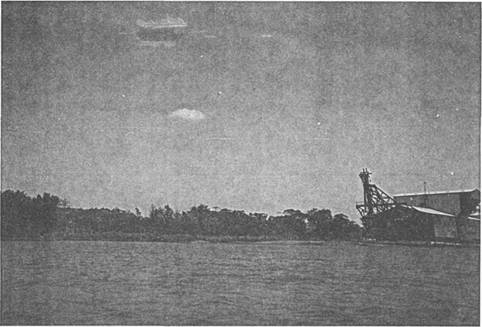
Coastal
region: the fishermen have faced more difficulty since
the company and military came to exploit the natural gas
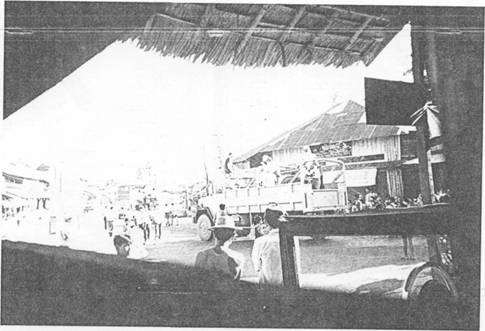
The field
personnels: the French citizens on the
trucks, they have operated to lay pipe in the area under dangerous conditions
and unstable political situation of Burma