*
To monitor human rights situations in Mon territory and other areas southern
part of
*
To protect and promote internationally recognized human rights in
human
rights foundation of monland
Human Rights Report 4/96 (
Indigenous
individuals and peoples are free and equal to all other individuals and peoples
in
dignity
and rights, and have the right to be free from kind of adverse discrimination,
in
particular
that based on their on their indigenous and origin or identity.
Article 2, UN Draft Declaration on
the Rights of Indigenous Peoples
The Suppression on Karen Villagers
with Allegation of [being] Rebel-supporters
The
Tactics for Ceasefire Agreement
The main ethnic nationalities of
When the SLORC tried forcing the
NMSP (New Mon State Party), an armed opposition representing the Mon people, its
local troops also pressured the local Mon population to persuade their close
NMSP leader. According to the local sources, at the time before the NMSP
reached ceasefire agreement, they always claimed to local Mon villagers, "if your NMSP did not make a ceasefire agreement with us we
will always accused you as supporters of Mon rebel and you have responsibility
to tell your leaders to talk with us". Normally, the Mon or Karen troops
always keep contacts with their same ethnic community for their struggles in
proving foods, information, recruitment, tax and etc.. Therefore, as soon as
the SLORC troops arrived to a Mon or Karen village, they always asked where is the bases of nearest base of rebel troops and its forces.
When the village headmen could not provide accurate information, they will be
again accused as rebel-supporter or if someone in village was relative of a
rebel, he/she was inhumanely treated by soldiers. By curbing the activities of
the rebels or pressuring them to start or complete ceasefire agreement, by the
way, the SLORC has launched this inhumane tactics.
According to records we received in
duration even the NMSP was talking with SLORC, many Mon villagers were
persecuted to death without trial and several villages were destroyed or dislocated
by SLORC troops under the accusation of rebel-supporters. Some villagers were
disappeared after they were arrested by soldiers, while some villagers were
tortured to death or killed on the spot. Furthermore, those villagers were more
conscripted in forced portering for carrying the logistics of the troops or
labour in infrastructure projects managed by the local battalion commanders. In
destroying the local villages which were suspected as bases of rebel, the SLORC
mostly burned those villages by torching or shelling with fire. Additionally,
the women who were accused as rebel-supporters have been sexually violated by
SLORC soldiers
when they went into villages. Then the villagers were displaced or
dislocated, and fled to border refugee camp.
In some areas the population of Mon,
Karen and Tavoyan peoples are overlapped and whether their same ethnic armed
forces agreed on ceasefire or not, all communities have been equally
conscripted for forced labour in government infrastructure projects. Recently,
those three ethnic communities of lower
All repressions on ethnic community
mean the persuasion of SLORC to concerning ethnic opposition forces to lay down
arms or stop fighting. The ceasefire agreement is alike creating the legitimate
role for SLORC as a champion of peace for safety of the country and unification
of a whole. Surprisingly, the SLORC would never like to accept as champion of
peace for
The SLORC has been used on local
Karen community with tactics creating troubles and through them,
it has persuaded armed opposition KNU for ceasefire talks. The Karen local
villagers have been faced the similar difficulties as
Meanwhile, similarly with Mon
refugees, the Karen refugees have been suffered as victims of kidnapping and
destruction of their camp residences. All such activities of SLORC pressed the
KNU to consider for talks with them. In 1996, even the KNU arranged several
rounds of talks with SLORC in
The
human rights violation on Karen villagers in Yebyu Township
Following the unacceptable methods
or tactics of SLORC, many local Karen inhabitants of Yebyu
Law Thaing village has only 50
households and all villagers are Karen who believe in
Christianity. Their main professionally occupation is farming of highland rice
cultivation. The most farmers have grown rice in the hilly and valley areas
east of their village.
On December 10, 1995, after the
fighting occurred between local SLORC troops from IB No. 104 led Col. Htaung
Yaza and a small KNU guerrilla force occurred in a place about 5-6 kilometer
east of Law Thaing village. The Burmese troops angered to local villagers. As
soon as the fighting was over three Karen farmers' huts nearby including rice
and other living stocks were burnt down into ash by the Burmese soldiers. Those
farm-huts were owned by U Kyaw Tin, Saw Kar Karr and Saw Maung Lee. Totally
about 80 baskets of unpolished rice of those farmers were destroyed and they
were also arrested by soldiers to be porters and interrogated them about the
guerrillas. They were also accused as supporters of KNU guerrillas and detained
in IB No. 104 base in Kyaukadin village for 15 days.
After two days of the fighting on 12
December, Captain. Myint Kyaw of IB No. 104 came into Law Thaing village again
and arrested 21 villagers including village leaders and women who were accused
relatives of KNU solders. They were also detained in Kyaukadin military
detention cell for 15 days. The names of those villagers are:
(1) Saw Sar Nar (male)
(2) Saw Sar Too Har (male)
(3) Saw Pho To
(male)
(4) Saw Phee Yo (male)
(5) Saw Pho Ke (male)
(6) Saw Bale War (male)
(7) Saw Koo Kay (male)
(8) Saw Pay (male)
(9) Saw Phar Bee (male)
(10) Saw Maw Yawe (male)
(11) Saw Bar (male)
(12) Saw Baw Tho (male)
(13) Saw Maung Khin (male)
(14) Saw Htoo Thar (male)
(15) Saw Pla Nar (male)
(16) Naw Kyae (female)
(17) Naw Chae (female)
(18) Naw Aye Loo (female)
(19) Naw Day Jay (female)
(20) Naw Lay Pow (female)
(21) Naw Phaw Plar (female)
After every incident, the Burmese
soldiers firmly ordered to villagers around the area including Karen villagers
from Ya Bu village group, to not travel east of their village to harvest or
other business. If they met on the way, those travelling villagers must be
accused as rebels and must be killed.
Since then, no villagers dare to
harvest their rice in east side of their villages and the rice products were
absolutely ruined after it getting too ripe. Besides such maltreatments because
accusation of rebel-supporters, the villagers also have to provide forced
labourers for Ye-Tavoy motorway re-construction and railway construction as
regular basis. Additionally, the villagers also have to work for military such
as collecting facilities for military barrack and building bunkers, trenches,
stores and other buildings in respective military bases and outpost. Several
kinds of tax are also collected by local Burmese troops.
Since the military restricted the
movement of the villagers for harvesting and collection forest products, those
villagers have been facing hardship to get food and income for the survival.
There was no more choice for some villagers who have nothing to sell and then
abandoned the village and fled to border refugee camp.
The
Focus of This Report
This issue of report just mentioned
the situation on Karen population in
Among several conducted interviews,
we selected two best interviews that described more detail situation of the
Karen ethnic community, human abuses committed by SLORC and livelihoods of
them. To protect safety of them, we changed all of the names of interviewees.
However, all events and stories are true which really happened in
Interviews
Interview
#1
Name:
Saw Kyaw Lay
Sex/
Age: Male/ 36 years
Nationality/
Religion: Karen/ Christian
Occupation:
Farmer
Native
Place:
Interview
Date:
The
ceasefire agreement between the NMSP and the SLORC could not prove for the
betterment of human rights situation in almost area where the Mon and Karen are
inhabiting. Such human rights abuses forced the local
villagers to abandon the villages and displaced.
Human rights abuses and refugee flux
When did you arrive to this refugee
camp? Why did you decide to stay here?
I arrived here just three days ago.
I came from Law Thaing village just two days walk and no trouble on the way. I
have ever come here for several rimes recently about two years to sell or carry
some products from
For this year, I think I could not
provide them labour they needed and cash as well. When we were in villagers we
were arrested to be porters or had to work for various kind in military
barrack. We had to carry the military logistics in rotation basis of the
villagers very often.
The instruction of the military in
recruitment of porters
How many times you have to go with
military operation as porter since September of 1995? What logistics did you
have to carry?
I have been as porter for three
times since September. My last time as a porter for Light
Infantry Battalion (LIB) No. 407 was on 23 December. In the last time
before I left here, on that day, we had to go with military operation according
to arrangement of village leaders with rotation basis among all male villagers.
Recently, we always fled around the village and the forest nearby. When the
Burmese soldiers returned back the battalion or moved to another way, we went
back to village again. But when the villagers were arrested on the way you fled
or in farm-huts, they were severely beaten by the soldiers. Later on, the
commanders of Burmese soldiers issued orders and instructed to every village
leaders in area that if they came to the village, they did not want to rashly
arrest the villagers. They will ask kindly to provide them the needed porters.
If the village disagreed with their instruction, they must burn down the
village, they said. In our village, the village leaders have to give the local
military battalion register of households and names of family members.
If you fled away when the troops
came you will be accused giving information to Karen troops and must be
severely punished by Burmese soldiers.
Since September and before I left
here, I have been as porter for LIB No. 407 and No. 410 and IB No. 104, for
three times respectively. At least, we have to walk with military operation or
stay in their military outpost at least for three days. But in my last time,
when I was as porter on 23 December, we asked to return back for Christmas
festival on 25 December. So they released us on 25 December.
Portering case, in every trip the
porters have to carry overloaded ammunition and other materials
We have to carry several materials mainly
ammunition and foods. In first time I have to carry six big shells of
ammunition with weight about 30 kilograms. No fightings on the way we walk. I,
other four our villagers and 23 porters from another villages had to carry
ammunition and foods for the troops for three days. The troops were, I think
for LIB No. 410. I don't know the name of the commander,
they have about 50 soldiers in that military operation. We have to walk up to
Aleskan village. In second time, I have to carry their rice and soldiers'
belongings such as their military bags and jungle boots. In the last time I
carried rice and vegetables with weight about 25 kilograms. We had to walk only
one day from Law Taing to Kyaukadin military, then we
stayed one more working in barrack.
Inhumane treatment to porters on the
way along the military operation
What were the
soldiers' treatment on villager porters? Did anyone hurt in the
portering?
We were always weak after we
returned back for portering. The soldiers fed us only one meal with small
amount of rice and bean curry. But they ate for two meals. If you had pass
through some village, it was better you can ask foods for villagers. The
villagers knew how the soldiers fed the porters and they sympathised. On the
way, without the order from the commanders we could not stop and take a rest.
If you were very tire and asked for a rest, surely they will shout and kicked
you with their boots to hurry up. They always shouted that "it was army,
you must know to follow the order and don't refuse". Some men were also
beaten behind with jungle boots or rifle butts, if they walked too slow. Such treatments are normal in portering of Burmese
troops.
You said they released you to
celebrate Christmas festival. Do you think the military commander also respect
for religious rights of your community?
Maybe. Col. Thaung
Yaza is a Chin nationality. I think he is a Christian like us. May be, he
sympathised on us. But they released us with works. We had to promise them we
will work for them.
Beside
the portering, the villagers also had to provide the facilities what the
military needed in their military base. In every village community, they have
to find out facilities and they, themselves, have to work in the military
barrack.
Forced the
villagers to collect materials which are needed to build the military barrack
or daily uses.
What kinds of work they order you
before you returned back and to give promise them you surely do for those?
When we returned back Captain Kyaw
Myint told us that "if you would like to return back to village for
Christmas festival, you might have to cut trees to send it" and we agreed.
We promised them we will do it. He told us to cut down small tree with one feet
diameter in forest and cut them into 5 feets length for 100 pieces. Then to sent those wood pieces to them. After the festival
we have to go into forest in east of village, but at that time the military
also ordered not to travel east side of motorway. But we had no more choice, we could not get trees around our village and plantation
nearby.
Then four of us told village leaders
and travelled to east side of village. We had to go about 5 mile
from village and we spent four days to get all 100 pieces of one feet dimension
wood. We were lucky, there was no activity of
I think they will build their
barracks, bunkers and trenches with those woods. They also made fences with
those woods. Not only us other villagers also provide
such kinds of woods and bamboos. Some of them also worked in the construction
of military barracks, bunkers and every jobs in the
military base. .
Besides the facilities, what kind of
other materials your villagers had to provide to that base?
Several
things. Besides woods for the construction, the villagers also had to
provide them with fire-wood. Before I left, myself and another one villager collected
fire-wood from every houses in the village and then, we sent them two full
bullock-carts fire-wood. We gave it to Captain Kyaw Myint.
Sometimes, the commanders sent
letters to village leaders and asked for vegetables or meats. Then, we have to
send them vegetables and pigs from the village. If they asked chicken, we had
to give them at least ten chicken. If they asked for
pig, a t least we have to give them one pig, they did not accept one or two
kilogram of pork. In Christmas festival, they also asked for one pig, and we
gave them.
You said the military barred the
villagers not to travel east of Ye-Tavoy motorway. Why?
Because of
fightings between Karen and Burmese troops. In October
and November when the Burmese troops from LIB No. 407, 410 and IB 104 launched
patrols and military offensives, they were ambushed by Karen guerrillas for
several times very often. When their officers died they angered too much to
Karen villagers around the area.
On December 10, there was a fighting
happened in south-east of our villagers about 6 kilometers far. The
Burmese troops were IB No. 104 of Kyaukadin. According to Ya Bu and Kyaukadin
villagers, many Burmese soldiers got injuries. So they angered too much to
Karens. After battle was over, some rice plantation were
burnt down by Burmese troops. Then, they issued the order to every village not
to move east of motorway as I mentioned. The order was still functioned up to
the time I left here. The village leaders warned us not to go east of village.
If they (the soldiers) met on the way they will kill for sure. They also
ordered the farmers who were in plantations to returned
back and stayed in the village.
Accusation on local villagers as
rebel-supporters
Severe torturing committed by SLORC
accompanied with accusation of rebel-supporters, after the fighting ceased.
On December 12, Captain Kyaw Myint
himself came into villages and arrested about 20 villagers including women and
village leaders. He brought them to Kyaukadin. They accused those villagers
were the relatives of Karen guerrillas. The guerrilla leader is Dar Lace. They
said those villagers are relatives of Dar Lace and his men. Some young men also
joined with Dar Lace troops and sometimes they returned back to village. The
village leaders cannot bar them. Actually, those all arrested villagers are not
relatives of rebels, but some of them. They detained them for 15 days in
Kyaukadin military detention. Some of them were severely tortured and I don't
know they raped the girls or not. They were beaten when the military
interrogated about the rebels. They were put under hot sunshine in mid-day and
poured water on their heads. Sometime, they closed the faces of villagers and
beated them. Next time when they launched the military operation, they also brought
village leaders of every Karen village around the area to show the places where
KNU group took base.
The situation is very serious. After
their men died, they always beated Karen wherever they met. The Karen men who
travelled to Kalein Aung or Aleskan always described that they were always
beaten by Burmese soldiers in military checkpoints on the way or when they met
soldier in mid-way or sometimes, even on the truck.
Restriction
of movement of local villagers has effected the rice production of that area
and as a result, those local inhabitants have to abandon their native village
and displaced.
Why did you decide to leave here
(Payaw refugee camp)? What are
difference between here and your village?
I also have a small highland rice plantation
east of my village near Kin Chaung (river). After fighting, I
had no opportunity to have a look in the plantation and then to harvest. I did
not know what happened in my plantation. I would like to go, but my wife
stopped me not to go. She said it was too dangerous, she worried the soldiers
will kill me. After they were ambushed, the Burmese soldiers launched very
often patrol around the area to catch the Karen rebels. But the Karen troops
were disappeared.
I left nothing. Our family was
totally depended on that plantation and we had no more rice even in Christmas
festival. We had to borrow sticky rice from other houses to make foods. I also
grew sticky rice in the plantation, but I lost all of it. Nobody
in our village did not dare to go to plantation and you had to sell
belongings to buy rice. I have no much belongings to
sell and then decided to come here.
Some
difference here and my native village. Here I don't have to worry
for foods and portering, working for military and no tortures. But I get very
small house surroundings, but I would like to return back again when the
situation is better.
Interview
#2
Name:
Tar Lae
Sex/
Age: Male/ 43 years
Nationality/
Religion: Karen/ Christian
Occupation:
Farmer
Native
Place: Ya Bu Village,
Interview
Date:
By
using the guerrilla warfare tactic, the ethnic nationalities of
Why did you flee from the village to
here (a place near border area under the control of NMSP) and how often the
Burmese troops came into your village?
I came here because I don't want to
stay in the village more. All our villagers have provide
to the Burmese soldiers with porters or cash, and they always beated villagers
when they dissatisfied. They came into village very often. At least two times
in one month. I don't know how many times they sent letters to village leaders
within a month. But every time, when the Burmese officers sent letter, the
village leaders will ask for a meeting and then we had to provide labourers for
railway construction, motorway construction or portering. Every time the
Burmese soldiers came into the village they always asked for porters. I have
ever been as porter of Burmese soldiers for several times.
According to the villagers from Law
Thaing, they explained there were many fightings occurred in Ya
Bu-Law Thaing area. Do you know about those and how is affected to your
villagers?
I knew well. Because I was a porter
when the fighting happened in third week of November (he could recognize the
exact date of incident). We were taken as porter by LIB No. 407. Before that
day, when the troops came they asked porters form our village, the village
leaders had to provide 7 villagers for them. Then we moved to east side of
(Ye-Tavoy) motorway along the Kin Chaung (river). We left early morning on that
day, and I have to carry rice and ammunition of them. The Burmese troops were
led Col. Hla Htun and they had about 60 soldiers and about 30 porters including
us.
Villager porters along with Burmese
troops and mistreatments in the fighting
In mid day when we arrived in a
place, the Karen soldiers shot us. I think the Karen forces had only ten. I
didn't know how to flee. The bullets came too much to us and the Burmese
commanders shouted us to lay down. We laid down on the ground and the officer ordered soldiers to
advance and shoot. Some young soldiers (children soldiers) scared to advance
and but they had to follow according to the order. One corporal took ammunition
from me rashly and shouted me not to flee.
In the fighting, three Burmese
officers died and other three got injuries severely. The three death included one Corporal, one Sergeant and one
Lieutenant. The fighting took place just for 15 minutes and then the Karen
soldiers fled away from the site. One rice plantation nearby was also burnt
down because of the fighting. I don't know who owned that plantation. On the
way when we returned we had to carry dead bodies up to Ya Bu and then to
Kyaukadin. The left soldiers shouted us along the way to hurry up.
Restriction of movement of villagers
and loss of chance for rice harvest
Two days later, the Burmese troops travelled
to east of motorway again and burnt down the rice plantations and farm-huts
around the area. When they returned back, they also ordered to villagers that
not to move to east side of the village. It is terrible for us at that time,
because many villagers were preparing to harvest their rice. We had no
opportunity this year to reap rice and we lost all. Many villagers lost their
rice like me.
Some of our villagers were also
arrested with allegation of rebel-supporters and they were detained in Kyaukadin
military detention. Next time, whenever the military launched the operation
they asked village leaders, not as porters, to follow them and show them the
base of the Karen soldiers. They also burnt the rice plantation of the Ya Bu
and other villagers in front of village leaders but they could not stop the
soldiers.
Taxation for portering cases
If you could not go for portering,
what is the response for the Burmese Army?
If could not go for portering for
some reason, you should have to inform the village leaders you have to pay at
least 2000 Kyat to the military. Every time we were taken as porters we had to
spend completely one week with troops and if they did not have move to anywhere
you have to stay and work in the military barracks. The most our villagers are
poor and could not pay. So when his father was busy the boys also had to follow
with Burmese troops for portering as substitute.
Population movement in rural areas
because of human rights abuses
Please describe me the background of
your village?
Our village have
about 50 households with nearly 300 population. Recently, our villages have
about 100 households and then many families moved to refugee camp or joined
into Ya Bu big village. Our village is small Ya Bu and the most call Ya Bu Ywa
Thit (new village). Another village is Ya Bu Ywa Ma (big village) and our
village under the administration of Ya Bu village group. Really our villager
situated beside Kin Chaung (river) and since four years ago when the military
launched four cut campaigns our village was relocated to this place (Four
cut campaign is the attempt of the Burmese Army to cut off information,
recruitment, logistics and tax from civilians to ethnic armed opposition). All
the time, our villagers were accused as rebel-supporters by soldiers and they
did relocate our village.
Besides the suppression related to
the accusation as rebel-supporters by Burmese soldiers what another violations
on your villagers?
Normally, we have to work in railway
and motorway construction like other villagers.

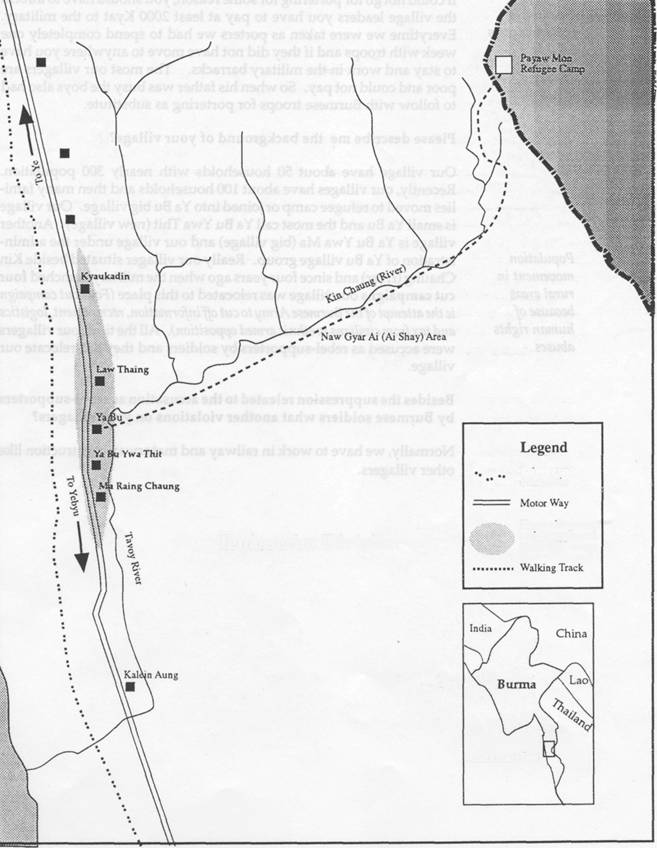
(These explanations correspond in
order to the items in the Legend)
Railway under construction
Motor Way
Karen village area which suppressed
by SLORC troops
Walking Track