* To monitor human rights situations in Mon territory
and other areas southern part of Burma
* To protect and promote internationally recognized
human rights in Burma
human
rights foundation of monland
Human Rights Report 3/96 (June 30, 1996)
P.O. Box 11, Ratchburana,
Bangkok 10140, Thailand
States
Parties condemn discrimination against women in all its form, agree to pursue
by all
appropriate means and without delay a
policy of eliminating discrimination against women
and, to this end, under take:
...
(d) to refrain from engaging in any act or practice of
discrimination against women and to
ensure that public authorities and institutions
shall act in conformity with this obligation:
(Article 2, d., The
Convention on the Elimination of All forms of Discrimination against Women)
Sex Discrimination Against Refugee Women by SLORC troops
Brief Information of Mon Refugees along the Thai-Burma
Border
On the eve of the situations
when the Mon refugees to be repatriated to Burmese territory of the border from
Thai soil, the situation inside Burma where the New Mon State Party (NMSP) and
SLORC had agreed for ceasefire zones has been still unsafe for the returnees.
But, for the Mon refugees they have no more choice except moving down to unsafe
Burmese territory.
Soon after the NMSP reached
for ceasefire agreement on June 29, 1995, a local organization which has been
taking care of welfares of Mon refugees, Mon National Relief Committee (MNRC)
requested Bangkok base UNHCR for protection and monitoring in Mon refugee
repatriation program. Then, the UNHCR has attempted to provide to Mon refugees
for monitoring and integration of community reconstruction. But the UNHCR must
need the recognition and agreement of concerned governments, for any monitoring
of refugee repatriation, according UN procedures and principles.
After MNRC's request, the
UNHCR representatives and legal officers often came and collected information
from Mon refugees to accept the real desires of Mon refugees, for implementing
voluntary repatriation. At the same time, in November 1995, the local Thai
authorities including Royal Thai Army's Ninth Division, which bases in
Kanchanaburi Province and has responsibility border security where Mon refugees
were residing, pressured to NMSP leaders and MNRC officials to repatriate the
Mon refugees as soon as possible. They also instructed deadline for Mon
refugees to move back to Burmese territory before April 30, 1996. The
transportation of supplies also must be completed before that deadline.
The UNHCR's concerned
officials had flied several times around Geneva-Bangkok and Rangoon to discuss
with governments, country of origin Burma and country of asylum Thailand, to
get the recognition for monitoring. However, even the UNHCR has attempted to
get mandate for monitoring to be presence in both territories,
as a result, the UNHCR could not provide monitoring to Mon refugees when they
were started repatriation in March. The SLORC, the military regime of Burma,
disagreed with UNHCR presence in Mon refugee repatriation for the moment and
just replied that Myanmar government will allow the UNHCR presence for
monitoring after all ethnic armed opposition groups along the Thai-Burma border
reached ceasefire agreement with government. It was meant that SLORC did
not allow the UNHCR yet in the repatriation of Mon refugees. At the same time,
the Mon refugees frightened the deadline of April 30 and forced repatriation of
Thai Army as the ever had experiences.
Since the SLORC implemented
government projects such as railway construction, and gas pipeline in lower
Burma of Mon State and Tenasserim Division, Rangoon has been pressuring to
local community to achieve ceasefire talks with ethnic armed opposition groups,
to ensure the security of projects. For a result, there have been many new
arrivals taken refuge in the border areas. About 25% of population
of Mon refugees in estimation are the arrivals in duration since 1993
October when the time SLORC started railway project. Therefore, those refugees
and overall were reluctant to move down to the Burmese territories where human
rights situations are still worsening.
Population Movement in Dry Season
Last year in 1995, the SLORC
had been forcing the local inhabitants to work in the railway construction and
constructed the needed buildings in the proposed gas pipeline area for the
whole year. The conscription of forced labour had been continued up to the
beginning of 1996 and that created the population movement in territories close
to the borderline.
Under the unsafe and lack of
security in local area or free fire zone, to avoid the conscription of forced
labour, many local villagers moved to border area as internally displaced
persons or refugees. At the same time, in dry season of the duration from
November to May, while the walking tracks were smooth to travel around, some
refugees also visited to their native villages or relatives' villages secretly
for a while.
The Payaw,
the last Mon refugee camp which left in Thai territory, was the most convenient
one for new arrivals to reach.
Then, the majority of the camp population are mostly
new arrivals from Yebyu township who escaped from forced labour. Beside the new
arrivals who have come to the camp, some Payaw Camp's residents also visited to
some Mon or Karen or Tavoyan villages in Ye or Yebyu Township to get
necessaries and living stocks there. For example, to raise pig or chicken, the
refugees have to go to some village where they could achieve such animals.
Additionally, some refugees also returned and collected rice and other
vegetables seeds to grow in the camp and hilly area nearby or they also
travelled for religion or ethnic tradition purposes.
Incident of Sex Discrimination
With purposes to meet their
relatives and to bring back some pigs for Christmas Day festival to be
celebrated in the camp, a Karen family comprises an old woman and her two
grand-children of a young girl and a man, from Payaw refugee camp, returned
back to their native village in Yebyu township
secretly. They started their trip at the end of November 1995. They arrived to
their village within two days. After they met with their relatives and bought two
pigs, then they returned back to the camp on December 3, 1995.
On the way to the refugee
camp on December 3, the refugee family unexpectedly met with a small company of
Burmese troops of SLORC Light Infantry Battalion (LIB) No. 407 which was
launching a military operation for the security of that area. The place was on
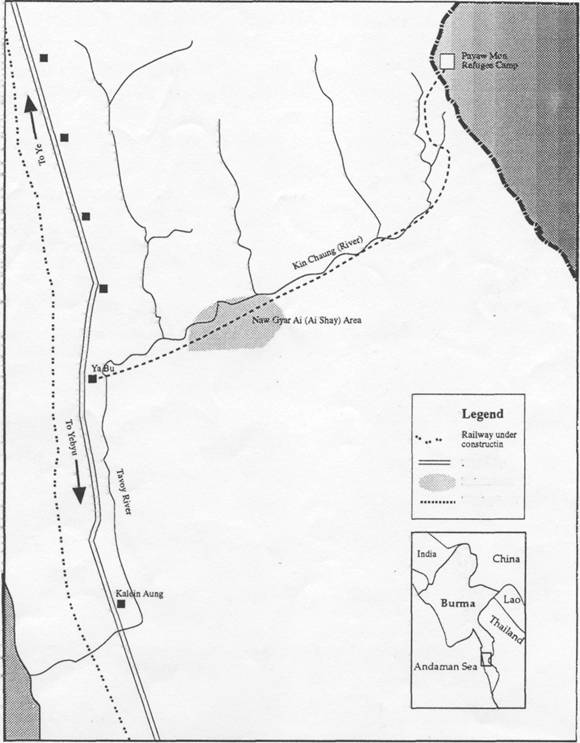
the bank of Kin Chaung (river) near an area called "Ai Shay" which
was far about 15 kilometers from Payaw refugee camp and 5 kilometers far from
Ya Bu village (see Location Map of Incident). Then, the Burmese soldiers
arrested all of three refugees and tied the man up with ropes. Then senior
officer of military operation "Captain Thein Soe" ordered his
military men and forcibly brought the 17 years old
unmarried girl to him. Then the Captain raped her about 9:00 p.m. in night
time.
About 4:00 a.m. in the
morning of December 4, an unknown Warrant Officer brought 54 years old
"Daw Ma Shin", the grand-mother of young girl, with him and raped
again.
Then, the soldiers let them
return back to Payaw refugee camp, after confiscating about 35 kilogram weight
one pig. On the next day, the military operation moved back to Kalein Aung
Battalion camp. Then Infantry Battalion (IB) had been active as troop
substitution in the latter military operation in that area.
Focus of This Report
This report also would like
to focus on the safety of refugees who were already relocated to Burmese
territory, and the plight of women in local areas or even in refugee relocation
site. Since the UNHCR could not provide possible monitoring for the repatriation,
the refugees were relocated to Burmese territory with program "community
itself organized relocation", after they had no choice because of the
deadline adopted by Thai authorities. The area where they are residing at the
moment is very unsafe for them. The relocation site is close to the area where
SLORC troops have launched regular military operation. It is not their native
places where they originally escaped from and so, that was not meant they were
repatriated according to the international principles. Additionally, the sex
discrimination against the local inhabitants and refugee women which regularly
happened make them fear to freely move around in the
area.
To get accurate and correct
information, human rights workers of HURFOM conducted interviews with those two
victims and put the real names of them. To protect safety of them, if you make
publicity about this case, please change their names. However, all events and
stories were true which really happened in Burma and, please feel free and can
change the better usage of English. It is hoped that all information must be
useful in helping the international community to halt SLORC from violating such
abuses and promote internationally recognized human rights in Burma.
Interviews
Interview #1
Name: Daw Ma Shin
Age/ Sex: 54 years/ Female
Nationality/ Religion: Karen/ Christian
Occupation: refugees
Native Place: Law Thaing Village, Yebyu Township, Tenasserim
Division
Interview Date: January 10, 1996.
Traditionally, the ethnic
communities in Burma who believe in Christianity, celebrated the every year
Christmas Day on December 25. On
the eve of Christmas Day, the Christians have to prepare to be ready for
celebration.
Q Why did you return back to your native
village? For what purpose? When you left there?
I returned back to Law Thaing
village to buy pigs there for celebration of Christmas Day. We could not get
pig here (in Payaw refugee camp) and may be expensive in Sangkhlaburi (Thai
border town). So I decided to return back to Low Thaing village. I have
relatives there and may be I can get good and low price and I went there. We
left there on November 28. I left there with two of my grandchildren a girl
"Naw Maw Nee" and a man "Mem Kow Htaing".
Population movement in border
areas
How many days you did spend in your
native village and when did you return back again?
I spent in the village just
for two days. We had to walk for two days to reach Law Thaing village and I
arrived on November 29 . We stayed there for three
days and returned to Payaw village on December 3. On those days we stayed
there, we visited to our relatives' houses and bought two pigs and put in a
closet. Then, we tied those pigs and pulled it along the way when we return
back.
The local SLORC troops always accused the innocent
local ethnic population as supporters of the armed ethnic opposition and if
refused, they were terribly treated by soldiers.
When did you meet with Burmese soldiers (the most local villagers used the SLORC
troops as Burmese soldiers) and what they asked you?
We left from Law Thaing
village in the morning of December 3. My grand-children pulled the pigs and we
walked along the way of Kin Chaung river. In evening
about 6: 00 p.m. when we arrived in a place Naw Gyar Ai (Ai Shay in
Burmese), we met three Burmese soldiers surprisingly and had no time to flee
away as I was an old woman and we had another two pigs with us. The Burmese
soldiers shouted to us not to flee and if we flee, they will shoot. They
arrested all of us and brought us to the place where they make a temporary
camp. We had to walk there for one hour to reach from the place we were
arrested.
Accusation against local
inhabitants as supporters of ethnic armed opposition groups
As soon as we arrived to
their outpost, they tied my grandson with ropes. I saw there were about 30
soldiers and 11 porters in the camp. All of them were taking a rest and they
prepare shelter to sleep. Then, the commander with rank Captain ordered his men
to bring me to meet him.
He asked me many questions
such as where I was staying, about the fighting and background of our family. I
answered recently I stayed in Law Thaing village and now I stayed in Payaw
refugee camp and I was a Christian. He also asked me did I know the fighting
happened just previously between Dar Lace led Karen rebels and Burmese soldiers
and made sure where was the base of Dar Lace group. I
told him I did not know the happened fighting as I was in Payaw. I also did not
know who was "Dar Lace" and his base.
He asked who was the young
girl accompanied with me and how she was related with man. I told him that
those young girl and man were my grand-children. When he asked me the young
girl was already married or not, and I told him the true that she was not
married yet. After parents died and she had came and took refuge along with me.
The sex discrimination
always happened by forces. Mostly, thee Burmese soldiers including senior
officers always threatened the victims to kill and they abused discrimination
of rape.
Then, how he threatened you and what he violated on
you?
He did not make any problem
to me, just threatened me that I bought pigs from village illegally (without
informing to the military) and he can confiscate pigs, arrest me and sent
to Ya Bu military detention center. I told him that I bought pigs just to use
for Christmas Day and to sympathise me not to confiscate. Then, he let me went
back to the place where the soldiers put to stay that night.
Later, what the treatments were made by commanders and
soldiers?
About 9:00 p.m., the soldiers
who got the order from that officer, came and brought my grand-daughter to
Captain. After one hour, my granddaughter shouted that "grand-ma, please
help me", "please came here". All of us, including porters,
soldiers nearby heard her loud voice and but nobody dared to help her. Nobody
slept yet at that time. The incident place was about 15 meters far from ours.
For a while, she came back with crying voice and explained me that the officer
raped her. While he was telling about the incident, one soldier shouted us to
sleep and stay quietly. May be, other porters and soldiers slept well, but me
and granddaughter could not sleep for the whole night.
Sex discrimination against
elder women by SLORC officer
What were the soldiers
treatments on you?
About 4:00 a.m. in the
morning on the next day, one warrant officer came and told me that the officer
agreed to release all of us, but he will confiscate the pigs. And, I told him
it was very important for me to get back pig to the camp and please give one
pig and confiscate another one. He said he don't know
what was the decision of his officer and it needed to ask him. He told me he
will bring me to him and will help explaining to get one pig. I agreed and
followed behind him to meet the officer again. On the way, before we reached to
officer's tent, when we arrived under a cluster of bamboos he gripped me with
his hands tightly and tried to fall me down on the ground. I tired making
insult from his rape, but he threatened me with knife to kill and then raped
me.
Interview #2
Name: Naw Maw Nee
Age/ Sex: 17 years/ Female
Nationality/ Religion: Karen/ Christian
Occupation: refugees
Native Place: Law Thaing
Village, Yebyu Township, Tenasserim Division
Interview Date: January 10, 1996.
The most of ethnic
civilians could not speak Burmese, and it is a weak point for them in
communication with Burmese soldiers and they have been always looked down and
maltreated by soldiers.
Accusation against the
ethnic community as rebel-supporters and discrimination against them
When you arrived to military officer "Bo Gyi
(Captain)", what he talked to you?
As soon as I arrived to him,
there was no body there and he asked me can I speak "Burmese". I said
"no", I can't speak Burmese and he said he can speak Karen. And he
also spoke in Karen to me. Continuously, he asked me that how I was related to
the old woman and man who accompanied with me along the trip. I told him the
man was my cousin and the old woman was my grand-mother.
When he asked me did I know
Karen rebel leader Dar Lace, I answered I don't know. He said, why did not know
Dar Lace. He was a Karen and I was also a Karen, I must know him. I said I
really don't know.
Did they ask you why did you stay in refugee camp?
Yes, he asked me. I told him
my parents died and then I stayed with grand-mother as I have no other
relatives. And I did not know how to work to get income. He also asked me what
kinds of assistance distribution we received in the camp. I explained him that
we received rice, fish paste and salt. He also asked our occupation in the camp
and I answered we cultivated rice in hilly area close to the camp.
Sex discrimination after
threatening to kill the victim
Did he force you for rape? If so, how did he try to rape you?
He said, he sympathised on me
and told me he would like me to stay with him. He said he loved me too. He said
it might be too tire for me in cultivation works and can created
better lives with him. Anyhow, I refused that I don't want to stay with him. He
forcibly embraced me and kissed me and I also tried making insult. I shouted
and cried out for help to my grand-mother. While I was shouting he gripped me
tightly with his hands and showed me a hoe which was put nearby and threatened
to kill me if I was not quiet. He said he will kill me with that hoe and
inhumed me there. He shouted me that don't make him to be angry. His body fell
down on me and then, he raped me.
LOCATION MAP OF INCIDENT
(these
explanations correspond, in order, to the items in the Legend)
Motor Way
Incident Area
Walking Track