
Text Box: Destruction and Degradation of the Burmese Frontier Forests
Text Box: #
Text Box: control over the reserve forest.” Logging destroyed some parts of the reserve forests, which are in the flat areas, and near the car road. Logging which began in 1962 has since destroyed the lower part of the forest of Tantibin Township. In 1988, the SLORC gave out logging licenses to citizens of Toungoo district. Many rich people/elephant owners applied for logging licenses. For example, Saw Pwe Lah's son got a license from SLORC. To practice logging officially and without disturbance, he also went to get permission from the KNU. After he had permission from both sides, he made a truck road into the Chaungmange reserve forest that is close to Metindein reserve forest, in 1991. He had to transport the teak trees to SLORC stockpiles for free and had to pay SLORC 2000 Kyat for one ton of wood. He also paid the KNU 1000 Kyat for one ton of wood. During one year (1991-1992), he sold 2000 tons of wood privately. After one year, the SLORC changed his logging license and he was ordered to sell only to MTE which paid him less. He did logging in Chaungmange forest and later he moved to Metindein forest. From 1992 to 1997, he produced another 6000 tons for SLORC. Other elephant owners such as Aung Htun, Mae K'taw, Kwa Po, Po Ton, Thawkya, Paya, and Padohko, continued to practice logging in Chaungmange and Metindein reserved forests until 2000. One elephant owner said that if you did logging officially, you had to pay many groups which cut deeply into your profits. “When I had a logging license, I paid SLORC 2000 Kyat, KNU 1000 Kyat, woodcutters 200 Kyat, elephant workers 700 Kyat, road makers 600 Kyat, crane drivers 500 Kyat, and truck drivers 2000 Kyat per one ton of wood. A total cost of about 7,000 Kyat. I sold one ton of Group One (high grade) wood for 8000 Kyat, and I made 1000 Kyat profits for one ton of wood. But when the SPDC took back the logging license, I paid less to the workers and the KNU so the total cost was 3500 Kyat. But the government pays me only 4000 Kyat. So I make only 500 Kyat per one ton of Group One wood. The SLORC sells the wood to Singapore $300 US dollars per ton.”
After 2000, good trees became rare and could only be found in hard to reach places. All elephant owners stopped logging. But since then people from villages close to the cities have practiced unauthorized logging of the remaining trees. They use buffaloes and cattle to pull down the logs from the mountainside into the flat area, and then they use bullock carts to carry the logs to the sawmill or to their village. Normally, local farmers are allowed by the KNU to collect fuel and timber in the hot season for their shelters. Most of the farmers collect wood for their private needs but a lot of urban people also collect wood for commercial purposes. The KNU local forester of Tantibin Township, who gives out bullock cart passes, said that about 3000 bullock carts collected wood in the forest of Tantibin Township in 2003. He estimated that nine thousand big trees would be cut down if one bullock cart didn't take more than three living trees. Trees are cut every year so the forests can not recover, and the condition of the forest become very poor. Both official logging and unofficial logging overexploit the forests leading to major deforestation. One of the villagers in the Htaw Ma Aye concentration camp said that some villagers collect wood and they send it to Nat Ywa sawmill, Peryahwya saw mill, and Zeryasgyi sawmill. Some people make firewood or charcoal and they sell it in the city. The bigger trees in the forest are disappearing quickly because of the people collecting wood to sell. Every hot season trees are chopped down and the forests are burned so the small wood can not recover in the forest. Some urban people come and cut Ter trees for short-term vegetable gardens.
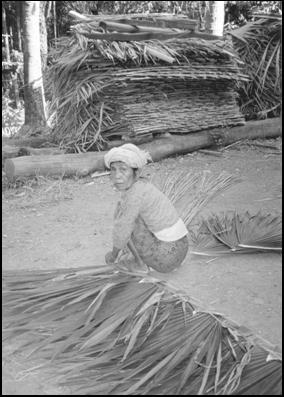
Conflicts have risen between loggers and local villagers. One of the elephant masters said that at first the villagers didn't allow him to make a truck road that crossed their orchards. He went to consult with the headman and paid compensation. But the villagers couldn't survive without their gardens. “Elephants of the loggers destroyed my orchard gardens”, said Saw Cigray in Soiloh village. The elephants ate and destroyed the fruit trees and plants in the gardens. Moreover loggers pulled the Text Box: Women weaving palm for building roofs for income

4 b