Text Box: Destruction and Degradation of the Burmese Frontier Forests
Text Box: #
Text Box: committee to monitor this work. We divided the area into two parts; one part we can use for our livelihoods and practice cultivation, and the other part are not allowed to use. Because of the campaign of KORD, we now have more confidence to work for the future.”
Headman from Klaw Hta Village: “Because of war and logging, the Karen have lost their properties and land. Our forests are gone, and some of us have become internally displaced people. Some have become refugees in Thailand. If war and logging still continue, we Karen people will disappear. We need a person who will take responsibility in solving the political problems and conserve the environment. At the local community level we will have a discussion with our communities, and we will create local community forest areas for our future needs. We will not allow any person to come and cut down or take vegetables or animals in the local community forest area. We villagers do not have the full power to make a local community forest area, so we request the local authorities in Mu Traw district to put pressure on the logging companies.”

.

The status of the rainforest


There are two types of monsoon forest in Toungoo district, mixed deciduous forest (Kawbway Ko) and tropical wet evergreen (K'ner Ko).
Mixed deciduous forest is located in the west of Toungoo district, starting from the flat area of the Sittang River (Perrenlohklo) bank and going halfway up the mountainsides. In this forest teak, ironwood (Xylia dolabriformis), Klaw Klay, Ter tree, and some other species from the Dipterocarp family grow.
Tropical wet evergreen forest is located in an area from the middle of the mountainsides into the high mountains such as Thawthi Koe (Nattaung) and Pworghaw Koe in the east of Toungoo district, next to Karenni State. This forest area is colder than the mixed deciduous forest and is misty in the rainy and cold season. Trees like teak, ironwood, Klaw Klay, and Ter do not grow in this area. Durian, a kind of fruit tree, divides the mixed deciduous forest from the tropical wet evergreen forest. Durian trees cannot produce fruit if it is either too hot or too cold, but is well adjusted to weather conditions on the warm border of the two forest types.
Reserved forest areas are found in some parts of the mixed deciduous forest, from the small hills down to the flat areas near the Sittang River. The use of the natural resources in this forest is under control of either the KNU or the SPDC. According to a KNU commander, there are nine reserved forests in Toungoo district: Matindein, Chaungmange, Pyochaung and Tonbo (in TantibinTownship), and Pade, Karenchaung, Gwethe, Mehaw and Thandaung (in Thandaung Township).  
Unreserved forest area, which includes regular rotational farmlands, integrated orchards and indigenous forests (old growth forest), are supposed to be the villagers' agricultural land but in reality is also controlled by the political groups. SPDC troops have seized the villagers land for building their camps like Beryinaw military camp in Thandaung Town

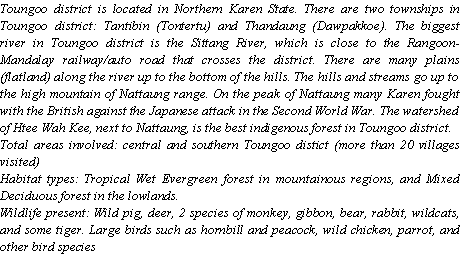
Toungoo district

Text Box: Toungoo district is located in Northern Karen State. There are two townships in Toungoo district: Tantibin (Tontertu) and Thandaung (Dawpakkoe). The biggest river in Toungoo district is the Sittang River, which is close to the Rangoon-Mandalay railway/auto road that crosses the district. There are many plains (flatland) along the river up to the bottom of the hills. The hills and streams go up to the high mountain of Nattaung range. On the peak of Nattaung many Karen fought with the British against the Japanese attack in the Second World War. The watershed of Htee Wah Kee, next to Nattaung, is the best indigenous forest in Toungoo district.
Total areas involved: central and southern Toungoo distict (more than 20 villages visited)
Habitat types: Tropical Wet Evergreen forest in mountainous regions, and Mixed  Deciduous forest in the lowlands.
Wildlife present: Wild pig, deer, 2 species of monkey, gibbon, bear, rabbit, wildcats, and some tiger. Large birds such as hornbill and peacock, wild chicken, parrot, and other bird species


1