
Text Box: Destruction and Degradation of the Burmese Frontier Forests
Text Box: #
Text Box: as an area where insurgents have access to. Anyone can be punished or killed on suspicion of aiding the insurgents.)  One of the villagers in Klaw Hta, close to Pa Pun, told KESAN: "In the past, there were not a lot of people who did logging. From 1997 the DKBA came to do logging and they also brought weapons to protect themselves. Some villagers were involved in logging with the DKBA because they trusted them. The DKBA is fighting against the KNU so they help the SPDC in the war and when they have the opportunity they try to find ways to get revenue for themselves".
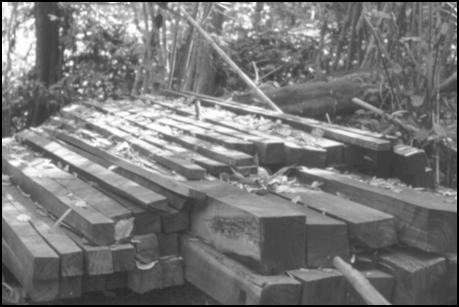
Business in brown areas often leads to the disempowerment of the local communities. People here have no voice or power. There are many sad stories related to logging. Some DKBA soldiers have forced villagers to transport logs with their cattle. In some cases people who protest are simply killed. People in the brown areas are caught between different political groups and are always living in fear. They do not have power to maintain their livelihood. It is also clear that there is a connection between the relocation and the logging. After villagers were relocated, logging started.
In the last two years, more and more displaced people are coming back to their homeland and trying to re-establish their livelihood. It is difficult to know whether they will succeed since their community forests are gone. It is possible that people will abandon their traditional ways of living and start to engage more in illegal logging, since this is a fast way to make some money and fulfil immediate needs.


Civil war in the north

In Lu Thaw Township most of the villages are controlled by the KNU. There is continuous warfare. Villagers have to face killing, torture, relocation, destruction of their rice storage shelters and buildings by the Burmese military. Many villages are burned down and destroyed by SPDC soldiers, forcing the villagers to move to other areas, leaving their properties, livelihoods, land, and village. Say Day, Pwa Gaw, Htee Moo Kee, Paw Day Ko, Por Khei Ko, Ler Mu Plaw, Maw Poo, and Saw Hta are all villages that have been destroyed by the SPDC army. Some villagers have fled to the jungle, others to Tongoo city or Pa Pun city, and many have fled to Thailand.
In 1996, the SPDC started the construction of a road for military purposes between Ler Doh (Kyaukkyi) city and Saw Hta (Lu Thaw Township) on the Thai-Burmese border. The road passes through Mu Theh, Pwa Gaw, Gu Day, Plat Ko, Maw Poo and Saw Hta villages in Lu Thaw township. With the road construction, a lot of forest was destroyed and all the villagers had to move to other areas. Due to the conflict with the KNU, the road was only completed in 1998. On the road there are army camps in K'Baw Tu, Pwa Gaw, and Maw Poo. Only the military can use the road.
Villagers living in the area became internally displaced people. Some villagers stay in the jungle in groups of 3 or 4 families. They build small huts for shelter and always have to worry about security. When they stay in any place they have to do shifting cultivation for their survival. They cannot use traditional rotational cultivation methods.
In some hiding places deep in the forest, shifting cultivation is not successful. For example, small insects and wild animals destroy paddies, or the IDP's are not familiar with the specific properties of the soil. In the deep forest, trees are very old. When they are cut, plants and trees cannot grow well afterwards. Some other hiding places are close to military camps and in some places there are many landmines, so the villagers cannot safely cultivate their food.
Text Box: Exporting timber in Pa Pun area

4 c