

Text Box: Destruction and Degradation of the Burmese Frontier Forests
Text Box: #
Text Box: prises operating in the area (Kahilu, Htee K'Hsaw Mae and Pa Pun). These enterprises log the timber left by the DKBA.
In Mae Wai reserve forest, Htoo Company is a major logging enterprise. 
Their representative in the area is U Sai. Htoo Company, obtained a logging concession from the SPDC-controlled Myanmar Timber Enterprise (MTE). After an initial survey by U Sai, Htoo Company in November 2001 entered Mae Wai area with logging materials. Before starting their operations, they had ensured their safety with both the frontline SPDC troops and the KNLA. Locally, the SPDC uses the logging company's trucks for transport of military supplies, and asks Htoo Company to supply rice, boots, and other needs to the soldiers for free. For the KNU, the logging company has to pay them tax for their security. The company brought in about 30 - 42 logging trucks, 7-10 chainsaws, 1 crane, 1 dozer, 1 log dragger, and 7-11 elephants. Htoo Company only logs teak with over 5 feet circumferences and 16 feet height. The company was contracted to cut 10,000 tons of teak and 2,000 tons of ironwood during the 2002-2003 logging season. The figures for the 2001-2002 season are not known. Htoo Company has to pay tax of 30,000 - 40,000 Kyats to the KNU.
In the Pa Pun areas, logging now encroaches upon the different categories of communal forests, without understanding of their function. Villagers from Kalaw Hta village, north of Pa Pun, started to see the trees disappearing from the forest; forests that they depend on for building materials and rotational farming. They worry that they will lose their livelihood. Because of the logging, poor people from Pa Pun also come in to clear land for shifting cultivation and to plant chili and eggplants.
The building of roads by Htoo Company at Mae Wai has destroyed farmlands and orchards. The local people were not satisfied because they received only small compensation from the company. The villagers from Mae Wai complained in a letter to the KNU Dweh Loe Township officer that logging was of no benefit to them. It didn't give them jobs because the Htoo Company uses its own people. They complained that the logging is destroying their environment, and also has little benefit to the KNU.
Impact on the traditional farming systems may even be greater because four streams that people use to cultivate rice may have become dry because of the changed meteorological conditions.


Civil war in brown zones in the south

During the same time the logging business in Pa Pun areas began, the DKBA and the SPDC implemented the ‘Four Cuts policy’ by forcing people around Pa Pun and Mae Wai areas to move to relocation sites, where they are held under surveillance. About 60 villages were forcibly relocated and lost their traditional livelihood. They also have to face forced labor, and torture and murder when suspected of being KNU supporters. Moreover, the SPDC put many restrictions on daily activities. For example, people are not allowed to go out of the village to work in the fields. This SPDC policy is killing off all traditional forest systems. In many cases of deforestation, the people involved are those who were forced to relocate.
All the logging business in Karen State takes place in conflict areas or so-called brown zones, as classified by the SPDC, which is contested for by different parties. (A brown zone is classified by the SPDC

4 b

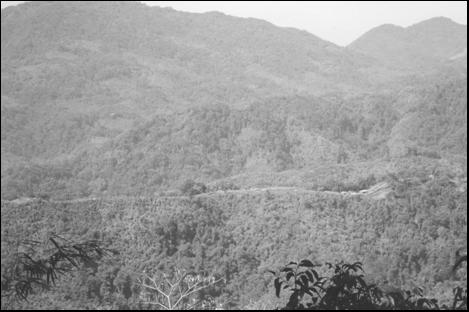
Text Box: Text Box: SPDC camp and road causing villagers to flee and become IDP’s