
Text Box: Destruction and Degradation of the Burmese Frontier Forests
Text Box: #
Text Box: money doesn't have to be spent for buying materials and tools in the city. The Karen people use K' Hee La, Lo Lah, K' Haw La, Hter La and bamboo for building roofs. For other building needs, resources are collected from the forest. In the higher and colder area (K'Ner Ko) pine trees are very important. Villagers use it for making light in the house and for night travel, and to make fire for cooking."
Forests are furthermore very important for the religious beliefs and practices of local communities. Karen people in Lu Thaw Township are famous for their traditional beliefs related to forests. Rotational cultivation alone implies many ritual ceremonies that are concerned with forests. If there was no forest, there would be no rotational farming, plant diversity, and the specific cultural identity, traditional beliefs and values of the Karen would disappear.


Ecological and social impacts of deforestation


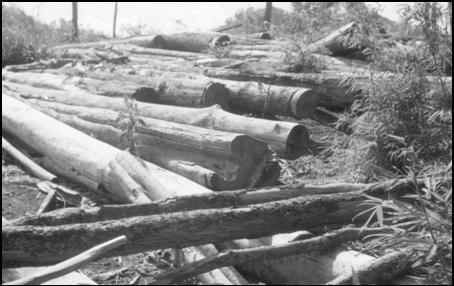
The continuing deforestation by logging or non-traditional shifting cultivation in Mu Traw district has seriously affected people's livelihoods and the environment. (Shifting cultivation constantly shifts to new plots, while rotational cultivation uses plots that have been left to fallow for 7 to 10 years, and strictly follows customary laws and regulation.) The logging of hardwood trees caused total deforestation. The dung of elephants and buffaloes used to transport the logs pollutes the streams. The courses of the creeks have changed because they are used as routes for the transportation of logs by elephants and buffaloes. Polluted water has led to increasing death rates among fish. In the summer season, the loss of shade from the trees on the banks of rivers and creeks has also caused water shortages. Furthermore, the dryness makes it easy for loggers to instigate forest fires.
Due to the extremely high security risks of conducting research in villages it is not possible to give a detailed overview of social problems related to the logging. However, it is undeniable that there are many problems. Logging in Mu Traw area was initiated by the DKBA from 1997 to 2000. From DKBA territory it spread out to other areas. A villager from Kalaw Hta, in the north of Pa Pun city, told KESAN “Now many different groups of loggers are moving their logging concessions step by step up towards our village and rotational farmlands. The trees that we kept for building and farming have all been cut. If you go to the logging areas you will see only bushes and very small trees. We have no trees to build our houses, schools and temples in the future. Even though the logging is in our village area, it doesn't give us any benefit. More than this, after logging in our village area finished, people who lived in Pa Pun city came and practiced non-traditional shifting cultivation, chilli, and eggplant farming on our village land.” Villagers from other areas complained that the elephants and buffaloes that were working at the logging sites came into their village area and ate or destroyed their crops, betel nut trees and the plants in their orchards. Many villagers do not want the logging to take place in their area any more because, as they said: “Logging is a kind of work that destroys forest and if there is no forest, we have lost our livelihood.”
In the west, logging takes place at Mae Wai reserve forest, which is situated on the west bank of Bilin River. According to the information obtained from a Karen freelance researcher this logging, run by Htoo Company, is causing lots of problems for local communities. It has destroyed the villager's traditional irrigation canal used for their wet paddies. The villagers did not have damages repaid by the loggers. 
Apart from actual deforestation, logging in the south and west of Mae Wai contributes to the depletion of non-timber forests products. “Many people are cutting all kinds of cane for sale or consumption, so the cane species are nearly


3

Text Box: Clear-cut for future dam development