Text Box: Destruction and Degradation of the Burmese Frontier Forests
Text Box: #
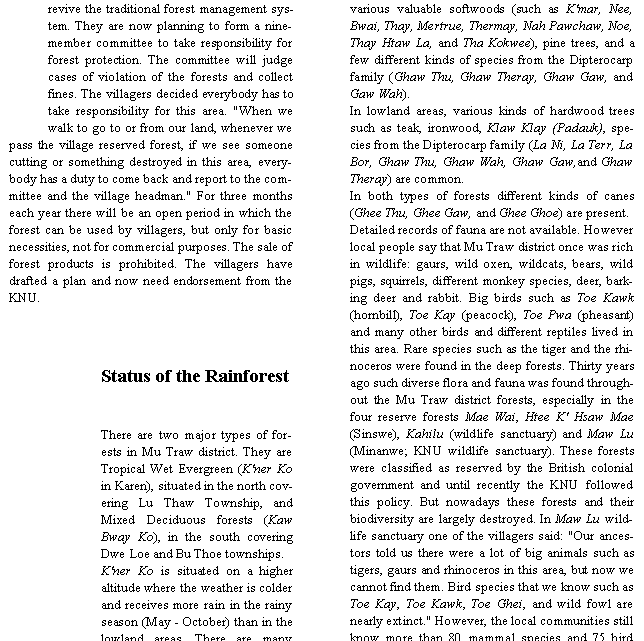
Text Box: revive the traditional forest management system. They are now planning to form a nine-member committee to take responsibility for forest protection. The committee will judge cases of violation of the forests and collect fines. The villagers decided everybody has to take responsibility for this area. "When we walk to go to or from our land, whenever we pass the village reserved forest, if we see someone cutting or something destroyed in this area, everybody has a duty to come back and report to the committee and the village headman." For three months each year there will be an open period in which the forest can be used by villagers, but only for basic necessities, not for commercial purposes. The sale of forest products is prohibited. The villagers have drafted a plan and now need endorsement from the KNU.


Status of the Rainforest


There are two major types of forests in Mu Traw district. They are Tropical Wet Evergreen (K'ner Ko in Karen), situated in the north covering Lu Thaw Township, and Mixed Deciduous forests (Kaw Bway Ko), in the south covering Dwe Loe and Bu Thoe townships.
K'ner Ko is situated on a higher altitude where the weather is colder and receives more rain in the rainy season (May - October) than in the lowland areas. There are many various valuable softwoods (such as K'mar, Nee, Bwai, Thay, Mertrue, Thermay, Nah Pawchaw, Noe, Thay Htaw La, and Tha Kokwee), pine trees, and a few different kinds of species from the Dipterocarp family (Ghaw Thu, Ghaw Theray, Ghaw Gaw, and Gaw Wah).
In lowland areas, various kinds of hardwood trees such as teak, ironwood, Klaw Klay (Padauk), species from the Dipterocarp family (La Ni, La Terr, La Bor, Ghaw Thu, Ghaw Wah, Ghaw Gaw,and Ghaw Theray) are common.
In both types of forests different kinds of canes (Ghee Thu, Ghee Gaw, and Ghee Ghoe) are present.
Detailed records of fauna are not available. However local people say that Mu Traw district once was rich in wildlife: gaurs, wild oxen, wildcats, bears, wild pigs, squirrels, different monkey species, deer, barking deer and rabbit. Big birds such as Toe Kawk (hornbill), Toe Kay (peacock), Toe Pwa (pheasant) and many other birds and different reptiles lived in this area. Rare species such as the tiger and the rhinoceros were found in the deep forests. Thirty years ago such diverse flora and fauna was found throughout the Mu Traw district forests, especially in the four reserve forests Mae Wai, Htee K' Hsaw Mae (Sinswe), Kahilu (wildlife sanctuary) and Maw Lu (Minanwe; KNU wildlife sanctuary). These forests were classified as reserved by the British colonial government and until recently the KNU followed this policy. But nowadays these forests and their biodiversity are largely destroyed. In Maw Lu wildlife sanctuary one of the villagers said: "Our ancestors told us there were a lot of big animals such as tigers, gaurs and rhinoceros in this area, but now we cannot find them. Bird species that we know such as Toe Kay, Toe Kawk, Toe Ghei, and wild fowl are nearly extinct." However, the local communities still know more than 80 mammal species and 75 bird

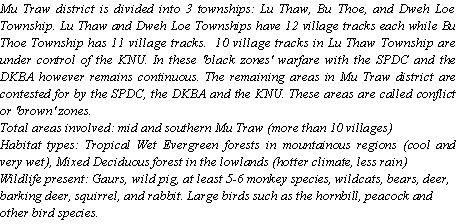
Mu Traw District (Pa Pun)

Text Box: Mu Traw district is divided into 3 townships: Lu Thaw, Bu Thoe, and Dweh Loe Township. Lu Thaw and Dweh Loe Townships have 12 village tracks each while Bu Thoe Township has 11 village tracks.  10 village tracks in Lu Thaw Township are under control of the KNU. In these 'black zones' warfare with the SPDC and the DKBA however remains continuous. The remaining areas in Mu Traw district are contested for by the SPDC, the DKBA and the KNU. These areas are called conflict or 'brown' zones.
Total areas involved: mid and southern Mu Traw (more than 10 villages)
Habitat types: Tropical Wet Evergreen forests in mountainous regions (cool and very wet), Mixed Deciduous forest in the lowlands (hotter climate, less rain)
Wildlife present: Gaurs, wild pig, at least 5-6 monkey species, wildcats, bears, deer, barking deer, squirrel, and rabbit. Large birds such as the hornbill, peacock and other bird species.


1

Text Box: