
Text Box: Destruction and Degradation of the Burmese Frontier Forests
Text Box: #
Text Box: forest, however females predominately spend more time, collecting forest products both for family-use as well as for extra income, and working on the land. With the decreasing forest products, they cannot collect enough to provide for extra income, and thus with lack of income they cannot send their children to school. 
Women are responsible for the housework and are the primary house owners. Their responsibilities include taking care of the children, feeding the family, feeding the animals, collecting water, collecting firewood, pounding rice, and cleaning. Additionally, they are responsible for all daily work when the men in the family have to serve for the military or be porters. The women also have to answer to SPDC military demand. The military will ask the women for firewood, building materials for their camps, night watch duty, and other jobs which conflicts with other regular tasks.  


Main factors that threaten the practices of traditional forest conservation


Traditionally the local communities in Doo The Htoo district have their own system of forest management. In the customary traditions each village has its own community forests with clear boundaries. Within this community forest land there are rotational farms, irrigated farms, orchard farms, communal forest, pasture, and sacred forest. This system has worked very well until recently. Now however, many factors threaten or weaken the system. The main interrelated factors are logging, problems of forest management and access to the forests, the civil war, and the introduction of monoculture.
Logging

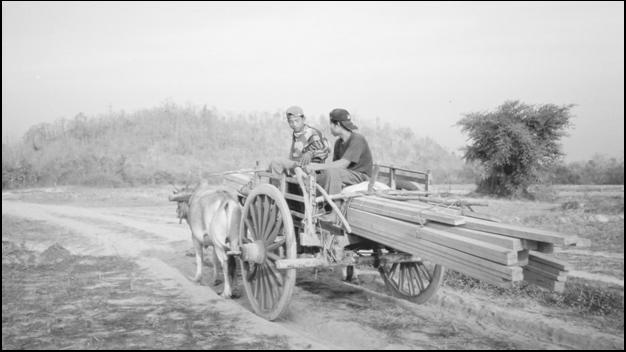
Since 1973, the Burmese military government has been heavily logging the forests in Doo The Htoo district. This logging has targeted most of the reserved and communal forests. Logging in Bilin Township forests exemplifies the situation. In 1992, SPDC troops advanced to Bilin Township. They also made the area secure for logging by building roads and bringing in trucks, machinery, and other material. Since then, the military-backed logging operation exploited the three reserve forests in Bilin Township. However, continuing surprise-attacks on the logging operation by the KNLA, the military arm of the KNU, did severe damages to hardware, personnel, and profits; thus the SPDC changed its strategy in 1996. This time it used local Karen businessmen (the 'log extraction group') to do the logging and to negotiate with the KNU, believing that the KNU would not attack their own countrymen. The Text Box: Urban dwellers collecting timber from the forest and selling it in the city


4

4 a