
Text Box: Destruction and Degradation of the Burmese Frontier Forests
Text Box: #
Text Box: to sell. With the money they earned they were able to buy basic kitchen materials. However, with commercial logging, there have been big environmental changes, including loss of wild food and acute water shortages, forcing the villagers to turn their back on the old way of life and join the logging business.
In 1994, after the ceasefire the serious logging began, and after only three to four years it had expanded to every corner of the land, although in some areas it is smaller scale and hard to document 
The majority of the logging concessions now are held by Chinese foreign businessmen and people in authority.


Logging companies and concessions


Today the word ‘development’ is very popular in Burma but in actual practice nothing positive happens, nothing changes to make conditions better for the Kachin and other ethnic societies. The national armies, the KIO and NDA-K are aware of the necessity for rapid development in Kachin society before outsiders have built too strong an economic position that disadvantages local people. They want to  set up their own development projects in Kachin State. But, the armies lack the skills and money to run these projects. The imperial jade from the mining town of Hpakant, the main source of wealth for the KIO and Kachin society, is now under control of the Burmese government. Opium production, a former source of financing, is internationally prohibited and has been seriously cut back by the KIO which wants international support and credibility. To support their own development projects the KIO and NDA-K have turned toward the sale of the forests. Big scale logging started in the KIO area, after the cease-fire agreement in 1994, and in the NDA-K area in 1996. 
Almost all the biggest logging companies are from China; which itself has a ban of logging to protect its own forests. Some well-known holders of logging concessions in Kachinland include the following lauban (a honorific title for boss or tycoon): Cing Shin (a company from Ten Chong), Cu Hi Jshau, Leng Wun, Hkang Lung (from Yin Jiang), Fan Du Shau (Yang Yin), Pong Han Chin, Lau Yin, Shing Leng Woon (from Loije) and Lau Fu.
There are different reasons given by the authorities for the selling of concessions such as the building of roads and hydropower plants. As one example, the Jadeland Company was engaged to build a road between Bhamo- Myitkyina - Sumprabum. In winning the bid to build the road they were given a logging concession one mile wide on each side of the road being constructed.
In 2001, the KIO hired  the Hung Ki Company to build the Mali-hydropower station. In return the Jahta area was given as a logging concession to the Hung Ki Company. Now the concession has been extended to two Chinese companies, including the Hug Ki and Hung Hta companies. The KIO leaders have ordered local people not to do any logging in this area.
Sometimes villagers are persuaded by the businessmen to ask permission for logging. For example in 1996, the villagers of Jaumau in the NDA-K area were persuaded by a Chinese company to ask the NDA-K leader for permission to log in their forest. In return, the company would build a school, hospital and church in the village. The Chinese businessman also offered to build a road and to carry all the logs. In the end however, the concession went to NDA-K officers and the village chief who privately sold to the Chinese and pocketed the profits; while the villagers were left without any benefits.  
 

Logging practice

When a logging concession is given to a Chinese company, Chinese workers move into the forest area for a period of months. They bring their own rice, but for their curry they usually rely on forest prod

A 1


A 2

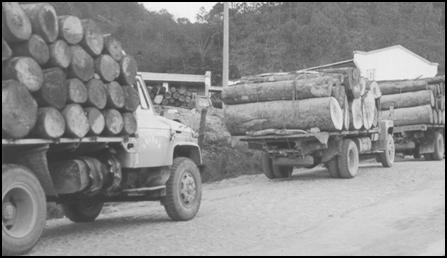
Text Box: Logging trucks at checkpoint